
Nickfromwales
-
Posts
31387 -
Joined
-
Last visited
-
Days Won
346
Everything posted by Nickfromwales
-
Oh, and best not to forget that the discharge only happens when there is a fault, so the longer that goes unnoticed.......... ”This message ( and your luxury HMO ) will self-destruct in 5 seconds”
-
Not too much I’m sorry...... If you had a catastrophic failure and the cylinder hasn’t been installed to the MI’s then your insurance could refuse to payout. I’ve heard that in a block of flats with around £30k worth of ( uninsured ) damage done. Next issue is if there is no integral air break on D1 then the downstream discharge pipe can freeze and block solid, then you have a bomb in your rental property. This really is not just a bad job but it’s very, very dangerous, especially with it going into winter. There is no ‘drip’ from a correctly fitted tundish. Water can pass through at nigh on full wallop if it’s been fitted with the correct size and length of pipe above and below ( D1 & D2 ) so a bit of scaremongering there. FYI, there are two intentional points of visibility for identifying problematic discharge from the tundish; 1) The chuffing tundish being alongside the UVC for periodic owner / self inspection / alert 2) G3 stipulates that the end of D2 terminates where it is visible, and that it terminates 100mm above outside finished floor level. The intention is the same with the old overflows from attic tanks where the overflow gives you a shower when it’s operating, eg so you do something about it sharpish. Reason being is that is potable drinking water that is being discharged so the water bylaws state that that cannot be happening ‘behind the scenes’, hence the open tundish inside the dwelling at the UVC and the external overflow discharging where it’s continued operation wouldn’t go unnoticed. The regs are there to be followed, so no slack for your guy from me, sorry. ? If everybody started putting ‘their spin’ on things then regs would be pointless. FYI #2, the Hotun tundishes have clear click on covers so can prevent your mans dreaded splashing if he’s that bothered. The only thing that make the tundish splash is not enough pipe above it and the same below / invert to close so it backfills. Nah, the more I type the less slack they get. It’s needs sorting. If your happy to be relaxed about it then that’s up to you. If you rang the governing body up and told them how it’s fitted they’d tell you to turn it off immediately. Your call pal ?
-
100%. Tell piss face builder to get ‘qualified ring-piece’ back to do the job properly. The installation manual will be handy to have to hand to demonstrate that the tundish MUST reside with the UVC, and his ‘interpretation’ of how it can be done, to make his life easier, is actually a breach of G3. The rules are there to be read and followed, not ducked and dived around. Jeez. Also, and this is VERY important, ask him if EVERY SINGLE mixer outlet ( showers / bath fillers / mono-block taps etc ) EVERY SINGLE ONE WITHOUT DOUBT have the cold water coming from the balanced output of the control group ( the multi function valve alongside the UVC ). If he shrugs his shoulders or cannot answer the question then the UVC is on borrowed time. Ask and update please.
-
Its only meant for commissioning Its for filling and draining the system when powered down. Where a motorised valve and cylinder stat are inclusive of the system design, you should never run a system knowingly bypassing the safety features ( the cylinder stat ). Also, for an ASHP installation, each flow ( DHW or Heating ) command different flow temps so another reason not to 'cheat' it.
-
 Scores of houses are like this, no regs, no BC and no approvals. Simply value it less the room in roof, other than as posh storage, and then retrospectively convert it properly with BC application and then get the house revalued and insured accordingly ( if you need the attic to be a bedroom that is ). It can be a nice kids playroom or cinema room etc, just not a habitable space, but PLEASE do get fire / smoke detectors right the way through all 3 floors regardless. There are some great bluetooth connectivity smoke detector systems out there now which mean no interconnecting cables required, just get 230v to them from the nearest light fitting and job done.
 -
Yup. Looks like a giant block of mahogany to me. End cost per m2?
-
Chicken or egg: do we render or install the windows first?
Nickfromwales replied to laurenco's topic in Windows & Glazing
If ph windows benefit from a cork / other thermal break in their construction to reduce the huge cold bridging, then leaving the face gapped at the sides would throw that straight into the bin. Ventilating to the cavity is great if you’ve got a cavity, but the thought of driving wind and rain not being deflected / otherwise arrested would not be a good thing imo, so for me it would have to be sealed. If those gaps were fully backfilled with foam after installation I fail to see how condensation could occur ? Afaic leaving the gap is what would cause / promote the problem, not cure it #confusedofwales -
Back up is one thing, so that was not aimed at you, it’s for those who have underestimated the ‘need’ for heat and how to best deliver it, both comfortably and conveniently. Having to employ auxiliary heating should be the exception not the rule at best.
-
If you’re going to the efforts of building your home to such a good standard, what a bag-o-crap it must be to litter it with £30 heaters you ran out to get from Argos when your wife told you “I told you ‘“ UFH is the number one way to heat imo, and in conjunction with a decent slab ( as opposed to a thin screed ) you can realistically plan for fine tuning your heat input to the nearest 0.5 degree. Heating by duct ( given it also commands a much higher airflow rate ) would be the last option for me to look at tbh as a generic MVHR should be near inaudible and unnoticeable in operation, and to use it for heating in anything other than a ‘small’ dwelling would take you away from that target. Accepting that higher flow rates are necessary, when cooling is utilised, is easy when you compare it to the rather unsympathetic alternatives ( split aircon ) etc.
-
Cant ignore an educated recommendation though eh?
-
QS was ~£200 for the above.
-
Hi If you plan on being hands on, a QS can give a valuable insight as to whats going to cost what. On an extension project I found it made an invaluable reference document to glean extras we had ( sometimes inadvertently ) undertaken, and basically identify anything that was above the original contact ( and therefore was chargeable ). If you're not hands on and are using a contractor then its equally of value IMO, for the Friday afternoon sit-downs where the stage payments are approved; eg how much work was supposed to have been done and what HAS been done to warrant the next stage payment.
-
Based on the ratio of what's available outside and what's available inside, in terms of transfer, I doubt there would be enough upward emitted light to 'pollute' .
-
In fairness, it does come with pretty clear instructions. I was just to tired to think last night.
-
Electric Monitors (Sunamp related content!)
Nickfromwales replied to Barney12's topic in Electrics - Other
The immersion in the SA occupies pretty much the entire floor of the cell. It's a single cell in each unit with a fully immersed heat exchanger for wet energy import / export. The immersion is actually entirely submerged / encapsulated in PCM, so as far as heat transfer characteristics are concerned it should be close to 100% efficient as it can get. No different to how an immersion is directly in the water of a cylinder. After initial talks with SA 'back in the day' I was led to believe the heat input should be liner, so a ~ 3kW immersion in a 9kWh SA should take ~ 3 hours to fully recharge. Re the element of heat loss, it's only really what ebbs away from the connective pipework really, so negligible but deffo will affect the times albeit only slightly. -
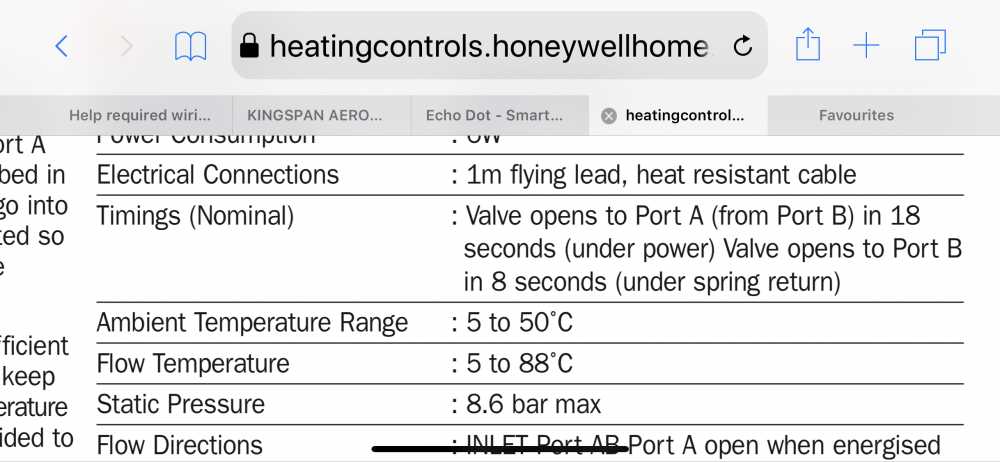
@joe90 With both eyes open it reads that B aka DHW is the parked position of the valve. I’ll get my coat. It’s the mid position that parks in the heating position for pump overrun.
-
Hold that compliment. Replied to joe last night with one eye half open.
-
I could live with that.
-
Wasn’t there some ‘scheme’ where you rent out your roof space? Assume that was when FiT was high ?
-
Link ?
-
ASHP noisy, as its going bloody flat out !! Poor design, and probably even worse implementation.
-
If heated by the immersion, the thermistors look for the heating sequence to be 'bottom > top', but if heated by an external wet heat source via the Hex then the thermistors needs to be told to expect heat to arrive from the top > down. Therefore this is critical to ensure the correct thermistor is selected for fully charged 'status recognition'. This is the difference between each model sent out, as in the universal PCB is program 'pre-selelcted' to suit the application, given Joe Bloggs may be fitting it so it would need to be 'plug and play'. The boxes are essentially all the same, with the same Hex and same porting, just the electronics ( software ) differ. Quite handy to be able to reconfigure these to run in different applications later down the line without having to change the original unit tbh. NOTE : Once primary ( heating ) water has run through a Hex for any device or equipment it CANNOT be later utilised to convey potable ( drinking quality water ). eHw PCM58 / 9 = £1963 HW PCM58 / 9 = £1821 both +vat +del. For 12's its £142 less For 6's its....guess what So additional immersion costs are £142 across the range by the look of it. One consideration is the units aren't as tall with the immersion removed so are physically different eg more compact ( 45mm of less tallness-ness )
-
The other ( 2 way ) valve is called a diverter valve, as it diverts flow to either port. ??
-
Someone say dumb? ?