

Nickfromwales
-
Posts
31390 -
Joined
-
Last visited
-
Days Won
346
Everything posted by Nickfromwales
-
 It’s a new invention.
 -
Scrap the lot and fit an UVC ( invented cylinder ) to future proof you and de-bug ( lol ) the system for once and for all?
-
CW glands = SWA ( steel wire armoured ) exterior type glands. You must use SWA for the backbone of this arrangement. Wiska is a make of good quality robust junction boxes. Wago connectors are modern replacements of choc block ( screw down terminal blocks ) as you aren’t supposed to have them anywhere where access to them is difficult or impossible. Wago’s are considered maintenance free. Stuffing glands are cable entry glands which you tighten up to make a weathertight ( not waterproof ) seal onto flexible cable. Use SWA to go box to box, then use as short as possible pieces of HO5 flex to go the actual fittings. Piranha nuts are larger nuts that the ones supplied with the SWA, and have an Allen head grub screw to make off the Earth cable to. That is often easier ( as it is more compact ) to use than ‘frying pans’ aka banjos which also come with the SWA gland pack. They need nuts and bolts through them to clamp onto a lug which is fitted to the Earth wire. Quite a convoluted method vs the piranha nuts. Google these things to see for yourself.
-
Coincidence or not, but I’ve just mentioned Duravit. They do a coating called WundaGliss ( spelling may be wrong ) which does what you’re looking for. I would bet that other brands offer similar coatings / refinery. Some brands to consider would be Duravit, Geberit, HansGrohe, Grohe, Vado, V&B and possibly RAK.
-
18L should suffice, but I’d prob go larger just to reduce the frequency of ‘topping up’. You can never have too much expansion imho, so I’d prob go around 24L.
-
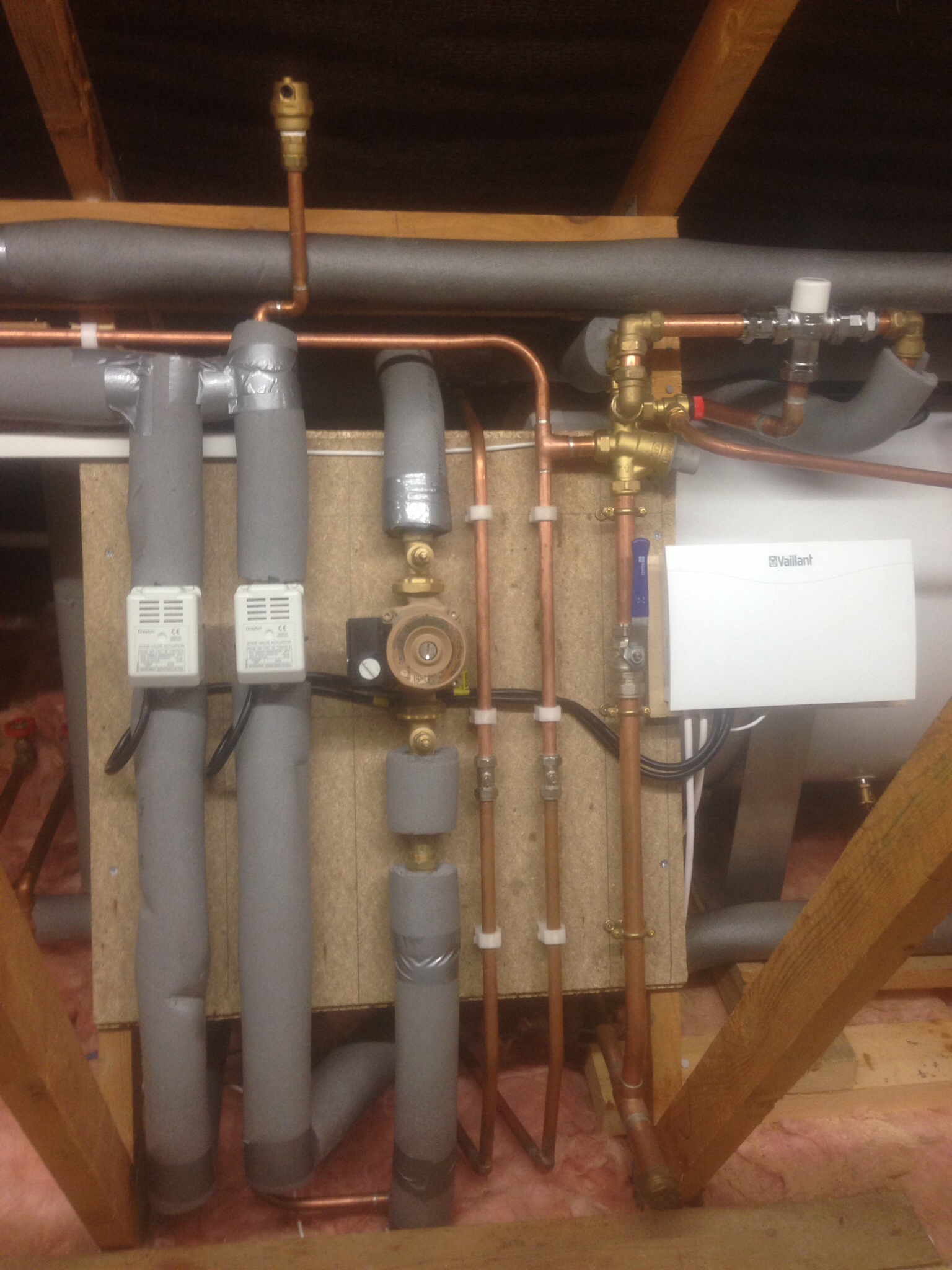
The actuator needs to travel to and activate the internal microswitch, so yes, no go = no show. If it jams in the hot water position then the heating can come on when DHW is called for, and the cylinder stat will be ignored. Design them out at the outset by all means, but you can't tell someone to delete one unless the full ( existing ) system requirements are identified and understood.
-
Yup, deffo 28mm.
-
One thing dies, two things are lost. Redundancy is doubled with 2 x 2-port. If boiler overrun is required, then a 3-port mid-position is the norm. Diverter ( either or ) is for W plan and ASHP's, mid position gives heating / hot water / or both simultaneously. All of the above can be achieved with 2-port valves, if designed in from scratch. Conversions may require extensive wiring adaptations, and the OP may not have existing equipment that lends itself to that.
-
My life's journey is now at an end with that last missing bit of info. See above. Most of the above is either in the dictionary or Wikipedia. Anyway, this is @moldy's fault, him and his.........
-
Is that not for ladies with “excess skin” ? B52 posse etc.
-
Best to be sure though. Buildhub is built on quality advice with no stone left unturned.
-
@moldy The blood is all on your hands for this. May be a long night, especially if @Onoff and @pocster have started drinking already......
-
Time for Buster Gonad and his unfeasibly large testicles to have some say in the matter...
.png.23a9b71c7dc7d85e342ba9e2f796f11c.png)
-
On an unrelated subject, I've just order an inspection cam lol. Largely due to the penis's ( I still wonder about the plural of penis ) moving wires to install insulation with zero regard as to how many holes I will then have to make in floors and ceilings to then go find the bloody things
-
What this needs is a less well-hung OP @moldy You can have longer protruding pans, I've seen and fitted Duravit ones. They come with Wundagliss coating so if your bellend strikes 12 it'll still be in prestine condition and not catch bog covid.
-
Finally, Dave's out of the closet
-
That instance in GH was negligence by the tenacious lady who decided to ignore next door and not add antifreeze. Was a typical example of biting off more than she could chew and moaning about it later. Ignore that, it was the exception not the rule. If you buy pipes from Wunda, they come sealed at each end and pre-pressurised to a few bar, so as above, if the pipes get damaged during laying you'll ( they'll ) know as the concrete will be blowing bubbles. The only thing I would be worried about would be vermin / weather attacking the insulation over that extended period of time. I would invest in some shuttering ply ( used / seconds off gumtree etc ) and make a skirt to go around the edge and upstand all the way to ground level and then bench some topsoil / other up against it for the duration. Prob be a good idea to sleeve the UFH pipes or make a similar timber kiosk, with a few breeze blocks around it, to prevent vandalism / UV damage of the UFH pipes. Absolutely the best choice, and no reason not to TBH.
-
Service Cavity Battens - nail or screw?
Nickfromwales replied to Longjock's topic in General Joinery
+1 to using screws. Most 120-130mm screws will have a part blind / unthreaded shank so that stops 'jacking' where the screw tightens before the wood is fully in contact / under compression. Just need someone who won't overtighten them with the impact. No.10 ( 5.0 ) screws will suffice, and when you see the heads disappearing just under the surface of the battens get your finger off the trigger! Nails can be hit and miss as you need to be holding the batten VERY tight to the wall to get the whole thing to fasten back robustly. Also a complete bastard to get a batten off / tweaked with nails vs screws with guaranteed damage to the membrane to boot associated with such a removal. -
You can have 3000m2 as that is what you size the heat source to, it's the smallest heat load that causes issue; eg if the study was the only room needing heat at a particular time, with every other room stat turned off / satisfied, then that would be too small a load to stop short cycling of the heat source. The buffer adds to the smallest load to allow the heat source to dissipate what it has produced in any single heat ( burn ) event.
-
Both gas and ASHP will modulate if selected to do so, therefore reducing the need for a large buffer. 100L would be ample.
-
You keep saying that, but this one has clearly lasted yonks, and so will the next. The upheaval of swapping to 2x 2-port is completely unnecessary imo, and even though I also dislike 3-port valves, the OP doesn't NEED to change / upgrade as it has no benefits. If the boiler is doing pump overrun it will actually cause problems, as the 3-port leaves a path from the pump to the rads ( when idle ) for the residual stagnant heat in the boiler heat exchanger to 'leak' away into.
-
35Kw Combi Boiler - Which make
Nickfromwales replied to NewToAllOfThis's topic in Boilers & Hot Water Tanks
With recent chat here about over-complicated / non-functional controls, and zero success from the support given from Veissmann, I would stick to something more established and wider recognised for ongoing maintenance / service / repair. -
35Kw Combi Boiler - Which make
Nickfromwales replied to NewToAllOfThis's topic in Boilers & Hot Water Tanks
Vaillant 938 if you want to run 2 showers simultaneously. You'd have had the 937 or 938. 2x7.5L tanks to give 15L stored instantly available DHW. Cracking boiler, fitted loads of them with zero issue. You do need a very good cold mains supply though to get the full potential from this boiler ( as with every combi, it is completely cold mains dependant ) and ideally you would run a 22mm cold supply to replace the existing, or run a new 15mm dedicated cold feed directly to the boiler from the stopcock. Not doing these peripherals will result in mediocre DHW flow rates even with the best "high-flow" combi's. You need the shoes to go with the hat -
@Oxbow16 You can 'mention' a member by typing the @ symbol and then type the first couple of letters of their username. Select from the drop list and bingo
-
They're typically set to higher temps than the boiler stat, because the boiler stat dictates the surface temp of the radiators so are usually set to a max of 60-65oC. Immersions are usually set to 70-75oC out of the box. Simple answer is switch it no and leave it for 3-4 hours, then carefully put your hand on the top pipe of the cylinder to see if it's uncomfortably hot.


