

Nickfromwales
-
Posts
31381 -
Joined
-
Last visited
-
Days Won
346
Everything posted by Nickfromwales
-

Advise on my underfloor heating design
Nickfromwales replied to Coll659's topic in Underfloor Heating
100mm in general will be much better, 200mm is passive levels, and for the areas with 50mm I guess just suck it up. Yes to the 100mm centres for the 50mm insulated areas, 150mm everywhere else may make it tricky to balance without zoning and putting stats per room / space. Consider running some numbers for going 200mm in the areas with 100 and 200(?)mm of insulation so you don’t get overshoot in those areas for the same flow temp. -
Cool. 👍. Just wanted to double check you’ll have the depth. By the time you board and tile (?) this you’ll be good. Prob on the cusp of getting away with that angle / offset, but it’ll work.
-
You'll JUST get that on imo, so put the pan connector onto that elbow with a bit of silicone lube, and then when you go to fit the pan do the same on the pan outlet as well as the seal on the pan connector. The issue is that the centres between the flush outlet and the soil outlet on the pan are set in porcelain, so you have zero tolerance here other than the flexibility of the rubber seals. On the pan connector you'll have JUST enough wiggle room methinks. Have you got a pic face on and face/side on plz?
-
Unvented Expansion Vessel Pre Charge
Nickfromwales replied to Mattg4321's topic in Boilers & Hot Water Tanks
Apologies, I was referring to upping the one on the main, the CG at the UVC was left stock, as when I put a 3bar PRedV on the mains the flow rates through the UVC CG suffered a lot (poor design and pipe size / layout) but upping the one at the main slightly made a huge difference; the mains there was crazy so needed the second PRedV fitting by myself after plumber #1 had ‘tried his best’. -
ASHP in uninsulated home?
Nickfromwales replied to PennineDave's topic in Air Source Heat Pumps (ASHP)
Good idea, just know with every improvement you’ll then be using less and less oil per annum. Solar would never contribute to heating so that’s put to bed, but solar PV is an absolute no brainer so pursue that asap. If you defo are going to do PV then avoid going to an oil combi, as you won’t be able to store excess PV as hot water (via the immersion). Reducing draughts from the house will outshine thickening up any planned insulation, so spend smarter -
I Fink that’ll work. Or get on the roof and dodge the core drill with vent tiles / slates?
-
Unvented Expansion Vessel Pre Charge
Nickfromwales replied to Mattg4321's topic in Boilers & Hot Water Tanks
I bumped everything up on a house with massive showers and big baths, body shower jets and so on. I set that around 3.8 bar iirc as the dynamic flow rate through the CG was hugely different with just that slight nudge up from the factory 3 bar. I was asked to resolve retrospectively so the options were limited, plumbing was shite so I’d have done it all totally different from scratch but that house was large, expensive, finished, and “not great” for M&E. -
Yup. Been on that in most hotels on tap, but not so good from a can I found. Prob not helpful to the OP, unless they like ipa. If they drink enough cold beer they’ll be able to cope I guess! 😜
-
After years on a core drill I never got blowouts tbh. Just have to use lots of revs and near zero forward force and let the cutter do 100% of the work. The ring is a good 60mm all round, so covers everything when it is in position.
-
Likewise, as the levels in the STP surely would be above the bottom inlet (outlet) as per the pic. The pic doesn't really correlate well and doesn't appear to show the vertically dropping pipe into it? I'll admit to being a bit lost when looking at the photos vs the SketchUp stuff? @d438a1?
-
Any movement of air will help a lot, and if you can have it cross-ventilate without needing any energy (fans) and maintenance then crack on. When we fitted flues without scaffold we fitted the outer rubber ring on, pushed it to outside from in the attic, pulled it back against to seal against the weather, and then cemented it in. Just needs a slightly bigger core hole to allow the seal to squish down and be pushed through, so no need to be swinging off a ladder if you can core drill from inside to out? Brewdog Wingman is the current favoured poison.
-
Yup, I know…. I’d rather spend on A/C than have the house looking like a dark prison tbh. Just my preference. I may look at a 2nd hand monoblock ASHP and a large fan coil unit on the landing (that used to be the box bedroom but is now a corridor to the rear bedroom in the extension, and had the stairs to the attic in it plus all the 1st floor bedrooms lead off it. As usual, I’ll do more thinking than doing. 🤯
-
There’s a lot of gravity to support the lower one, but if the levels of the unfavourable don’t / won’t get up to the new level then rodding access should be enough insurance I guess.
-
Why not have a fan to purge the attic space in peak summer? I did this to the ‘attic’ room and it shifted a LOT of unwanted heat and humidity, but downstairs had to work much harder to balance this out. The attic is unbearable in summer, and terrible (too warm / clammy) in winter. The A/C unit dumps air from the room to atmosphere to cool the heat exchanger., so is a win win as it’s still purges humid air and any u wanted heat to the clouds. I refuse to work out what this costs to have two systems at war, but with 3 stories of house it’s just time to plug in, switch off, and get you to send me some of the fine lemon gin. Then I’ll swap it for IPA. 🍺
-
Yes, and there’s your problem….. “they” not “me” “They” will be certified and insured, “me”, not so. So can’t be DIY’d afaic. And your mortgage supplier.
-
Erm…….. the big shiny thing in the sky I think. 🤔 🌞 Decrement delay is alive and kicking here, was worse when the house was grey dash but now painted white, no major impact as this just catches early N/East morning to late morning sun, but some as this also catches very late southern sun. We’re semi-detached so S/E sun doesn’t do much but South to west sunshine really hammers us at the rear (yet to be painted white) so curtains just stay shut there. Rear extension is 9” brick without cavity, so flip-flops between turning into a microwave oven in summer and a fridge in winter. Will likely look into PIV in there this summer, or I’ll finally bite the bullet and do a single outdoor A/C unit > 3x internal units; the fear is wasting time and money on failed attempts which also reduce comfort (with excess noise). Cooling is a pita.
-
Technically it all looks ok, but I’d be worried about how low your new Y branch is connected and how low the new horizontal pipe run is, as the level of ‘product’ in the STP could rise and come to backfill into that new pipe and settle / block it. I’d want that as high as the existing run.
-
I’m going to look into this for this summer, as our place (stone walled colander) is utterly unbearable each summer. Thinking to force a lot of outdoor air in to the house early evening through to early hours. Attic ‘bedroom’ has a freestanding A/C unit which is sublime. Yup, I hear you there. For some days my kids will crash on the settees on the ground floor, as with curtains closed and all that jazz the first floor is still near unbearable for those horribly hot days. I don’t know the layout of your flat, but a decent freestanding A/C unit (large 150-180mm duct off the back which needs to be out of a window) could be placed in the kitchen and then a couple of pedestal fans could be used to blow the chilled air into the rooms off the hallway. The noise / sound from all this would then be away from the bedrooms, but would require all doors to be fully open. Cooling is way more of a ballache than heating, unfortunately, and it’s clear that the developers (yet again) had no understanding of how these units would fail to perform as habitable dwellings during summer (now part O), and I guess you’re not alone there with this issue!
-
Please set up a Timelapse camera so we can sit with your SE, popcorn in hand, and watch your house slowly disappear. I very much doubt you’ll be in any kind of ‘control’ here, and this method sounds crazily indiscriminate to me, but I’m no basement expert. I hope your pockets are as deep as your basement, and also that you have certification for this methodology and that your SE’s PI insurance allows them to advise you to do this; also that it would pay out if it ‘accidentally’ undermines your current homes foundations / underlaying ground. Sounds to me like a slow, risky, impractical and non passive way to do this as it’ll need huge amounts of electricity, a recirculating filtration system (which will need near constant caretaking), and your time to monitor and control. I do love a basement, but this sounds like a ‘less than good’ idea to me, sorry. Suspending it in the water so it can be exported through the pump as a slurry.
-
One ground mount we did was 135m away from the property, so as long as you jump the size of the SWA cable up to combat voltage drop (and export A/C not D/C) distance isn’t a show stopper. Compromises vs necessity etc.
-
👍
-
Running hep2O in insulation below screed?
Nickfromwales replied to daunker's topic in General Plumbing
Prob best to add, that I don’t see much value in charging clients for designs, as most change their mind a good few times and then all that time / work is 💰 🔥. -
Running hep2O in insulation below screed?
Nickfromwales replied to daunker's topic in General Plumbing
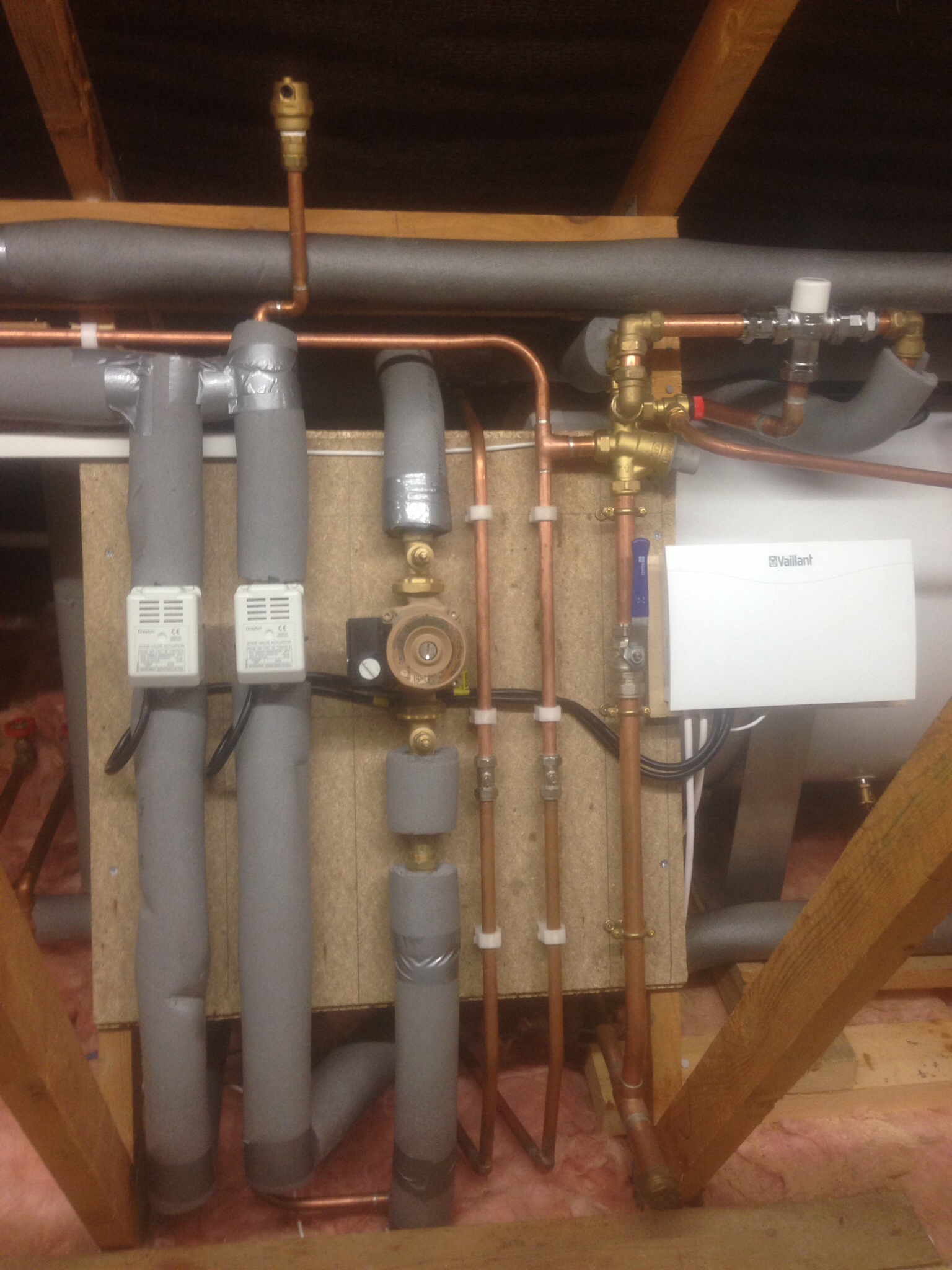
That lot just appears in my brain, after a few cups of ☕️ and some in-house procrastinating, and then I just start cutting and soldering. That pic is the result. By the time someone’s done the design, I’ve usually finished the job. To answer your question, erm….”no”, sorry. 😕, but to affirm, you’d not really want it as I spec & design each job uniquely (under the well known 2019 “horses for courses” act). -
Why I beam?
-
Defo guilty!!
