

Nickfromwales
-
Posts
31382 -
Joined
-
Last visited
-
Days Won
346
Everything posted by Nickfromwales
-

In-slab UFH layout and suitable ASHP?
Nickfromwales replied to zzPaulzz's topic in Underfloor Heating
Unvented hot water cylinder. -
Odd, but not a life changing issue. The only reason to wrap this pipe is if your intended concrete work is going to come into contact with it, or encapsulate it.
-
In-slab UFH layout and suitable ASHP?
Nickfromwales replied to zzPaulzz's topic in Underfloor Heating
I’d install a bigger UVC and plan a cheeky 2-3hr hour top up via the immersion heater(s), timing this to happen for the last 2 hour window of cheap rate nighttime juice, a-la Octopus, so you’ve got a good supply of DHW for the morning shower runs etc. This would be a winter strategy btw, but assuming solar and a base temp assumed at 50-55°C when heated off the HP, then having higher capacity can only be a benefit here as you’ll have more energy stored in the same size cylinder when heating via the immersion. Add PV and topping up the DHW at midday for the evening (at a time where an hour or two of HP > DHW won’t effect anything / anyone, this is win win. I’d try to keep the HP away from doing DHW overnight, ever, during winter, especially with such a lack of headroom with a 3.5kW unit. When you do the sums and include defrost and the expedited demise of the HP it makes more sense to use cheap electricity directly (near 100% efficiency) via the immersion when running the HP just doesn’t make sense. -
Running hep2O in insulation below screed?
Nickfromwales replied to daunker's topic in General Plumbing
Anti convection loop would have to go between the UVC and the manifold. But it doesn’t matter because you’re not going to install one……..😉🤝 -
Running hep2O in insulation below screed?
Nickfromwales replied to daunker's topic in General Plumbing
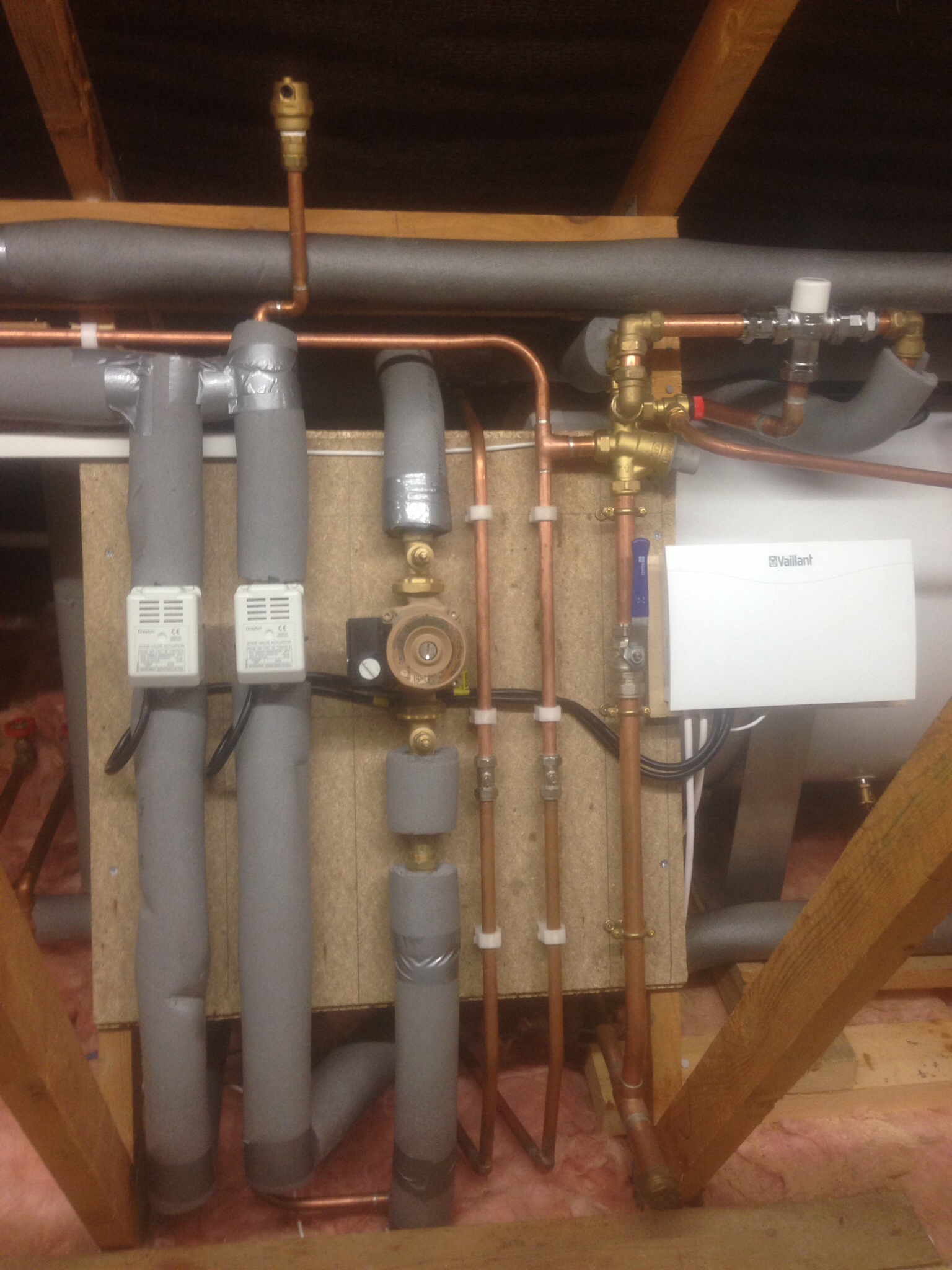
Not that I ever throw any spanner’s into any works…… ……actually I’d think this through before making a bad choice . In that pic you’ll see I’ve provoked (intentionally) this exact thing to happen, as with the last setup I did, and it’s how I will plumb the next, and the next. Short lived will be your cunning and planned celebrations of the joys of foreseeing this ‘terrible loss of heat’, and the use of 10mm pipe to get your DHW swifter than a swift flying during a hurricane, as it’ll go tits up the second you do your anti-gravity / convention loop. All the wasted (and useless) water volume held in that plus the fact it’ll either be 28 or 22mm pipe, will instantly negate all this as you’ll prob have longer to wait than if you’d run the feeds in 15mm. By the time you get the dead leg out of the primary larger bore pipework and then premium (useful temp) DHW out of the average outlet you’ll be sadder than Mr.Bean when he lost his teddy bear as you will then realise it was the wrong choice to set it up this way. The ACTUAL annual costs (perceived savings of stopping heat wicking up the pipework) would need to include the wasted cold mains water that you then draw off as useless dead leg, then you’re very much into the price of a decent meal for 2, in ACTUAL reality. Then factor in that this primary DHW pipework will be well insulated plus the sobering reality that this aforementioned ‘runaway convection’ just won’t happen, (as you refer to with the open pipe / vent of yesteryear (which is entirely misleading and utterly irrelevant here btw!)), and then you place a cherry on top. The cherry is, that with the large bore primary pipework already preheated by (local) heat wicking up it from the UVC, this then cancels out the delays caused by lengthening the pipework between the UVC and the hot manifold; viola! The result you want from this is for the pipework from the UVC to the hot manifold, AND the hot manifold itself to be warm / hot as the default; insulated to stop latent losses as best as is practicable. THEN, my dear Watson, your plan of using the 10mm feeds will be one of genius, but more importantly will then actually bear some fruit. Convection (runaway) can’t happened here as there needs to be an unobstructed path from hot > cold to create a convection loop, as your taps / outlets will be closed, the case for this is closed. Use this ‘problem’ to your advantage squire . -
@Egnaro If it’s Terram / weed barrier it’s in an odd place but should be inconsequential in terms of what you’re doing. Weed barrier is usually to do exactly that when landscaping, eg stop organics from growing. Somebody may have put this over the pipe as a marker, just a bit odd due to how close it is to the pipe. If it’s all backfilled with concrete then you’ll get the same effect, but you should wrap the pipe of concrete will be meeting / encompassing it, to allow movement.
-
Imprinted concrete - Grandad has been ripped off
Nickfromwales replied to diyenthusiat's topic in Driveways
😉👌 -
That’s absolutely shite. You may be better off, if you’re otherwise happy with the stove install, getting another independent roofer out to just do this properly. Completely pointless getting this wally back as he clearly just cannot do roof work, and the risk is he’ll make it worse and then disappear / stop responding anyways. The second attempt is worse than the first.
-
Then don’t fit a thin laminate as it’ll likely be dogshit and won’t go the distance. Everywhere where I’ve seen cheap laminate the corners have come away, where they have already started their death roll by the boxes being moved and edges bumped which fractures the laminate, or they start to show their age early in high traffic areas. Consider ribbons or other thresholds so a room can be ‘fixed’ without pulling up other areas to facilitate this.
-
Cant see why not. You’ll not be running at very high temps down there?
-
https://www.floordepot.co.uk/vinyl-click-lvt-spc?gad_source=1&gbraid=0AAAAACv8UoDj6eSo8V8Ljqjd1SJLPRJIl&gclid=Cj0KCQjwiLLABhCEARIsAJYS6ukAPmOwf0mPbFG3-N-xmZMktlcB2oSSNBQllBUJfu9qQCEqwqyTyrMaAszKEALw_wcB
-
Why not wood effect LVT?
-
Advise on my underfloor heating design
Nickfromwales replied to Coll659's topic in Underfloor Heating
That’s all good, but remember that you’ll need to install MVHR if you want to seal the place up well eg no trickle vents on windows or mechanical extractor fans for kitchen and bathrooms etc. -
Advise on my underfloor heating design
Nickfromwales replied to Coll659's topic in Underfloor Heating
Insulate, insulate, insulate. Airtightness (killing off excess cold air infiltration) will trump 1000mm of insulation so we need to be practical when giving advice. Ultimately you should be putting 50mm of insulation (IWI) to the walls & floors and putting carpet down, and fitting radiators, if you want a comfortable home with reduced running costs. -
Running hep2O in insulation below screed?
Nickfromwales replied to daunker's topic in General Plumbing
Not really, if the softener of choice can’t cope then you’ll just fit one at the stopcock and then the factory one at the CG, as with a ‘second’ PRedV at the mains there’s no need for the one for the kitchen sink raw cold feed. IIRC most softeners can take >5 bar, just check the MIs of the one you want to go for. The Harvey for eg is showing options / models that state 6, 8 and 10 bar max inlet pressure (all WRAS approved stuff is tested to 10 bar max to get approval); note that it is the “working pressure” you need to clarify. If you can choose one that will take 6-8 bar then do so, and preserve as good a cold main as you can for as far as you can into the plumbing setup, to get you the best value at the CG. If you can choose a softener which allows you to avoid the PRedV at the stopcock (and have one for the kitchen raw feed etc) then do so, but I doubt it’s life or death as your supply seems to be very good anyways. Use larger bore pipework than normal for the cold if you reduce the pressure at the stopcock, which will help. If you drink water from the tap (not from a chiller type device) then also consider the kitchen sink pipe going underground and popping up out of the slab; then you can have cold (temperature wise) water instead of room temp water. For clients who had carbon filter whatsits with a little tap outlet next to (or incorporated in) the kitchen sink tap for drinking water, I put a second rising cold main directly under the kitchen sink so the water was at ground temp. -
Advise on my underfloor heating design
Nickfromwales replied to Coll659's topic in Underfloor Heating
They’ll tell you to F O in the 1st 5 seconds when you tell them what your setup needs to deal with. -
Advise on my underfloor heating design
Nickfromwales replied to Coll659's topic in Underfloor Heating
Agree that the 50mm of insulation would just be wasted head height and cost as it would add much value for performance numbers. At that thickness the heat will only penetrate downwards so far and then the whole thing becomes the heated emitter. One of those instances where “it is what it is”. With a heat pump and a decent chuck of slab you’ll get where you get to and just accept the losses, and then you can have less screed on top too as you’ll just want to cover the 16mm pipes by 15-20mm for a level floor to be applied. Definitely won’t be something to ‘turn off’ though, as you’re looking at days to get this up to a temp where it’s useful as space heating I expect. -
Near impossible to see what you're seeing there fella
-
Odd, as in practice the difference when introducing water to the foam during application is night and day, and yields massive benefits / results.
-
Any need for A/C in the attic for your lad? My boys in the attic and without A/C he'd be dead by now, or at least a bit dried out and 'crisp'.
-
Our best waterproof adhesive is PU30. In a nutshell, it is a ‘half-hour’ solvent-free moisture curing PU wood glue. It is rapid-setting and the initial bond strength is achieved within 30 minutes. Because it has an open time of up to 20 mins (10 mins if glue-line is misted with water), it is easy to work with. Also, due to its chemical composition, it is ideal for bonding wood-based materials where a water-proof bond is required.
-
Why does the packaging say "moisture cure"? Pretty sure that's how 'they' word it.
-
Imprinted concrete - Grandad has been ripped off
Nickfromwales replied to diyenthusiat's topic in Driveways
https://www.sealantsandtoolsdirect.co.uk/everbuild-403-concrete-hardener-dustproofer-25-litre-chdu25?language=en-gb¤cy=GBP&gad_source=1&gbraid=0AAAAADx-2OLrIkC4daQ0NqLgYUnTssPtD&gclid=Cj0KCQjw5azABhD1ARIsAA0WFUFtqNMjNcrv9P8SKoqAEHxhYsVajTwvU0afp-GwewtBqdGl2ITV5NoaAqyDEALw_wcB Although..... .....isn't the best news. -
Saves you worrying about them asking to borrow stuff after you move in lol.
-
They refer to this as "thermal shocking", but tbh I think I've done this twice in 20 years and doubt it made any difference. Reason being is that the slabs / screeds have never been down and then laid on. Any that have I have just used a decoupling membrane to cheat the risk of cracks migrating through to the finished floor. At 6" of concrete (and assuming some mesh in there, if not 2 layers of?) and the fact it's been down for nearly 2 years means this has done anything it's ever going to do already, and I'd not even bother with expansion gaps at the doorways. As you say, the flow temp will be very low 20's so this will all expand and contract (if ever) at the same rate of knots at the beginning and end of each heating season and life will go on. Your tradespeople are 100% correct to follow the path of due diligence as you'd be the first to complain and sue if the 'cracks began to appear' so they're rightfully covering their arses as would I. Follow their advice and then you have full recourse. Just ask that they use a quality flexible adhesive, and that the slab is thoroughly cleaned / prepped / primed so the adhesive has excellent purchase on the concrete, after that I doubt you have anything to worry about here at all; sounds like you have tilers who GAF too which is reassuring.

