

ragg987
-
Posts
872 -
Joined
-
Last visited
-
Days Won
1
Everything posted by ragg987
-
Another approach would be to make the speakers become part of the decor rather than discreet - achievable for those with very deep pockets. No need to sacrifice audio quality. http://www.sonusfaber.com/en-us/products/guarneri-evolution
-
I fall into that category. I recall their subwoofer and satellites attempt from a while a go. There was a massive "gap" between the highest frequency of the sub and the lowest of the satellte. On top of this the sub could not reproduce low frequencies at all. In effect you were missing about about 4 octaves from the 11 humans can hear. Can't fault their marketing!
-
I think you have a number of options for "discreet" speakers. Bear in mind my input is based on what I would want - i.e. critical listening / focus on sound quality - rather than just having sound in the room. In-wall speakers, which gives you just a subtle front to look at. You need to take precautions to prevent the sound in the wall cavity getting transmitted through the rest of the house - e,g, build a sound-tight box inside the wall - depends on wall construction. Also, you have now "fixed" the layout of the room e.g. you cannot put furniture in front of these locations or turn your sofa to the other side. In-ceiling speakers, same issue to guard the sound transmission through the cavity (very critical if you have a bedroom above). Probably the most "subtle" in appearance. I personally dislike in-ceiling as the sound is not directional. And it reminds me of dental surgeries. On-wall, using flat speakers mounted like pictures. I have not heard these but understand that you lose bass. You can move the "pictures" if you wish to change room layout. Tiny speakers on stands, on furniture or on a wall. Being small you will have no bass. You can always supplement lack of bass with a small subwoofer hidden someplace - bass directionality is less critical.
-
That might make sense if you look at fuel costs only, but if you factor in the additional running and captial cost of having BOTH technologies does it still stack up. Very simplified example. 100% gas: boiler cost £600, installation £1,000 annual fuel cost £600 annual service £50 20 year total £14,600 100% ASHP: pump £2,000, installation £2,000 (includes hard-standing and piping for external unit) annual fuel cost £550 annual service £50 20 year total £16,000 Both gas and ASHP: capital cost £5,600 annual fuel cost £575 annual service £100 20 year total £19,100 Above is very simplified and does not factor in inflation, nor the extra running costs or extra capital costs in integrating the gas and ASHP (e.g. larger TS, more controls, more pumps). Costs I use are for illustrative purposes, you need to plug your own scenario in. I would suggest you go with gas only, put in a largish TS (e.g. 500l based on your concurrent bath / showers scenario), put in a gas boiler based on DHW recovery times you are willing to put up with (12kWh boiler to 500l TS is approx 2hrs recovery from cold), and use a standard S-plan configuration to run UFH direct from the boiler (no separate buffer). In 20 years time, if gas becomes prohibitively expensive, then revisit the solution based on latest technology. (In reality, our electricity base is derived by burinng gas so increase in gas price also impact electricity price).
-
Not sure I get it - if you are paying UK prices and are on mains gas then why put in the ASHP as well? It seems you are adding complexity to your system, plus increasing capital cost quite a lot, and I doubt if the running costs of ASHP will be much lower than mains gas - at least not enough to recover the additional outlay.
-
I paid 5k to fit 24k of windows and doors. Triple glazed, 25 units, approx 60-70m2. No sliding doors involved. Norrsken - no complaints and would use again.
-
Great to hear - I await that event eagerly... How are you coping with hot water?
-
I used Excel with formulae and conditional formatting for the Gantt part. Excel has the advantage that it is very flexible - e.g. adding quotes and tenders etc, plus I can use it on the move on my smartphone. The disadvantage is setting it up for what you want can take some time and requires quite a bit of knowledge, plus you need to be disciplined in the way you use it. And it does not take care of scheduling dependancies automatically - down to you to identify and work on. Happy to share - PM me your email and I can send it across.
-
My understanding is that ASHP COP will improve when modulating compared to at full capacity. However I am not sure this would reflect overall system efficiency as power consumption of ancillary devices like pumps, valves etc will become proportionately higher when pump is modulating. Another factor could well be impact of ASHP start-up on COP. I have not seen any published data on this, however I would expect that maximum pump efficiency will not be achieved immediately on start-up - it might take a few minutes of operation to get there. +1 When your DHW is cool, would the ASHP not be running at maximum speed? I would only expect it to modulate when the return temp rises close to flow temp. So in this case the COP improvement from modulation has little benefit.
-
We seem to be saying the same thing - my point was that "ticking over" for ASHP is lowest 30%, so no good trying to put in a 10kW ASHP when your heat load is 2kW. IMO. It is a compromise - of course cycling is inevitable so put in a buffer, point would be to reduce cycling by combination of sizing and buffer. If yours is a very low energy house then perhaps DHW becomes the key factor. And if you use PV with solar diverter, or PT, then you can reduce ASHP for space heating in the shoulder months.
-
I was told that an inverter ASHP can only modulate down to 30% of capacity (unlike a gas boiler which can go down much lower). So when the heat load is lower (e.g. mild spring day) it might end up cycling more often if lowest modulation is still too much heat input. And to amplify this effect, ASHP COP will be higher so your 30% is worth more than the 30% on a really cold day. In my case we had space heating demand of 3kW but went for a 7-8kW ASHP (the calculator said oversized by 263%) so as to improve DHW recovery times - household of 6 did not want to risk running out and having to wait forever to heat.
-
Do you ever feel like giving up
ragg987 replied to Vijay's topic in General Self Build & DIY Discussion
Oh, and this is having just come back from 1 week holiday where I switched away from all things build related and tried to relax and enjoy. Perhaps the return nudged me closer to the edge? -
Do you ever feel like giving up
ragg987 replied to Vijay's topic in General Self Build & DIY Discussion
I have to admit our build is now beginning to wear me down a bit. I remember reading some other posts about depression - I don't know if this is it or just going through a puple patch. We are pretty close to the end, this should have been the exciting part as we are fitting flooring, painting, with second fix electrical and plumbing and kitchens, fitted wardrobes etc to follow. The problem is that it is a case of two steps forward and one back, and things I might have shrugged off before seem to frustrate now. The sequencing is pretty critical in the way trades need to follow each other and there are all sorts of obstacles in the way and hence completion is sliding further and further away. Leave, illness, bereavement, new babies, weddings, out-of-stock issues, errors in interpreting instructions (or inability - "we never do it like this") - we have seen it all. Coupled with damage to previously completed works. Aaaargh. I keep trying to remind myself of how much we have achieved since Nov 2013 when we bought the site. Ask again in 3 weeks when I hope we have completed the first floor. Once we get the kitchen in we intend to move out of the small rental flat... On the positive side, we do have a great build team - real people who are doing their level best - just that we have a lifetime of building norms working against us. -
Removal is a service so you will not be able to reclaim VAT - services must be zero-rated at source. I cannot see why it should not be zero-rated. In my case spoil removal was part of a wider external works package and was all zero-rated.
-
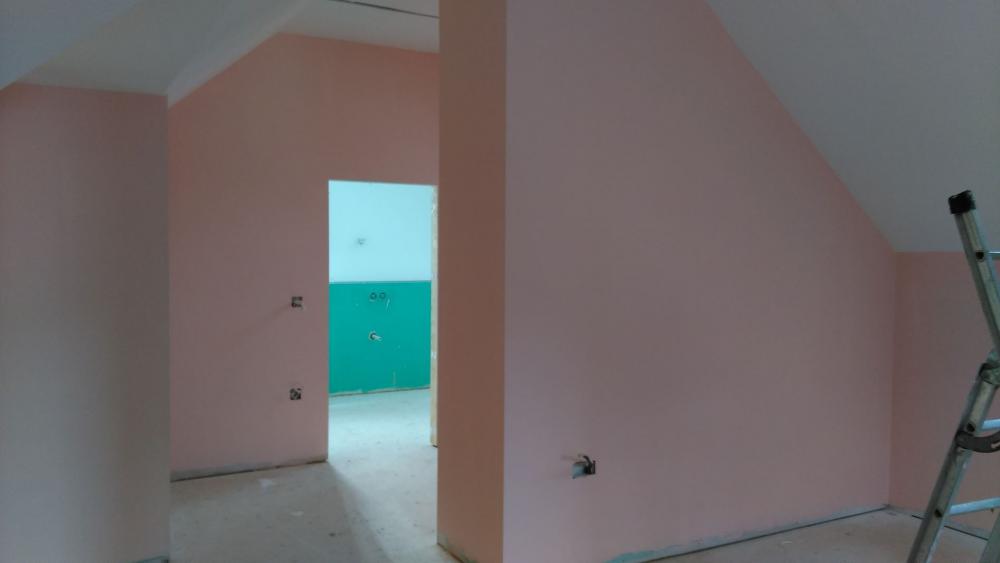
We have vaulted ceilings in our bedrooms and bathrooms. Some are symmentrical and others (e.g. bathroom) are not symetrical, but still at full height. Our smallest vaulted room is the bathroom at 3.25m x 2.4m - the ridge of the vault is along the longer side. I think this works extremely well, the vault and asymetry are aestehtically pleasing (to us) and add a degree of quirkiness into what could otherwise be more box-like. You are welcome to take a look if you happen to be in the area (Aylesbury). I attach a picture of another vaulted area to give you a feel of ours (not the one described above). Image is from larger bedroom through to smaller dressing area (vault is not symmetrical here) through to bathroom. We do not intend to fully tile the bathrooms - only to height set by shower screen and half-height for the rest, as dictated by boxing for suspended toilet and sink (green bit in the image).
-
I would argue that these are not "replacement windows" in the traditional sense, but are rectification work against the original build, so should be in scope of the zero-rated VAT regime. Especially as you are not claiming zero-VAT twice having been refunded for the original faulty works, plus are still in build stage (for VAT purposes). I can understand your supplier not wanting to get stung down the line and wanting to charge VAT now. I think this is the key point to address. Perhaps a call to HMRC to explain the circumstance and ask them their view. If they refuse to put it in writing then make a note of the date, time and person you spoke to plus advise given.
-
My installation was done by my builder, if I were do do it again I would employ a specialist. Most of the ducts were semi-rigid so that was fine, rigid ones were not simple to get done. One large unit is not always going to be more energy efficient than 2 smaller ones. With 1 unit you may end up pushing air through very long ducts and will need a higher fan speed to overcome the increased resistance, whereas 2 smaller units could mean positioning each for shorter runs and reduced fan speed. (e.g. closer to either end of a long house). I have no practical experience with 2 units, but would be concerned on how to balance the 2 given the house is a single volume. Also you have 2 inlets and outlets to take care of.
-
Architect who could turn our aspirations into reality and challenge our thinking in the process.
-
In all my previous houses both have happened, in the last house it became part of the annual ritual to replace snapped brackets on gutters and downpipes, re-attach and re-align gutters. Mind you the RWG were probably 15-20 years old at that point.
-
Powder coated.
-
After looking at all these options I decided to go with Lindab. Yes there are horror stories and questions about how valuable the warranty is, but in the end the choices seemed to be: Plastic - cheap and WILL deteriorate in a few years and looks horrible Galvanised steel - more expensive, looks the part (we have some zinc roofs and were able to colour match) and *should* last much longer Aluminium - slightly more expensive materials plus would be more labour intensive to fit Copper and steel - ruled out as "wrong aesthetic" for us or too expensive or both Zinc - could not find any off-the-shelf RWG and seems it has to be custom made at horrendous prices Ask me again in a few years if we made the right choice. Certainly 7 months on I am pleased with it and there is no sign of rust. I made sure it was cut with a hand-saw and no power tools to burn off the galvanised layer. My ideal would have been zinc - this seems more common and cheaper in the US where they can rock up on site and roll the size and profile to suit. I looked at a number of the galvanised steel providers. Lindab had a heavier gauge of steel than the others, and their sales rep put me in touch with a company who were able to offer a great price, almost on a par with the other galvanised steel providers. Happy to whisper it - PM me.
-
Update after a few calls and chasing around. Ofgem say that it is recognised that the change in legislation has caused a problem with new builds and that there is a review that could lead to a change in the future. No promises. Said they have received a lot of complaints and are keeping a register of people who they can contact if there is a change here. PV company have said they can decommission and recommission the install (plus change generation meter) and hence re-issue a new MCS. Supply company says that they will accept a new MCS. I am going to try this - cost of recertification is equivalant to 1 years loss is revenue with the Lower rate, so worth it for years 2 onwards.
-
On economic terms it makes no sense at an individual house level IF you already have mains water supply and public drains available - the water authority are, in effect, processing grey water and putting it back into the water cycle, but on a massive scale and hence at very low unit cost. I think this is for people who are either off grid or are really single minded about saving water - though the cost to environment of all that extra kit might reduce any perceived environmental benefit. I decided, early on, to focus my effort and money elsewhere.
-
From EST website (my emphasis) "If you submit your application on or after 10 May 2016, the EPC will need to be dated before the commissioning date of the system. If the EPC band D or better is dated after the commissioning date of your system you will be eligible for the lower rate" These things are set to try us - perhaps it will kill take-up of PV for new builds? Maybe that was the intention... Perhaps I need to get it re-commissioned now. Not sure it that is actually possible, and if so will the supplier accept that.
-
Thanks - that is the head scratcher. I did speak to supply company and the chap I spoke to was not too helpful, seemed just to read the rules back. Suggested I try to get a new MCS dated after EPC and they would review it. Have gone back to my PV supplier to see if they can provide any guidance.


