


MJNewton
-
Posts
1354 -
Joined
-
Last visited
-
Days Won
1
Everything posted by MJNewton
-
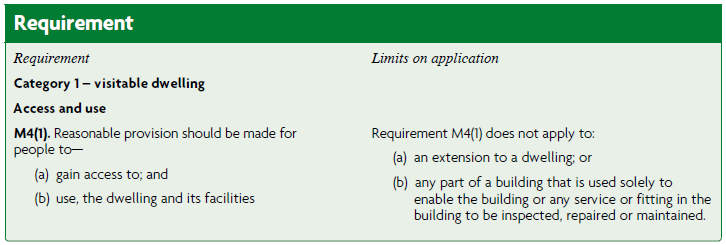
There's nothing grey about it - Approved Document M clearly states, for the mandatory section where minimum/maximum heights for sockets are prescribed, it does not apply to extensions: I'd still go for the 450mm minimum though as, personally, I like it.
-
Same here. When we moved into this 'new build' it felt odd having sockets so high up, not least given our previous place still had some sockets on the skirting boards. We soon got used to them and have grown to prefer it. That said, I did install a run of outlets (mains, aerial, ethernet, surround sound etc) at around 300mm (centre line, of course ) in our extension as looking around at 'modern' TV units it seems many of them are only 400mm-or-so high these days (I suppose as screens get bigger the stand height gets lower if you want to maintain optimum eye-level positioning) and didn't want them all on show, particularly if we wall mount the TV and run the cables up inside the service void to it.
-
You'll be back. (Did you know there are rules and regulations about that sort of thing?)
-
What would we talk and debate about then though?! This stuff matters, and forms the bedrock of the modern Internet.
-
The reference is from the Approved Document, and whilst only offered up as guidance for compliance with the Building Regs they are generally regarded as authoritative references of how they can be met. The ambiguity over where the measurement was to be taken was only removed in 2015 with the introduction of it specifying it being the centre line. There'd been nearly 20 years of inconclusive forum discussions prior to that. It only matters to people like me who can't help but measure these sorts of things...
-
Yes, but note the language in Part M revolves around making 'reasonable provision' [for wheelchair users to use the dwelling and its facilities] and so there will be circumstances where a socket/switch might be perfectly acceptable to be positioned outside the limits. Note also that these requirements don't apply to extensions. Was there something specific you had in mind, or just asking out of curiosity?
-
The one word answer is 'yes'. I was just explaining that there is also a maximum height too, and the arguably minor detail that it is measured to the centre of the socket and not the bottom as your electrician said.
-
You're reading too much into the diagram. It is showing the minimum and maximum heights, that's all. The fact the socket shown happens to have its bottom edge just above the minimum line is neither here nor there. It could equally have been half way up. Similarly with the lightswitch it is shown some inches below the maximum height but is not to be taken literally.
-
Yes, although note that it is 450mm to 1200mm to the centre line of the socket. (Ref: Section 1.18 of Approved Document M)
-

Dipping a toe into MVHR
MJNewton replied to Moonshine's topic in Mechanical Ventilation with Heat Recovery (MVHR)
Doesn't the insulation layer need to be vapour tight? If not, surely the moist air passes through the insulation and condenses on the pipe, which would actually be even colder than without the insulation in place hence increase the condensation further. Or am I jumping to the wrong conclusions when you say 'loft insulation'? -
Thank you everyone for the input and suggestions. It is clear we have a lot in common in terms of the importance of taking the 'right' approach! All good food for thought and I will have re-read through to pick out the key ideas. I was considering using copper within the unit, and likely building up the required pipework on the bench before fixing in place and connecting up, and so it was good to see this suggestion being repeated. Even aside from the aesthetics I do recognise the benefits in terms of cost, bulk and likely longevity too. A trick my Dad taught me, which I must admit to have never actually needing to use/test, was to stuff a small piece of bread up inside the pipe. Doesn't need to be wedged in there - just enough to soak up and stop the water flow whilst the joint is made. With the water back on the bread will be pushed out through a tap. I suppose this comes from an era where there weren't fine strainers in taps so they might need to be temporarily removed, although I imagine the bread would break up eventually and pass through.
-
I shall soon be installing a new kitchen and, with it being in a newly-built room, I have a blank sheet of paper on which to design the undersink plumbing and was wondering if anyone had any tips/suggestions about particular items to buy (e.g. I am drawn to the McAlpline double bowl space saver trap kit to maximise space in the cupboard), features to include (e.g. isolators), pipe layouts to ease installation and maintenance etc? One specific quandary I have is whether or not to use the flexi tails that were supplied with the tap (a Franke Athena mixer) as I stumbled across an article that said they account for 22% of water damage insurance claims in Australia houses which made me wonder how good they are. I know they are often regarded as a poor method of supplying individual sink-mounted taps, when compared to fixed piping, but I wondered how feasible fixed piping up inside a mono tap is? We don't need the stability benefits of fixed pipes as the tap will be mounted in the quartz worktop. In case it is relevant to my options, the unit is a standard 600mm width, the sink is a 1.5 bowl undermount (Franke ARX 160) and there will be an integrated dishwasher adjacent. The water supplies will be coming in via 15mm Hep2O pipes but I am happy to switch over to copper within the unit.
-
I use a bit of silver tape to pull boards forward. If I'm unlucky and end up tearing the surface foil the same tape is suitable for the repair.
-
Very I'd warn! Being skylights they'll be magnets for flies in the summer who will leave poo specks on the glass.
-
I always run the vacuum over the cut faces - it makes all the difference to the amount of dust that gets everywhere, and avoids the face-full of it when tapping a perfectly fitting board home!
-
It sounds like you've got a solution now but for future reference the Simpson Strong-Tie I-Joist Hole Support can be used to allow huge holes (250mm width x full web height) to be cut to within 50mm of the joist support: They're around £25/pr (you need one for each side) so whilst not cheap they can be extremely handy if you don't have alternative options.
-
Yes, and leaves a much smoother finish than a saw or other tool.
-
A bread knife can also be handy to trim thin slithers off if/as required without virtually any dust.
-
I can't help but be reminded of this xkcd classic (and I mean no offence by this; indeed if anyone deserves it aimed at them I'm as guilty as the next man!):
-
Only on the Internet can a discussion on 'Minimum distance between DNO feed and another protected circuit' lead to a pissing contest about deep fat fryers on warships. Whilst it is mostly making me cringe, a small part of me is in sheer admiration of the impact of the Internet on mankind... and how actually I wouldn't want things any other way! ?
-
And on that point why don't MCBs etc have spring loaded connectors (Wago style) in order to avoid the issue of undertightening, overtightening, vibration, copper creep etc altogether?
-
As mentioned you can get wireless interlinked alarms (from Aico too).
-
Some different makes can be interlinked but the usual advice is to stick to one make. What make are your current ones?
-
Yes, that's the 'interlinked' aspect to them. Usually a 9v trigger line between (so you wire them up with triple+earth cable) or wireless ones are also available. Fairly standard these days (and possibly a building regs requirement but haven't looked up the details on that).
-
Heath Robinson or wot
MJNewton replied to joe90's topic in Mechanical Ventilation with Heat Recovery (MVHR)
Will be interested to hear how this works out! I was surprised there weren't 'iris' type restrictors available which would be ideal for this sort of thing. (I think I may have found some, but they were very expensive)

