MJNewton
-
Posts
1354 -
Joined
-
Last visited
-
Days Won
1
Everything posted by MJNewton
-

No room for pipe!?
MJNewton replied to gc100's topic in Mechanical Ventilation with Heat Recovery (MVHR)
The corner-to-corner suggestion is just to maximise the crossflow or air but it's not an exact science so don't be to too concerned about compromising. With your idea about wall-to-wall were you thinking bottom-left to top-left? If so, that might result in less-than-ideal airflow on the right-hand side of the room. An improvement on that might be bottom-left (for the supply) to top-right (extract) with only the latter duct needing boxing in and this being at the kitchen end where it might be more aesthetically acceptable. -
Not sure what DIY Kitchens use but it could be a moot point as I think we're leaning towards the timber options (for the grain, as above) and I am relieved to have not heard any scare stories about potential warping (cue scare stories about warping!).
-
I think you've hit the nail on the head there. We felt that, for us, the smooth doors looked a bit too modern for what we were going for and so we were drawn more towards the grained options which, as you say, effectively means timber if we want the real McCoy. Thanks all for the input; you've been a really useful sounding board.
-
Thanks Barney12. It looks like a made an error with the last two in that they both actually have a veneer panel. The differences therefore seem to be down to appearance as the Linwood has grooved joints whereas the Norton are flush/square. I think my concerns boil down to not wanting to spend more on timber only to later find that we've ended up with a worse product in terms of performance. Perhaps I am worrying too much - I do tend to.
-
We are in the middle of designing a kitchen from DIY Kitchens and have decided to have shaker-style door/drawer fronts. They have five options available varying in price and material: Malton (from £24) - Foil wrap MDF, 22mm Clayton (from £29) - Painted MDF, 22mm Stanbury (from £32) - Lacquered MDF, 19mm Linwood (from £50) - Solid timber with veneer panel, 20mm Norton (from £52) - Solid timber with veneer panel, 20mm Having received a sample of each our preferred (well, my wife's - they're all starting to look pretty much the same to me) is the Norton. I don't have issues with it being the most expensive, particularly if there are some benefits to it (aesthetics, feel, longevity etc), but I am concerned about the any drawbacks such as structural stability, warping etc with it being timber. Should I be at all worried? We have an MVHR system and the kitchen is part of a family room and so we strive to maintain decent air quality and so don't anticipate an overly humid environment if that helps mitigate the risks. Any comments (concerns/reassurances)?
-
I'd look into that further if I were you. Our system (an estate build so ought to be regs compliant at least in design) has no open vent; just two AAVs for the two internal soil stacks we have. Perhaps positive presssure is dealt with by the sewer system in our case?
-
AAVs admit air; they don't allow it (and smells) out.
-
MVHR newbie.. help needed
MJNewton replied to Savage87's topic in Mechanical Ventilation with Heat Recovery (MVHR)
I've got some. How much do you need / what for? It sounds like you might just need a very short length - happy to pop some in the post. -
I've just started on this road myself as I am in the middle of creating an open-plan 'family room' space consisting of kitchen, dining and lounge areas. Each area has different lighting requirements and I want/need to be able to control them independently to suit different scenarios throughout the day (night). I have flood wired the room with lighting cable coming back to a central distribution point which, with a 4-switch bank also being regarded as a spoke to this hub, means I can have either a traditional 'dumb' setup or something 'smart' (in both name and function ideally!). Put off slightly by the cost of Philips Hue, to start with I have picked up a bunch of bulbs, remotes and a gateway from Ikea and have been trying them out. First impressions have been mixed: + Good colour rendition with CRI's >90 + Good response from the remotes (generally; I've sometimes needed an additional button press as if the first got lost somewhere) + Seemingly good synchronisation - I've yet to end up with one bulb's brightness being out of sync with the others - White spectrum functionality of the GU10's (not tried other bulb types with this) has been disappointing - the 2700K is fine (as has always been our preference), but the 2200k has been far too orange and the 4000k (or whatever it is) far too blue. As a result we'd never use this functionality, which on the plus side means we could their cheaper non-spectrum bulbs. Despite being able to change the colour temperature, they cannot be configured to automatically warm as the light is dimmed as per incandescent (and indeed as per Ikea's cheap dumb bulbs which have this functionality). - Not sure about the aesthetics of putting four of the Ikea round remotes on the wall (which is something we'd want to do as turning the lights as we enter is something we'd continue to expect to want to do). The square remotes aren't much better and with only two buttons means you have to press-and-hold for dimming rather than being able to tap in small increments - Ikea smartphone app somewhat basic in functionality, with seemingly artificial limitations on what you can do (e.g. the number of remotes a given bulb can be bound too). 3rd party apps have been slightly better but still suffer what are presumably limitations imposed by the gateway I still feel like my itch hasn't been scratched and so what I'm going to explore next is the use of 'dumb' bulbs and use smart dimmers. The recently-released Shelly Dimmer is going to be my starting point. I don't expect smartphone or voice control to be our primary control method (but who those - I am open to my habits being changed) and so am still keen on wall switches. For this, and in the absence of many off-the-shelf options, I am looking at using a bank of four Philips Hue dimmer remotes interfaced to the system via a Pi running zigbee2mqtt and Home Assistant. Sure, my 'roll your own' approach is going to take a lot more effort to get going but it'll give me maximum flexibility - full choice of what bulbs I use (I can pick the 'best of breed' for each different type if required) and methods of control without the limitations of what the closed systems each bring. It should also be a lot cheaper given the lack of a commercial gateway and expensive proprietary bulbs, not to mention that a single dimmer can drive a whole strings of bulbs if appropriate (e.g. the worktop task lighting will always function as a group). It could of course be a massive failure but there's only one way to find out!
-
Urgent MVHR help needed
MJNewton replied to vivienz's topic in Mechanical Ventilation with Heat Recovery (MVHR)
Loose connections can often only cause a problem when power is removed as arcing tarnishes the mating surfaces which increases the resistance of the connection (or disconnects them entirely). I'd suggest temporarily connecting the control panel directly to the MVHR unit as this would eliminate a variety of potential causes. -
I've always found the longevity of woven duct tape to be limited, particularly in exposed environments or heat. Aluminium duct tape ought to last longer, or at least I would hope so given the reliance on it for gap sealing etc, and so I tend to use that.
-
For the very reason I already gave.
-
In the absence of any point loads (eg joists, other beams etc) a lintel only carries the weight of the triangle above it so if this is a window opening it's not going to be much. You'll need to post a picture to have any reasonable chance of someone saying why it's bent. Yes, I know your camera is bust but you really need to get another.
-
The strength comes not from the thickness but the shape, in particular the vertical web section. I've got an 'extra heavy duty' IG lintel here that's 4m long and still made from steel that's only mm's thick.
-
Your attitude is disgusting.
-
I can't speak for jfb but for myself I like to help people but it can be very tiring and frustrating providing help to someone that is seemingly too lazy to help themselves. You sound like a bright guy and so I am confident you are more than capable of Googling insulation prices for yourself. If not just shout and I'd be happy to help you and teach you to fish rather just hand you one I've caught.
-
I might've misunderstood what you're saying, but picking up on this last point note that the supply and extract sides of an MVHR system are separate and so any smells picked up by the latter don't pass to the former. This is one of the main reasons the intake and exhaust terminals are always sited far apart.
-
If, as mentioned previously, he is just building you a shell then yes it is entirely normal. The screed can be vulnerable to damage from subsequent trades and so it is quite common to do it later on to minimise this and so if you are doing the 'later on' bits it'd fall to you. Again though it all depends on the plans and what has been agreed up front. I had a builder build me a shell and whilst the plans from the architect showed a finished screed we agreed in advance that I would take responsibility for it as there was other internal work that required doing before that layer could be added so he just did his bits (slab over insulation in my case).
-
Both methods of slab location are common. In either case you would expect a smooth and perfectly level screed layer to go on as well, and it'd be not unusual for the builder to expect others to do that if he's only building you a shell. The plans would normally clarify your construction details and from that enable you to agree who's doing what.
-
It must be otherwise it would be sitting outside of the BCO's remit. That will have nothing to do with it. The BCO has no interest in such matters. Stop making assumptions and just ask him why he wants it putting in.
-
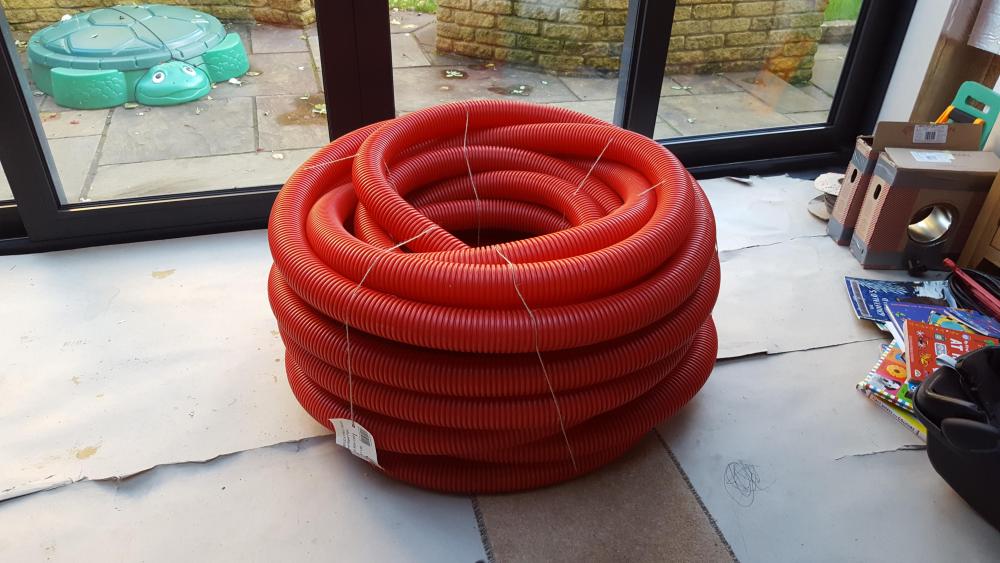
I forgot to pick up on this first time around... I did have a better photo of the ducting but spotted that the turtle had 'photobombed' this one so had to choose it! It does indeed bring back memories for me also as I had one as a child myself. A timeclass classic! The ducting is up on eBay now so we'll see if there's anyone nearby that it's of interest to - or is willing to take their chances with Parcelforce!
-
No problem at all. Whilst I may have got away with it twice before they might not be so forgiving if they think I'm running some sort of ducting business!
-
P.S. Not wanting to tempt you away but that Blauberg price seems pretty good, and would be 'pristine' unlike mine? Remember that you should be avoiding sharp bends anyway; not so much for kinkiness (matron) but more the impact on airflow.
-
Unfortunately I think we'll only know what Parcelforce think once it's on its way - presumably they must have some sort of revenue protection process at the hub to check people are paying the right amounts? I don't think the drivers do any checks on collection. I've sent two previously and they seemed more interested in what it was than how big! Bank transfer would probably be easiest for me if that'd suit? I'm away with work for a couple of days but can get it wrapped up ready to go at the end of the week if you want to proceed.
-
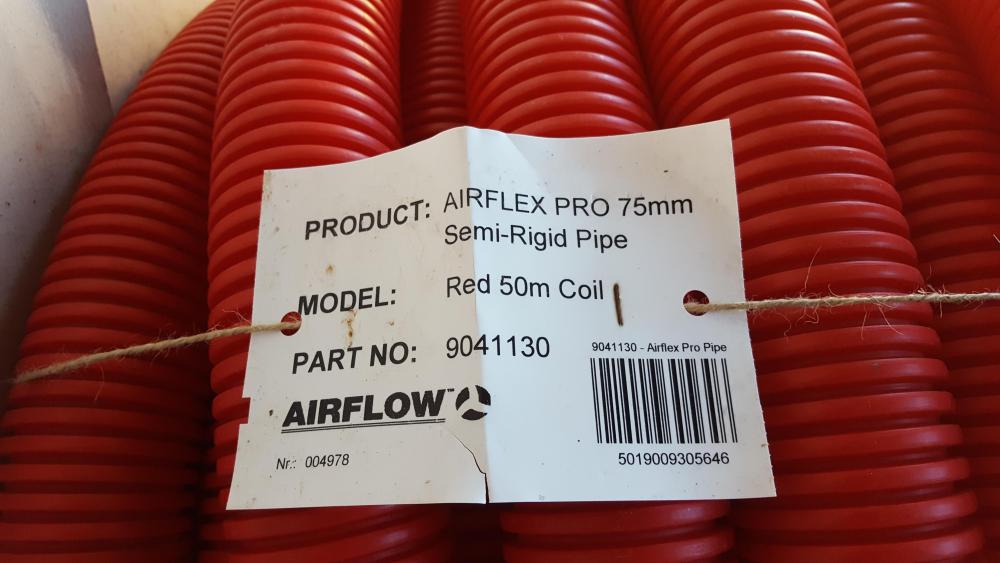
I did! ish... The ducting is the full 50m and still has the end caps in place, however there are a some scuffs and scrapes and it's picked up some dust/dirt on the outside in places where the wind has blown through. The biggest concern though is that I think I may have misunderstood Parcelforce's dimension limits as the 3m limit is for length+girth combined whereas I must've previusouly assumed it was just the girth (with length having its own 1.5m limit)! The coil is roughly 1m in diameter and 53cm high hence why I thought the 1+1+.53+.53=3.06m was pushing it. Perhaps they don't mind too much if it's still able to be handled (it's a one-man lift at around 17kg) and they've taken two previously without issue. Given its condition and being more keen for space than excess ducting I'd be happy to offer it at half-price (so, £80 + £12.99 postage) if it's of interest otherwise I might just stick it on eBay as collection only the that avoids the risk of Parcelforce demanding excess fees if they decide it is over limit with this one!