curlewhouse
-
Posts
377 -
Joined
-
Last visited
-
Days Won
2
Everything posted by curlewhouse
-
My Options on mvhr
curlewhouse replied to janedevon's topic in Mechanical Ventilation with Heat Recovery (MVHR)
Jacks point about reusable filters is something which is a feature for me about our final choice when we get to it - all these many different models and manufacturers around makes me think that in only a few years time, some owners may struggle to get the filters any more, so one with a filter which is cleanable and actually can be remade yourself seems a damn good idea. -
I've got to put a 72 meter foul pipe to put in plus of course incoming water pipes, some armoured cable runs around the property, a couple of inspection chambers and so on. I did plan to hire a mini digger but speaking to someone who has self built before, he found that it took such a time to become competent with them if you haven't used one before, that he had felt it was cheaper to hire a guy in with one as they did it so much faster. Has anyone any experience either way?
-
I'm a new build in a National Park and that wording seems to have been missed on my PP - BUT, I know when early in the process I spoke to them about fitting solar panels at a later date (our orientation is really bad and we'd in effect need to have them on both sides of the roof, which is beyond our budget at this time) they sort of fudged the question as to whether I could do it as PD later or would have to apply for PP - the answer was sort of "you can do it as PD, but it would help if you added it to your planning application" - which is clearly contradictory and made me think it is still PD but they don't like the fact and still want to wield power over us proles who live in the park (they definitely seem to see their job as overseeing the occupants) .... could be wrong though. I've learned that whatever the question their answer at least where I am would be "no you can't do it" (or alternatively, yes, but only if you pay us and our agents lots of money) unless you actually have researched beforehand and know your law in advance. Not the consultative relationship I'd hoped for. Interestingly, when I talked to my architect about sizes and accuracy, he told me he has only ever had 2 houses actually measured by planners in his whole career. But here in the park I've no doubt they'll be out with a bloody micrometer! They were seen checking out a refurbishment/alteration build the other day while the owner wasn't there.
-
Yup, done that more than once! Gone on a site to buy a small item and come off with the £50+ order
-
Roof Gutters - Metal or Plastic?
curlewhouse replied to mike2016's topic in Roofing, Tiling & Slating
Was cursing the other day as there was an absolute mass of *unbroken* cast iron guttering in a skip at work. easily enough for our house. Went to liberate it later after getting the go ahead, only to find the skip wagon had been -
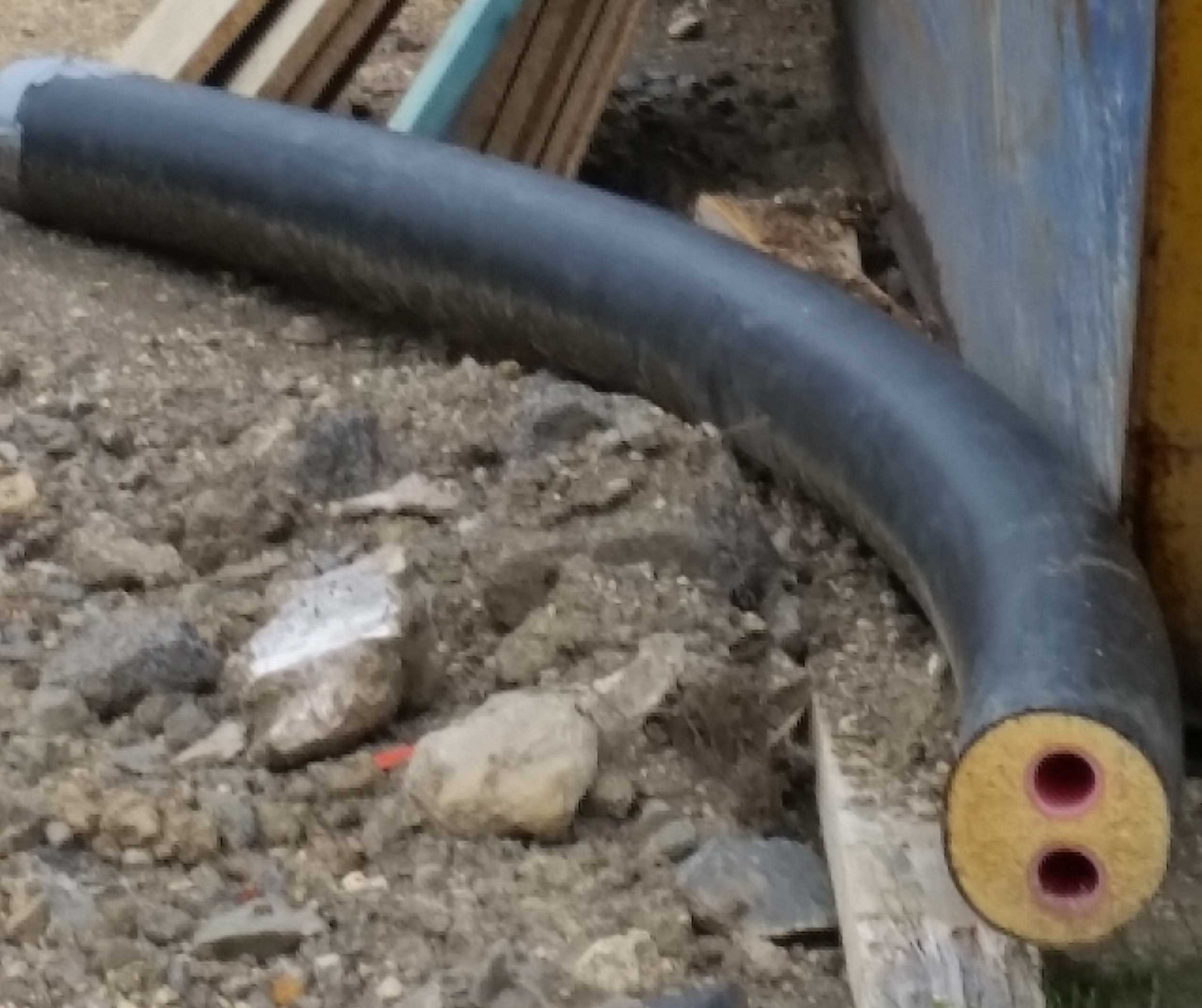
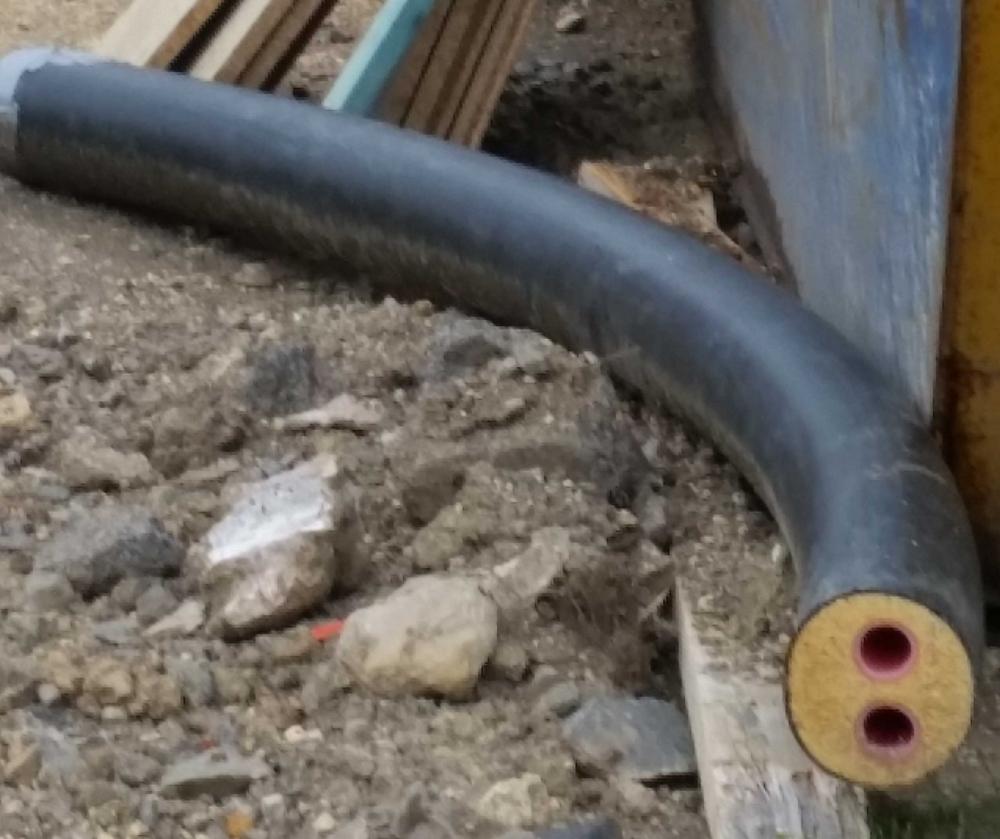
Ah, now I've got it. The house they are building is just one property, but I noticed their ASHP is way across the garden from the house - so this pipe would make sense from what you've both said above. Cheers. Had my eye on that offcut (like you do ) but wouldn't really have a use for it .
-
Just seen this on a building site - looks like some sort of really well pre insulated pipe but I've not seen it before. Any ideas?
-
Finished my roof tiling at last.
curlewhouse replied to ProDave's topic in Roofing, Tiling & Slating
That looks a totally professional job! I'd really like to do my own (got to be natural slate as National Park) but my fear is it would take me so long a gale would come along and rip it all off as it must be pretty vulnerable partway through. Did you just pick up a book and learn or did you get "lessons" ? I've actually just started reading "Roof Tiling And Slating, a practical guide" by Kevin Taylor with thoughts of at least trying to do the garage...... -
Must admit that for brightness levels, after trying to get my head round what 1 or 10 or 20 LUX actually looks like, and how big an area it would light at what level etc, when buying LED bulbs I now buy just one first and see what it looks like. Not very scientific, I know, but it works for me. I've also found some variation in makes of LED which both claim the same lux level.
-
Archaeological Survey Planning Requirements
curlewhouse replied to Ferdinand's topic in Planning Permission

-
Archaeological Survey Planning Requirements
curlewhouse replied to Ferdinand's topic in Planning Permission
Glad I saw this because I'm in a similar position with having to subsidise that level of detail - unfortunately though our planners seem to love anything that adds cost to the householder so they have adopted this, and the quotes I've received from archaeologists so far make me believe they all think they are Howard Carter! (or possibly Indiana Jones in their dreams - certainly from the level of quotes I may well be subsidising a major motion picture). One even quoted me for him taking transport from his house back and forth to the county archives to research the village before he even comes to do the "work", carbon dating is included , also paying for "publication and dissemination" of their work! This all supposedly under the heading of a "watching brief" on the one day we dig. A "watching brief" would be fine with me, but the potential in what they actually specify is without exaggerating tens of thousands of pounds. I think we'd have a damn good argument that this would not be "reasonable", but experience so far has told me that our planning dept are not open to negotiation or discussion - there's a real power trip going on in there. I am confident there is nothing to dig up though because to make it all even sillier, my site has actually even had a proper archeological dig done on it about 5 years ago, which found nothing apart from a couple of shards of medieval pottery, which you will find absolutely anywhere you dig at all....... and that proper dig was part of an entire village survey, (so our plot was just a random bit of ground as we offered to let them dig there if they wanted, not because of any significance or likely significance) paid for by the very same National Park who now specify almost £2k of "work" for an archaeologist to look in on 1 days worth of digging! (sloping site will take 1 day to level so my founds will actually be below archeological depth, confirmed by the planners archeologist himself, so it's only the site clearance these people are needed for thank God). But this: 5. precise and; 6. reasonable in all other respects.” Gives me hope because clearly it is not reasonable to expect people to pay for research into the whole village (yep, that's included in some of the quotes as the brief sort of indicates it) - to add to the lunacy, this research has actually already been done.... by the National Park themselves at the time of the dig and they produced a rather excellent file where they interrogated the county archives fully and produced a fascinating 100+ page document with masses of the archives and old maps etc (all of which show nothing on our bit of field) and an entire history of the village. So it's actually already done (though expecting a self builder to pay for an entire history of a village to be researched would not "reasonable" anyway by any sensible standard I would say) but they want me to pay for it to be done again! Madness. I felt it was obvious from the similarities in some of the quotes that the archeological practises are familiar with our National Parks attitude towards self builders and these parties very clearly know they are in a position of power by proxy and can financially exploit it. Like JH, I'm all for a sensible overwatch and care, in fact having grown up in the village and planning come back and to see my days out there now, I would say I care for the history of the place far more genuinely than any office wallah frantically looking for ways to exercise power. The charges for "written scheme of investigation (WSI) for archaeological monitoring has been submitted to and approved by the local planning authority in writing. For land that is included within the WSI, no development shall take place other than in accordance with the agreed WSI, which shall include the statement of significance and research objectives..." should in fact be very low (they are not - quotes £100+ on top of the £250 per day) because in reality, that will be a cut-and-paste exercise for the archaeologist as very little will vary from building site to building site in that respect. It is interesting also that "watching brief" has somehow morphed into an entire research project with "research objectives". It's a hell of a leap. It looks very like archaeologists providing work for other archaeologists rather than a sensible watching brief. I would suggest for a genuine "watching brief" the "written scheme of investigation" In reality only needs to say "stand with hands in pockets whilst watching the digger, shout STOP and look in the hole if something interesting appears." ! How I wish I had just levelled the site before we put in the planning application - there was absolutely nothing stopping us doing so, but we did not forsee we'd be told we had to fund a "research project" - I mean it's so insane and wasteful that it just wouldn't occur to you.. -
Plans and an unexpected visit to another site.
curlewhouse commented on curlewhouse's blog entry in Sips and stones may break my bones...
Lack of interest and more pointless delays. So over a month on and only 2 builders have shown an interest in doing the foundations, outer walls and roof! One is only able to do the foundations and site clearance due to sheer volume of work on, but seems very efficient and knowledgable, and one is willing to do it all, but I worry a little about the quote as it was done so quickly and is not very detailed. But I liked the guy, which is important, so we may talk more I think, and possibly split the work. Meantime, I've been digging to discover the water main depth because our entry track passes right over it - so looking at protection for it during the build, in particular when the crane comes in to do the SIPs. But, having dug and dug and dug down where it (definitely as we measured when it was laid a few year back and have also detected it) is I gave up when I could hear the faint sounds of a digeridoo coming from the hole! So reckon it's actually so deep that there is unlikely to be an issue - though I'm considering making a slab over there under our track just to be safe. Our plans are now with BC (we chose a private one in the end which both builders I spoke to and our architect said were sensible and practical in their approach... but thier first actions were a bill and an email saying the plans looked perfectly safe and fine but whose opening statement was "Prior to commencement of the works you must provide" - which does not bode well at all when they make so very clear that they see stopping you as their first and main priority. This really annoyed me as I'm fed up with people desperate to stop us doing anything on a power trip whilst they faf around (our planners decided to take 27 weeks to do what they are meant to do in 8 for example), and I had thought we were at last past that sort of thing. I'm not sure why they think stopping me putting a track in or levelling the site in preperation is necessary, and sadly it seems just yet another case of someone using their power because they can. We've lost a year already thanks purely to this sort of thing up to now and if I can't give the builder for the founds a definite booking in the next couple for weeks he thinks we'll have to wait until next year! Hopefully our designated Inspector will prove to be more positive. The plans have also just gone off to the SAPS people - I'm actually quite excited to learn what our SAPs results will be! -
The Green Building Bible - currently in it's 4th edition. It's not a how-to build book, but rather an excellent overview of options, explaining them all in sufficient detail for the non expert. I wish I'd found this 3 years ago when we first started researching options as it covers concisely what I've been researching for all that time and would be great for informing the decision making process on your build, power and insulation direction. This one read would have settled it all! It also has sections on green gardens, water saving and harvesting and so on. It is in 2 volumes, with volume 1 (482 ages) starting with the reasons we all need to think green now in our building and then step by step taking you through the learning process of fabric first, CSH and the path towards Passiv (which so many of us self builders are clearly using as an aspiration at least) in a logical order, through power and heating options, the varying build methods from ethically sourced timber frame right through to yoghurt knitting straw bale construction - but it also covers the dangers of falling for Greenwash and is in fact very practical - it is about green building and living, but certainly is not pie in the sky Swampy stuff. It's definitely the most comprehensive overview all in one book that I've seen. Volume 2 (295 pages) goes into the more technical details of form and function, energy ratings, the technicalities of materials thermal performance, ventilation, the realities of renewables and geography, lighting, heating & cooling, energy monitoring and so on. normally I find such stuff dry as dust and an unfortunate necessity but I'm actually enjoying reading this! I would say the articles are "bite size", but that would imply they don't give enough information, which is not the case at all. Rather I think, it is like a collection of articles (maybe it is?), which is actually a good way to learn I think. Both volumes (they come together) also have a few adverts in and suppliers lists, but these do not detract and perhaps have helped subsidise an extremely useful pair of books!
-
Do you ever feel like giving up
curlewhouse replied to Vijay's topic in General Self Build & DIY Discussion
Yes, definitely. Each time (so far anyway) nothing to do with the actual build, but just because of jobsworths on power trips and the feeling of being seen as a cash cow for people doing very, very little (except look for ways to stop you or for ways to make it cost you more), and then doing it very, very, very slowly, but exploiting the power they know they have over peoples dreams. In truth, without our level headed and very nice architect who has stepped in and smoothed the waters or just encouraged us at times, I'd have without doubt swore at people on the phone or gone round their offices and yelled at them and we would have walked away. But also the fact is I don't want to let these tin pot dictators beat us. -
Having looked at the cost of hiring a portaloo and "welfare facilities" has anyone just used a caravan? I've been looking at the price of some cheap caravans and have been quite surprised at just how cheap some reasonably condition vans are - was thinking that in one go you've got a loo, hot and cold water and cooking facilities and somewhere warm and dry for site workers for as little as £400 or even less in some cases. Plus a bit of storage in the bedroom. Sell it on at the end for even pennies. Obviously I'd have to deal with the chemical loo, but it's not such an unpleasant task as it used to be (flashback of the sound of friends dad retching whilst emptying bucket type loo many years ago! )
-
That's how I found Buildhub. Searching the term "self build forum" . Welcome MAB, we are all drifting here slowly one by one it seems. :-)
-
"Doesn't seem to be the case where I am. I've had a few delays lately due to double booked street permits. Our council doesn't let 2 utilities have them they the same week. " - yes, God forbid the street only gets dug up once when it could get dug up twice! Gotta love council "thinking".
-
What is minimum drop for waste pipe?
curlewhouse replied to TheMitchells's topic in Waste & Sewerage
Have you tried dowsing it to find the missing drain? Been discussed elsewhere, but all I can say is that it works for me every time. Just two bent rods from wire coat hangers will do. This guy is using the simple method that works for me. Works for my daughter too, but not my wife. No idea how it works, but it does! http://www.bing.com/videos/search?q=how+to+dowse+for+a+pipe&view=detail&mid=621C19A447668C1696B8621C19A447668C1696B8&FORM=VIRE -
Having done this in the past, I'd happily pay to have someone else do it!
-
Data Cat5 and other wiring
curlewhouse replied to Auchlossen's topic in Networks, AV, Security & Automation
I take it from this that apart form JSH who got it free, no one is bothering to use Cat6 but sees Cat5e as plenty future proof? I had hoped to rely on wifi, but am stuffing my studs with rockwool (of which I have a big heap I got very cheaply) I find Cat6 to be about double the price of 5e and I'm just "value engineering" my spreadsheet towards our final costing, so every bit I can save counts. To get the benefit of Cat6 every component of a system would have to be Gigabit rated anyway and that Cat5e actually can generally run at or very near those speeds but simply is not certified to do so. Would be a bugger to find that an advance in technology requires CAT6 in 2 years time..... -
How safe is my School BBC1 Scotland
curlewhouse replied to ProDave's topic in Property TV Programmes
When that incident was first shown on TV I'm sure I wasn't alone in immediately saying out loud "wall ties" - despite me being by no stretch of the imagination a builder! So it seems staggering that no one working on the site would have raised the issue as it's so basic, and surely any bricky worth his salt would have thought it was odd while working that he was only putting in very few (if any) wall ties? So it seems very, very strange to me. I mean even forgetting about building control, (it's funny isn't it because we are building our own homes so build way more carefully than someone for who it's just another task to get done, but we are watched like hawks, yet if you watch what goes into the build on a big developers site you wonder if BC ever go near) I'm sure any one of us if present when those walls were being built would have asked the question. Very odd. -
I was particulary interested to notice in that photograph, that from your mugs logo that you are apparently "queen of the garden" .
-
Actually, this is what I was thinking of using some spare loft insulation rolls I have for. I've been toying with "hanging" them inside the stud walls of the main bedroom and lying them under the floor too (Its an upstairs room). My wife is a nurse and works nights mostly, so a quiet room through the day is a great thing - though it's very quiet where the house is going anyway, so most noise would be from inside the house itself. Not sure if sound transmission through the studs from one plasterboard to another would cancel out any advantage or if it would be the otherwise empty voids which would be the main culprits and thus make this worth doing.
-
This whole subject has been doing my head in for almost 2 years and I've flip flopped on it more times than an MP with a second home! I've gone from biomass (because in effect the fuel is free to me), then off that as the systems are way too high powered for our design, then torn between LPG for installation and purchase cost (lived on LPG for heating & cooking for years before going to biomass for heating/DHW in our last home) and ASHP. We have more than enough ground for GSHP but crazy installation costs. In the end had to say ASHP to keep our planners happy in the National Park, and keep our renewables bit present as we cannot have panels, though it pains me to have an item in my house that I myself cannot fix in the future (never having paid a plumber in my life except to certify my LPG gas work when selling our last house). At least by not going through RHI we won't be held to ransom on the prices by the approved companies however. We will still be cooking on LPG though. Which kind of means at least there's another heat source in the house if ever we get the winters back where our electricity goes off (was a regular thing here when I was a kid). Once again, learning from the forum will save me thousands!
-
WWHR - oh yes another set of letters!
curlewhouse replied to curlewhouse's topic in Environmental Products
The straight through version looked very unlikely to block, but also least efficient. I think there might be an application for these in commercial buildings perhaps, Jack's back-to-back showering regime writ large in a leisure centre for example could make for interesting results, where there will be to all intents and purposes a constant flow at certain times. I remember thinking years ago about how good it would be if you could somehow get a massive slinky pipe down into the main sewer network and take some of the heat away! There must be megawatts of heat going into the sewers every day nationally. A coastal village here in Northumberland used to have a big coal fired power station pumping masses of warm water into the sea for about 40 years - always struck me as insane that all the houses a mere 100 metres away were all having to pay for their own heating systems (though on the plus side some interesting fish used to turn up near the warm water outflow) at the same time as all this hot water was being dumped.