jayc89
-
Posts
1389 -
Joined
-
Last visited
-
Days Won
1
Everything posted by jayc89
-
So a 10mm2 SWA would be suitable for the longest route ("shed"), which runs past the garage. Can I use a 3-way joint connector to tee into the "shed" feed and save running a 2nd cable back to the meter box from the garage?
-
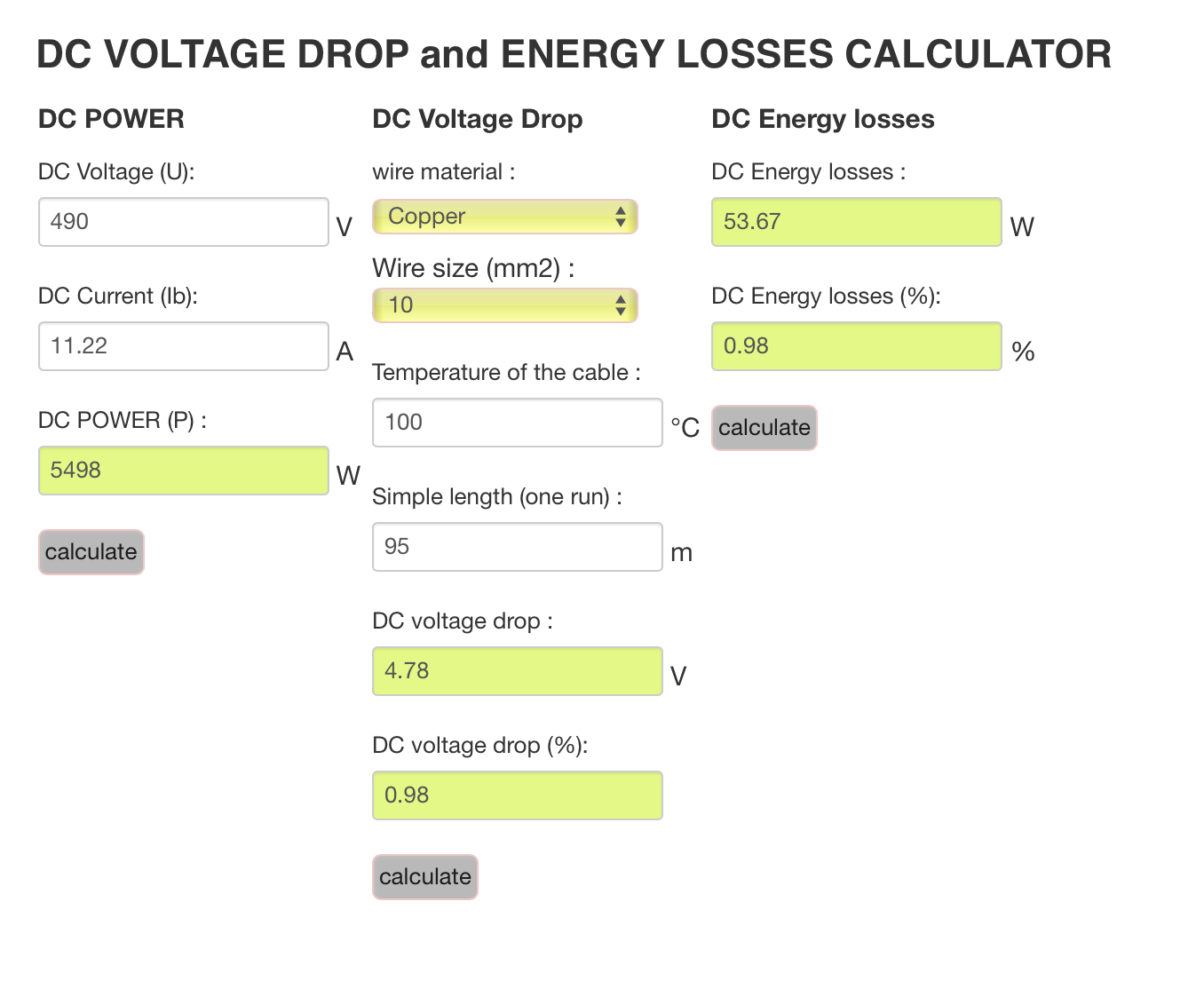
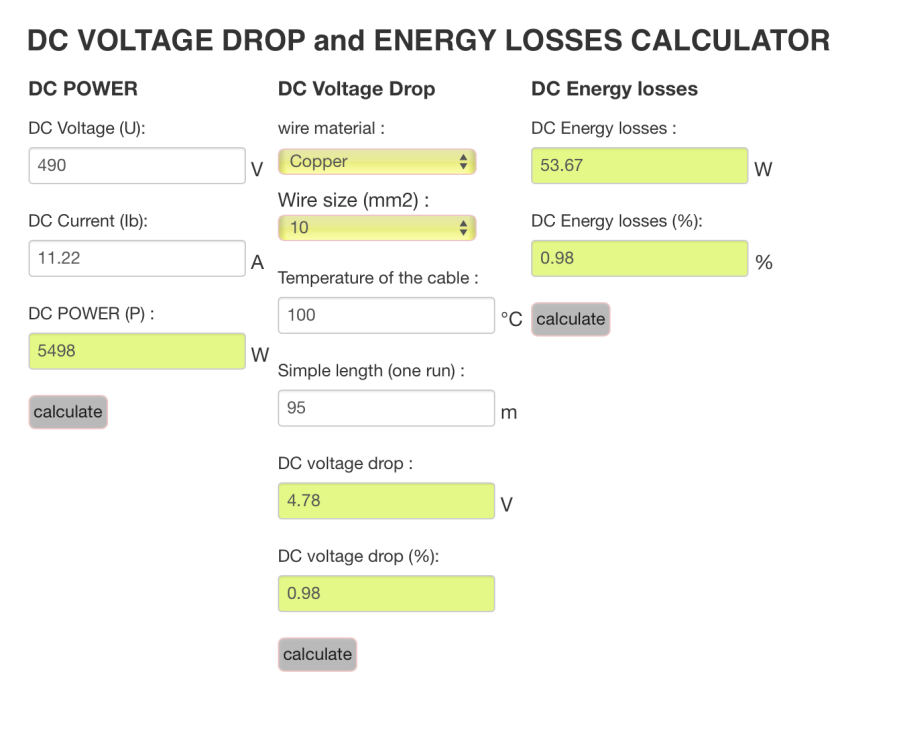
That was one of the ones I used, I must be doing something wrong (appreciate the cable temp is, hopefully, wrong, but reducing that only reduced the losses anyway);
-
Ah ok, I thought only voltage increased in serial strings, whereas current increased in parallel strings... I'm still at a bit of a loss though as I've used a couple of online calcs using 490v, 11amps over 95m and they're suggesting a cable size of 10mm2, which would be doable. How are you getting 50mm2? If, the shed run is going to be problematic, what about an inverter in the garage. So a 65m DC run from the shed, then a 30m run of 25mm SWA (AC) from the inverter in the garage to the meter box, which, again if my calcs are right this time, be good for up to 9kw (shed + garage arrays)?
-
Trying to come up with a sane design for these runs. All will be in serial strings, as parallel will result in too high amperage (I think). "shed" - 10x 550w panels @ 49v each. garage - 5x 550w panels @ 49v each. house roof - 6x 550w panels @ 49v each. AFAIK, when running serial strings, voltage is accumulative (volts x panels) but the wattage remains constant (550w in my case). That being the case, to stay within a voltage drop of 1%, the cable runs required seem to be; "shed" - 10x 49v = 490v @ 550w = 1.12a over 95m distance, requires 0.8917mm2 cable (1.5mm2) garage - 5x 49v = 245v @ 550w = 2.24a over a 30m distance, requires 1.1264mm2 cable (1.5mm2) house = 6x 49v = 294v @ 550w = 1.87a over 25m distance, requires 0.653mm2 cable (1.5mm2) tl;dr all runs could be done in 1.5mm2 cable which seems far too low, especially as everything I've seen online suggests between 4 and 6mm2 SWA (but that is generally when talking about AC). Am I mis-calculating something?
-
Makes sense - so I could use a 6mm2 SWA from the arrays back to the lean-to near the meter, and house the inverter + any batteries there? Then the AC run is a max of 2m into the meter box.
-
One of my many projects is our PV set up. Eventually I plan on having 3x arrays; - Shed roof (essentially ground mounted) approx. 5.5kw - Garage roof approx. 3kw - House roof approx. 3.5kw Eventually there will also be some battery storage too, as I don't plan to feed any back to the grid, either in the garage (so could store power from both garage or shed) or in a lean-to near the meter box (so could store from all 3x arrays). If the former, I might never install the house roof array. The problem I'm currently tackling is the distance between the "shed" and garage to the meter box. The garage is approx. 30m and the shed is a further approx. 65m behind the garage, so the longest run would be a max of 95m. In order to keep the voltage drop below 1%, assuming an AC cable of course, I'm calculating that would need a 50mm2 cable, which would be ludicrously expensive. Ideally I'd only have one cable coming from the garage back to the meter box which is carrying the supply from both the "shed" and the garage arrays. Would would you suggest is the most efficient solution here, both in terms of cost and performance?
-
It’s a 300l cylinder, 330kg when full. 530mm diameter. Joists would be spec’d for up to 1.25 kN/m2 load so should be good, but that load would then be spread across the existing trusses which may or may not be a good idea?
-
Finally coming back to this. The roof has 2x King Post Trusses that span the full house width, sitting on external walls (330mm thick). There are no internal load bearing walls. Distance between the two trusses is approx. 2.5m. I'm thinking of running some joists between the trusses at 400 ctrs for the make shift plant room to house; - MVHR unit - water manifolds - unvented cylinder - Grundfos HomeBoost (potentially) at some point I’ll run the idea past our SE before cracking on, but does this seem plausible? Can I put a load bearing floor on the trusses, or do I need to put in some new beams just for this purpose? (Getting them up there would be a PITA)
-
I tried just vertical battens in one room and didn’t like the lack of support around the ends of the PB boards so I put uprights at 1200 ctrs in all other rooms I’ve done. Where I’ve run wiring loops, I’ve left the uprights slightly short to allow the cable to pass through.
-
Our old Trevi shower mixer has 3/4" inlets, the flow and pressure is pretty impressive and we want to keep the same feel in our new en-suite. All new stuff seems to be 1/2". Are there any decent new mixer valves that come with 3/4" inlets? It'll be fed by 22mm HEP.
-
I was quoted £2,000m2 turnkey 3 years ago, no way you're getting it for that around here now.
-
What cables to pull through?
jayc89 replied to WWilts's topic in Networks, AV, Security & Automation
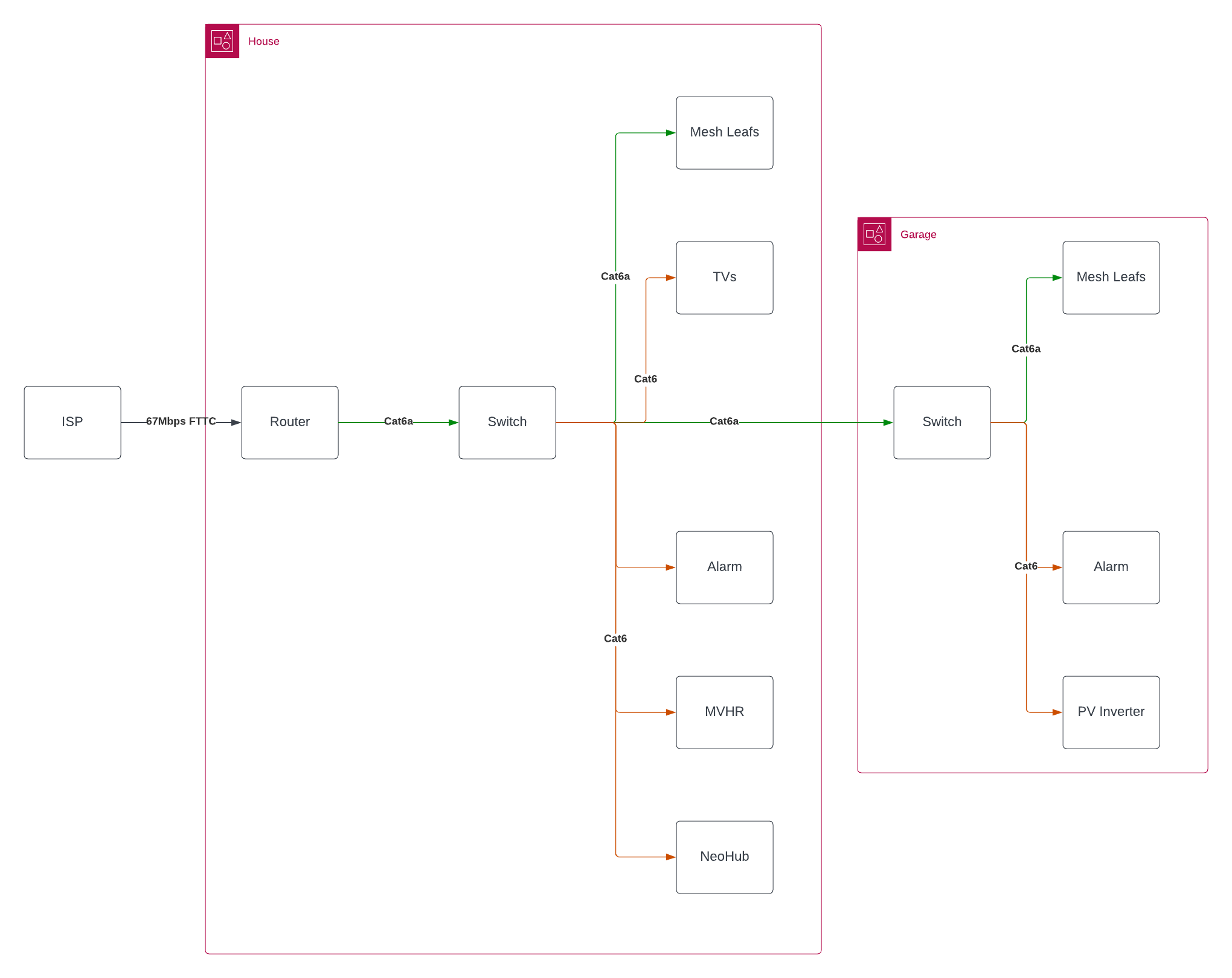
We've just changed from BT to NowTV for our internet. I had no idea how good the BT HomeHub WiFi signal was. It reached every corner of our, solid wall construction, house. The NowTV in comparison is pants and doesn't reach more than 4m through our thick walls. I'll get around it by putting a WiFi mesh in, but I am somewhat relieved all our TVs etc are hardwired, so they haven't been affected. My house's network looks, or will look, something like this; I'm only using Cat6a for the backhaul; between routers, switches and Mesh Leafs, which means anything within our boundary could, theoretically, communicate at speeds up to 10Gbps, but in reality, nothing we have has the physical capability to do so; the mesh leafs have AX3000 chips, so support up to 3Gbps over 5Ghz, but all our consumable devices have BASE-1000-T ports at best, even the latest iPhone "only" supports up to 1.2Gbps over 5Ghz. (I suspect wifi technology will outpace physical cables for domestic and SMB use over time) Our internet supply is 67Mbps FTTC, even if/when we get FTTP, we're not going to exceed 1Gbps for a very long time, I can't imagine typical TV streaming ever will, at least in my lifetime, so running Cat6 elsewhere is a risk I'm willing to take. None of us are console gamers, so a single run to each bedroom has worked fine, if we really needed more, a 5 port switch would hide neatly behind the TVs. The only place I'll run more than 1 cable is to the living room, where we plan to have a media wall, and even then I don't know what I'd do with the additional ones yet, but they'd be there if needed.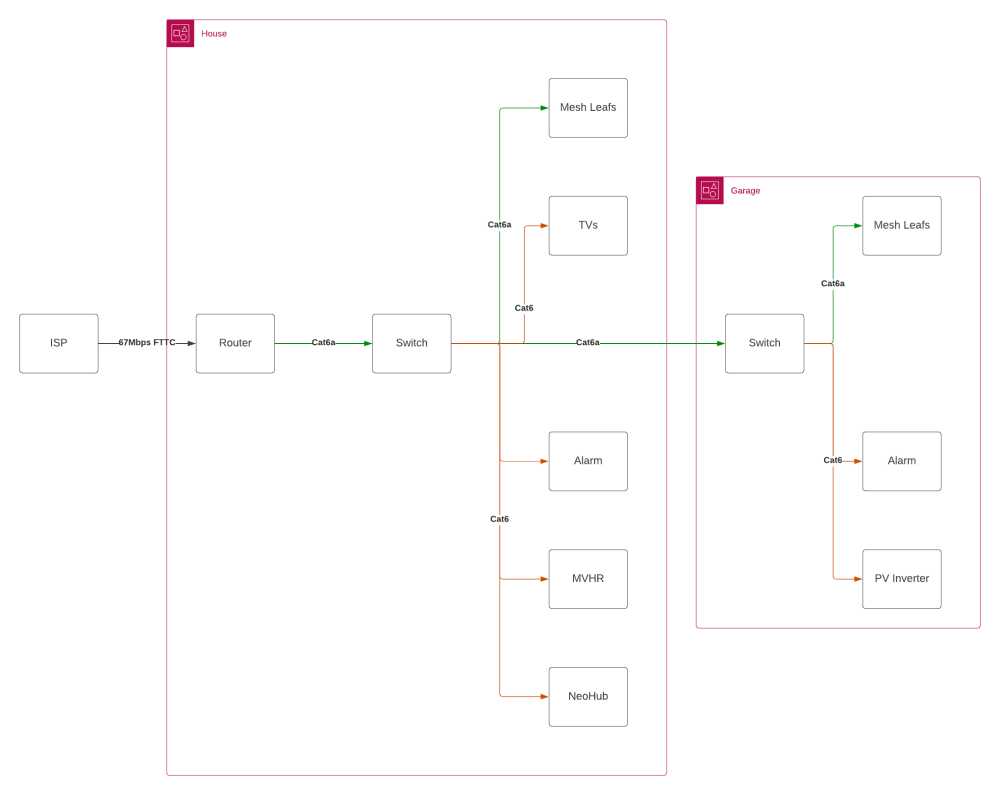
-
Having fitted IWI to our house, I much prefer wet plaster. Both from a "feel" POV but also not having to faff about with wall hangings other than wall plugs. An insulating plaster could have been used (like hemp, which would have also been breathable), which would have left us with "solid" walls, but it would have taken up 2x the floor space and more than double the cost. I guess it's a necessary evil given we couldn't use EWI.
-
What are your plans for the low, wide window? We have something similar in our kitchen to run along the sink. Idea is to let plenty of light in, but avoid onlookers - that elevation looks out onto a pub.
-
I normally use a 50/50 mix of trade contract matt emulsion.
-
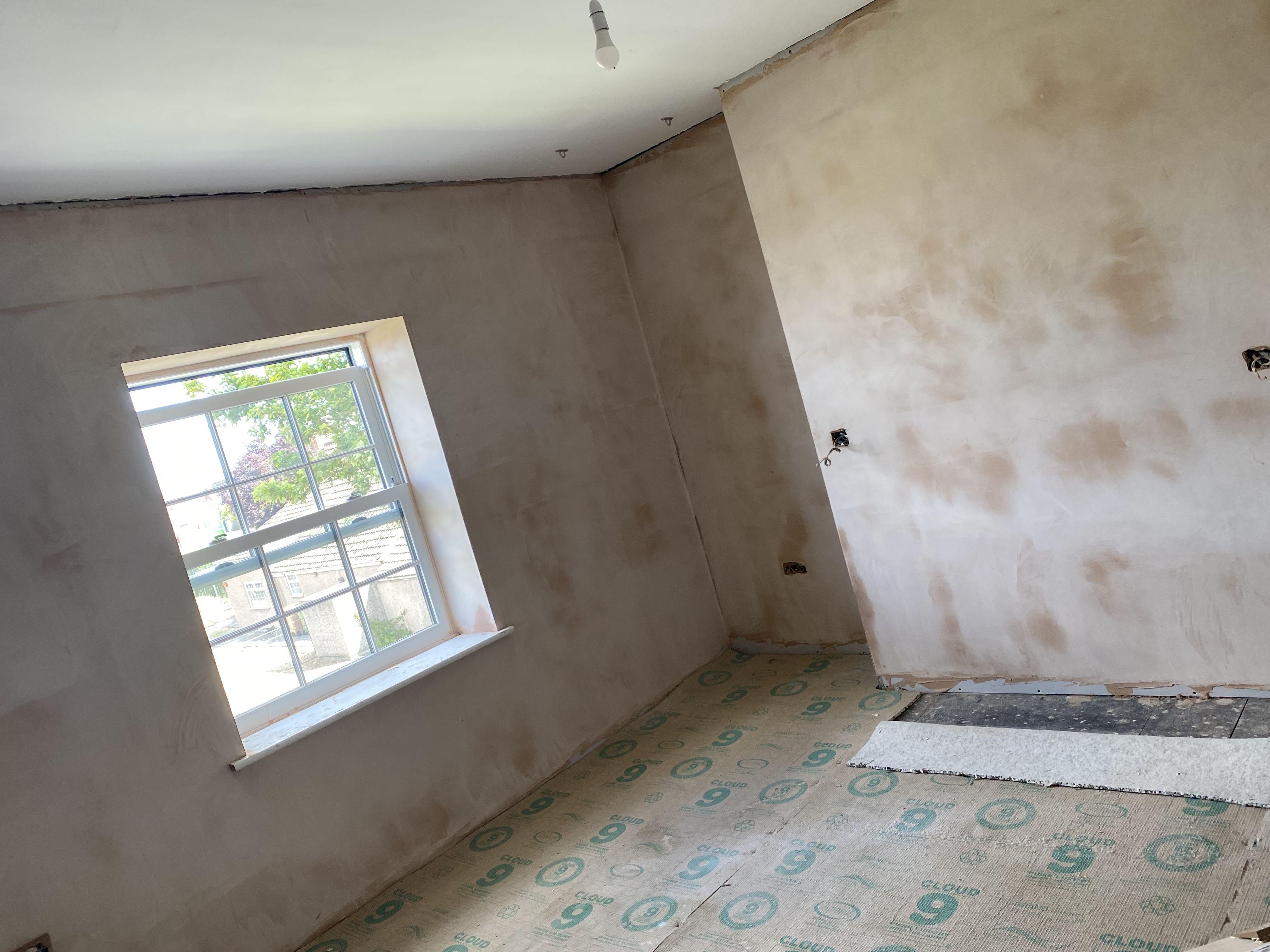
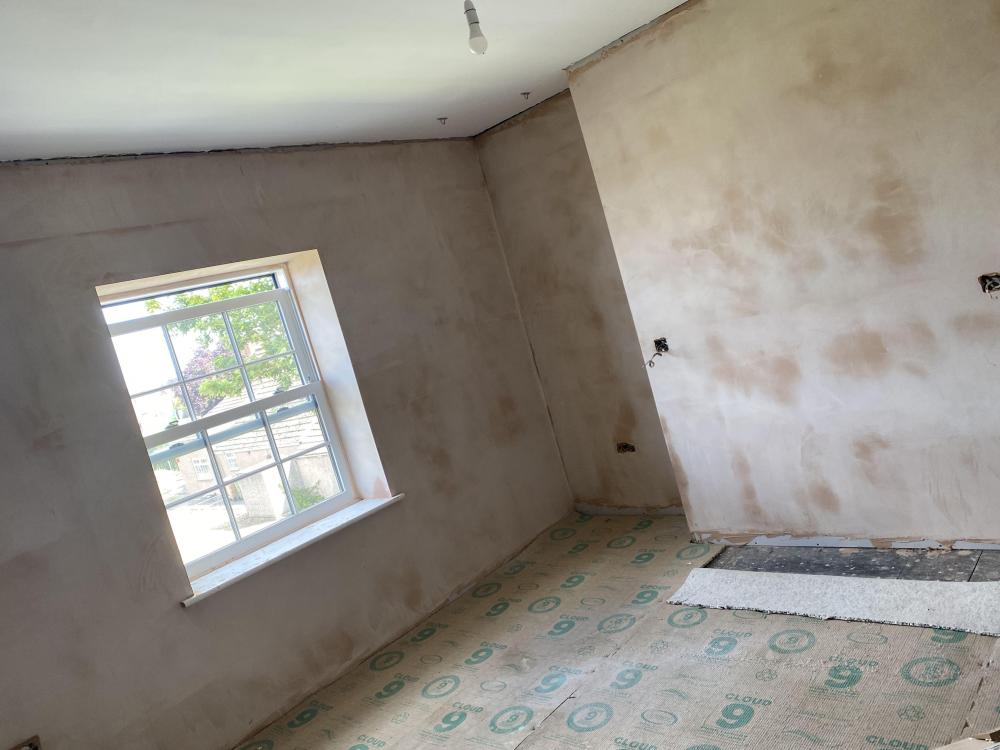
That's my understanding too, but guidance online suggests anything between 4 and 14 days, not 48 hours. This is what ours currently looks like;
-
Had a room skimmed yesterday, guy finished around lunch time and it's drying incredibly fast, it's pretty much turned a light pink already, just 24 hours later. We've had a couple of windows open to encourage a through draught and it's been pretty warm here - approx. 25c. Is it drying so fast OK? And, if it's entirely light pink tomorrow, I think it will be, only a couple of corners still dark as I type this, can I crack on and mist coat it?
-
Removing lining paper before plastering
jayc89 replied to Jimbo123's topic in House Extensions & Conservatories
Stripping paper isn't a builder's nor a plaster's job. When I'm getting my plasterer in I'd have the surface(s) prepped for him, ready to go, I assume he'd expect the same. -
Insulating the unit in a cold loft?
jayc89 replied to Jim K's topic in Mechanical Ventilation with Heat Recovery (MVHR)
I plan sandwich some sheets of OSB between 50mm PIR and build a "room" out of it. Will use it for the MVHR unit as well as a few other bits and bobs. -
There would be a thermal bridge at the wall/floor joint. The 60mm insulation should drop past the 80mm screed to be touching your 100mm floor insulation. (Called a perimeter upstand). Neither wall nor floor insulation is that great, I'd recommend going thicker whilst you're going to all this trouble. 150mm floor (just dig deeper?) and 100mm on the walls. You need to pay careful attention around things like floor joists, are they pocketed into the existing solid walls? If so they're a thermal bridge and at high risk of condensation and rotting. Best idea would be to remove them, insulate and refit the joists inside the new thermal envelope, this is a lot of work, so an alternative could be to repoint around the joist pockets in lime, to reduce any air leakage, and use a more breathable insulation within the floor void. For your services, do you have space to batten out the walls by 25mm to allow you to run wiring wherever you need? I did similar; adhered PIR to the walls, mechanically fix 25mm battens through the PIR into the wall, run services, plasterboard over.
-
Also in a similar position. Quoted £2k to pull it down and make the roof right again.
-
We had similar when re-routing a cold supply when laying a new slab. No internal stop cock, external one didn't shut off fully. Plumber had me blowing down the end of a copper pipe whilst he soldered the joint. Proper Laurel and Hardy moment.
-
Excuse my ignorance, what's the benefit of the additional CAT runs? We have 1x run to each TV point and never found a need for more, but we don't have surround sound etc anywhere yet.
-
My understanding was that mesh was sat on "shoes" to leave it middle of the slab, which also means the pipework is central, not having to work its way up from the bottom before the users feel any benefit.
-
There's certainly hardwall under there, about 25mm in places, which is what I thought would be used to get the wall level prior to skimming.