SteamyTea
-
Posts
23851 -
Joined
-
Days Won
200
Everything posted by SteamyTea
-
You may be able to get away with a cheap, 'non inverter' type then.
-

Air-to-air ASHP replacing warm air heating
SteamyTea replied to Gooman's topic in Air Source Heat Pumps (ASHP)
Base the power calculation on the same flow temperature i.e. 40°C, then adjust floor insulation in the extension, along with pipe spacing, to suit. -
It is because it is distributed generation, but it still feeds into the main electricity grid. It does not supply electricity, ready to use out of the box, for locals people. It is still conditioned, stepped up in voltage, connected via a relatively small sub station, usually via underground cabling, into the main grid (those huge pylons). A large thermal plant (gas or nuclear) does all that at the facility and then the cables are run in. The difference is that a nuclear plant may be turning out 3 GW, a large windfarm 50 MW (occasionally) and a solar farm probably less than 5 MW. So there is a lot of planning for this, and it that which can cost money, and then not succeed. Renewable Energy has relatively high fixed costs, but very low running costs. I have often wondered how much energy the site at Hinkley Point would have generated with 15 year old RE technology by now. They could have installed a very large solar farm and some 7.5 MW turbines on the site, and all the infrastructure needed was already there.
-
I feel like giving up on the idea.
SteamyTea replied to Big Jimbo's topic in General Construction Issues
There is nothing inherently wrong with a block built house, but like everything, it is the attention to detail. You can still achieve a good airtightness value (aim for <1), a good U-Value, so insulate better than building regulations. Windows are a tricky one, double glazing, rather than triple, but fit MVHR, then no need to worry about trickle vents showing (they make windows look unfinished). Heating is then the difficult one, but if you design for a heat pump, but fit gas or oil, when the time comes to swap the boiler (and if you buy a cheap one, it will need swapping) the new owners may not have a choice about what they fit. Do you remember the Windows 98 Ready slogan, well your house will be Heat Pump Ready. Don't fret about the embodied carbon and energy in the materials, you can look at ICE and work out that it probably does not make a huge difference over 20 years, let alone 1000. Save money on the fittings, so basic stuff, no automation, a passable kitchen (if it looks good, it is good) and simple white bathrooms (steel baths). You can always sells the potential about what can be done, rather than your dream. -
If people want more information about UK energy then DUKES. https://www.gov.uk/government/statistics/electricity-chapter-5-digest-of-united-kingdom-energy-statistics-dukes
-
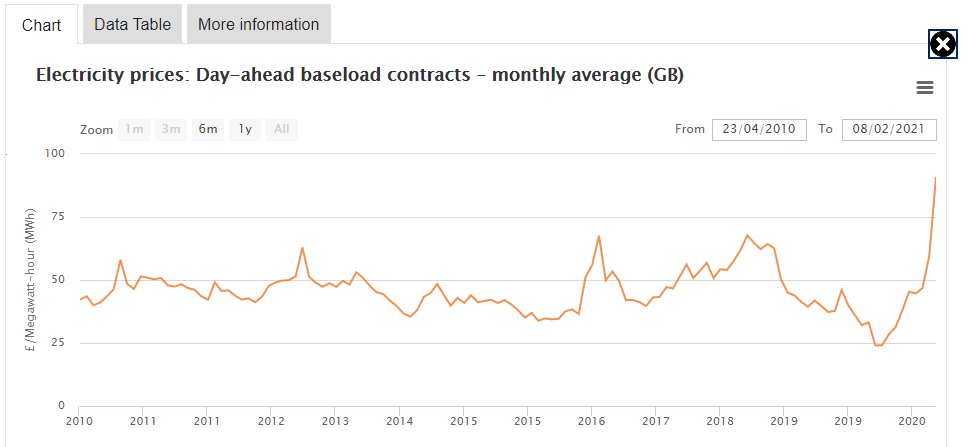
Here are the last few years wholesale prices for base load. (ofgem) Pretty stable for until last year, and when EDF sell me off peak power, they cannot be making anything on it.
-
Already happened, the road fund licence, which was £0 on EVs, is now £150/year I think. A back of the fag packet calculation: 30million private cars, mean RFL £100 Mean fuel consumption 30 MPG, mean annual mileage 8000, mean fuel cost £5.70/gallon. Fuel taxes 65% RFL = £3bn Fuel Taxes = 26bn Round that up to £30bn, divide by the number of cars and you get £1000/year. About the same as my council tax, pretty good value really.
-
Looks like the sort of place where those special home made movies are made, or a special in door farm. Probably both.
-
I meant RIBA, it was late, and I was drunk. https://www.architecture.com/
-
Doesn't RICS have a a section on there website about what to expect and how payment should happen. https://www.rics.org/uk/ The one Architect I now know gets charged extra if he wants milk in his tea, and charged even more if he does not want it. Seems fair to me.
-
Your larger, newer house, will also benefit from having a better wall to floor area ratio. Heat loss should really be calculated like air loss, on the total surface area, not just the habitable floor area.
-
ASHP Suppliers/Installers Review?
SteamyTea replied to Jeremy's topic in Air Source Heat Pumps (ASHP)
That is just statistical noise, if it was a couple of MWh out, that would be a different matter. -
Air-to-air ASHP replacing warm air heating
SteamyTea replied to Gooman's topic in Air Source Heat Pumps (ASHP)
There is quite a bit of useful information on this site. https://www.engineeringtoolbox.com/hvac-systems-t_23.html -
New heating for terraced house in London
SteamyTea replied to Ferdinand's topic in Central Heating (Radiators)
It is a very rare issue and normally caused by being too small for the job, or damage/lack of maintenance. The comparison with a small wind turbine is spurious at best. -
New heating for terraced house in London
SteamyTea replied to Ferdinand's topic in Central Heating (Radiators)
Jones is trolling again. -
LG Therma V mono block Air Source Heat Pump
SteamyTea replied to ProDave's topic in Air Source Heat Pumps (ASHP)
Could be size of buffer as a fraction of energy required. -
Selling or Significantly Renovating Will Mean No Gas Boiler?
SteamyTea replied to Ralph's topic in Housing Politics
That's interesting as the suppliers are going to control what people use either through price or automation. Bob Hoskins also said "I have put money in all your pockets, but now there has been an eruption".
-
New heating for terraced house in London
SteamyTea replied to Ferdinand's topic in Central Heating (Radiators)
While this can make sense, I think with the UKs attitude for Me Me Me, and our inability to financially support people when out of work, there is a risk that people may pay more than necessary, and some use a lot more than they should. -
I never understood the design from sketches and drawings until I went to Jeremy Harris' place, the it all made sense. Can't remember the finer details now, but it works. I know there was some toing and froing with Kingspan about their soleplate detail and the condensation risk. @saveasteading Maybe look up that detail and see what they do now.
-
You have had pornhub even longer.
-
Selling or Significantly Renovating Will Mean No Gas Boiler?
SteamyTea replied to Ralph's topic in Housing Politics
Resistance heating may well be a viable option in the near future as the carbon intensity is now getting very low nationally. I think SAP now has an updated number to use (or it may be next year). I suspect that a combination of heat pumps and resistance heating will be the solution for hard to heat places. They could still halve the overall energy usage. Flats, generally, are low energy use buildings, so air2air is a cheap option. I studied renewable energy at university and I am still amazed how fast we can build generation now, and we have not built any significant onshore wind generation for a few years now.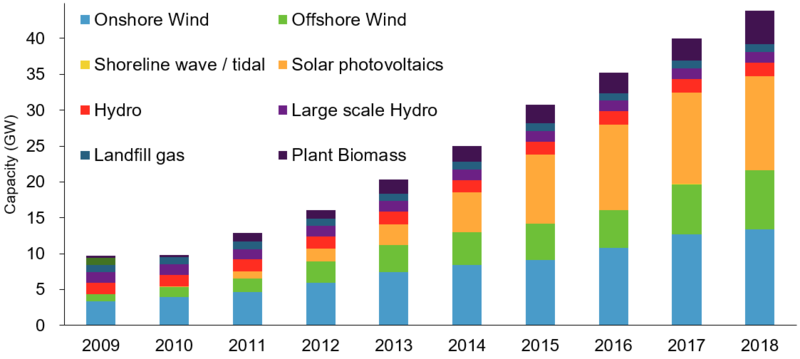
-
Cars are like my women. Dirty, unreliable and now all over 20.
-
Or just poor design, testing and quality of materials. (My Suzuki Swift used to eat through rear wheel bearings and it only weighed the same as an empty packet of crisps) "If you want to go to the Outback, get a Landrover, if you want to come back, get a Toyota"
-
Happens when they turn Dinorwig on.
-
You don't live in Cornwall do you, wading rivers is not unusual, had to do it this week. But I would think that lateral loads on a wheel bearing are higher on the road, as are the breaking forces (generally the greatest forces on a car). It is decades since I studied automotive engineering. But the book fell open at the right pages.