SteamyTea
-
Posts
23851 -
Joined
-
Days Won
200
Everything posted by SteamyTea
-
Do a lot of searching and reading, on here and your problems will be solved. You can use Google's site: prefix as I don't find the built in search that good. You will even find a topic on searching. The main thing to keep in mind is that prices vary a lot. So you can save lots of cash by buying sensibly. A decent HP heating system will be on a lot, but not always heating. A gas or oil system does not work in the same fashion, it over heats, then over cools, to a greater degree than a HP based system. The actual energy losses from the building will be the same over a period of time, just that every time it fires up, and shut down, the efficiency takes a big hit. It is like my driving, usually get low 50 MPG from my car, but this week, with all the holiday traffic about I get mid 40s, because I have to keep stopping and starting as Emmets find Cornish roundabouts and left hand turns different than the rest of the country for some reason. They are the place to suddenly stop and point at St. Michael's Mount, or a seagull, and argue with the kids.
-
Welcome. Went to university in Dorset and had a holiday cottage in Weymouth for a few years. What part are you in? Dorset has the worse drivers in the country, and they are all down here this week.
-
Combination of immersion heater and a heat pump. You will very really get enough power, for long enough, from any micro renewables to purely choose just one system if DHW heating, so you have to play the numbers games. An immersion heater can be quickly switched on and off as generation is forthcoming, but only has a CoP of 1. A heat pump does not like short cycling, and has a minimum startup current demand, so it is more usual to time it to come one during times of greatest likely PV generation, usually between 10AM and 2 PM GMT (thus does depend on solar array orientation). PV generated power will go to the nearest and biggest load first, so even if there is not enough PV power to fully satisfy the HP current draw, it will contribute to it without intervention. And a well set up system should give you a CoP if 2.5 to 3. The thing with micro generation us to not be greedy about it i.e. think that for the cost it should supply all the power, all the time. And regarding the thermal store's thermal losses, just like a house, and especially UFH, you need to insulate properly. The bigger the temperature difference, the thicker the insulation has to be. There is no magic to be found here, though people will try to sell you some.
-
My journey to work is going to have to be in escorted convoy apparently. We have not heard too much more this last week. Still, I can write slogans on the side of the car.
-
I prefer sleeping at the moment. 400,000 extra people in Cornwall this week, I and have fed at 1000 if them.
-
Not sure what that is, sounds like dynamic loads. Being single and living on my own, I have no understand about what happens when I sleep, other than, I cease to exist.
-
Yes, I forgot the welcome as well. Where about in the country are you? Not sure Mike's comment about 'people like us' is good or bad.
-
Don't tank track spread the load, this is partly why they can traverse rougher ground than wheeled vehicles (there are other reasons as well).
-
Slate tiles are probably the most expensive you can get, roof integrated modules may be cheaper than normal roofing. Hunt around on here and you will find a few threads about them. No real point going lower than 0.1W.m-2.K-1 in reality, airtightness is very important though. You have to make sure that cold outside air cannot bypass the insulation. If you read the the term Far Infra Red, you know it is snake oil. Infra Red heating is a specialist product and not designed for housing, it only works within line of sight, may as well fit a fan heater, which costs a tenner. That is just down to sizing a heating system correctly and ventilating it. You have not mentioned ventilation, have you looked into MVHR? You will need some sort of ventilation in an airtight house. She is right, for so many reasons, and it will not be long till they are outlawed I suspect. Sort it with the space heating, an ASHP can do both. Yes, if designed and installed right. The devil is in the detail.
-

LG Therma V mono block Air Source Heat Pump
SteamyTea replied to ProDave's topic in Air Source Heat Pumps (ASHP)
I think they want to take advantage of excess PV generation. No you are not, 10 kWh/day would be correct. I used about 8 kWh/day when I had a lodger, now between 6 and 8 kWh/day. Though this is going to go up as I have a second job, so more uniform to wash. -
Do you mean 32 kWh/m2.a ? If you have to re-roof, then consider roof integrated PV, about the same price as slates. You have to design in for an ASHP at this stage. MVHR relies on very good airtightness results >2.5 ACH is often quoted.
-
Adding Value and Discerning Buyers
SteamyTea replied to MattSu's topic in General Self Build & DIY Discussion
PV is worth having, can be installed at build time for about the same price as traditional roofing. Make sure the house orientation is suitable, and no shading, so get rid of that porch roof. Ditch the idea of a green roof, that just shrieks "leaks" to me. Fine on the garden shed, not on a house roof. Triple glaze, people are interested in the triple bit, not the U-Value, so they do not need to cost more. UFH is not anything new, fitted to a lot of mass produced places now. Just up the amount of insulation under it, more than BR specify, you have a larger delta temperature. ASHP definitely, but make sure that there is room for a decent sized buffer tank and cylinder. Don't skimp on the power output, oversize by at least 30%. Don't skimp on insulation, and make sure airtightness is as good as it possibly can be, AT TIME OF BUILD. As for looks, drive around your area and see what high priced places look like. As for rooms inside, I like separate rooms, hate it when a room becomes a corridor (which I have and it stops me using the room, and I live on my own). Make sure all bedrooms can take double beds. As for 'connected houses' don't bother, with a ASHP/UFH combo, there is no need to adjust it when away for a few days, same with lights. Who really feels the need to turn lights on and off, and if left on, they only burn a handful of watts these days. No more 25W downlighters in a small kitchen (have seen some people fit 40 of them in in a 4m by 3m kitchen FFS). Decent garage/shed that can be an office will appeal at the moment, tough i suspect that people will be flocking back to offices in the not to distant future. -
LG Therma V mono block Air Source Heat Pump
SteamyTea replied to ProDave's topic in Air Source Heat Pumps (ASHP)
I would have thought it would act as normal, temperature is temperature. The only thing I can think of is when the heater is on, and a little time after, the base of the water column will be hotter than normal. This may affect the flow temperature to the UFH, but probably not a serious issue. Connect it up and fire it up, be interesting to see what it does. -
Does it not work by generating vortices and eddy currents as well as purely blocking? Bernoulli principle and all that.
-
GRP - how to deal with non-standard angles
SteamyTea replied to Adsibob's topic in Roofing, Tiling & Slating
It is easy to work 'into an angle" but not over one. So it would work fine with the top picture, but would fail with the bottom one. Cured GRP will always be under stress if bend it, so using pre-moulded 90° angle is out on the lower diagram. The ways around it are to radius the eternal angle, a 50mm radius should be OK. Alternatively, get some trip made up that is the right angle. A simple mould can be made on site by place a couple of strips of Contiboard over the angle and joining them together. Then laying up on the inside of that new mould, release and stick in place. Then the roof layup overlaps he edges. As for being wet, it won't sure properly. GRP layup has to be bone dry otherwise the resin will not cure properly. Even a small amount of moisture in the timber can cause problems. I have no experience of some of these newer resins, something I should look into. Polyurethanes have a good track record and have been in service many years. The main thing that plastics dislike is UV light, this is usually filtered out with a pigment, so should not be a problem.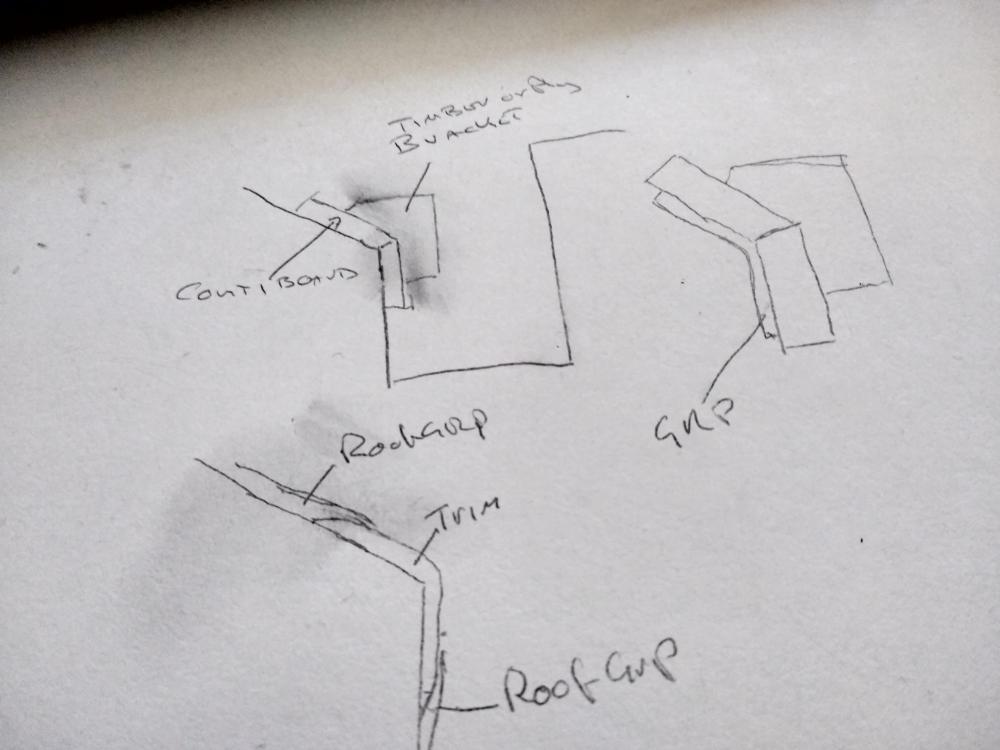
-
I the 'olden days' when FiTs started, there where several thousand '4kW' systems installed with larger that 4kW module arrays. Even though the output was limited to 16A per phase, the overall yield was significantly greater, maybe up to a MWh/year. This was not too much of a problem electrically, especially if the local grid was robust, but it pissed off the people paying the FiTs as they had to pay out a lot more, maybe over £500/year, for 25 years, tax free. So the MCS/FiT/RHI people put a limit on the module array size, so a normal 4kW system could not have more than 4kW of modules on the DC side. What I have been unable to establish is if this is monitored/enforced by MCS only, or it is a DNO 'thing'. I do know that if a single MCS installation company fitted too much PV in an area, they were liable for the local grid/transformer upgrade, and in some instances, just a couple of rural installations could trigger an upgrade. The company I worked for got caught out on this one, a 6 kW install with full permission, then a week later a 4kW installation on the other house under usual installation rule, i.e. no prior approval. They were fighting with WP about the 20 installation in one street of about 50 houses when they went bankrupt. It would be nice to get a definitive answer to this.
-
I think this may be the problem. When most of the hole are plugged (usually in pairs), a greater back pressure can arise, that coupled to a lower fan speed (because the house is less leaky), may possible make the readings unstable. Of all the kit the forum has access to, a door blower would be one of the most useful. Trouble is, it would probably go missing.
-
I suppose the test equipment may start to get a bit unreliable at very low flow rates, but is will be good enough.
-
Yes. I am not really on about what is possible, rather if it is allowed. I just seem to remember that it is the system size i.e. the modules combined output that set the limit. Not sure where one would get this information from, maybe a called to the DNOs.
-
Is this one of those cases where you legally have to do something, then there is another law that says it is illegal to do it?
-
Is that the best place to site the ASHP, is there a solid wall below it?
-
Did we ever get a real solution to the difference between system size and inverter size?
-
I am up for teabagging someone, been a busy, hot and sweaty night. Ideal way to relax.
-
radiator covers with foil heat reflector
SteamyTea replied to TryC's topic in Central Heating (Radiators)
Here is a quick exercise to do. https://www.shorttutorials.com/heat-loss-due-to-radiation-and-convection/index.html As long as the radiators are not on a poorly insulated exterior wall, I would think they are not worth bothering with. -
Will I be known as Tea