


SteamyTea
-
Posts
23850 -
Joined
-
Days Won
200
Everything posted by SteamyTea
-
 Actually, that is more clever than I initially thought. Turn the pump on and you can store more (OK, you loose a little more though parasitic losses). May be useful if you have extra guests staying.
 -
Hotter water just needs to be mixed with extra colder water. Really makes no difference at all. No. My system is as simple as it gets. A cylinder with an immersion heater at bottom, cold water from a tank in loft, and s pipe out the top to the taps. Works well. Cylinder lasted for about 31 years.
-
Fabric and ventilation heat loss calculator
SteamyTea replied to Jeremy Harris's topic in Heat Insulation
Milliwatthour I was under 4 MWh last year (again). When I moved here, 17 years ago, and even have a keen interest in energy usage, I was using 11 MWh.year-1. I still use resistance heating (no gas), have original timber windows and back door, though re-glazed to a 16mm gap, rather than a 4mm gap. Added some insulation to the loft, fixed easy to find leaks (got one I just cannot seem to cure), the rest of the savings have been better management of my usage.- 204 replies
-
- 1
-

-
- heat loss
- ventilation
- (and 4 more)
-
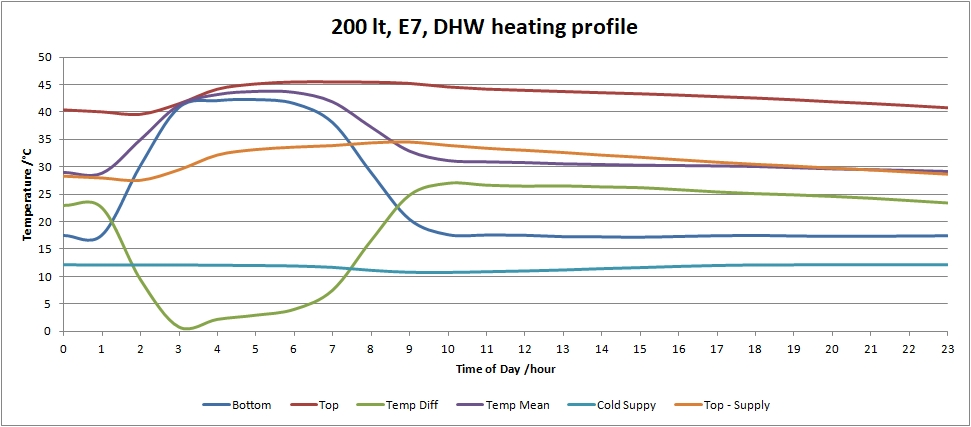
Why should that matter. You can store more energy if the temperature is homogeneous i.e. mechanically stirred. Here is a picture of what happens in my tank as it is heated, and then settles once the heating is off (settles is a better term than stratifies, stratification implies discrete layers that move up and down).
-
Yes. Seems to me, from what I have observed on here, that most of the expense is inside i.e. electrical, plumbing, woodwork. And people spend really stupid money in kitchens and bathrooms. Regarding the 6m wide sliding windows with thin frames to get a better view. Put the chair a foot closer to them. (Was watching a TV show, 'retire to the sun with other arseholes, just like yourselves' or something. People where looking at views from the balconies. Spectacular they were. Except the wall was 4 foot high and you would see nothing when sat down.
-
Get the correct screws for doing floors, not just any old number 8 or 10. Plumb in plastic. ASHP, or any boiler outside. You can also design in sound proofing with resilience bars and insulation. Make sure stairs are not attached to internal stud walls. Be careful of holes between one room and another. Make sure ventilation systems have dampers fitted. Cellulose insulation is very good at sound deadening.
-
Usually. It gives the system enough fluid to work with. If there is not enough the HP will keep turning on and off. There is no real harm in the buffer going a little hotter than needs be, just mean you have stored a bit for later.
-
Software and any templates?
SteamyTea replied to LaCurandera's topic in New House & Self Build Design
Google SketchUp seems popular. -
How often would that be used? If it is the master one i.e. yours, could you not just live with it. Not sure about a buffer in loft. As long as everything is well insulated, can't see why not.
-
I have found that 300 miles is far enough to keep them away, 150 miles wasn't.
-
It takes quite a long time after sunset for air temperature to reduce. Humans tend to feel the difference as we take advantage of solar radiation. Take today, air temp about 8⁰C, but when I sat in the sun I felt very comfortable.
-
With your reputation with loose holes, yes.
-
depends. Some of the work will already have been done i.e. putting you on a register, ducting in the ground. You may, or may not have a right cable in place already. It will need a new meter and fuses, some connecting up. And double checking that the appropriate authorities know you are on that register. It is this slapdash attitude that makes them want to charge you loads. If everyone had stayed awake in science lesson, they would know why you can't have KKKWWW which is kelvinkelvinkelvinwattwattwatt, or even kelvin3watt3. Kelvinkelvinkelvinwattwattwatt, seem to remember your wife saying that.
-
(expletive deleted)ing haven't you innumerate (expletive deleted) It is kW
-
Not for homes. I was thinking more academically. Only need a tiny fraction of an ohm increase, but multiplied by roughly a billion switches, sockets and plugs, it could be a sizable amount.
-
I have often wondered how much electrical energy could be saved if all terminals were tightened up five years after installation.
-
He has all the kit.
-
Sack your builder, buy the cheapest fire doors you can find, fit them yourself. That will give you plenty of time to find the ones you want, and a joiner to fit them (if you made a pigs ear out of the originals). Rather than look at all the risks, look at the benefits, I seem to remember that your rent was stupidly high, probably enough to have bought a house like mine. And my heating works, and has done so for 35 years without any maintenance.
-
Not sure I understand that. Is your plumber/designer saying an ASHP don't produce much at night? And, just to be pedantic. Your chosen heat pumps/MVHR will have a power output in kW, not kWh (or Kwh, kwh, kW/h, KWH). If you have an A2WHP and UFH, just get a buffer plumbed in, it will save grief.
-
That is OK, hardly goes below that down here.
-
Thank you.
-
Was thinking about putting one in my shed.
-
Have a ferret around, if it is a large, fat one, with some nobble ends, it may well be.
-
How noisy are they, and do they chuck out warmed air, and how warm is that air.
-
Ask again, they may have put the cabling in.

