SteamyTea
-
Posts
23850 -
Joined
-
Days Won
200
Everything posted by SteamyTea
-

The Economics of our SunAmps
SteamyTea commented on TerryE's blog entry in The House at the Bottom of the Garden
Have you done the same calculation using an ordinary E7 hot water cylinder? May find that the lower initial cash outlay easily offsets the thermal losses (which do not have to be high in an insulated cupboard). Excel does it for me.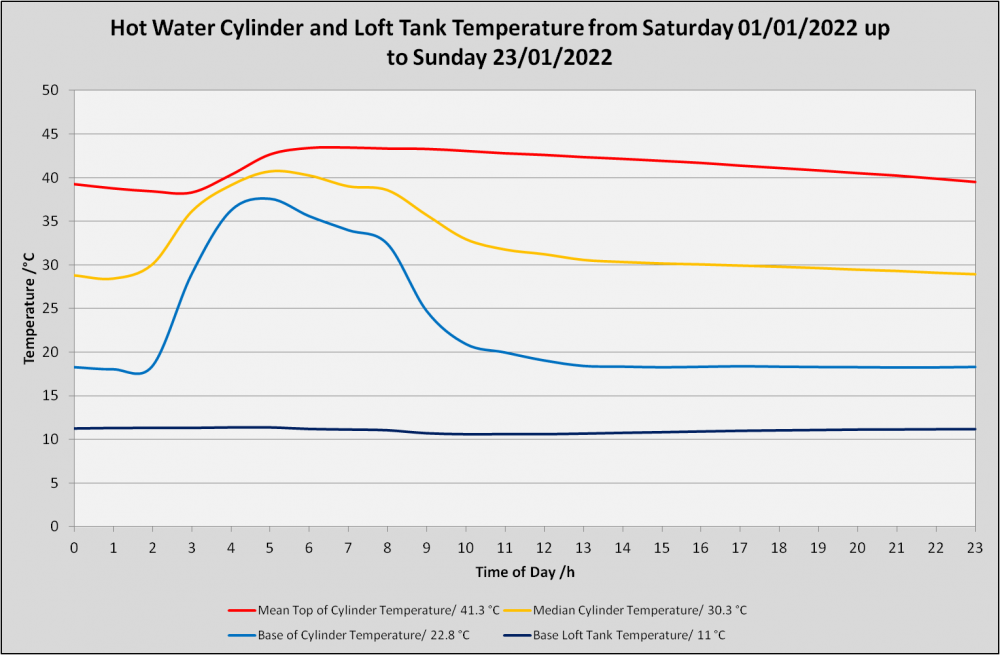
-
How net zero works in reality
SteamyTea replied to oldkettle's topic in General Self Build & DIY Discussion
Not just atmospheric CO2 levels we need to worry about. https://www.epa.gov/climate-indicators/climate-change-indicators-ocean-acidity Climate Change Indicators: Ocean Acidity This indicator describes changes in the chemistry of the ocean that relate to the amount of carbon dioxide dissolved in the water. Figure 1. Ocean Carbon Dioxide Levels and Acidity, 1983–2018 This figure shows the relationship between changes in ocean carbon dioxide levels (measured in the left column as a partial pressure—a common way of measuring the amount of a gas) and acidity (measured as pH in the right column). The data come from two observation stations in the North Atlantic Ocean (Bermuda and Canary Islands), one in the Caribbean Sea (Cariaco), and one in the Pacific (Hawaii). The up-and-down pattern shows the influence of seasonal variations. Data sources: Bates, 2016;7 González-Dávila, 2012;8 University of South Florida, 2021;9 University of Hawaii, 202110 Web update: April 2021 -
How net zero works in reality
SteamyTea replied to oldkettle's topic in General Self Build & DIY Discussion
Excess CO2 emission, and that is the difference. It would also be nice to see the original source of that 3% figure. I see it a lot, but never been able to track it down. For a start there will be seasonal and yearly variations, for a number of reasons. But, whether you like it or not, anthropogenic climate change is happening. -
Last year I drove just over 18k miles, at not much over £1/litre. Last few months I have alreaded done 20k miles at close to £1.45. And I am loosing two extra days work every week. Still January us almost over and we have more than an hour's worth of extra daylight.
-
How net zero works in reality
SteamyTea replied to oldkettle's topic in General Self Build & DIY Discussion
Most definitely Did I post this up. Not read it yet. Columnist Pollution is the forgotten global crisis and we need to tackle it now Leon Werdinger/Alamy Stock Photo IN THE lead-up to Christmas, my household began to feel like a badly managed waste-processing facility. We planned to spend time with vulnerable relatives, so were keeping a close eye on our covid-19 status. Each lateral flow test generated seven items of non-recyclable waste, which piled up in the bathroom until I bit the plastic bullet and binned the lot. They are now, presumably, in landfill. The pandemic may have temporarily cut global consumption and greenhouse gas emissions, but from a pollution perspective, it has spawned an almighty mess. It became clear early on that large quantities of discarded masks and other medical detritus were finding their way into the wild. Recent research has revealed the shocking scale of the covid-19 waste heap. It estimates that by August 2021, the pandemic had generated 8.4 million tonnes of plastic waste, which has been dumped into the environment rather than disposed of properly. Such mismanaged waste is the main source of ocean plastic. Before the pandemic, we collectively fly-tipped about 32 million tonnes of it a year. The extra 8.4 million tonnes “intensifies pressure on an already out-of-control global plastic waste problem”, write the researchers (PNAS, doi.org/gnct34). This is no exaggeration. Last year, the United Nations declared that waste and pollution is a planetary crisis on a par with climate change and biodiversity loss, and that we must tackle all three together. However, until recently, this crisis was a distant third in the global pecking order. That, in part, was down to a lack of data. Quantifying waste and pollution is hard. But if there was any doubt about the scale of the problem, new research dispels it. It contends that waste and pollution have crossed a Rubicon called a “planetary boundary”, and are now a threat to the habitability of Earth. We are literally choking on our own detritus. The concept of a planetary boundary dates back to 2009, when a group of researchers led by Johan Rockström at Stockholm University in Sweden tried to define what they called a “safe operating space for humanity”. They picked nine global parameters that have stayed remarkably stable for the past 10,000 years, including climate, biodiversity, land degradation and pollution. These collectively create a life-support system for us, but are being pushed out of whack by our dominance of the planet. For each of them, they attempted to set a boundary that we breach at our peril. In 2015, the team declared that four of the nine boundaries – biosphere integrity, climate change, land use, and the nitrogen and phosphorus cycles – had been breached. And two of them were still undefined, including “novel entities” – mostly chemicals released into the environment by human activities. In other words, waste and pollution. The new paper attempts to fill this knowledge gap. It defines the boundary as the global capacity to run safety tests on these novel entities and monitor them in the environment. The authors say global production of chemicals has increased 50-fold since 1950, and there are 350,000 synthetic chemicals on the market today. Most haven’t been properly assessed for environmental toxicity (see page 44). The team estimates we have overshot the boundary by about 200 per cent, roughly as much as for biosphere integrity and worse than climate change (Environmental Science & Technology, doi.org/gn6rsw). The timing of the research is both fortuitous and strategic. Next month, the fifth UN Environment Assembly – the world’s highest-level decision-making body on environmental issues – will meet in Nairobi, Kenya. On the table is a resolution to set up a global science body for chemicals, waste and pollution, modelled on the ones for climate and biodiversity. This is the culmination of a campaign that began last year and has been gathering support. It is no coincidence that many of the researchers on the planetary boundaries paper are involved. Even without the covid-19 waste, it is clear that the campaign needs to succeed. The Intergovernmental Panel on Climate Change has done more than any other group to cajole world leaders into taking the climate crisis seriously. The Intergovernmental Science-Policy Platform on Biodiversity and Ecosystem Services, created in 2012, has elevated awareness of the biodiversity crisis to a new level. Waste and pollution deserve no less. We aren’t going to step back inside the boundary any time soon. Global chemical production is forecast to triple again by 2050. But when our covid-19 waste has become an archaeological record of the first great pandemic of the 21st century, maybe we will have learned to stop fouling our own nest. If we are still around at all. Graham’s week What I’m reading The self-styled poet laureate of punk John Cooper Clarke’s memoir I Wanna Be Yours. What I’m watching Archive 81 on Netflix. Isn’t everyone? What I’m working on My wardrobe. Honest. This column appears monthly. Up next week: Annalee Newitz Graham Lawton -
If the loft space is thermally isolated from the rooms below, I think it is a good idea. If you add up all the flow rates you can work out how much cold air will get drawn into the loft.
-
How net zero works in reality
SteamyTea replied to oldkettle's topic in General Self Build & DIY Discussion
Have to be a very big and clever fraud. Larger in scale than the moon landings. What you remember was misreporting by the media. The reason you remember it was because that scenario was different from all the ones that said warming was happening. And to put it into perspective, it was one scenario, out if many, that got copied into 3 reports. There are still people that think the virgin birth was real. Some stories stick because they are so different, not because they are true. -
Big one off payments to plant trees coming (in England not sure if Scotch farming is different). May be worth looking into circa £10k/hectare and £300/hectare.annum. You must be up near Ed Davies.
-
If it got wet, and then the GRP was layed up before it was dry, that could cause a bonding problem. Means that the interface is uncured, and still sticky. Would have thought you would smell it in a sunny day. Cut a circle out and have a look.
-
If this site was not so set against commercialism, I think Screwfix would be a good sponsor.
-
You could tap the GRP lightly and listen out for a hollow sound. Not, as you say, usual for GRP to delaminate from a substrate. Having said that, I have known some MDF board to not bond, does not happen with ply very often. It may be a case of a release agent used when the SmartPly was manufactured. I don't know the product well enough. Even if the GRP has delaminated around the screws, it will probably be a long time before the material fails. One way around it would be to use a hole cutter, with the screws as the centre. Cut a circle if GPR out and repair locally with some flexible additive added to the polyester resin (assuming that is what was used). You may need to replace some screws.
-
Looks like you are an Economy7 user. Fix the drips. There used to be a thick, clear silicone in a yellow tube, LSX or something it was called. Used some on a leaky joint and it worked ok.
-
How net zero works in reality
SteamyTea replied to oldkettle's topic in General Self Build & DIY Discussion
I grew up by oil refineries, you have made me feel quite homesick. -
Not much, more of a swap or one of my NFT. I shall upload an image, when you transfer your NFT to me, I shall put it into the blockchain I have created and send you mine in return. So no cash involved between us, but if we want to sell the 'rights' we can. Here is my SHA-512 f744623c59319631320570a773661c2bac876844803447d3e26af4ab956df5375cfe727884f5953f12f7a7df408e07709c9963c465f366e97fc601843366df08
-
Been trying to get one of those badges for years. Make an NFT for it and flog it to me.
-
Not heard of it either. How think is the GRP, thickness is often referred to as 'layers', ounces or gm.m-2. Also what are the screws holding together, could that be expanding and contracting more than the design parameters?
-
ASHP linked to log burner boiler
SteamyTea replied to Lewis88's topic in Air Source Heat Pumps (ASHP)
Or most likely sequester into the soil. Partly how soil is made after all. -
How net zero works in reality
SteamyTea replied to oldkettle's topic in General Self Build & DIY Discussion
That will depend on how, and what, you measure. Exploring for, drilling, extracting, refining, transporting and storing oil will have a relatively small carbon footprint. But burn it in a car and it becomes horrendously high. So is it the oil company or the car company that is (ir)responsible? Or the end user. I have just driven 34 miles to read my weekly comic and have a coffee. Could have done both from home. -
ASHP linked to log burner boiler
SteamyTea replied to Lewis88's topic in Air Source Heat Pumps (ASHP)
Think again. Only dodgy accounting methods that make it look carbon neutral. -
I bought a new car and had to pay a 10% new car tax. That car got written off, and after a few months, the I Durance paid out, bought another new car, 5% new car tax. Then the new car tax was dropped completely. Cars were the same price. So no consumer saving, and I doubt the dealer made an extra 5%.
-
How net zero works in reality
SteamyTea replied to oldkettle's topic in General Self Build & DIY Discussion
And due to mistrust, many people will not accept a gift. -
ASHP linked to log burner boiler
SteamyTea replied to Lewis88's topic in Air Source Heat Pumps (ASHP)
Do you know the high costs, finacial and enviromental, of sold fuel combustion? A correctly sized, and opperated, ASHP should not be a problem in winter. -
How net zero works in reality
SteamyTea replied to oldkettle's topic in General Self Build & DIY Discussion
But would seriously hurt the 50% left. I think we really need to distinguish what people mean when they say 'save the planet'. What most probably mean is 'save my lifestyle'. -
How net zero works in reality
SteamyTea replied to oldkettle's topic in General Self Build & DIY Discussion
Just a snippet from this weeks comic. May be of interest to those that think all models are wrong. Some models are useful though. This Week Climate change made the past 7 years the warmest on record The UN’s World Meteorological Organization found that 2021 was the seventh hottest year to date, at 1.11°C above pre-industrial levels IN PALMDALE, CALIFORNIA, TEMPERATURES REACHED 41.1°C IN JULY 2021 ROBYN BECK/AFP via Getty Images The past seven years were the warmest on record as climate change continued apace, despite the cooling effect of the La Niña weather pattern in 2021, the United Nations has found. The UN’s World Meteorological Organization (WMO) analysed the six main global temperature data sets, which revealed that last year was the seventh hottest to date, at 1.11°C above pre-industrial levels. “The continued onslaught of record years, including the seven warmest having occurred since 2015, is precisely what we expect to see due to human-caused planetary warming,” says Michael Mann at Pennsylvania State University. Governments at the COP26 climate summit in November reaffirmed their commitment to trying to hold temperature rises to 1.5°C and well below 2°C at worst. But emissions reductions pledges currently have the world on course for 2.4°C or more. 2021 is the seventh year in a row where temperatures have been more than 1°C above pre-industrial levels. While only the seventh warmest year on average globally, 2021 saw climate scientists shocked by several temperature records broken by much larger margins than usual in some places, such as the near-50°C record set in Lytton, Canada. Previous research showed this event would have been “virtually impossible” without climate change. Read more: 2021 in review: Weather records aren’t just broken, they’re smashed “Climate change impacts and weather-related hazards had life-changing and devastating impacts on communities on every single continent,” said Petteri Taalas at the WMO in a statement. Although not a record for surface air temperatures, 2021 was another record-breaking year for heat content in the upper levels of the oceans, which are absorbing much of the carbon dioxide emitted by humans and the heat that this gas traps. The cooling effect of the La Niña weather pattern is expected to give way later this year to its opposite, El Niño, which was responsible for 2016 being the hottest year on record. The UK Met Office, which holds one of the six data sets examined by the WMO, forecasts that 2022 will be 1.09°C above pre-industrial levels. Sign up to our free Fix the Planet newsletter to get a dose of climate optimism delivered straight to your inbox, every Thursday Adam Vaughan -
Your heating bill will go up now.