SteamyTea
-
Posts
23850 -
Joined
-
Days Won
200
Everything posted by SteamyTea
-
 Not legal now.
 -
But no better than electrical resistance heating, and more expensive to buy. The OP wants free heating.
-
What are the best ways to save money ahead of a demolition
SteamyTea replied to LaCurandera's topic in Demolition
Told you before, this is illegal and must not happen. -
Shredded paper, old duvets/blankets. Yes, air2air ones. https://www.ebay.co.uk/itm/324884906941
-
Beat me to it. The refrigerant gas is at around -23°C, so still 18°C to play with.
-
Yes. You can use all sorts of different materials. All they really have to do is trap air in small pockets. You could fit a secondary, dark coloured tin roof to the south facing side, leave a gap between it and the original (now insulated) roof, draw out warned air with a small fan. May even work with cheap, clear acrylic sheeting. Maybe keep an eye on on eBay for cheap PV modules and a few old storage heaters. Just pump the juice into them and if it gets too warm, open the door.
-
Chiltern Hundreds. Chequers is in one of the Hundreds.
-
(expletive deleted) all loft insulation.
-
If if it was so, you would be overproducing hot water. I am sure every real engineer involved in the hydrogen economy knows the truth, a resistance heater is easier and probably, including infrastructure costs, cheaper. Not as if there is no infrastructure costs needed to produce hydrogen. The fixation with hydrogen shows a lack of basic physics and chemistry. If we take todays electrical infrastructure, it can reliably supply 60 GW. We very really use that much. The UK is currently using ~43 GW, so we could store that extra 17 GW in pumped storage, compressed air, thermal and chemical devices. Come tonight, we will probably be using ~25 GW. So plenty of spare.
-
If you know all the dimensions of the external walls, floor, ceiling/roof (depends on if a cold or warm roof), doors and windows, then multiply the relevant components by their U-Values and then multiply by the heating season temperature differences i.e. 1% at 30°C difference, 20% at 25°C, 40% at 20°C and so forth (get data from PVGIS or similar). That will give you a rough estimate of what those losses are, then you add in the air change ones, work on 5 ACH, you need to work out the volume for this. Then add the DHW load i.e. 2.5 kWh per day per person. That will give you a rough estimate of the energy needed, the kWh. Divide that by the number of hours that the heating will run for i.e. 19 hours (because you may need 3 hours to heat the DHW), will give you the power, the kW, of the heat source. A proper thermal survey will do a room by room heat looses as that also sets the radiator/UFH size and the room temperatures.
-
By first working out the heat load your house needs. Can't be worked out the other way around i.e. what size house will a 6 kW ASHP heat.
-
No. Macdonald's cheeseburgers. Only £3/kWh. Bargain in food terms. My engine gets pretty hot. Not as hot as my first car, that got so hot it burns the head gasket away. For at least 20 years people that claim to know have told me that Redox batteries are the future. Mate of mine was selling them. Well actually he was not selling them. Had a great calculation to show that they were the cheapest on the market. When he quit (when his own money ran out) he told me that my ballpark figure was much closer to the truth. Think it worked out at 65p/kWh then.
-
After 3 hours drive today, I am enjoying lunch at a motorway service area. Cost me 2 quid. Bargain. Couple of hours left to do, then a coffee in town at nearly 3 quid. They must be running the coffee machine off a Model X.
-
The Economics of our SunAmps
SteamyTea commented on TerryE's blog entry in The House at the Bottom of the Garden
Not how I plumbed in my system. I pump from they cylinder on the hot side, and from the F&E on the cold side. Pump was 100 quid in 2007 when I fitted it, still going. No need for thermal mixers, just set the 'tap' to same place (easy as it is a lever) and scrub away. Using a relatively low DHW temperature gets rid of the scolding risk at root as well. I like to keep things simple. -
The Economics of our SunAmps
SteamyTea commented on TerryE's blog entry in The House at the Bottom of the Garden
A vented cylinder does not require a certificate either, though if you fit a pump for showering it may well require a Part P sign off. -
I have been wondering about this, but if they are managed carefully i.e. 15% discharge rather than 80% discharge, and with the latest design chemistries, it should not impact too much, especially if the power draw is small i.e. 6 kW. Some EVs have now done 500,000 miles on original batteries. https://electrek.co/2016/11/01/tesla-battery-degradation/ I still think it is an unnecessary thing to do as the battery pack and management system in a vehicle is heavier and more complicated than what is needed for a home. Not as if we carry a slab of windturbine foundation in the boot of the car to 'show how green' we are.
-
Keen to get started! If only I could find an architect...
SteamyTea replied to jno's topic in Introduce Yourself
You are not doing extension and home offices. Unless there is another reason. -
I think it shows on a desktop, but not on a mobile.
-
Strange, I used to have my location up, but it has vanished. Can you put an HTML tag in there?
-
She is right.
-
The Economics of our SunAmps
SteamyTea commented on TerryE's blog entry in The House at the Bottom of the Garden
Not sure, I was doing it in a hurry, but I think the overall temperature is okay to use. There will be more losses at the top than the bottom, but on average it evens out. It should be the mean temperature I think. As the probes are on the outlet pipe at the top (as close to the tank as I can get, and under pipe insulation) and the lower probe is on a bare patch at the base, the median temperature is the same as the mean temperature (technically it should be the geometric median, but treating it as a 2D problem, our CET weather temperatures use the median temperature at 9AM and 9PM I think). Any water I draw off is from the top half of the cylinder, so the hotter part, that will reduce the overall losses thereafter. But even of the losses where up to a kWh a day, still pretty low in reality. Shows that insulating the cupboard around the cylinder helps. What is interesting to me, is that the cylinder has fully stabilised after 1.5 hours after taking, the the majority of the turbulence being in the lower half of the tank, which isn't a surprise as that is where the element is. -
The Economics of our SunAmps
SteamyTea commented on TerryE's blog entry in The House at the Bottom of the Garden
Can't really do that, but it is possible to see the temperature loss over the day, bearing in mind that from 10AM to about 9PM (short after work shower, there is a steady loss. That loss is around 5°C. Taking the median temperature (only have two probes on it), the losses are less than 1°C. May seem odd that, but it s probably down to turbulence caused by the bottom element heating, hot water usage and being replaced with cold water base temperature can actually increase by 3°C or so. So how much energy is actually lost. 4.18 [J.kg-1.K-1] x 200 [kg] x 1 [K] = 836 kJ [0.23 kWh] Now I am probably at the lower end of energy usage (my water is not that hot as I only need enough for me, though my system can do 4 people i needed) So call it 0.3 kWh.day-1 losses. At 15p.kWh-1 (about what E7 is now), that is £16.50 a year. I replaced my cylinder after 32 years, cost less than £300. Oh, forgot the chart of a days cooling off.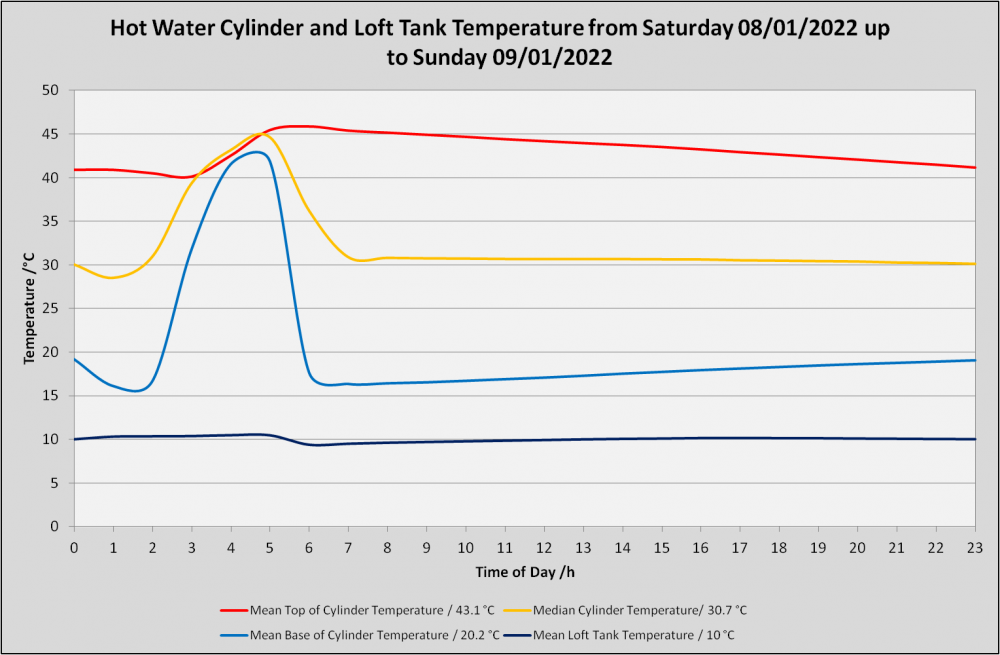
-
The Economics of our SunAmps
SteamyTea commented on TerryE's blog entry in The House at the Bottom of the Garden
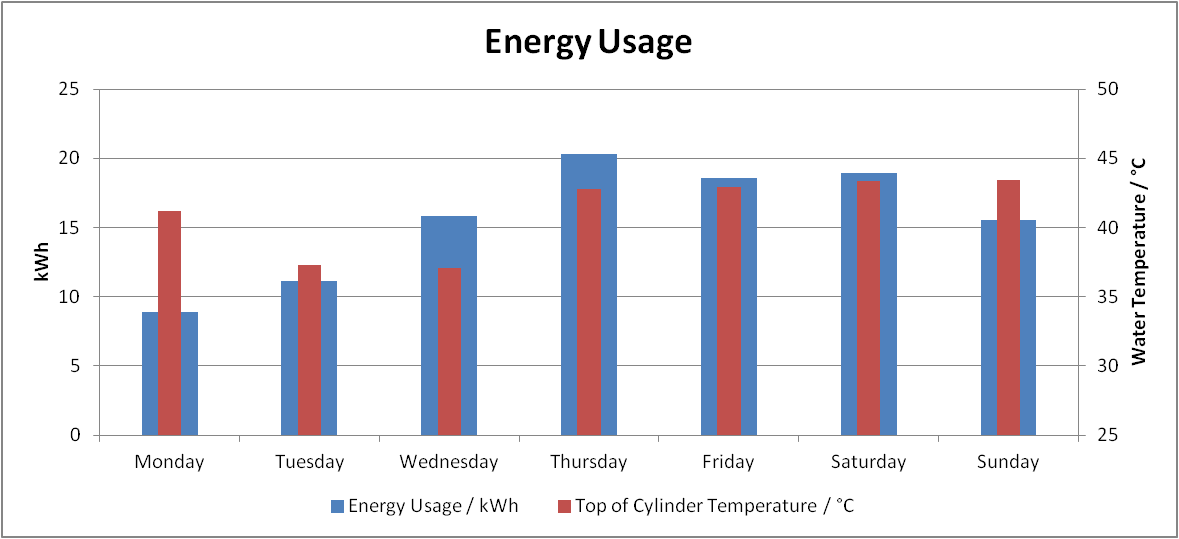
@MikeSharp01 Right, hope this is understandable. This year, I have always been away on a Sunday and Monday (get back late Monday or more usually a Tuesday), usually travel up on a Saturday, so turn the DHW off, but leave the heating on. Now as I am on E7, there is a time shift of a few hours, but my E7 is limited to 3 AM to 7AM (to get the most out of LC generation and less standing losses). So a chart of all energy usage and top of cylinder temperature (water is probably higher temperature as I have only taped a sensor to the output pipe). On a Monday I have not been at home, so there has been no E7 recharge (heating is on though). Generally the same on a Tuesday, think I have had only 1 Tuesday at home. This is when I turn the DHW back on, but it does not recharge till Wednesday morning (3AM to 7AM, or when enough is in the tank). Wednesday though to Friday I am at home as normal. I usually leave Saturday morning, really early, so DHW is used first thing, but I turn it of so there s no recharging on a Sunday. Now you would think that the usage and temperatures would be more in sync, but I suspect that when I return, the DHW is at a lower temperature, and my 4 hour window is not enough to heat it up fully. So maybe I need to look a bit more closely at what is happening when I first turn the DHW back on i.e. how low has the temperature dropped, how much extra energy have I used. Off to cook some lunch now.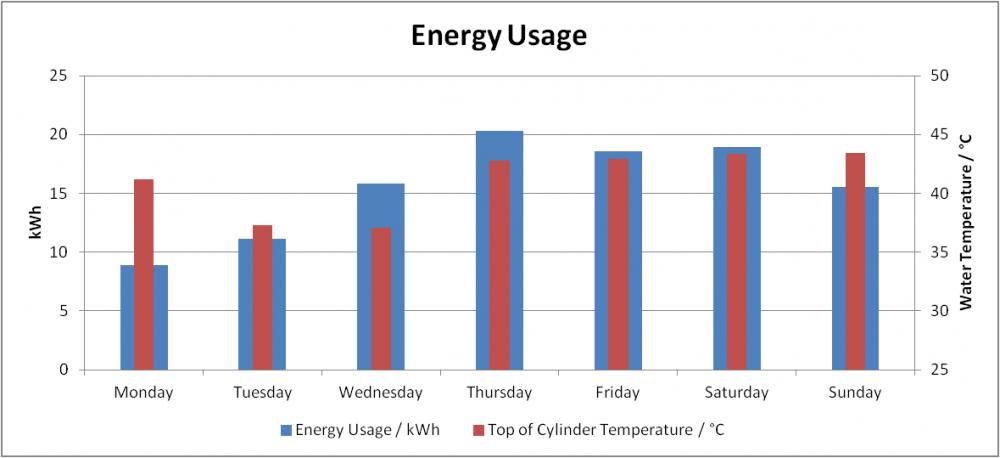
-
The Economics of our SunAmps
SteamyTea commented on TerryE's blog entry in The House at the Bottom of the Garden
I can probably do more than that as have been away quite a bit, so can see when the tank is on and off, no draw days which are also no heat input days), normal days, and my general usage. The chart above is all usage between the stated dates, usually had a bath by 10 AM when I am there. Shall see if I can have a play with the data later, got niece and her children visiting (actually visiting my Mother) soon, so that is my day buggered. -
Sometimes I miss it, but mostly not. If I had a 'proper' 9-5 at the moment I would have been sacked for the amount of time I have had to have off this last 4 months.