SteamyTea
-
Posts
23847 -
Joined
-
Days Won
200
Everything posted by SteamyTea
-

ASHP, how to decide - I just don't get it!
SteamyTea replied to Jimbo37's topic in Other Heating Systems
Whoops, linked to the live Page, so John Finnemore ATM. https://www.bbc.co.uk/programmes/m001mbl9 -
Verify with evidence.
-
Don't judge a book my the cover, I have seen some brilliant German videos on the interweb. Real quality.
-
ASHP, how to decide - I just don't get it!
SteamyTea replied to Jimbo37's topic in Other Heating Systems
If you want to hear some total twats talking about heat pumps, listen to this. Any Answers The general public really are ignorant. -
Is this a 'small man' rant, they are called 'incels'' now.
-
Have you seen my corns and calluses. Should be called porn and callusness.
-
Would think it was quite interesting as well. My house is built on an old scrapyard, that used to be an undertakers. Would scare me to meet him walking home from work.

-
Can shake glands, whoops, hands, bloody autocorrect.
-
At my school, the built in wardrobe, in Dormitory 3 was where it all went in. Bodmin and De Suza got locked in one night. Bodmin came out crying, De Suza grinning.
-
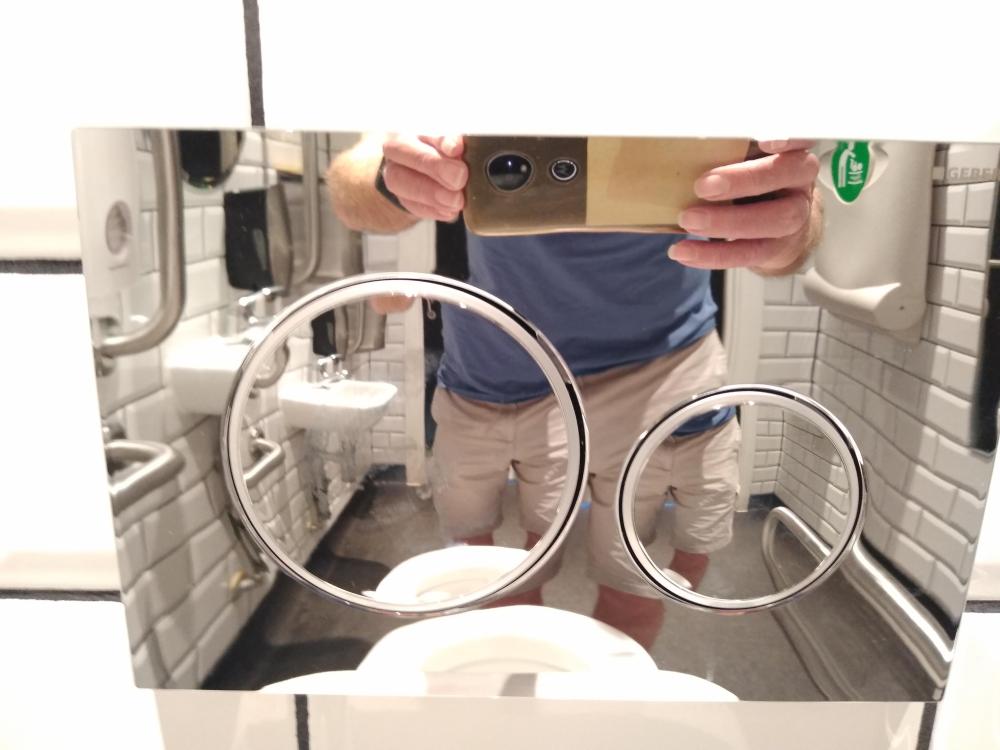
Two things. It was the disabled toilet, I feel qualified to use that, not all disabilities are visible. Second thing, there are 'Keep your Distance' signs up, maybe because Phillip Schofield is staying at his mum's near Newquay.
-
Get the angle right makes me bigger, or twice as handsome. Did manage to get 3 'images', but just made a mess. (expletive deleted)ing brilliant
-
Brass hydrosure hose end connector not working
SteamyTea replied to Adsibob's topic in General Plumbing
I had a similar design, but in plastic. Worked well if I used the right fittings, squirted water everywhere when I used a generic male fitting. Always worth checking. -
Brass hydrosure hose end connector not working
SteamyTea replied to Adsibob's topic in General Plumbing
I assume this is screwed to the tap. Have you got the correct male insert (no sniggering at the back). Is the tap switched on. -
PV on a flat roof, how far from the edge?
SteamyTea replied to Smallholder's topic in Photovoltaics (PV)
Was it not 200mm from ridge and gutter and 300mm from the other edges? Been a while since I had to worry about it. -
I was going to say similar.
-
ASHP, how to decide - I just don't get it!
SteamyTea replied to Jimbo37's topic in Other Heating Systems
All good science is tested on dumb animals. Should be a Government Slogan, just got to condense it to 3 words. @Adsibob is the slogan man. -
ASHP, how to decide - I just don't get it!
SteamyTea replied to Jimbo37's topic in Other Heating Systems
Not read it. Heat_Pumps_for_the_Home_-_John_Cantor.pdf -
ASHP, how to decide - I just don't get it!
SteamyTea replied to Jimbo37's topic in Other Heating Systems
I think you/they only need to know about heat capacity of materials, energy density, combined gas law and the difference between energy and power. Newtons Law of Cooling would be an added bonus (but then it is a bonus for the world). The rest is pipe fitting. Probably the biggest problem is controllers, too many on the market and no standard interface. -
The only thing that may cause a real problem is if you cannot get your batteries close to your inverter. The reason for this is that the DC cables have to be large, AC ones don't. The general rule with ''renewable energy' installations is to keep all cable voltage drop to below 1% (I think this comes from a metering issue where placement of the meter can show different generation amounts). When it comes to pipework, just insulate it more than you think you need to. This can be as simple as boxing in pipes and filling with mineral wool.
-
ASHP, how to decide - I just don't get it!
SteamyTea replied to Jimbo37's topic in Other Heating Systems
They are frequently rubbishing heat pumps. -
ASHP, how to decide - I just don't get it!
SteamyTea replied to Jimbo37's topic in Other Heating Systems
Exactly, one group is ignorant of science, the other isn't. It is how to educate the vast majority. The science and theory behind heat pumps is talk at secondary school but not reinforced often and then forgotten. Madcap ideas that skip the science and theory are reinforced ever day, even within the heating industry. -
ASHP winter additional heating ideas?
SteamyTea replied to ashthekid's topic in Air Source Heat Pumps (ASHP)
You say the floor is traditional stone, is there any insulation under it? You say the upstairs gets hot in the spring, how much insulation is up there. You may be better off heating your hot water with the heat pump when the sun is out. But if your PV is supplying your needs, not much in it. As for space heating in the winter, not much you can do, a direct electric boiler will cost you more. Your HP will almost certainly have a direct heater built in. That may be on permanently. Turn it off. Can you get some thermal energy data directly off the heat pump, that should show you how much energy the house is using. -
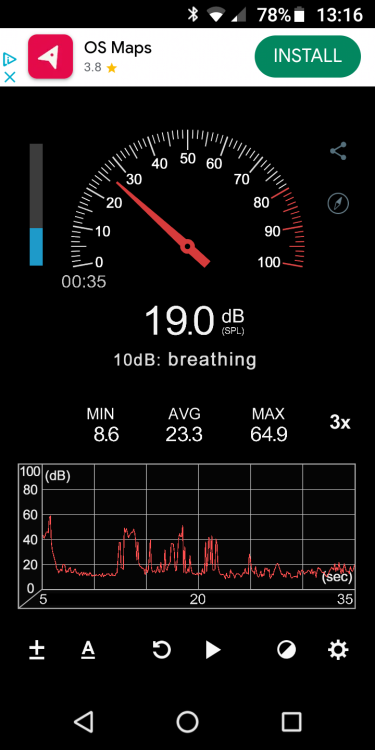
They are mental then. I held my phone at arms length, the peaks in the middle is me breathing.
-
ASHP, how to decide - I just don't get it!
SteamyTea replied to Jimbo37's topic in Other Heating Systems
The smaller the temperature difference, the longer you need to run it. So within reasonable operating conditions, probably no difference. I think, as tried to explain in my previous post, the whole thing is a lit more nuanced than people think. The same us true for a gas boiler setup, not many of them are close to efficient, but when NG was tuppence a kWh, no one gave a (expletive deleted), which just shows how little the is understood. Yes, really needs a machine to do it, better than a plumber's mate. -
Why not put a bit of insulation in as well, you know it makes sense.