SteamyTea
-
Posts
23847 -
Joined
-
Days Won
200
Everything posted by SteamyTea
-
Me too. As I was waiting to order my coffee and plumber joined the queue behind me. I asked him what he thought. "(expletive deleted) that is a high pressure" But a quick Google shows it is not unusual.
-

Loxone question: So many dimmers...
SteamyTea replied to BartW's topic in Networks, AV, Security & Automation
Just spend it in alcohol, the blind in 'blind drunk' takes on a better meaning then. -
Some design strategies please
SteamyTea replied to Nic's topic in Energy Efficient & Sustainable Design Concepts
Large picture canvases. Can also hide a bit of carpet in the back of them. -
There were drain back systems that got around the problem, and the opposite freezing problem. As long as your pressurised system can handle the pressure, there should not be a problem, but even a couple of kilos of steam blowing off at 6 bar is potentially deadly.
-
Some design strategies please
SteamyTea replied to Nic's topic in Energy Efficient & Sustainable Design Concepts
Do you think that would have sorted most of it? I went to Jeremy Harris's place when it was still empty, I was amazed how quiet it was, seems that is a benefit of wood fibre board and cellulose insulation. -
Some design strategies please
SteamyTea replied to Nic's topic in Energy Efficient & Sustainable Design Concepts
Do you get that hollow 'empty house' sound? Was in a flat a while back, and while quiet, it was quite a lot of echo, was all dry lined. -
Loxone question: So many dimmers...
SteamyTea replied to BartW's topic in Networks, AV, Security & Automation
We spend 2,900 hours asleep each year, that leaves 5,860 hours awake. More than half of those no artificial lighting will be needed, so les than 3000 hours to control the lighting. Now I doubt that every room will have lighting on all the time, let us say that 3 rooms out of 8 do, that is then 1,100 hours, 3 hours a day to get into the mood. I find that seasonal, daily, hourly variation of natural daylight is enough for me. Yesterday, I got up an it was light, went to bed and it was light, 6 months time, it will be dark. As @JohnMo wisely says, get on with life. -
Some design strategies please
SteamyTea replied to Nic's topic in Energy Efficient & Sustainable Design Concepts
Yes. As much as I like alternative construction methods, especially factory made timber frame, reducing financial risk needs to take precedence at the moment. -
Foundations for a small out building next to a plum tree
SteamyTea replied to Adsibob's topic in Foundations
Some say the same thing about Trevithick's engines. -
Is it (expletive deleted), shows my house is in a world heritage site, now everyone will know there are restrictions on my house. Was not there when I bought the place.
-
Foundations for a small out building next to a plum tree
SteamyTea replied to Adsibob's topic in Foundations
Fourteen foot? Have you seen Spinal Tap's Stonehenge. -
Built in microwave that doesn't keep beeping?
SteamyTea replied to Mr Punter's topic in Kitchen & Household Appliances
Wish I could do the same with my washing machine. Booklet says I can, but it does not happen. -
Not sure what you are disagreeing with Dave like to disagree on most things. You want 200lt of hot water at 40⁰C, you will be told that you are wrong and need 500lt at 60⁰C. You want a small car that does 70 MPG, you will be told that they don't exist. Post up some data, you will be told it is lala land statistics. Ask to see his data, or calculations, you get no response, because there isn't any.
-
Some design strategies please
SteamyTea replied to Nic's topic in Energy Efficient & Sustainable Design Concepts
Or making shuttering to hold the inconsistently shaped blocks in place. -
Some design strategies please
SteamyTea replied to Nic's topic in Energy Efficient & Sustainable Design Concepts
Does it need a curing retarder in the mix? -
Ghost carp are ruthless killers. Dolphins are as well, and they fornicate in public.
-
You can make a computer game out if it. I find the really sloppy ones do the trick.
-
@DanDee I fully appreciate it is work in progress, but do you have lots of data? The current chart shows half the data points for non WC overall, and almost a third below 10⁰C.
-
Some design strategies please
SteamyTea replied to Nic's topic in Energy Efficient & Sustainable Design Concepts
Read up @ToughButterCup's experiences of Durisol, he was warned before he started. None of the ICF system are Lego, though they give that impression at first glance. -
MHRV /HRV and no other heating
SteamyTea replied to Nic's topic in Mechanical Ventilation with Heat Recovery (MVHR)
PV is used to run a heat pump that is set up for cooling. Design and build the place right and there is little need for cooling (and heating). -
Some design strategies please
SteamyTea replied to Nic's topic in Energy Efficient & Sustainable Design Concepts
Why Durisol? -
Some design strategies please
SteamyTea replied to Nic's topic in Energy Efficient & Sustainable Design Concepts
Have you some numbers for these. Building regulations are a minimum requirement, and really quite genetic. One big area is floor insulation with UFH. Thermal energy can easily be conducted to the ground i.e. wasted. Another area is PV on a roof. Most people will tell you that there is not enough in winter, too much in summer. While true for our latitude, steeper, south facing PV array can improve the usefulness. Batteries are all the rage, but you can buy just the right amount of power at under 40p/kWh, which is really quite cheap when you think about it. And you can do that exactly when you need it. -
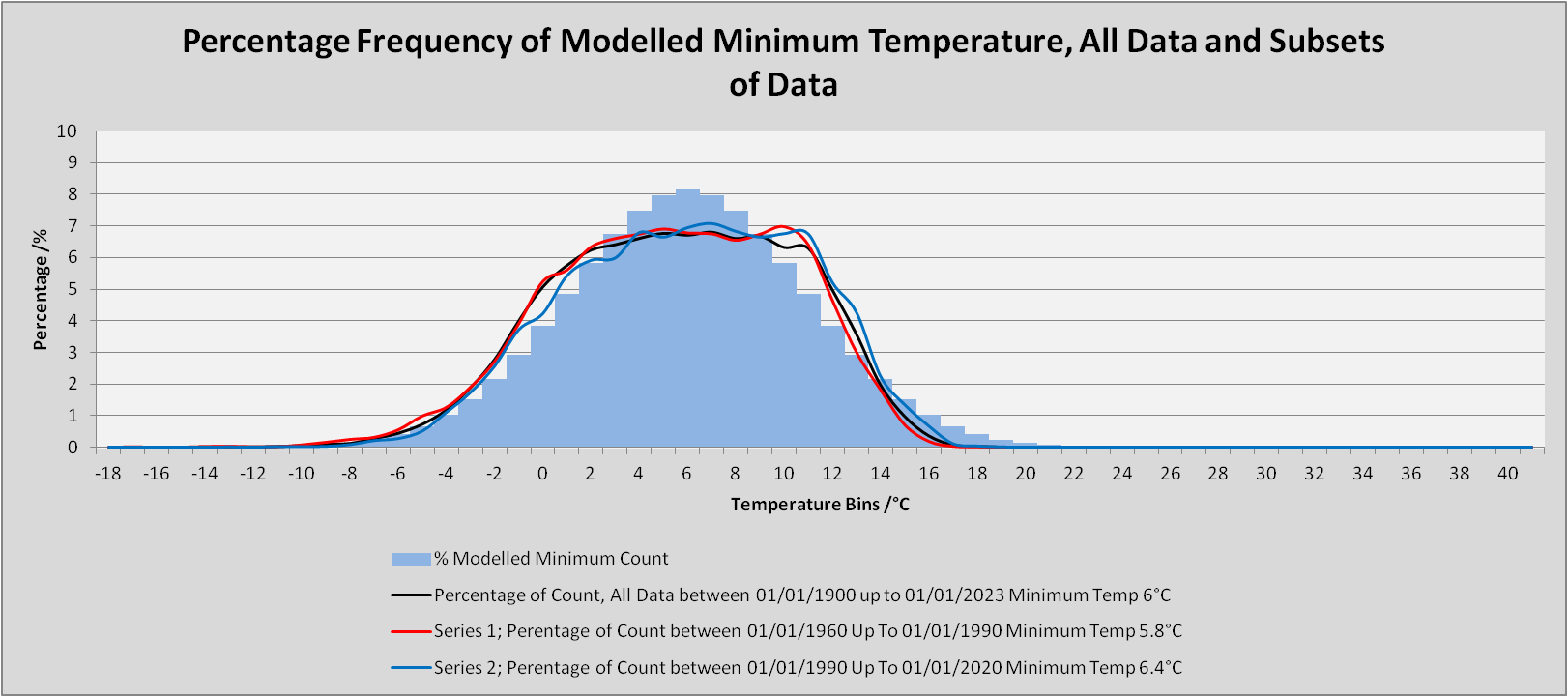
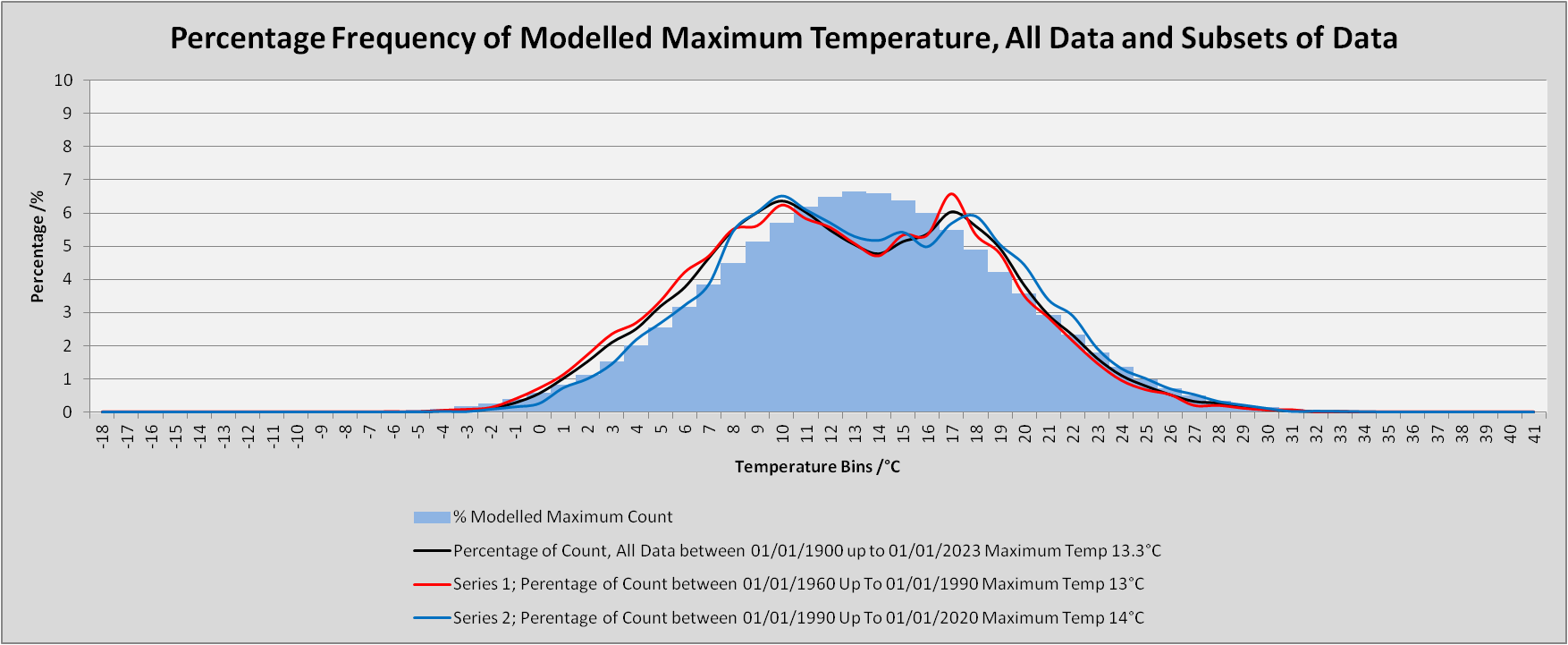
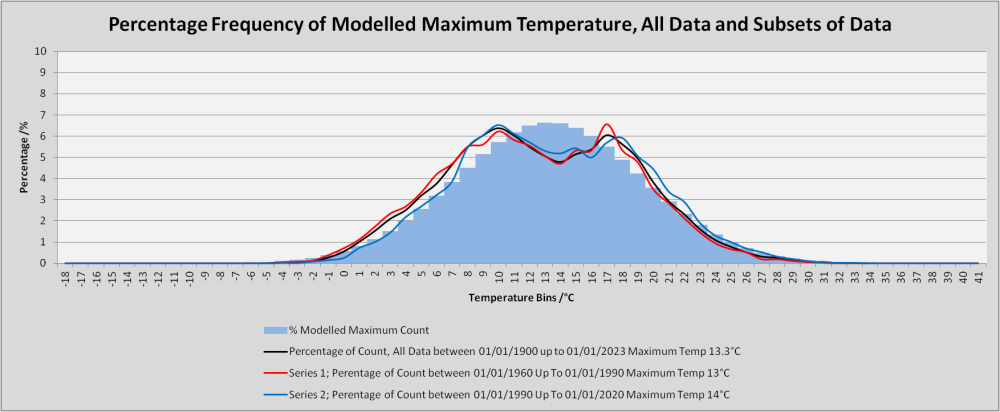
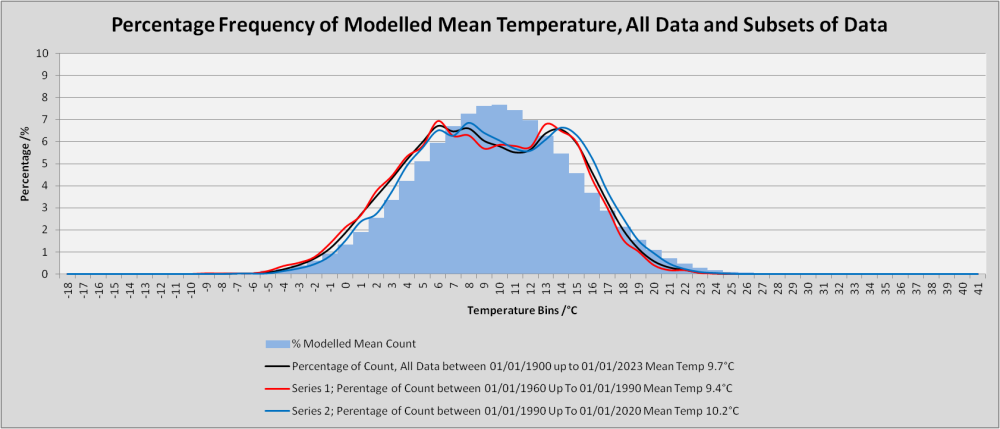
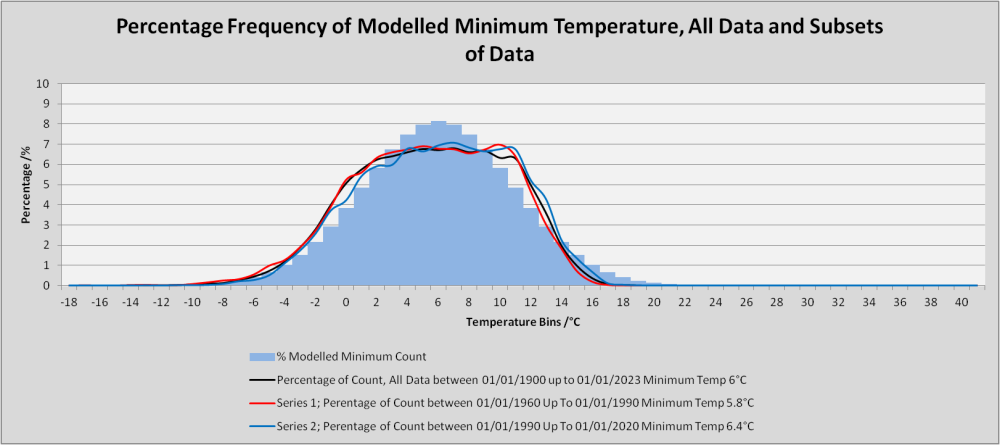
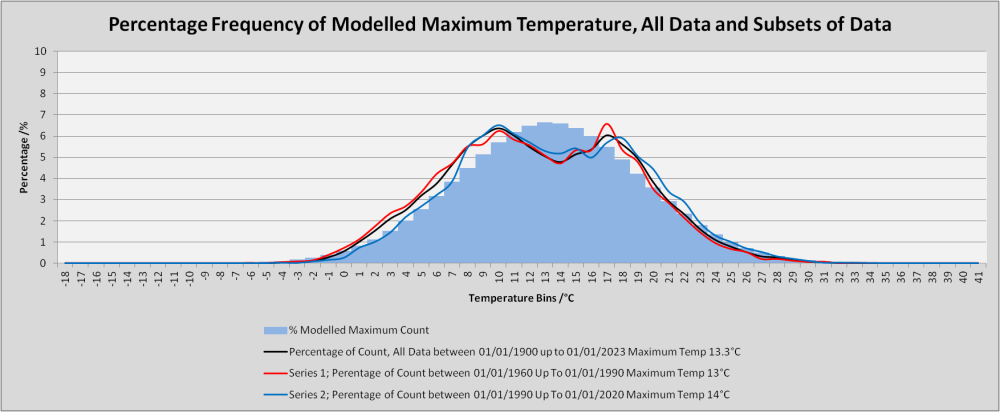
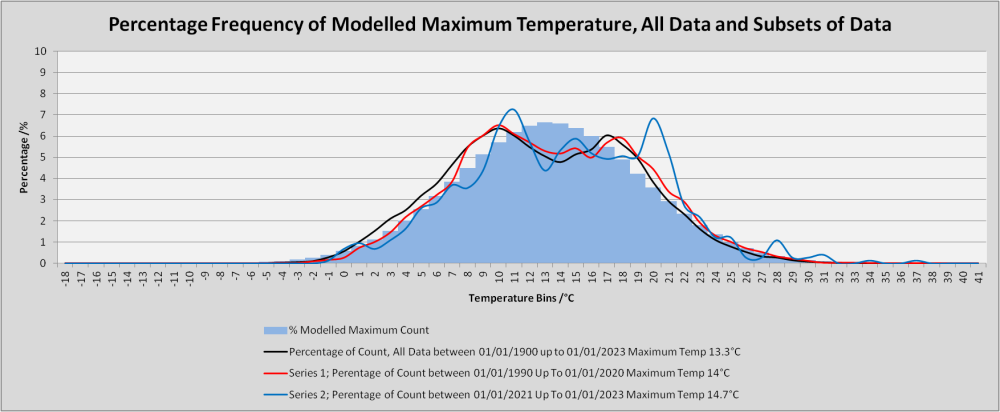
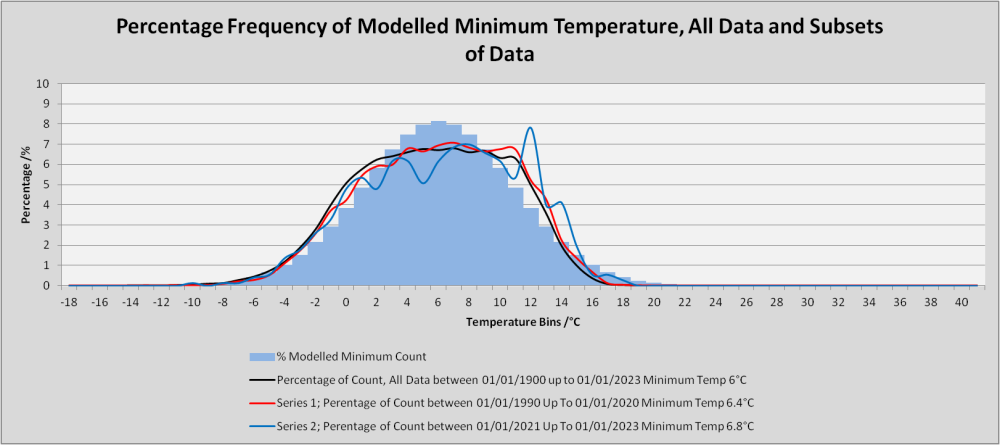
Couple of technical points, the efficiency of a heat pump is proportional to the refrigerant temperature, usually around -25°C (248K), the outside air temperature AND the delivery temperature, between 35°C to 60°C (308K to 333K). The flow rates of all the fluids (outside air, refrigerant, working fluids and inside air) makes a difference as well if calculating efficiency on temperature difference alone, rather than energy differences, which is the correct way to calculate it. When looking at Outside Air Temperature (OAT) distribution, care has to be taken on which block of data is used. Taking the last 120 years of data from the CET dataset can easily give different results. Below is a Probability Density Function chart of all the data, data between 1960 to 1990 and 1990 to 2020. The Skew, which is really just how lopsided the distribution is about the mean of each sample (or subset of samples) is same at -0.1°C difference (1990 - 2020). Similarly the Standard Deviation at 5.2°C. But the mean temperature has increased by 0.8°C in the last 30 years (1990 - 2020) compared to the previous 30 years (1960 - 1990), which is significant, more for the design of the house than the heating system. If you know your long term mean OAT and Standard Deviation, you can use a Normal Distribution to give you a good enough distribution at the 3 SD level (99.6%), medical research i.e. the treatment you get, is calculated at the 1 SD level, (66.2%), so our heating and cooling is calculated more rigorously than chemotherapy. Looking at Minimum Temperatures, which is the main point of fitting a heating system, the Minimum Temperatures have changed from a Mean of 5.8°C (1960 - 1990) to 6.4°C (1990 - 2020) and the Standard Deviation by 0.1 (4.9 in 1960 - 1990 and 4.8 in 1990 - 2020), so not really significant. Skew is also very similar -0.1°C (-0.3 in 1960 - 1990 and -0.2 in 1990 - 2020). If you are worried about overheating, which features more on here than underheating (as we know we can just plug in a fan heater when it is cold) then Mean temperature has increased by 1°C (13°C 1960 - 1990, 14°C 1990 - 2020), Standard Deviation has a 0.1°C change (6°C between 1960 - 1990, 5.9°C 1990 - 2020). Skew is similar (though they are not really related in the natural environment) 0.1 (0 between 1960 - 1990, 0.1 between 1990 - 2020). The last two years we have had heatwaves, so here is the data for 2021 and 2022. Mean Temperatures 14°C (1990 -2020) and 14.7°C (2021 and 2022), Standard Deviation 5.9°C (1990 - 2020) and 6.2°C (2021 and 2022), Skew 0.1 for both. Two spikes on the 2021 and 2022 subset (blue line) (~10°C and ~20°C and a couple of smaller ones later on (~28°C and ~31°C, lovely). Minimum Temperatures are not greatly different. Means 5.8°C (1990 - 2020), 6.4°C (2021 and 2022), Standard Deviation 4.8°C (1990 - 2020), 5.1°C (2021 and 2023), Skew -0.2 for both. The Standard Deviation changing by 0.3°C is significant, but probably NOT a long term change, but like the effects of the French Revolution (1789 - 1799), it is too seen to tell.
-
MHRV /HRV and no other heating
SteamyTea replied to Nic's topic in Mechanical Ventilation with Heat Recovery (MVHR)
Welcome. MVHR is ventilation. By definition the mass flow rate of the air in it is quite small. A few kilograms a minute. The specific heat capacity of air is also very low, 1 kJ/kg.K. There are 3,600 kJ in a kWh, or 10p worth of mains gas. So to get a meaningful rise in temperature, you either have to pump a lot of warm air in i.e. larger ducts, or have a high temperature (think a fan heater). So either noisy, or smelly. -
Your links can get kW right. Why the (expletive deleted) can't you.