Jump to content

SteamyTea

Members
  • Posts

    23383
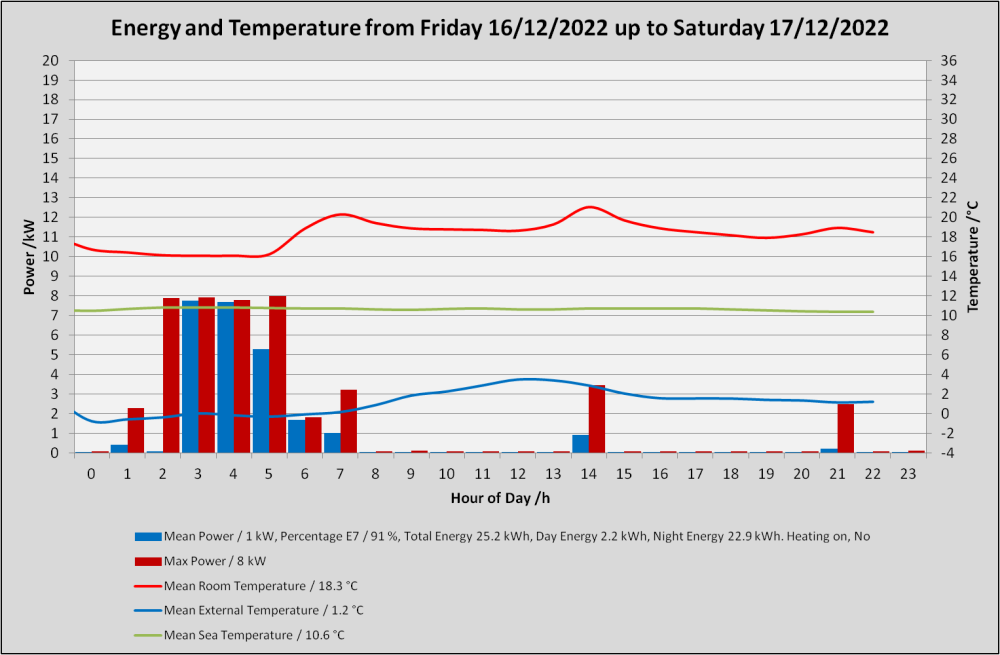
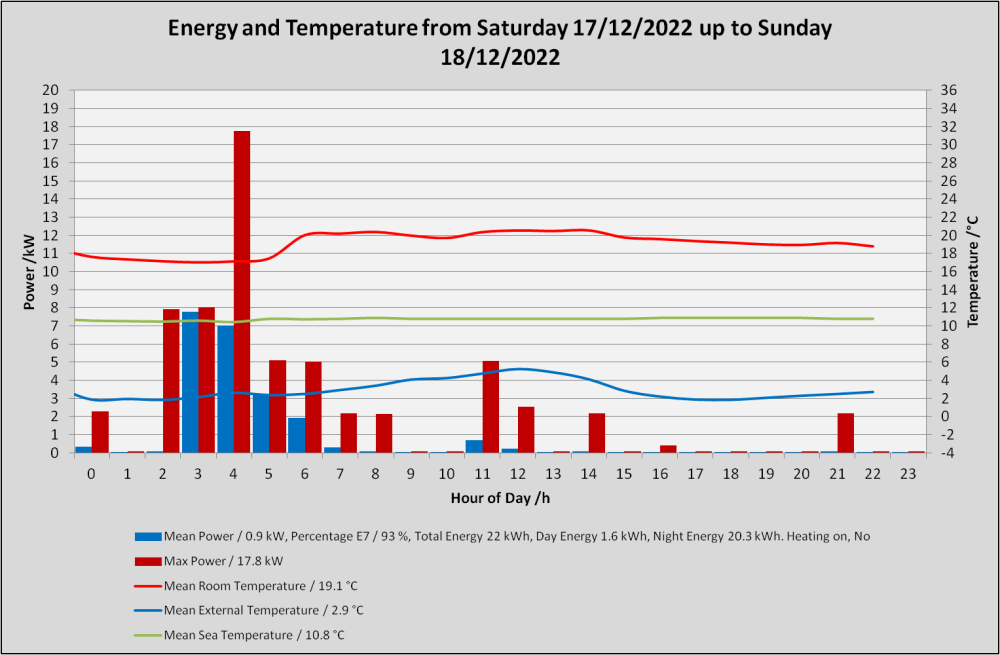
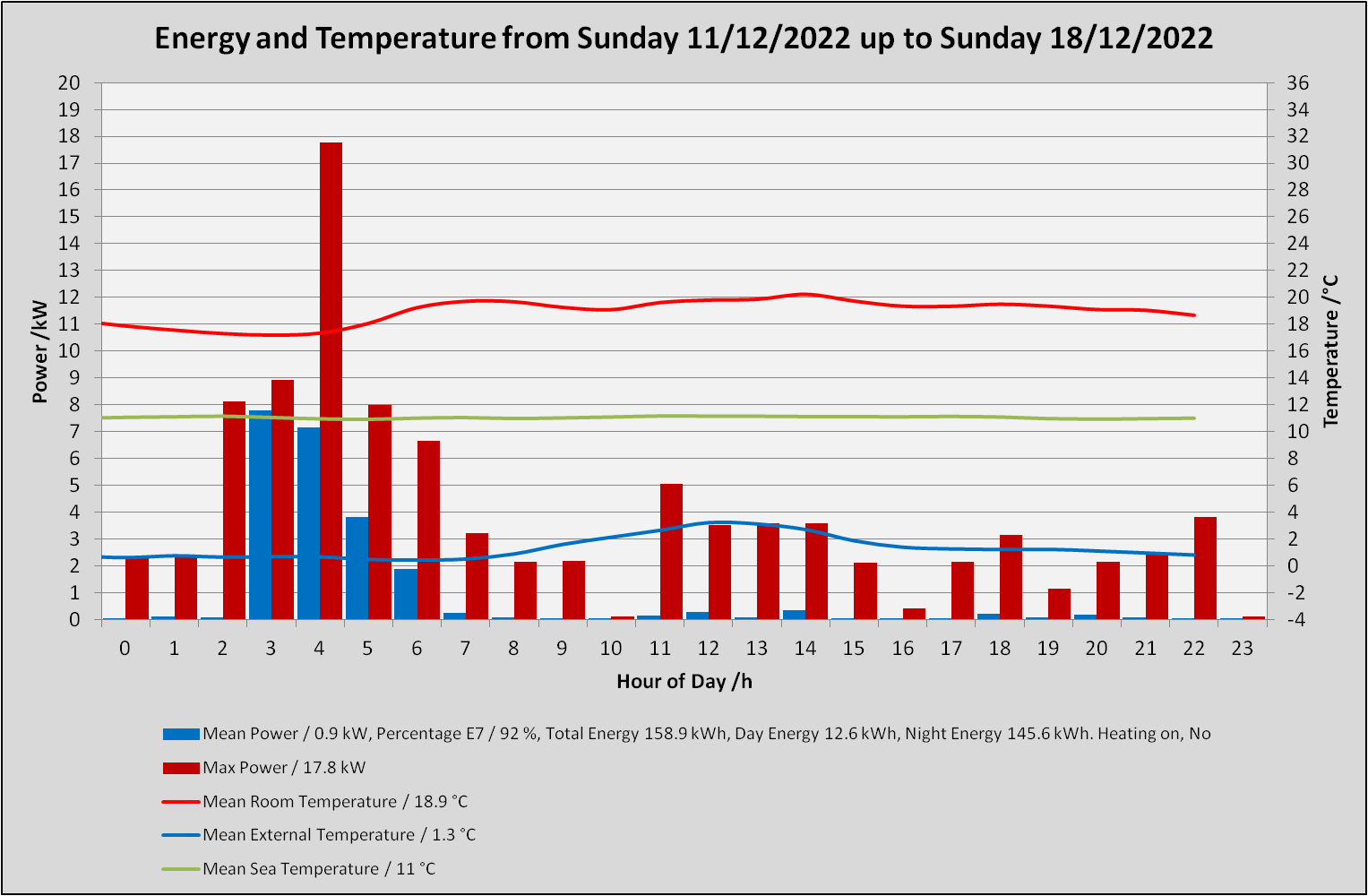
  • Joined

  • Days Won

    190

Everything posted by SteamyTea

  1. Yes it should be. It was late.
  2. I actually prefer that, but you can get humidity devises that control it. Vapac is one make I have used in the past, but for a steam room.
  3. Would be 1,000 kWh [1/2.5 * 2,500). So Saving = (2,500 x 0.15) - (1000 x 0.15) = 225 So that bit was right. EASHP After 5 years (2,300 + 150) / 5 = 490 £/year UVC after 7 years (750 + 375) / 7 = 160 £/year It is the dilemma I have had for years. My power bills are just too small to change anything.
  4. Basically it can be done (high temperature and high how) and be modulated to lower levels quite easily, from an engineering perspective. But I doubt many manufacturers want to install 2 kg of gas at 20p MPa next to a structural wall of a building. Especially if it unnecessary with existing technology. The environmental/embodied energy/CO2 of scrapping an old, or brand new, cylinder is minor.
  5. Yes, but I do use >80% night rate. I could reduce the price by going on a monthly direct debit, but last time I did that it cost me £90 in bank charges. I am also in one of the most expensive region for electrify, so may not get a good deal. Last time I looked, with my usage profile, I could have saved £9/year, with my same supplier.
  6. Just got my new, after April Fool's day electricity prices from EDF. I was paying; Meter Rental 59.1 Day Rate 54.16 Night Rate 13.01 Now (1/412023) Meter Rental 65.19 Day Rate 48.59 Night Rate 15.06 Some days I am going to be pay twice as much to be connect than I actually use.
  7. pV = nRT It is all in the ideal gas law. How large do you want p to be?
  8. Is that similar to Columbian Marching Powder.
  9. I saw a video, from Japan, where the flat had a secondary floor that sat on the primary one. There was a void in that floor to run pipes and cables in. Quite a good solution for a flat as you cannot easily get 'underneath' to access services. Would be fairly easy to design something with a steel or aluminium plate that could conduct thermal energy effectively. Then pump in warm air.
  10. Any advice about claiming money back if not sectioned at 75. Or what to look for if criminal fraud has been committed?
  11. I think is was when I started to derail a topic about something or other that @saveasteading said 'why have I not heard of this. Well here is a bit about it. Not new, nor clever, and it has been tested. Start-up is developing world’s first ammonia-powered ships Paste of copywrite material has been removed. You can read the full article here: https://www.newscientist.com/article/2367003-start-up-is-developing-worlds-first-ammonia-powered-ships/ Meanwhile here is a precis of what it says by ChatGPT: "Amogy is a New York City start-up that aims to harness ammonia as a low-carbon fuel for the global shipping industry. The company has developed a more efficient and miniaturised "ammonia cracking" method that can chemically extract hydrogen from ammonia at a lower temperature. In July 2021, the company first demonstrated its system, supplying 5 kilowatts of power to a drone. Since then, Amogy has shown that its technology can work in a John Deere tractor, a semi-truck, and now a tugboat. A successful waterborne demonstration later this year would set a course for the first commercial offerings to follow in 2024. Ammonia is more easily stored and transported in a stable liquid form at room temperature than hydrogen. Many countries already have pipelines and port facilities for handling ammonia that is produced industrially as fertilizer for agriculture. The US alone has more than 5000 kilometers of ammonia pipelines. However, ammonia still "has a carbon footprint associated with the production" because the standard industrial process uses natural gas. Low-carbon ammonia production would require the use of carbon capture."
  12. The main obsession should be with maximum output temperature and modulation. Too many people think that there will be a 'drop in replacement' for a gas boiler. Physics are against this, so best to stop thinking that there will be a better jam tomorrow.
  13. I changed my old 4-8-4 units to 4-16-4 ones in timber frames. All I did was made my own external trim up from some moulded timber. Post up a picture of them, especially a corner and we can probably give you so much conflicting advice you will not know what to do, ever. Here is my dirty rear corner.
  14. Probably done the decent thing and gone to Spain. https://www.idealista.com/en/news/lifestyle-spain/2022/11/30/7292-towns-and-villages-spain-where-you-could-get-paid-live I think I read that you get extra payments for making babies, better start practicing as I will have stiff competition from our @pocster.
  15. He is a cleaver bloke and probably knows what to do to get the best possible outcome. And has had trouble with his own builders. Just don't ask about choosing a car, wine fridge, driveway, thermal blinds.... But he is a good bloke that is helpful.
  16. Where is our tame contracts lawyer when we need him.
  17. When all else fails, turn to the literature. How to build a sonic crystal 1 March 2011 What you’ll need: poles or tubes, a saw, measuring tape, a drill, a hammer, nails, two planks of wood (one as a base plate and another as a top plate) 1. Collect poles or tubes (almost any type of pole can be used – metal, plastic or wood, hollow or solid) and decide on the range of frequencies you want to block. The wider the tubes, the broader the range of frequencies the crystal can stop. The pole separation also affects the frequencies you can block so you may want to calculate this now: Pole separation (a) = speed of sound in air /(2*frequency). 2. Cut the poles into pieces of equal length. To be most effective, the poles should be a long as possible. The crystal should be at least five poles deep to be effective. 3. Mark out a grid on your base plate to show the position of the poles by using the pole separation equation given above. For example if you want to attenuate low frequencies around 440Hz (this is the frequency of the note A above middle C in the musical scale) you should use cylinders separated by a distance of 39cm and the diameter of each cylinder will need to be 26cm. This structure will be very large! 4. Attach the poles to the base plate. If you’re using solid poles, the simplest option is to nail them to the plate from behind. Depending on the poles you’re using, you may also want to use glue or screws. 5. If the poles are unstable, add a top plate to keep the structure rigid. 6. The best way to test the crystal is with a sound at a single frequency. To create a test tone, you can use a tone generator (like this one available free online) to create a sound file with a specific frequency and duration. Upload this tone to your cellphone. 7. Position your cellphone on one side of the crystal in the centre of the array, roughly 30 cm away from the poles. Play the tone and listen for it on the opposite side of the crystal. You’ll know your structure is effective if the sound is muted. Sculpted sound By Philip Ball 23 March 2002 PUBLIC sculpture is all very impressive to look at, but what use is it? It just sits there providing a perch for pigeons and a backdrop for tourists’ photos. But a few years ago, Francisco Meseguer of the Institute of Materials Science in Madrid found an unexpected answer. He discovered that a minimalist sculpture on display in Madrid can block out sound. Erect such barriers throughout a noisy city or along the sides of a motorway and the tumultuous modern world might not only become a quieter place, but a more attractive one too. The structure he stumbled across is called a sonic crystal because it scatters sound waves from a periodic array of “atoms”—anything from glass spheres to metal rods. Unlike conventional, solid sound barriers, sonic crystals are mostly empty space. And they’re a lot easier on the eye, too. Now Meseguer and his colleagues have shown that these structures can do a lot more than simply block sound. Sonic crystals can shape and manipulate sound as if it were putty, reflecting, bending and filtering it in unexpected ways. They might even transform unpleasant environmental noise into something far more soothing. And the Spanish team hopes to make similar structures for controlling other kinds of unwanted vibrations. In the grandest and, by their own admission, the craziest of such schemes, they think it might be possible to build gigantic sonic crystals that dampen seismic waves and protect buildings from earthquake damage. Meseguer first stumbled across sonic crystals while he was working on tiny structures called photonic crystals. Developed in the 1980s, these can be used to manipulate light, and are now being turned into devices such as lenses and fibres for all kinds of optical communications technology (New Scientist, 12 June 1999, p 36). One of the simplest forms of photonic crystal is simply a block of silica with a regular array of holes drilled in it. The difference in refractive index between the silica and the air in each hole means that light is scattered at the boundary where they meet. Make the distance between the holes about the same as the wavelength of light shining on it and the scattered photons interfere destructively. Simply put, the crystal blocks light in that range of wavelengths. It has a “photonic band gap”. Nowadays, photonic crystals are often made by allowing microscopic glass beads to settle out of a suspension into organised lattices called colloidal crystals. Structures like these form in nature too. The iridescent appearance of opal, for instance, comes from the light-scattering properties of the tiny silica spheres that make up its lattice. For photonic crystals with band gaps in the visible region of the spectrum, the holes or spheres must be a few hundred nanometres apart. But in 1995, while Meseguer was chatting with acoustics expert Jaime Llinares of the Polytechnic University of Valencia (UPV), they realised that if these structures were scaled up to centimetre dimensions—corresponding to the wavelength of sound—they might be able to create an acoustic analogue of a photonic crystal. Inside their imaginary sonic crystal, the scientists reasoned, sound waves should bounce off the “atoms” in such a way that the waves interfere destructively, cancelling out the oscillations in the air. Llinares suspected that some form of sonic crystal might already exist. He remembered that on the UPV campus there was a sculpture by the Spanish minimalist artist Eusebio Sempere, made from an array of vertical metal bars of various lengths, of about the right thickness and spacing, like a set of surreal organ pipes. Could this block sounds? To find out, they placed a loudspeaker on one side of the sculpture and a microphone on the other. The speaker broadcast white noise through the sculpture, but when they measured the intensity of the sound on the other side, there was no sign of a band gap. The problem, they decided, was that the sculpture was made of hollow metal cylinders which resonated like organ pipes. Since some of the pipes were very short—about 10 centimetres, the same as the separation between pipes—they were resonating at frequencies inside the expected acoustic band gap, and this vibration masked the gap. Fortunately, Sempere had constructed a similar, but larger bar sculpture, on display at the Juan March Foundation in Madrid. In this outdoor sculpture the pipes are up to three metres long. The two researchers set off with their loudspeaker and mic to try again. This time they found that the sculpture actually blocked out sound. It wasn’t a perfect “crystal”, however, so the acoustic band gap was rather leaky. Worse still, the measurements were muddied by noise reflected from nearby buildings. To improve their data, the researchers decided to make their own minimalist sculptures by hanging cylinders of stainless steel or wood from a frame. This created a regular forest of bars that wouldn’t look out of place in any modern art gallery. In 1998, instead of entering it for the Turner Prize, they mounted their crystal in an echo-free acoustic chamber and began experiments to measure how sound travelled through it. Their data revealed that the structure strongly suppressed sound waves in the audible range, at frequencies between 1400 and 1700 hertz. At last they had clear evidence of a sonic crystal. Just months ago, the team also revealed how sonic crystals could be used not only to block sound but also to manipulate it (Physical Review Letters, vol 88, p 023902). At frequencies below the acoustic gap, sonic crystals are transparent to sound. But they don’t let sound waves pass unscathed. Just as light is bent by refraction when it passes from air into glass, so sound waves are bent when they pass into a sonic crystal. The researchers realised that they could use this to create a lens that focuses sound. The lens they built is a convex array of cylinders (see Diagram). Put a sound source on one side and the lens focuses the sound waves on the far side. The focus is rather blurred, however, partly because the surface of the lens is quite rough—you can’t make a smoothly convex surface from a small number of cylinders, the structure is just too “grainy”. It’s like trying to make a lens from a handful of atoms. They also built an acoustic analogue of another common optical device: a Fabry-Pérot interferometer. This is made from a stack of thin films that create interference patterns when light reflects off each layer. The acoustic version is simply a “slab” of sonic crystal, with rows of cylinders hanging parallel to the flat faces of the slab. Fabry-Pérot devices are commonly used in microwave technology as filters. But Jose Sánchez-Dehesa, a physicist at the University of Madrid who worked on the project, admits that it is not yet obvious where the team’s sonic analogues of lenses and filters might be used, because they are so large. The basic sonic crystal, however, which blocks sound waves within a tunable frequency band, might find all sorts of uses. Imagine a barrier made from crystals that are designed to have all the aesthetic qualities of a Sempere sculpture but which cuts out traffic noise on the far side. “Sound-deadening barriers could be an interesting application of our findings,” says Sánchez-Dehesa. They would be more expensive than regular barriers, because they’re more elaborate, but he argues that in residential areas they would be a definite improvement on “ugly concrete panels”. His colleague Juan Vicente Sánchez-Pérez at UPV is now planning to patent a prototype sound barrier based on an array of cylinders. Not everyone is convinced that sonic crystals offer any real advantages over conventional materials. Victor Krylov, an acoustics specialist at Loughborough University, believes that the sound barriers currently used along motorways and railways are at least as effective, and cheaper too. Certainly, the need to space the cylinders at a distance of about one wavelength is a drawback, because it means that sound-proofing structures have to be big and thick. In 2000, however, Ping Sheng and his colleagues at Hong Kong University in Kowloon showed that there might be a way around this. They made sonic crystals from a cubic array of lead balls just one centimetre across, each ball coated with silicone rubber and glued into the array with epoxy resin. It was a kind of giant sonic opal. This structure displayed acoustic band gaps for sounds with wavelengths of around 1 metre and 25 centimetres—wavelengths that are hundreds of times as large as the spacing of the sound scatterers. They attributed this unexpected effect to the rubber-coated balls resonating at specific frequencies—they vibrate like heavy masses attached to springs. Sheng’s colleague Che Ting Chan says the Hong Kong team are now making sonic crystals that absorb sound. They believe sonic crystals like these could be used to block sonar signals at sea, for instance. Make submarine hulls from this stuff and they would be invisible to sonar from ships or other subs. Alternatively, say Peter Matic and Narendra Batra from the Naval Research Laboratory in Washington DC, the acoustic gap might be useful for filtering out particular frequencies generated by heavy machinery. They aim to design multifunctional materials which can be stiff and tough as well as providing acoustic shielding. Build them into a ship’s hull and you might be able to silence the sounds of the vessel’s engine, making it harder for submarines to detect. Sánchez-Dehesa thinks it might even be possible to design barriers that change the quality of the sound as it passes through. Just as photonic crystals can filter the wavelength of light passing through, it might be possible to design a sonic crystal so that objectionable noise passing through it becomes more tolerable—even pleasant. “My goal is to look for a panel based on a sonic crystal that could transform bad sound on one side, like traffic noise, to good sound on the opposite side, like the sound of the trees or ocean waves.” If that sounds daring, it is nothing compared to another idea they are toying with. Since these materials work for light and sound waves, it should be possible to build a structure that can block or transform other kinds of wave—including seismic waves in the ground. Just as you can make a slab of material impermeable to light by perforating it with a lattice of tiny holes, so you might make the Earth’s crust impenetrable for seismic waves by drilling an array of huge holes in it. Surround a city with such a lattice, and you could shield it from earthquakes. “If seismic shielding could achieve an attenuation of two points on the Richter scale [a hundredfold reduction in energy], it would be great,” Meseguer enthuses. To test the feasibility of the idea, in 1999 Meseguer and his colleagues drilled two vertical lattices—one triangular and the other honeycomb-shaped—in a bed of marble in a local quarry. Each hole in these lattices was 6 centimetres across, 160 centimetres deep and separated from its neighbours by 14 centimetres. Then they created vibrations by dropping a steel ball bearing onto the quarry floor, and used sensors to measure how the vibrations passed through the lattices of holes. Both lattices significantly damped down the vibrations. However, to protect against real seismic waves, the holes would have to be hundreds of metres across and at least a kilometre deep. “It is clear that such a proposal is not feasible yet,” confesses Sánchez-Dehesa. “But you can protect an isolated building.” Used in this more modest way, underground “ring fences” of seismic crystals could make labs or buildings immune to vibrations such as those from passing trucks. This could be very useful, since some high-precision instruments—scanning probe microscopes for studying structure at the atomic scale, for example—are very sensitive to disturbance. Meseguer has already started looking at the practicalities of such a system. And who knows, one day these giant structures could become art in their own right. A sacred bird’s voice seems to be trapped in the very stone of the Mayan Pyramid of Kukulkan at Chichén Itzá, surrounded by the jungles of the Yucatán Peninsula in Mexico. Stand at the foot of one of the stairways that climb the outer walls, clap your hands and a chirp rings back at you from the stone surface. According to David Lubman, an acoustic consultant based in California, this is the sound of the quetzal bird, the spirit of the Maya incarnated in their plumed serpent god Quetzalcóatl. Lubman claims that it takes only a little imagination to hear in the curious echo from Kukulkan’s staircases the sound of the quetzal as it would have been heard by a Maya in the Peruvian cloud forest. This, says Jose Sánchez-Dehesa, may be an example of Mayan acoustic engineering. Architects have designed buildings since ancient times to generate and exploit particular acoustic effects, such as the whispering gallery of St Paul’s Cathedral in London. But this is engineering of a particularly sophisticated kind: for the Kukulkan staircases, with their periodic array of scattering surfaces, have many of the characteristic features of a sonic crystal. Could the Mayans really have known the secret of sonic crystals as long as 900 years ago? “I think the answer is yes,” says Francisco Meseguer. Sánchez-Dehesa agrees: “We can say that the Maya are the first people to harvest sound by making a sonic crystal.” And he hopes to prove it with a series of experiments at the pyramid. We may soon know whether the quetzal bird sings at Chichén Itzá by chance or design.
  18. Take a buildhub.org.uk banner along.
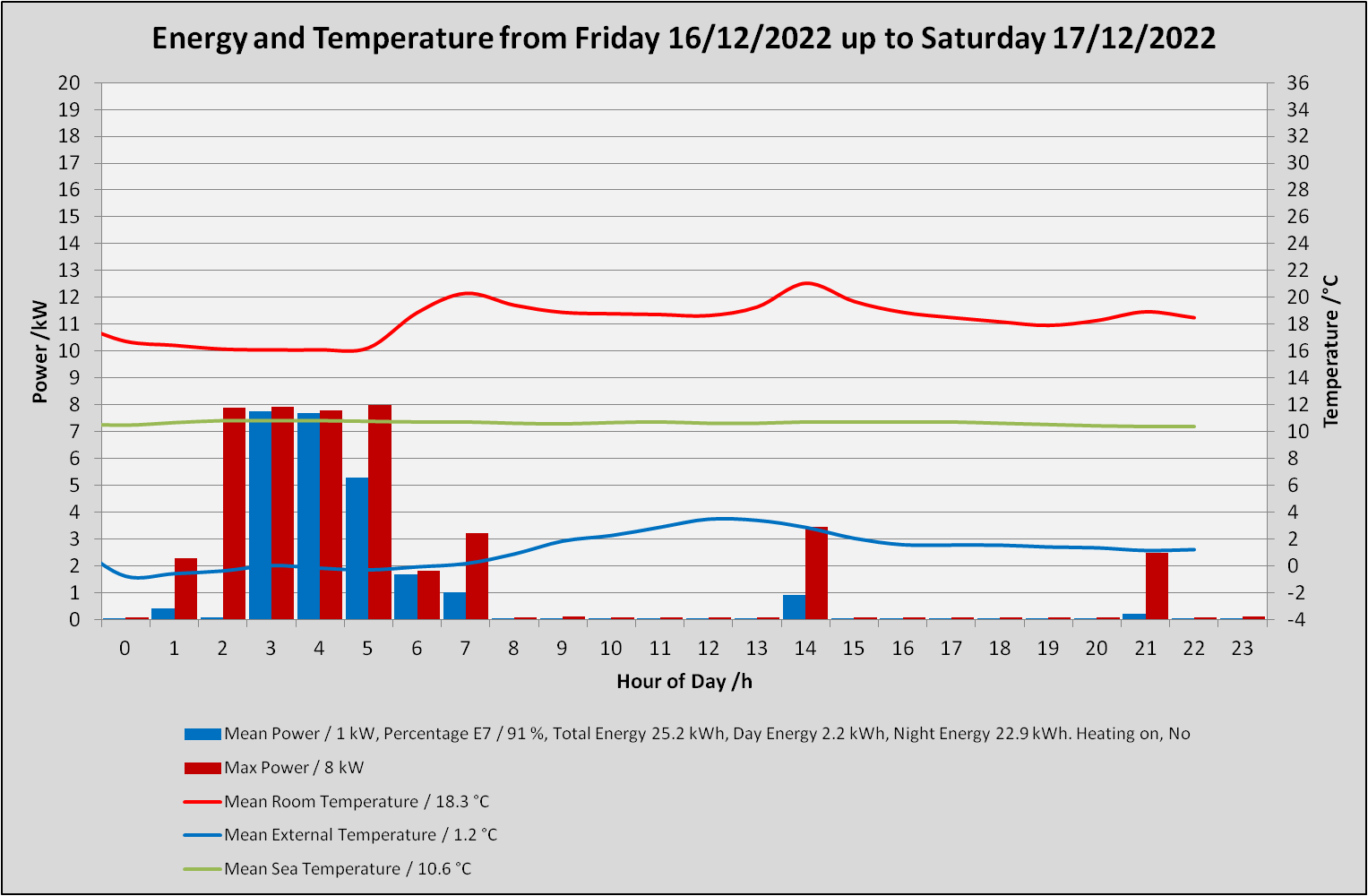
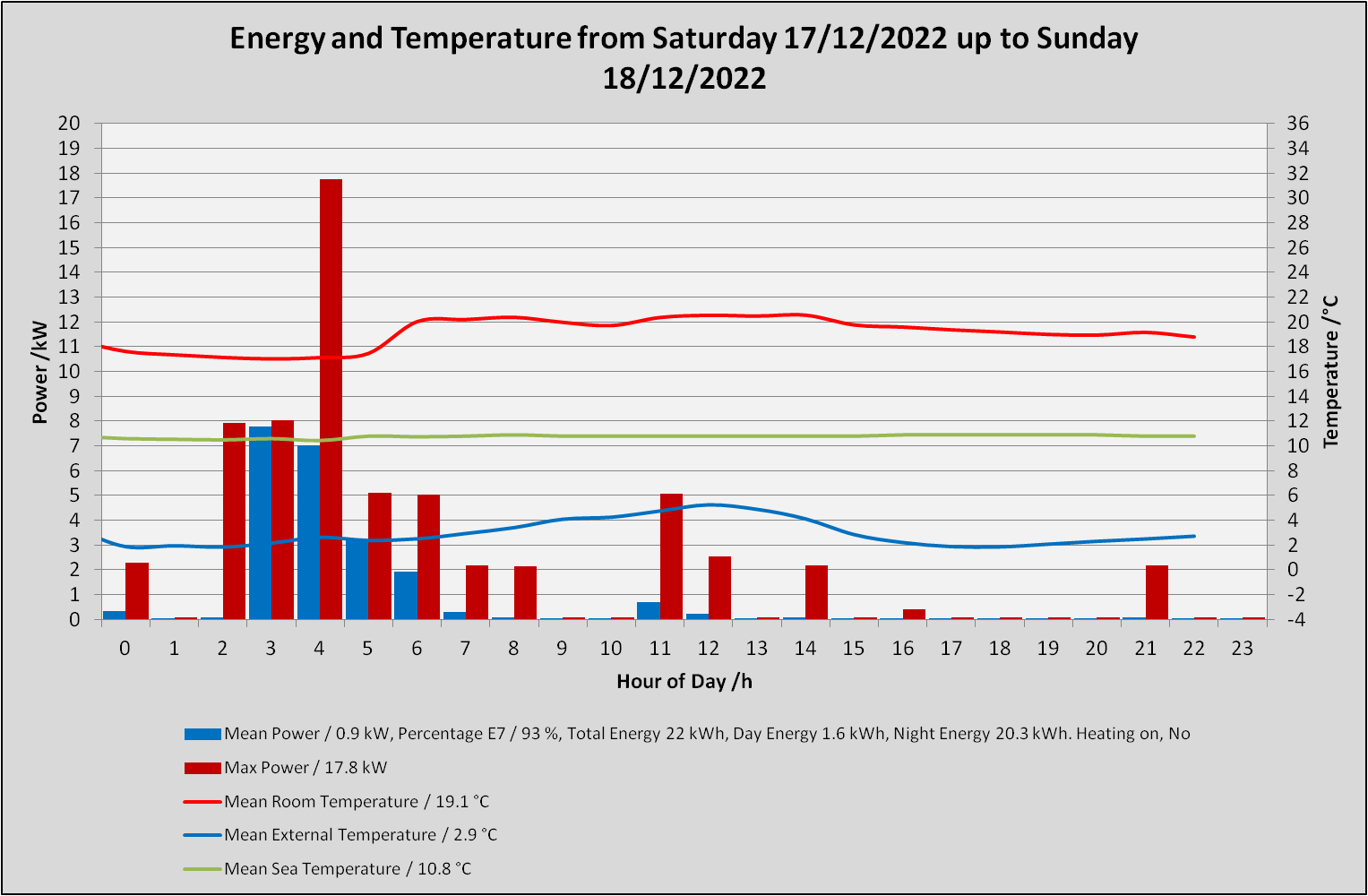
  19. My 'heating on' daily mean temperature is now 9°C. Used to be 10°C. It is why a 1°C drop in house temperature can make a large saving on energy costs. We tend to have more days where the temperature is between 6°C and 10°C than we do -1°C and 3°C. I also think that HDDs are one of the few metrics that benefit smaller houses, though not actually analysis it too closely yet. My cooker, which has been on less than 30 minutes, has increased my house temperature by over 1°C.
  20. I don't know, not my problem. But I suspect that The London Gazette will know, eventually.
  21. Is this legal? I thought the original FiTs was a contract with OFGEM/Government/DNOsand energy suppliers. They got caught out over a decade ago when they changed the scheme at very short notice.
  22. Sounds to me they may be the ones that issued the winding up notice.
  23. @Jamie Kent It is a bank holiday weekend, so no need to knee jerk anything. Also, may be best to get your name changed on here as you don't want legal people search for you and what you may have said. It is an over connect world now. I also don't think the time you have invest in getting to the BR stage is wasted, there are many ways to achieve the same result.
  24. 11°C peak tomorrow, about the same as today. May get some sun tomorrow afternoon. Trouble is sea surface temperature and air temperature are very similar, so may be misty instead.
×
×
  • Create New...