


SteamyTea
-
Posts
23836 -
Joined
-
Days Won
200
Everything posted by SteamyTea
-

Carpet over UFH. is it special stuff?
SteamyTea replied to saveasteading's topic in General Flooring
Roll it up and take it to a cousin's shop in Tangier, for you, special price. -
Welcome Is the renovation in London? If so, which bit, it is a large city.
-
AKA a puddle.
-
Sanity check - heat loss calculator - Crooked Lodge
SteamyTea replied to BotusBuild's topic in Heat Insulation
You may as well. When I went looking for a small ASHP, the smallest someone on here found was 3.5 kW. Was same price as the 5 or 6 kW one, but it as unavailable. -
ASHP, UFH and connection to Thermal Store
SteamyTea replied to JamesDRG's topic in Other Heating Systems
I am going to follow this with interest as I am a believer in storing energy in water, rather than batteries. Couple of things spring to mind. How often will the thermal store go below 35°C. Water below that temperature is not much use, and even of it drops to 8°C every day, then that is only 16 kWh. What are the thermal losses of your house and your DHW needs? Does a thermal store need antifreeze/inhibitors in it? If each circuit is isolated then I guess not. -
I am going to have to get some and have a play about.
-
MCS uses a standard convention, which I think is that the system must be able to deliver enough energy 99% of the time. I had a look at the Central England Temperature (CET) records for 1900 to 2000 and 1990 to 2020, which are the longest running instrument recordings, so considered the gold standard. Without getting into silly decimal places of percentages, between 1900 and 2000, the lowest 1% was from -3°C downwards, 1990 to 2020, it was -2°C and below, so 1°C higher. Looking at the point I turn my heating on, outside air temperature (OAT) of 9°C, 1900 to 2000 is 53% of the time, and between 1990 and 2020, 49% of the time. It is a similar story with overheating, just not so frequent. 1900 to 2000, >=24°C is 0.02%, 1990 to 2020 0.1%. The mean temperatures during those dates (actually the median temperature as the MET Office reads twice a day) is 9.5°C and 10.2°C. So if you design your house with way to much glazing 'because you love natural light', you really need to think about paying for cooling.
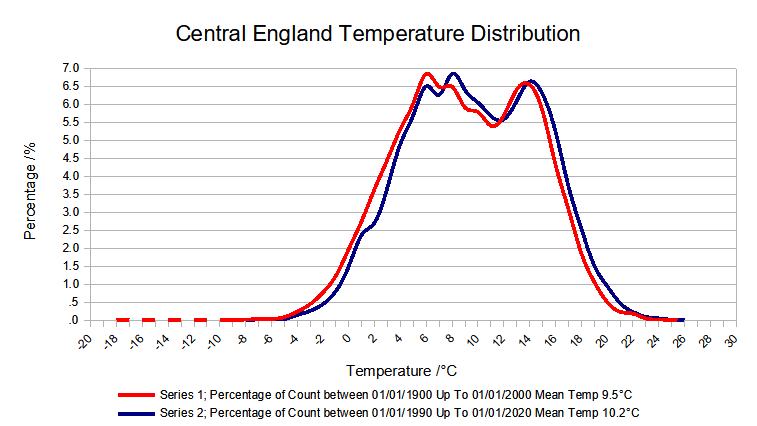
-
Timber Frame arrival & erection!
SteamyTea commented on mike2016's blog entry in The Fun Irish (House)
A lot of people think that without internal walls, houses look much larger than they imagine. Was that your experience. -
Yes, good point. I noticed that there is a data handbook that you can ask for.
-
I just had a quick look at the Ecodan R32 spec sheet, and it seems they name the models after the power output at -7°C. It was a quick look though.
-
Did you use the Everbuild Aquaseal instead of polyester resin? This is where my knowledge breaks down. I have used many different resins with glass, aramid, boron and carbon fibres, as well as natural fibres like jute, hemp, cotton and cellulose. But apart from injected PU resins, I have never hand laid with PU resins. It is something I want to experiment with one day. The price of the Aquaseal seems pretty good.
-
best UVC/diverter set-up to maximise PV use
SteamyTea replied to Tom's topic in Boilers & Hot Water Tanks
You can also use an ozone generator to sterilise water. -
How much error correction is on that QR code?
-
Do they. This government has dropped hydrogen as an alternative. While governments do change, physics does not. No idea what that is. Is it like BP and Shell saying they are going to become Net Zero companies. Apart from the selling practices, what do you dislike about them?
-
What power?
-
Passivhaus in St Albans for sale
SteamyTea replied to TheMitchells's topic in General Self Build & DIY Discussion
I am not so sure, but maybe because for the last 16 years I have been in hospitality and have to often deal with customers who cannot string a sentence together, and then don't listen to the words 'we don't serve that' I have met real stupid people, and drunk, stones, angry, violent, hungry, famous ones at that. Prior to that I was lecturing and had to deal with young (and not so young) students that knew (expletive deleted)ing everything (social science students where the worse). Could take ages to teach them to unlearn what they knew, and then let them relearn a different 'model' that was more appropriate. Similar to here with some people. That is not a criticism, just that building physics is not always simple and intuitive. Why I like to break the problems down to the smallest relevant parts, and then rebuild in a more appropriate order, and put recognised units on each part. "I Think You'll Find It's a Bit More Complicated Than That" is a good starting point. -
Passivhaus in St Albans for sale
SteamyTea replied to TheMitchells's topic in General Self Build & DIY Discussion
A perfect example badly done GRP. I think that it has been cut up and sections then just replaced and a flowcoat added over them. So not really representative of GRP. -
They have. I think @Onoff used some on his roof. I have some details about it somewhere. I think this stuff is similar. https://www.topseal.co.uk/topseal-pu/ One Day I would like to try some out and see what it can do.
-
Mixing wood fibre sarking with PIR in pitched warm roof
SteamyTea replied to DonnaP123's topic in Roofing, Tiling & Slating
Probably rusted because of lack of movement. 16°C and above only happens 21% of the time, and some of that is at night. And we had a really hot spell last year. -
If you could nail a thin sheet of ply to it, then it can be coated in-situ.
-
not so experienced Hampshire DIYer hello!
SteamyTea replied to jmatthes's topic in Introduce Yourself
Can of worms. You may be able to buy some tape and do your own airtightness details, does depend on how they are finishing between the wall and the frame, and if the frame straddles a cavity. I think you know the answer to that already. The problem is that a greater proportion of the energy will go through the floor, rather than unto the room. To overcome this, the flow temperature is increased, which increases the the losses to the floor. Better off fitting as much insulation to the floor, then using radiators or forced air heating i.e. air to air heat pump. If you do decide to dig and insulate, then you want to get the lowest U-Value floor you can practically manage. As a general rule, UFH will use more energy than radiators, but it is more complicated than that as heat source efficiency can vary at different delivery and return temperatures. There is a useful heat loss spreadsheet kicking about on here. But it may be time that I started a blog specifically about it. All I have done so far is general Physics stuff. -
Do you mean the substrate thickness or the GRP thickness? Substrate is really down to if it is walked on a lot and what snow and wind loadings happen, same as any sarking really. GRP is best at about 3mm before any finish coating. I would usually do this with 3 layers of 450 g/m² matting. No. GRP, is basically inflexible. If the angle is known then a trim piece can be moulded and attached, then bonded in place. Alternatively a thin sheet of just GRP can be moulded, cut to the right size to fit under the original roof, but over the new flat roof sheets, then locally bonded. It may be better if I draw something up when I get home. It is drizzling today so not going to be oggling bathing beauties on the beach.
-
Passivhaus in St Albans for sale
SteamyTea replied to TheMitchells's topic in General Self Build & DIY Discussion
I am going out as it is Comic Day, but shall look for it when I get free. -
not so experienced Hampshire DIYer hello!
SteamyTea replied to jmatthes's topic in Introduce Yourself
Yes. But welcome anyway. I got as far as the windows being fitted. So how did they seal between the window frames and the old opening, did they use any airtight tapes, or the usual can of foam? As you have a drawn plan, now is an ideal time to take a stab at a room by room heat loss calculation. It will take a bit of work finding out what each element is made from, but well worth it. -
Passivhaus in St Albans for sale
SteamyTea replied to TheMitchells's topic in General Self Build & DIY Discussion
Not sure I understand the second part. This may be a topic for a new thread.

