SteamyTea
-
Posts
23836 -
Joined
-
Days Won
200
Everything posted by SteamyTea
-

Insulating a former Concrete Water Balancing Tank
SteamyTea replied to Dave and Helen's topic in General Construction Issues
Not much higher than the surrounding uncovered ground. We don't thermally insulate our houses by sticking on another layer of bricks. Clay has a k-value ~3 W.m-1.K-1. So not very good. By the very nature of building, the ground needs to be well compacted, so often a worse thermal conductivity. It is also a nature of physics that the greater the temperature difference, the faster it looses energy. So what does get through the slab, is then into a semi infinite heat sink. A lot of people think that the ground under a house makes for a good thermal store, so good that every house has one. There is a reason that insulation has a low k-value and a low density, it stops the energy leaking out from where you want it. -
Insulating a former Concrete Water Balancing Tank
SteamyTea replied to Dave and Helen's topic in General Construction Issues
Not that often. Maybe on a few really cold winter days. At the moment the air temperature is 13⁰C and the ground temperature is 6⁰C. The sea temperature is 10⁰C. So most of the time the ground is colder than the air, and especially the air in a building. And people wonder why I say that just adding mass to a building makes it colder. -
Getting frustrated with heating suppliers.
SteamyTea replied to MikeSharp01's topic in Other Heating Systems
In the olden days, when I was a lad, one of the few jobs you could get with no qualifications was as a 'mate' to a qualified tradesman. To get an office job required some 'O' levels, usually English and Mathematics. These days, just about all the trades need quite good GCSE results, and then there is the on site safety courses. Do all the school failures end up in the office these days, doing the intellectual work? I have worked for small businesses where the owners are proud to point out that they have no qualifications, they are usually crooks and bad business people. An example was when I made steamrooms and we had to fit one where the steam generator was several metres from the cabin. I queried how well this would work as there is back pressure in the long pipework and lots of energy loss. Got old by the MD that I was talking nonsense. It did not work as I tended. So the 'solution' was a larger steam generator. That did not work either. (expletive deleted)ing numpties. -
Pi and a 4g sim card as a site security camera setup
SteamyTea replied to Post and beam's topic in Boffin's Corner
Yes https://www.ebay.co.uk/itm/266514324748 I use an old 4G phone as a hotspot, can reliably connect 5 devices to it. -
Technology Connections does heat pumps (USA)
SteamyTea replied to George's topic in Air Source Heat Pumps (ASHP)
As I am already all electric, could change that 3000 as the efficiency is better. So that works out at 1 kW, which is probably about right. -
Good, I can breathe properly again, and hopefully the mouth foaming will stop.
-
As windchill is a function of evaporation, relative humidity and surface boundary windspeed, it will make for an interesting partial differential equation solution. Many years ago I looked at the correlations between windspeed, wind direction, solar power and air temperature. Basically as windspeed increased, so did air temperature (for my location), solar power went up with more northerly winds, but I did not look at relative humidity. I am not sure how buildings are affected by external evaporation. One way to check would be to put calibrated probes just under a sample of the wall surface and another on a similar sized bit of glass, or an identical bit of wall surface but sealed to stop evaporation i.e. a clear varnish. The idea being that glass does not absorb water and will dry off fast, while brick or render will absorb a bit and evaporate over time. If it is done at night, then solar power does not enter the calculations, daylight testing would become a secondary experiment. A more comprehensive experiment could be done with added sensing i.e. RH, solar power and airspeed near the samples.
-
But oddly
-
Where is @craig when he is wanted. He will know right away.
-
Have you got children? Get then to invoice you, then charge then board at lodging to an equal amount. Immoral labour maybe, especially if you leave their inheritance to an old folks home (which seems, inadvertently, to be what my mother is doing), but you may save a few quid to spend on decent holidays.
-
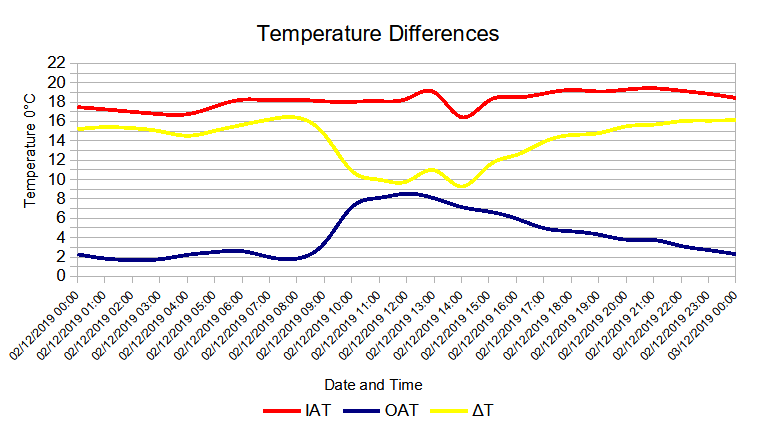
Yes, and to add more conflict to it, no. Overall, if the mean temperature difference, say a ΔT 20°C, produces a result of 10 kW (that is the power), then over a day that is 240 kWh (the energy). Now the confusion will arise that the temperatures inside and outside the house will not stay the same i.e. 0°C outside and 20°C inside. This will produce a picture like this. Now these are real readings for my house. The mean inside air temperature (IAT) is 18.2°C, the mean outside air temperature (OAT) 4.1°C, the mean ΔT is 14°C (or K, for kelvin in real science). Just looking at the ΔT, the yellow line, you can see that it starts high at around 15°C, then drops to about 10°C then rises again back, peaking at 16°C. The IAT, is fairly stable apart from the dip between 1PM and 2PM (probably cooking and opened the window). The OAT is stable during the first hours of darkness until 8AM at around 2°C, then rises quite fast 8°C, then the day slowly cools back to 2°C. It was probably a day with a sunny morning and then a slow wind direction change (to the SE) during the afternoon. The relevant part as far as heat pump (or any heat source) part is concerned is the biggest temperature difference (ΔT). This happened between 10 PM and midnight, though it can happen at any time of day, and on some days can happen multiple times (spring and autumn stormy days, lowish sun angle and scattered showers). You need to know not just the the greatest temperature differences, but also what performance hit your heating system will have when it is cold outside. This is more important for A2AHP's as they may have a lower rating at low OATs. It is usual to size a heating system to cover 99% of the loads that can be expected, that leaves 88 hours when the systems will not deliver enough power to keep the IAT at the desired level. It is usual to use supplementary heating i.e. a fan heat to fill in that gap (or just be tight and have a slightly colder house). During those few hours, which may or may not be contiguous, the heating system is still supply thermal energy, just not enough to keep the IAT at the desired level. It is generally cheaper to run a resistance heater for a few hours than fit an oversized heat pump that will take a performance hit because is cycling on and off. This is why a buffer tank is fitted as it allows a heat pump to deliver energy for a longer time, which generally translates to a better coefficient of performance (CoP) for the ΔT. Not always ideal, but better than if the system was cycling. In brief, if your house takes 0.5 kW of power for every Δ°C, when you hit the really large ΔTs, and your pump can only deliver 3kW, rather than the stated 8kW, which is what you need, you have to have supplementary heating, or accept that the ideal IAT (say 20°C) will drop by 10°C, so down to 10°C, not very nice, but not fatal. These will be very rare events as most houses store a fairly high amount of energy in the first few millimetres of internal wall, and temperature loses are not linear, the colder it gets inside, the slower the energy release is from the walls (and other parts of the structure and fittings). This will, over a few hours, help to keep the temperature reasonable enough (it is why buildings do not instantly change temperature).
-
Architect advice. Do we need this or not?
SteamyTea commented on TheMitchells's blog entry in Renovation of Ellesmere Bungalow.
They just heat the air in the building, but with a much improved CoP. -
HELP: New Ceiling comes with a lot of Noise!
SteamyTea replied to ACA's topic in Plastering & Rendering
£100k for not having a carpet would feel like a fine to me, unless I was the one getting the tax free cash, then it would be a Porsche and holiday in Barbados. And a lot of laughing at the neighbour. I would laugh so loud it would keep them awake at night. -
Architect advice. Do we need this or not?
SteamyTea commented on TheMitchells's blog entry in Renovation of Ellesmere Bungalow.
Have you considered fitting air to air heat pumps (A2AHP) to warm up your parents? Probably the cheapest and most cost effective thing you can do. Insulating the floor, if you have the room, is effective as well. If no stairs to worry about it is a lot easier. I would not worry too much about the windows, and bless they are really dreadful i.e. rotted through timber. May be possible to just replace the glass. -
Getting frustrated with heating suppliers.
SteamyTea replied to MikeSharp01's topic in Other Heating Systems
That is a better reason than any I have heard so far. -
Can't you get the qualification yourself, may end up cheaper and easier.
-
Was she in her late 70s?
-
I know nothing about these at all, so did a very quick search. Are these what they are? https://duckduckgo.com/?q=Ground+Protection+Mats&atb=v390-1&ia=web
-
She's Up! (Juliette that is) : but how tight should - -
SteamyTea replied to ToughButterCup's topic in Windows & Glazing
Schweinenase -
Off grid, timber frame bungalow transformation, SW Wales
SteamyTea replied to GaryBmth's topic in Introduce Yourself
Welcome Which way does the roof face? Can you easily add external wall insulation and add quite a bit to the floor? I currently use about 12 kWh/day of energy (50m2), all electrical resistance heating as well. It should not be hard to halve that, so that only leaves 6 kWh a day to generate and store. -
What do you all think about the recent sea temps?
SteamyTea replied to gavztheouch's topic in Environmental Building Politics
I don't remember the precise predictions, but 1:100 storms have become something like 1:30 storms. Most of Cornwall is going to cope reasonably well with storms, there will always be the odd ones like Boscastle 2004, but that really was a quirk of topology. Storm surges are probably the biggest threat down here, but they tend to take out carparks and amusement arcades. The Wherrytown storm of 1962 is an interesting example, the sea defence has lasted well. New types of material are currently being tested there at the moment. -
She's Up! (Juliette that is) : but how tight should - -
SteamyTea replied to ToughButterCup's topic in Windows & Glazing
Mr Slater's Parrot -
She's Up! (Juliette that is) : but how tight should - -
SteamyTea replied to ToughButterCup's topic in Windows & Glazing
Goblin more like. -
Welcome Just to add to the good advice above. If you are having UFH, how much insulation has been specified below it?
-
She's Up! (Juliette that is) : but how tight should - -
SteamyTea replied to ToughButterCup's topic in Windows & Glazing
They can chase the spots, hours of fun, or seconds if they are high up.