SteamyTea
-
Posts
23689 -
Joined
-
Days Won
198
Everything posted by SteamyTea
-

Mini Store - Heat Geek / Newark Cylinders for ASHP
SteamyTea replied to Nick Laslett's topic in Air Source Heat Pumps (ASHP)
Not sure that is a good analogy as wheel rims, once fitted to a vehicle, hang from spokes, while a solid cast wheel distributes the loads through all the 'spokes' (loads vary with the angle, but they can cope with tension, compression and shear forces, traditional spokes can only handle tension). -
Long time since I did my surveying course (2006), but I did get 90% in it (would have got 100% if I had drawn it up in Autocad rather than TurboCad). Worth playing about against some known fixed points just for fun. You can usually find a known point in a street. Bench Marks are the good ones, but you will often see a scribed 'washer' nailed to a footpath. If you want to get really nerdy, get down to Newly and look at the tidal gauge, it is where all the UK's surveying is based from. Difference between Bowditch’s rule and the transit rule:- Bowditch’s rule is used to balance the traverse when the linear and angular measurement are equally precise while transit rule is used to balance the transverse when the angular measurement are more precise than linear measurements. Bowditch’s rule:- Bowditch’s rule or compass rule is most common method to traverse adjustments. By they rule, the total error in latitude or departure is distributed in the proportion to the lengths of traverse legs. Correction to latitude of any line: = length of that line/ perimeter of the traverse)× total error in latitude Correction to departure = (length of that line/perimeter of the traverse)×total error in departure Transit rule:- By this rule, the angle are measured with more precision and error in latitude or departure is proportional to its latitude or departure. This method is adjusting the consecutive coordinates of traverse is completely empirical and no theoretical base for it. Correction to latitude of any line: = (length of that line/ arithmetic sum of all latitudes) × total error in latitude Correction to departure = (length of that line/ arithmetic sum of all departures) × total error in departure
-
Easy enough to concatenate files with the command prompt:
-
Do you love the right wing rioters who are taking control of the streets. Are they all hard working people like you who have never benefitted from state services.
-
Advice please on core drilling a slab
SteamyTea replied to saveasteading's topic in Barn Conversions
There will be some very minor inductance, and possibly capacitance, losses, nothing major. -
Back in the 1980's, had a girlfriend that moved to Cambridge, the place was so (expletive deleted)ing backwards that on a Sunday you needed a car as nothing was ever open.
-
Advice please on core drilling a slab
SteamyTea replied to saveasteading's topic in Barn Conversions
One I still use. -
Does beg the question where the fire engine will turn around.
-
Advice please on core drilling a slab
SteamyTea replied to saveasteading's topic in Barn Conversions
Not really. a 230V to 110V transformer electrically isolates from the neutral. There are two separate windings. If you ground either of the secondary (110V side) windings, the voltage drops to zero. At zero voltage, no current can flow, so it is intrinsically safe. The other reason is that in the past, it was cheaper to buy in 110V equipment from the USA and add an isolating transformer, than build 230V and 110V units at home. You are talking two different things here. One is getting the wall wet, the other is dislodging dirt. Wetting is just mass transfer, the other is breaking a mechanical lock, which may require a minimum power or energy level. -
These places are rentals. So may well be rented out to the 'hard to home' people. In a developing country we call these ghettos.
-
Advice please on core drilling a slab
SteamyTea replied to saveasteading's topic in Barn Conversions
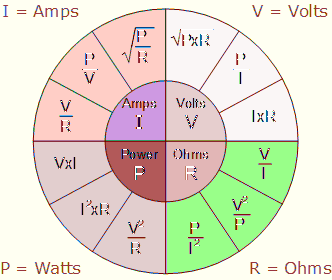
Yes, as that allows more electrons to 'flow' at the same speed. Electrons, which have a mass, are the particles that do the work. But we should really talk in coulombs (an amp per second). There are 6.241509×10¹⁸ elementary charges in a coulomb. -
Advice please on core drilling a slab
SteamyTea replied to saveasteading's topic in Barn Conversions
Shall use the old pipework analogy. You have to get some water from one place to another, in a set time. You can use a large diameter pipe with a slow flow, or a small diameter pipe with a high flow. The diameter is analogous to the amps, the flow to the volts. (the trouble with that example is that it does not take the resistance of the pipework into account, which is assumed to be laminar at all flow rates) -
Advice please on core drilling a slab
SteamyTea replied to saveasteading's topic in Barn Conversions
-
Advice please on core drilling a slab
SteamyTea replied to saveasteading's topic in Barn Conversions
I posted a response, asking you to video it. Don't know what happened to it, seemed to have 'vanished'. -
No good for polypropylene, polypropylene and polytetrafluoroethylene, so that is most of the recycled plastics out then.
-
Small house using I-beam portal frames
SteamyTea replied to pir8ped's topic in New House & Self Build Design
@pir8ped Did you say on the other thread that because the place was small, you did not need the French equivalent to building regs? -
Small house using I-beam portal frames
SteamyTea replied to pir8ped's topic in New House & Self Build Design
Plenty of time then, as long as you live the French lifestyle. Half my family is French descendants, most live well into their 90s. -
Small house using I-beam portal frames
SteamyTea replied to pir8ped's topic in New House & Self Build Design
Well I did my apprenticeship at a materials testing machine company. How much of a hurry are you? Hopefully @Gus Potter will come along with his SE specs on and impart pearls of wisdom. -
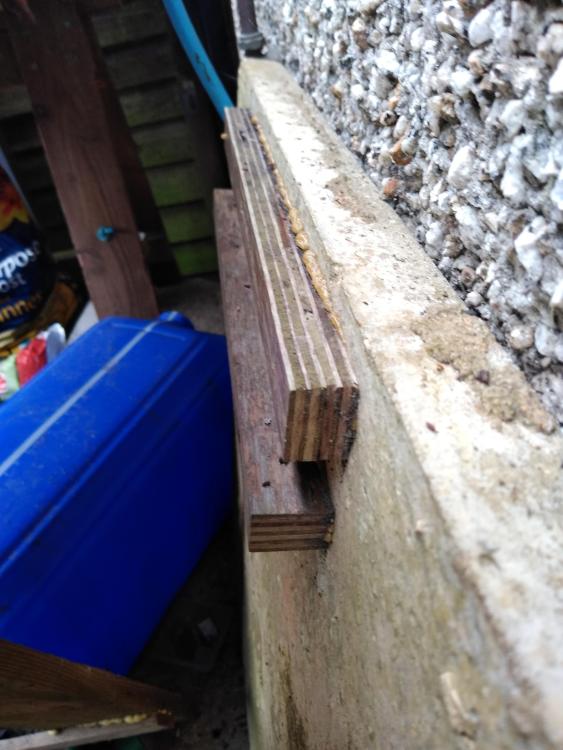
Been to the woods, seems the new owners of the cafe have changed the benches. But no matter, here is a picture of some ply stuck to a slab that has been out in all weather for over a year. I wiggled it and it did not come off. I am sure a tube of Lumberjack will sort you out.
-
I glued a bit of ply to a recycled plastic bench over a year ago. If I can be bothered, I shall pop to the woods tonight and have a look. Generally there are better things to look at in the woods at dusk, but for you, I shall resist my urges and just stick to the plan.
-
Are you saying you have saved £900 over two years on £2500 per year (£5000)? Or saved £900 in your bill, which may be higher than the price cap average. I have not spend £900 on electricity in 2 years, so can't really save that much.
-
Small house using I-beam portal frames
SteamyTea replied to pir8ped's topic in New House & Self Build Design
While I think some calculations, or at least some testing, is called for, a full report from a structural engineer is probably OTT. I did that DIY I-Beam test a while back, which was more about testing cheap adhesive. It performed really well. I am sure a few test pieces joined together in different ways will find out what is strong enough. All that is trying to be achieved is the joint expanding when the cord (think that is the right term) of beam is in tension. -
Small house using I-beam portal frames
SteamyTea replied to pir8ped's topic in New House & Self Build Design
I shall have to look at the sketches. But I don't think you will get away with just butting up I-Beams. -
Short term fix needed. Any suggestions?
SteamyTea replied to TheMitchells's topic in Electrics - Other
Was that 01:00 GMT or BST? Metering times are usually GMT. -
Small house using I-beam portal frames
SteamyTea replied to pir8ped's topic in New House & Self Build Design
Welcome I am going to follow with interest as I think making I-Beams should be simple. Take lots of pictures.