


RobLe
-
Posts
234 -
Joined
-
Last visited
Everything posted by RobLe
-
This just doesn’t match my personal experience. My parents years ago had a timeshare in a triple glazed highly insulated wooden house in the UK, which had hollow sounding plasterboard walls. It was build around 2000, I don’t know what insulation it used. Many evenings in October it was too hot (either due to cooking or solar gain), windows were opened wide for an hour to decrease the temperature. After a hot evening it invariably would be really cold in the morning, so electric heaters were manually switched on as it didn’t have central heating. We all appreciated how wasteful this was, but had no way to change the property to prevent it, and elec was not separately charged. Our retrofitted home now is similarly highly insulated, but has solid walls and floor, and the temperature just doesn’t change much over a single day - and we never heat and open windows in the same month let alone day.
-
We use Thermox DTX in our gshp groundloops at 25%. I found we needed it as the cold heat exchanger iced up once - I was lucky not to kill it😅. The header tank (diy, old school) ended up with a lower percentage and went a bit funny with floating manky stuff in it. I didn’t have any more DTX, so I sieved the header contents to get rid of the worst, then added half a bottle of fernox F7 biocide. That was a year ago, no more floaters, haven’t noticed any issues 🙂.
-
Knackered ballast maybe. Perhaps it has a few shorted turns due to old age and heat. The ballast generates the high strike voltage when the starter bimetallic switch opens - if it’s a bit tired it just won’t be quite high enough. You can often get led replacent strips now, they won’t need a ballast I expect - Ahhh, beaten to that comment 🙂
-
calculating heat loss from window u values and degree days
RobLe replied to rolling-orbit's topic in Windows & Glazing
HDD generally has a "base temperature", which will affect the results. When considering how much heating your home will take to be comfortable, you need a base of maybe 15C - that's the outdoor temperature at which no deliberate heating is required inside. Ie you don't include accidental heating sources such as body heat, incidental electricity use, sunlight, cats n dogs. I think the subtly different question of: "How much energy is lost per year out of the windows" would need a base of 21C. -
I think your electrician doesn't want to bother his a**e talking to the DNO. It doesn't matter if you do/will export - it matters if you can. So if that Solis inverter can export, then the DNO need to know - and if it's over 16A ACrms (which it sounds like it is), then you need to ask permission. If <=16A ACrms, then you just need to inform the DNO - hence a lot of inverters being rated at that limit rather than over it.
-
I have a 3.6kW sunsynk inverter + 15.5kWh Seplos battery (from fogstar). Building the battery was slow but easy, and I think should only be done by people with some electrical experience. It's so crucial not shorting stuff out! I got the vertical 280L battery - big recommend - it's got wheels! Once built, a 15kWh battery is insanely heavy, so wheels are very helpful. Only issue I noted was having to pack out the bottom myself to get good battery compression. We use 7.5p elecy always now too. Well - more like 7.5p/efficiency, and the round trip efficiency is 76% (round trip carefully measured AC-batt-AC averaged over 30 days with a mid certified meter), making it 9.9p/kWh. The sun is peeking out now, so it'll all be free soon!
-
Eps does breathe very well, it’s not XPS which is like a plastic bag. Of course the render must be breathable too. And it doesn’t mind being wet in the slightest - it won’t rot, while natural materials might, that would be my worry. Happy to be shown to be wrong, I’m just a cautious diy-er.
-
Without a DPC i suggest only use materials that do not wick water, and are not damaged by water. My experience of eps is that it’s very resilient against water, and I’m unconvinced about natural materials - cork or wood fibre in the same circumstances. Nb: ive used diathonite internally, and platinum eps externally - all just diy. Eps is by far the easier to use. If you’re avoiding it for eco reasons, check your assumptions - the jury is out on what the upfront carbon emissions are of the different materials, hence which is the more ‘eco’. Eps might be made of oil, but wood fibre takes a lot of kiln drying.
-
I expect if your mains supply is underground it’s less of an issue than up a pole and getting hit by lightning!
-
Need to reduce costs of running Water Source Heat Pump
RobLe replied to MKF's topic in Introduce Yourself
@MKF The graph’s useful, shows the right sort of behaviour from a on/off type of gshp. While the water loop has about a 2C delta, the glycol loop shown has a 7C delta - indicates the glycol loop could do with a higher flow rate. For comparison, we have a DT of about 2C input to output of our glycol circuit. Roughly every 4C drop costs a 10% COP hit. Given the glycol out of the heatpump is often below zero, is there ice on the pipes? -
Need to reduce costs of running Water Source Heat Pump
RobLe replied to MKF's topic in Introduce Yourself
You're right, can't argue with that - more trenching is always better. It's always a compromise though - effort versus efficiency - and it's made it through 2 winters so I think it's ok. It's not like "ground freezing" is a on/off thing - it would be gradual as there is so much latent heat released during that phase transition, I'm not worried. Allegedly shallow horiz systems get better over time, as the earth compacts. @saveasteading The "wasted" pump energy will raise the water temperature of the flow water marginally - if indeed an oversized pump is used. It would be pretty much waste - it's definitely not all going into the house. I am to be convinced this is the case; it's an odd install decision. -
Need to reduce costs of running Water Source Heat Pump
RobLe replied to MKF's topic in Introduce Yourself
A WSHP with a shallow supply isn't fundamentally a problem. It sounds like the temperature of supplied water is higher than we get with our horizontal pipes 900mm below ground - I think they are around 3C now, which is ok as they have glycol in them. For comparison, our flow rate is 12lpm, so I anticipate you'd need around 36lpm due to the 7.6kW(heat) rather than our 2.5kW(heat) system. The power needed to lift water by 4m at 36lpm I think is 4m * (36/60) * 10 = 24W, ie. not significant. Perhaps the pump is a problem; maybe it isn't running at that power though. If we had a 4m borehole that could supply that water, I would have used it instead of hiring a trencher - the borehole is cheaper, simpler, and better. The only issue with it might be contamination, but I understand you backflush to prevent this. -
Need to reduce costs of running Water Source Heat Pump
RobLe replied to MKF's topic in Introduce Yourself
That is one big pump - perhaps it is turned down? We have a 2.5kW(heat) gshp; the glycol pump is 40W and is included in the elec meter figures. A common rule of thumb is for the pump to be below 10% of the compressor power. A similar comment could be applied to an ashp; sometimes only the active compressor power is considered, not the external fan nor controls nor other pumps. -
Need to reduce costs of running Water Source Heat Pump
RobLe replied to MKF's topic in Introduce Yourself
Do you have any independent measurements? I realise that the heatpump may have heat out, electricity used figures, but they may or may not be accurate (accuracy costs money). If you haven't I would definitely recommend a mid certified electric meter feeding the heatpump (and anything associated, if there is a separate borehole pump etc). A suitable elec meter is pretty cheap (<£50), I think all heatpumps should have them fitted by default. You can also get independent heat monitoring equipment - this will cost more, I think £500 or so, and with both meters an accurate COP can be found. There are many reasons for high electricity useage, and it's quite difficult to untangle them without definitive measurements: Something else using power Higher than anticipated heat required Poor COP: high temp rads, low input water temp, wrong refrigerant charge, backup immersion on, internal W2W bypass leaking through Good luck! -
Start collecting big pop bottles. Fill them with a 10% salt water solution, which won't freeze until -10C or so. Bury them in a line, upright. It should give a few extra degrees before this bit of path freezes, as it sucks up heat from a greater mass of soil underground. If you put loads of them down it's perhaps more likely the earth below freezes, so it won't work so much. It's (almost) free! Try it ?
-
We have a 15.5kWh Seplos Mason battery, it comes as a kit from fogstar here and it cost £2550: https://www.fogstar.co.uk/collections/seplos-mason-kits/products/seplos-mason-280l-and-x16-grade-a-eve-lf304k-battery-bundle You do need to be very careful assembling it, it's not for the faint hearted. Personally I think this sort of thing belongs in a garage, even though they are the "safe" type of cells (Leaf ones are the dodgy "vent with flame" type btw) It connects to a 3.6kW Sunsynk hybrid inverter, and for the moment there's no PV. This has been handy as I've had a mid-certified in/out elec meter put inline, so I can calculate the efficiency. In our case we get an overall 76% round trip efficiency. While this sounds dreadful, this encompasses charge, discharge, and also standby stuff - I think it's to be expected. There's 3 of us at home, in an all elec house with a gshp and elec car. We use on average in winter £2.50/day of pretty much exclusively "go" electric. Without the battery we'd pay another £4 ish per day in winter, but I'd need to try a lot harder to actually work out payback though. And the entertainment value is worth it alone 🙂
-
Passivhaus - safe with power outages?
RobLe replied to puntloos's topic in Environmental Materials & Construction Methods
I don't think it should worry you. I notice rooms are stuffy around 1500ppm - there's still a long long way to go before it's acutely dangerous: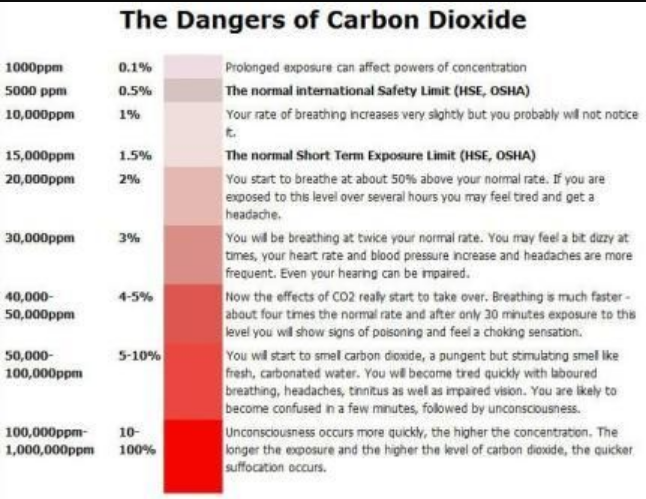
-
I’m a big fan of expanding foam in any gaps, having used it all over the place! Having said that, any piccies ? I’ve never yet seen a big standard window fitted in a thermally effective way; usually there’s big gaps all round with a bit of trim and silicone so you don’t notice. Do you have condensation, or some other reason to attack the reveals ?
-
Is there anywhere inside your thermal envelope to put that cylinder? Most lofts are very cold, and there’d be a lot of extra loss from a 200l tank and all the gubbins associated with it. Failing that, can you make an insulated room for it perhaps? I expect a lot of your useage is dhw rather than heating at that very low level, which is commendable ! Perhaps one of those water heater type heatpumps would then be appropriate (eg Vaillant aroSTOR, although there are many makes). If you’re grant eligible, I expect that rather skews things towards something more standard.
-
Clean Heat Market Mechanism to incentivise heat pumps
RobLe replied to LnP's topic in Air Source Heat Pumps (ASHP)
CO2 fits all of those criteria. Sadly it needs ludicrously high pressures (like 150bar instead of the usual 15bar maximums), so I’m not convinced it will go mainstream. If you could fit a propane system together without brazing, it would be safe enough for diy I think. We’ve been looking for magic new refrigerants for 100 years, and we’re back to one of the earliest ones - propane - again, so I wouldn’t hold your breath waiting for a significantly better one. -
Add insulation to the garden room ? Add a fan boosted radiator ? Zoning and time division multiplexing will reduce the amount of time the HP is heating the garden room and the house - so they would both need higher flow temps while they are on, and the HP get a worse COP for both cases.
-
Sucking is likely better than blowing for this application. Blowing is directional, and has significant turbulence - good for heat transfer admittedly, but it will vary hugely over the heat exchanger - not what you want. Sucking gives a more even laminar flow over the whole heat exchanger. No puns in there 🙄
-
You def need some sort of charge controller, or the batt will die - the cheap ones tend to be PWM only - I think they're fine if the panel is about the right voltage for the battery. MPPT will perhaps double the current (hence power) output from the panel - eg this one: https://uk.renogy.com/renogy-rover-20-amp-mppt-solar-charge-controller/?Rng_ads=03b67fab5b39c2aa&kw=&ad=&gr=&ca=20759790391&pl=ga&gclid=Cj0KCQiA6vaqBhCbARIsACF9M6n-o8GFD95rBOJdUawQzalez1l8EGmQBSzacZ-BLyoECsXhTQDmfC0aAr2iEALw_wcB&gad_source=1 Only you can decide if it's worth the extra money!
-
I can see a lot of thermostatic valves for the underfloor stuff - my perhaps obvious comment is that you really want the UFH to run at the same temp as the heatpump flow - if that valve is dropping the temp then it will give a COP reduction. Pool rooms often have high humidity - how do you cope with this? I suggest that an MVHR would be useful, keeping the RH under control without huge ventillation losses. Does the pool have enough insulation under it? Where does the heat go from it, if it is the greatest loss for the house? We have a gshp now. We used to have solar thermal with a dual coil 200l tank, the top coil was originally for a gas boiler, bott for the thermal. Now that tank has the coils plumbed in series, the flow going to the top first, lower coil after that. It increased the surface area of coils - so the tank gets much hotter now with the same flow temp (generally 50C stored water). It also has the advantage that the gshp is exercised all year round - I'd rather not leave it off for 6 months, only to find a problem when it's actually needed in winter! nb: the "push" to make the coil change was a particular cold snap, and one of the thermal panels bust, no probs for 10 years then gahhhh. Freecycled the other panel.
-
Present ASHP monoblocs are best installed with WC, which is basically a feedback loop controlling the flow temperature by adjusting the compressor and fan and pump power based on a temp sensor outside and a controller in the hose. I honestly don't why they bother with the feedback loop? Why not control the ashp output power (ie compressor/fan/pump speed) based on the outdoor temperature? The reason I suggest this, is that makes the system agnostic as to radiator sizing. Sure more rads running together or UFH will be more efficient - but this requires WC changes, which a regular plumber can't be bothered with. So with this idea when installing, maybe you'd figure you need a 9kW ashp say, plumb it in. Call for heat like with a gas boiler it's probably replacing in the uk - and it delivers 9kW if it's -5C outside (where the unit is, no need for wires), or 3kW if it's 15C or whatever. On top of this, as has been suggested, a thermostat for fine tuning (which you likely have anyway)- it won't kick in and out too much as the system power is only a little more than needed at any one time. And another control wire for DHW - this would just go full wack until 60C flow is achieved, then off. I just don't get why present units use weather compensation, which adds a whole bunch of complexity to give constant flow temperature, which isn't actually useful - we need constant power! Nb: for ref, we have a diy gshp, constant power 2.5kW unit controlled with a thermostat. No fuss.
