


gravelld
-
Posts
526 -
Joined
-
Last visited
Everything posted by gravelld
-

Internal edge beads agains window for wet plaster
gravelld replied to gravelld's topic in Plastering & Rendering
Which caulk did you use? -
Internal edge beads agains window for wet plaster
gravelld replied to gravelld's topic in Plastering & Rendering
I can't quite picture this - to be clear here's what I have: Does that work with your plan? Is the 20mm gap big enough to fit and fix the stop bead? Do you put a bed of plaster before the thin coat?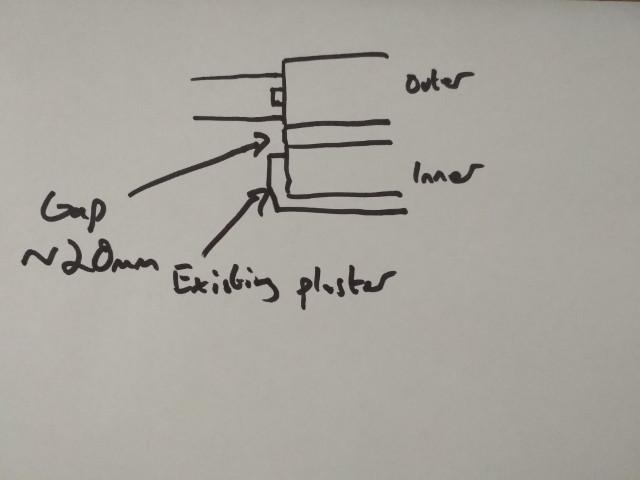
-
Can Compacfoam take the load? Compressive strength calculations
gravelld replied to gravelld's topic in Doors & Door Frames
Eeep, copied the wrong figures across - I included some extra frames either side in the mass but forgot to update the N. Thanks Ed. -
Can someone check my calculations are right? I have a slider - depth 174mm, length 4500mm. Weight is 405kg (3924N). 174 * 4500 = 783000mm2 (I assume it's the surface area of the weight rather than the CF that is used). The compressive strength of CF200 is 1.01N/mm2 - http://www.compacfoam.com/26-compressive-strength.html http://www.wiki-compacfoam.info/wiki/dichteklassen So 783000mm2 means it can cope with over 790830N and so... easily?
-
We've got a load of internal reveals to make good, meaning fill in the wet plaster between where the plaster has been cut and a newly installed window. This is generally about 20mm gap. Do any edge beads exist for wet plaster to keep a nice straight line, avoid cracks between plaster and window, and not have the plaster on the window frame? Ideally I'd then put an acrylic sealant between bead and window. All I can find are edge beads for plasterboard, e.g. https://www.amaroc.co.uk/collections/thin-coat-plaster-beads/products/locusrite-thin-coat-stop-beads-2-4m I think these are added on Could I use https://www.wemico.com/pvc-window-frameseal-beads-dup which is normally for external render?
-
There will probably be more than one supplier in your area, do some searching and also get in contact with some different manufacturers - Rationel are generally on the value end but they can be matched.
-
Rationel windows, with different sliding doors.
gravelld replied to Russell griffiths's topic in Windows & Glazing
This is quite common in my experience - Rationel have a lower maximum slider size than some other manufacturers. -
I actually wired mine to a smart plug so it can be automated with other things, but again that's because of my use case.
-
I've actually taken the plunge with this, will report back at some point.
-
I've actually just had ours fixed (the pump was broken since we brought the house). It's not actually for recirculation to the taps though - for us it's actually used to circulate the hot water out of the top of the HWC, where the water is heated by an immersion coil powered by PV, and into the bottom. Otherwise, we only get 1/3 of a tank heated by the PV. I just run it for ten minutes as soon as the immersion coil hits 60C. If we didn't have such a silly design to begin with, I wouldn't bother, for the reasons @MikeSharp01 explained. You can do the calcs to work out the volume of water in the pipes. Another concern is overheating in a high spec house (the pipes become radiators). Naturally, all pipes must be lagged, and then ideally lagged/insulated again!
-
You get Passivhaus Plus, which is a pretty good magazine.
-
@Clive Osborne when you use the term "efficient" - what do you mean? From your last post, it appears you just mean time-efficient, not input-energy efficient.
-
Our DHW loop has three showers on it - one with an integrated pump, fed from a cold and hot water tank, and two with an external pump for which the pump turns on when water is drawn through it. These are also fed from a cold and hot water tank. I want to fit a recirculation pump to the DHW circuit. Is it ok to have more than one pump working at once? This sounds wrong to me...
-
Your Home Base Load / Background Power Draw
gravelld replied to MrMagic's topic in Photovoltaics (PV)
Absolute base load about 125-150W, although rarely see that - one of the many fridges/freezers tend to kick in! -
For this use case, increasing ventilation, I feel a solution already exists - a ventilation system. Windows are not very good ventilation systems because they rely on ambient pressure and they are even worse for cooling during the day because there's barely any temperature delta (although they can provide a perception of cooling when, and only when, you are standing next to them).
-
The speed might be ok, but with the output of 200W surely there's not going to be enough torque to turn a blade through (potentially wet) grass? Or am I misunderstanding the application of the output here?
-
I have one external wall light. I want two extra lights. Is it possible to: - Install some kind of junction box where the current wiring comes out of the wall into the existing light - Cut a groove in the existing rendering for the armoured cable for the two extra lights, install the cable, render over again (we'll be painting anyway) - Wire in all lights to the new junction box - Fit the lights AIUI this isn't a new circuit, just extending the existing one. Is this notifiable or Part P work?
-
You have to replace the inverter of course.
-
Can I wire a plug to a internal circulating pump?
gravelld replied to gravelld's topic in Electrics - Other
Thanks everyone! -
Going to get one of these: https://www.anchorpumps.com/grundfos-ups-15-50n-130-hot-water-service-circulator-240v I understand this comes without a plug. However I'd like to wire a plug so I can just use one of my smart plugs to turn it on and off. Is this permitted? And if so, how do I do it? Max current is 0.23A. Wiring diagram looks simple enough! https://product-selection.grundfos.com/product-detail.product-detail.html?custid=GMA&productnumber=97549426&qcid=544221119
-
Extractor not staying on (on lighting circuit)
gravelld replied to gravelld's topic in Electrics - Kitchen & Bathroom
Thanks. Fitted the new cable today, works a treat, trickling away with the light off! Thanks everyone. -
Extractor not staying on (on lighting circuit)
gravelld replied to gravelld's topic in Electrics - Kitchen & Bathroom
Oh - both earths terminate in the same block in the isolator? Duh.... -
Extractor not staying on (on lighting circuit)
gravelld replied to gravelld's topic in Electrics - Kitchen & Bathroom
Regarding using an isolator, what do I do about the earth? I can park the earth from the junction box in the back box of the isolator, but what do I do about the earth conductor in the cable running from the isolator to the fan? The wiring diagram on the isolator suggests earth from the switch is parked in the isolator, and earth from the supply goes to the fan, but the fan does not need earth. -
If that happened either the weather is getting past the aluminium, which means the warranty applies (most of these windows have 10 year warranties), or water's getting to it from inside, which sounds like it's not a problem with the window. The design of the alu cladding does change from window to window. Some have cavities. Some fill in the cavity with insulation for better U values.
-
This is it - you can't be overly broad about comparing windows just based on the material. You can get PVCu that is more expensive than wood etc etc. @patp you didn't mention alu-clad timber or alu-clad PVCu which is another option. Alu tends to be the best for low maintenance and high durability.
