


gravelld
-
Posts
526 -
Joined
-
Last visited
Everything posted by gravelld
-

Chopping back reveal plasterwork without removing windows
gravelld replied to gravelld's topic in Windows & Glazing
Well - that's interesting. Neither of the two remaining bidders 'want' to do it, they are saying it would be cheaper for a contractor already on the job to do it. -
Chopping back reveal plasterwork without removing windows
gravelld replied to gravelld's topic in Windows & Glazing
So it sounds like it is possible to do, but better to do both at the same time? -
Compriband on window replacements - how to finish paint coating?
gravelld replied to gravelld's topic in Windows & Glazing
So I think it's fair to say there's not the same level of scepticism about mastics between render and window as I retain! -
Want to replace some windows that are currently fitted with straps. Mixture of wet plastering and plasterboard on the internal reveals. I need to chop back the internal reveals to install the new windows with straps. The new windows are at least 30mm deeper than the current windows. I need to know if we can chop back the reveal plaster without removing the current windows. Then, when the replacements come and the install team are in place, remove the window and install the new one fixing with straps (making good later). Or is it best to remove the original windows first? I'm concerned about security and I want to try to simplify the installation process by reducing dependencies between contractors.
-
Compriband on window replacements - how to finish paint coating?
gravelld replied to gravelld's topic in Windows & Glazing
I can't use a render stop bead as I'm not re-rendering (unless I misunderstand). Type of windows - alu clad 3G. What render to window sealant products are recommended by those here? Don't want to take chances with this for obvious reasons. -
Compriband on window replacements - how to finish paint coating?
gravelld replied to gravelld's topic in Windows & Glazing
I don't really trust the sealant to last. If the sealant has gaps in, and the foam has gaps in (we know it's generally inelastic - even Flexifoam doesn't expand very well and keep adhesion) then that's more air movement through and around the window, giving a cooling effect. I was hoping C would provide a longer term full seal of the gap. Also, different topic because we're now talking about two 'sealants', what about water getting in behind the render to frame sealant? -
Compriband on window replacements - how to finish paint coating?
gravelld replied to gravelld's topic in Windows & Glazing
Thanks - bear in mind the house is already rendered - this is refurb. -
Compriband on window replacements - how to finish paint coating?
gravelld replied to gravelld's topic in Windows & Glazing
Yeah - I realise in a rendered masonry new build we would probably have render beads on the windows themselves, so the render covers where the compriband is. But here, the rendering already exists in the reveals and the replacement windows will be fitted in behind that render. I just realised I've been thinking about this in the wrong way. If the existing render finishes at the existing windows, should the compriband for the new windows be between the new window and masonry and therefore be invisible behind the existing render? I suppose it depends how good a fit we get in the aperture with the new window, so long as the gap around the window is no more than the thickness of the reveal render the foam tape should be invisible? -
I want to specify Compriband (or equivalent) as part of replacing our windows. The house is rendered. We will also be repairing the render and recoating with a flexible paint after the windows are installed. So how should we paint up to the Compriband? Obviously, I don't want the paint to be touching the foam...
-
Also consider the cost and ball-ache of fixing it later. We will probably have to fix the current just-passing-regs walls in the future.
-
Sounds like my journey @Ferdinand - see the other thread on high build coatings. Turns out there are flexible paints out there which can accommodate, to some extent, cracking in render. I'm still in the middle of researching this. By the letter of the regs, if you re-rendered you would have to upgrade the thermal element. But there are loads of exemptions and general word on the street is that it's possible to avoid if you simply prove the extreme cost would be a problem.
-
Good to hear, thanks. Sounds like I have a new plan forming... any specific product reccos gratefully received.
-
I did a bit more research and it looks like there's a category of paints called "elastomeric" paints which are supposed to be flexible. Bedec Extra Flex Masonry is one product I've seen mentioned. I wonder if it would be best to patch then paint with one of these products... this might retain the existing texture.
-
Yeah, that's the problem - most of the finishes seem a bit too rough for me. There is a smoother option with a flat trowel I think but even that looks a bit rough. It's an intriguing (new) idea (to me) to patch and then paint with something that has some elasticity and is easy to maintain. This means I could save up for EWI down the line.
-
"High build" - this was the product specifically: https://www.sandtextrade.co.uk/product/sandtex-trade-high-build-textured-decorative-coating/ Depends how much it costs. EWI would need a lot of enabling works - the gables would need extending, meter box, waste pipes, drains, one of the lean-to roofs would also have to be treated... In fact originally I wanted to do EWI but gave up because (1) the cost of the enabling works and (2) the sheer complexity of thinking about it all. Fresh coat render sounds more expensive, but maybe it's an option. I didn't realise you could get a renderboard over existing render. Our verge overhangs (at the gables) are very shallow, about 40mm, not sure if that's an option. Eaves overhangs are ~200mm. I've seen products like this: https://www.parex.co.uk/External_Walling_Systems/Non_Insulated_Render_Systems/Rendering_-_Lime/Base_Coats_-_Lime/Parinter.aspx which I believe have a mesh in them, then top with the covering of your choice. But rendering seems to bring extra cost, e.g. scaffolding (the "high build" is referred to as "painting" by the builder who seems to think a scaffold tower at most is required).
-
I've sand and cement render on my house. Some of it is shot, but most of it is still on very nicely. There are also quite a lot of small cracks. I was going to have the render taken off and silicone render applied. However, a builder suggested patching all the shot bits and cracks and then putting a layer of "high build" on. This is because taking the render off will be a huge job (> 220m2) especially where the render is sound and we might damage the blockwork underneath. He reckons that when cracks form (which he seems to think will inevitably happen to all renders including silicone based ones) you don't have to grind out and re-render the crack, you just repaint this high build stuff back on and make good. This is a bit of a new one to me - I'd been led to believe modern renders solve most of the problems of S&C (correctly applied of course) and so this new option is a bit... disorientating. My other concern is: can you get smooth versions of "high build"? They look a bit overly textured to me. I want a modern look.
-
This is just for taking the old render off and doing some other jobs at the eaves - full scaffold will be up for the rendering itself. The other option is to remove the render with the full scaffold, but that means paying multiple people to work at the same time due to the scaffold cost, plus I won't necessarily get to do "my jobs" (air tightness, insulation, roof ventilation) at the eaves. Thanks for the ideas, will investigate.
-
Thanks! The 25 degrees lean to is ok to walk on carefully, but I don't think it's suitable for working on, especially not with a breaker. There's only one "open" side so we can't span across. Plus it can be accessed along the length. That one is about 2-3m deep. Attached is the photo - "SE.jpg". The other one is more like 35-40 degrees, about 1.5m deep and can't be walked on. Again, only open on one side, so can't span. On that one the closed side is a rendered wall where the render is going to be replaced, so I could fasten something on that. This is "NE.jpg".
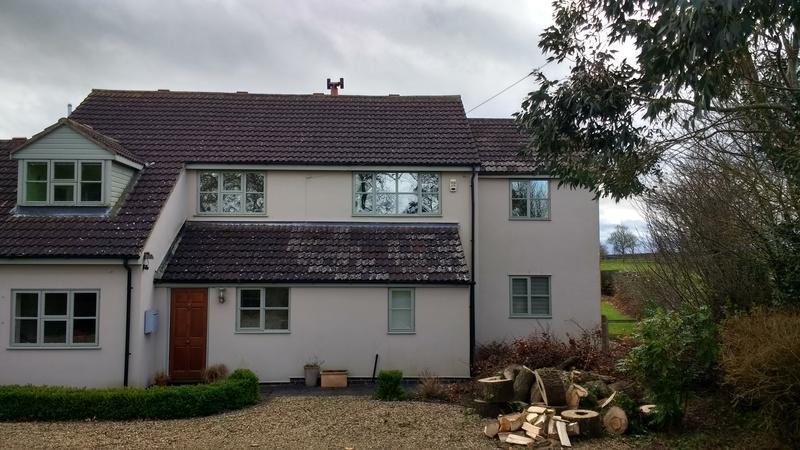
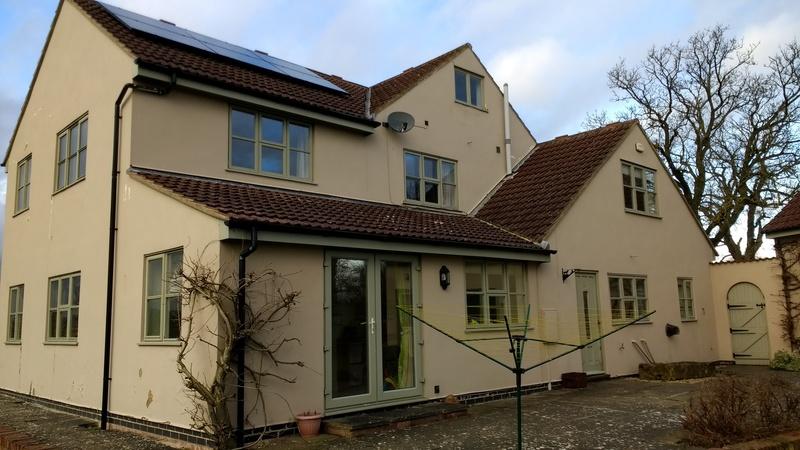
-
I'm thinking of hiring a scaffold tower to save a bit of cash and do some render removal myself. But we have two fairly deep lean-tos at about 3m in depth with a shallow pitch of about 25 degrees. In both cases the lean-to is open to a gable beneath at one end, but not the other. I've seen there's such a thing as "cantilever" scaffolds for towers but they aren't deep enough to reach the full depth. Is this something I have to have "proper" scaffolding for?
-
Lag them; don't try to do two jobs (DHW and space heating) with one solution. Also, if you build to a high spec you've got a potential over heating problem.
-
What about, in an all electric setup, having multiple instantaneous water heaters? Would've thought you'd need 3 phase for that in case two or three or running, someone turns on an electric shower and someone fancies a cuppa (or maybe I'm catastrophising).
-
Air tightness is a major factor in the overall performance of the house, and it's the performance that dictates your heating requirements. To work out your heating requirement you need to create an energy model, of which air permeability is an important element. So the answer to your question of what values you should be looking for is... it depends.
-
Wood burning stove and flue install
gravelld replied to ProDave's topic in Stoves, Fires & Fireplaces
Doesn't the pipe in the bedroom get a bit hot - don't you need to guard around it? -
Window Companies Alu Timer/Alu PVC
gravelld replied to canalsiderenovation's topic in Windows & Glazing
Likely better performance - wood is a better insulator. More hackable - if something goes wrong you can fix the timber and re-affix the cladding (although obviously this will be far more of a job than plain timber). People tend to prefer the softer wood aesthetic (painted or not) internally. -
Window Companies Alu Timer/Alu PVC
gravelld replied to canalsiderenovation's topic in Windows & Glazing
On its own PVCu is low maintenance but I wouldn't call it high durability, at least not as durable as aluminium... but it probably depends on the context and the manufacturer (and installer!) In most cases I see aluclad PVCu as a cheaper way of getting alu-clad and therefore the look/durability of alu.