

Marvin
-
Posts
2382 -
Joined
-
Last visited
-
Days Won
3
Everything posted by Marvin
-
Or the oil tank
-
Plaster board direct onto timber without battens?
Marvin replied to TheMick's topic in Plastering & Rendering
Ditto -
who's supplying the scaffold?
-
Not without measuring the Bowl contents
-
What I meant was, more recent models that already solve these problems.
-
Yes I bought a flow sensor but that went off every time you have a weeee. We have now resorted to a non latching pullswitch by the side of each loo with a time delayed relay to turn it off again.
-
If you are going to live in the building for a long time then the more insulation the better in my book, and by the look of the snow the more the merrier!!!! Airtightness is also very important or a little more so in some ways. The cash flow is always a consideration. My thoughts are if you need to find more money (or spend less) to complete the job the way you want, then defer works that won't cause you to redo works later. I can live without an expensive kitchen for a while longer, or no garage if separate, or landscaping for example, But I want to be warm and dry with loos and showers that work with lower utility bills going forward. We insulated and sealed against air flow and installed a MVHR system when renovating our 100m2 bungalow, and replaced the night storage heaters with a bottled gas fed boiler. (no mains gas) We toyed with the idea of PV but weren't convinced that the outlay was worth it. This all changed with the arrival of the electric vehicle and the option to have an ASHP also using electricity. We now have what I think is the best combination of ASHP, MVHR, PV and EV. Would we have afforded all this at the time of building? No. However retro fitting some of the services through and airtight building has been a real pain. If you think you would fit anything later swot up on all the information on how to obtain the best from the proposed system and what the pitfalls are, and you may be able to prepare some of the things to avoid lengthy ( and costly) alterations later. Good luck. M
-
At least they will not be able to complain to me as I will be dead.
-
Hi @JohnMo Your comment: Why does MVHR need complex control or even coupling to home automation. My opinion: An MVHR system doesn't have to have complex controls or coupling to home automation. HOWEVER, several issues have arisen with different parts of the building and these controls have been introduced over the last 4 years to overcome these, and also the control of water coils added to the ducts due to the lack of emitter (radiator) area required for the ASHP to function properly. Your question: It's supposed to run at a constant flow 24/7, except when on boost? My opinion: Your quite right. In fact if there isn't a constant flow of air through the system this can cause problems. HOWEVER, when required to boost (due to a humid shower room, or heavy cooking smells in the kitchen, or even after the loo has been used) this options speeds up the air flow to the whole building not just the effected areas. Your thought: My option is you are making things complex for the sake of it. My comment: Have you been talking to my wife? Actually there are valid reasons due to this building, its location and its use, as to why we wanted more controls. The main issues were heating and cooling requirements caused by solar gain because the windows are all east and west and the supply of either heating and cooling to combat the problems. Even if I was not able to add the controls I absolutely feel that a normal MVHR system is far better than no MVHR at all. And finally, I see in more expensive and more recent models that several of the problems are already integrated into the system. We bought a very basic model. Good luck M
-
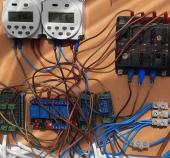
This is what my system controls would look like if I didn't have a computerised home automation system: Wait a minute, I haven't got a computerised home automation system!
-
Since January 5th we have used 222kWh on the ASHP over the last 26 days. That's about 9kWh per day for heating and hot water. However some days the hot water temperature has been boosted by the PV excess power going into the immersion heater so let's assume 8kWh per day for 100m2 home. The heating is running 24 hours a day at an average of 20C. The outside temperature has been low (I will look up the records later) with only about 4 nights of frost. Results from trying different programmes seems to indicate that running the heating all night at about 2C lower than day temperature uses less energy than turning it off over night and letting the building drop lower and then reheating in the morning. Some mornings at 6am it is a lot colder than between 10pm and 4am and I think the ASHP has to work alot harder in a colder temperature a lot longer to enable the house to reach the required temperature. Interestingly, when we were out all day the system used even less power to maintain temperature even though we left it running. Another item that effects these results seems to be the amount of power used in the building almost regardless of the purpose of its use. I will start keeping a record of the whole house energy use to observe the results. Another is solar gain. Others are leaving doors open for extended periods of time, and body heat from things like housework. When we were leaving the heating off in the night I noticed that the north east bedroom became colder than the rest of the house. Having installed the insulation and vapour barrier myself I reason that this is due to wind chill as this is the most exposed part of the building. The ASHP Ambient Temperature probe registered 15.6C two mornings ago at about 9.30 in the morning although it was actually only about 6C. This caused the ASHP to lower its output temperature and the house was a degree or two lower. So I have shielded the probe against direct sunlight and this seems to be working.. The weather compensation mode in the ASHP control system relates the outside air temperature to the ASHP output, in an attempt to produce the minimum heat required to satisfy the temperature required in the building. Set up correctly this will lower the temperature of the ASHP output in line with a rising outside temperature and vice versa. In my opinion, the setting of the weather compensating levels would need to be adjusted for each individual property in order to have any chance of success. Because this bungalow can over heat when the outside temperature is above 10C I have adjusted the water temperatures down in the weather compensation control area. We have not tried out the cold settings yet as the weather has been mild. The coils in the mechanical ventilation heat recovery (MVHR) ducting work well in heating mode. The air from outside , at about 5C, goes through the heat exchanger ( raising the temp to about 19C, then along one of the main supply ducts and through the heated water coil (water circulated from the buffer tank), before splitting up into outlet ducts and entering the rooms at about 26C. The cooling opperation will have to wait until the summer to be tested. Having installed additional insulation around both the hot water tank and the Buffer tank the loss of heat greatly improved. The utility room is now at about 21C unless washing is going on. I am very glad we managed to keep all the tanks etc inside the building's thermal envelope and all the 28mm pipes with maximum pipe insulation. It may be this is long and boring but hopefully someone will read this before installing an ASHP and benefit from my experience. Good luck. M The best combination:
-
The pipes on the outside of the house make me wonder how much heat loss when in winter the wind chill factor to -5C and the water at 55C travelling 8 meters in each direction with what looks like 13 or 19mm pipe lagging....
-
No problem with the plumbers work. Just how not to design an installation for the best results..... If ever there were things to avoid, I think there shown here.
-
My brother in law, who lives near Rainham in Kent, has a typical 4 bed 100 odd square meter semi detatched block and brick 2 story 1970s house which requires all the ceilings to be plaster boarded skimmed and coving installed. Having been trained by British Gypsum I have been roped in to tack up the ceilings and he is now looking for a plasterer to do the ceilings and coving in late February. Any recommendations? If so Personal Message (PM) me. Oh, and for coving, being typical 127mm type, what product is best to use? Gyproc? Polymer? Or? Thanks Marvin.
-
Assuming the pipework from the ASHP to the emitters is not too long and very well insulated.
-
?
-
Hope you've fixed your heating...
-
Our ASHP unit runs most of the time and in the morning when it is not running its about 5C warmer than the air or surrounding surfaces
-
Most people around here think its an air conditioning unit.
-
As far as I'm concerned I don't have that capability.
-
I have no fans. Even my wife is not impressed.
-
Maybe, but on the EPDM flat roof on the south side of the bungalow there's definetly warmer air hitting me.
-
If you use it for cooling in the summer then perhaps better out of the sun?
-
Well I do but I don't necessarily know what I'm looking at....
-
+1.
- 12 replies
-
- 1
-

-
- ashp
- compressor
- (and 1 more)
