Marvin
-
Posts
2389 -
Joined
-
Last visited
-
Days Won
3
Everything posted by Marvin
-
 Yes... However nothing these days seems that simple....The ASHP is not on standby all the time because it is used now and then. During the year when the average 24 hour temperature is above 16C we don't need the ASHP on.
 -
Further to @Temp's reply in @joe90's topic Can we keep the lights on this winter? Our ASHP has it's own main electric meter with nothing else connected. Testing over hours, it appears that my previous estimation of the standby power consumption is about right. The results for our ASHP on standby is a rate of about 82-84 watts, so total used for 24 hour standby is 1.968-2.016kWh assuming no power used for the heat protection of the ASHP. This was measured with an outside temperature no lower than 8.8C over the last 24 hours and no lower than 9.9C during the period of measurement. Bearing in mind that the ASHP compressor must be warm enough to work without causing excessive wear, and requires 12 hours of standby after the outside temp achieved rises above 5C, this may mean that we cannot turn the ASHP back on for 12 hours after a power cut! I hope every ASHP owner with the same compressor requirement is aware of the dilemma of either having no heating for 12 hours or risking excessive wear of the compressor. Marvin
-
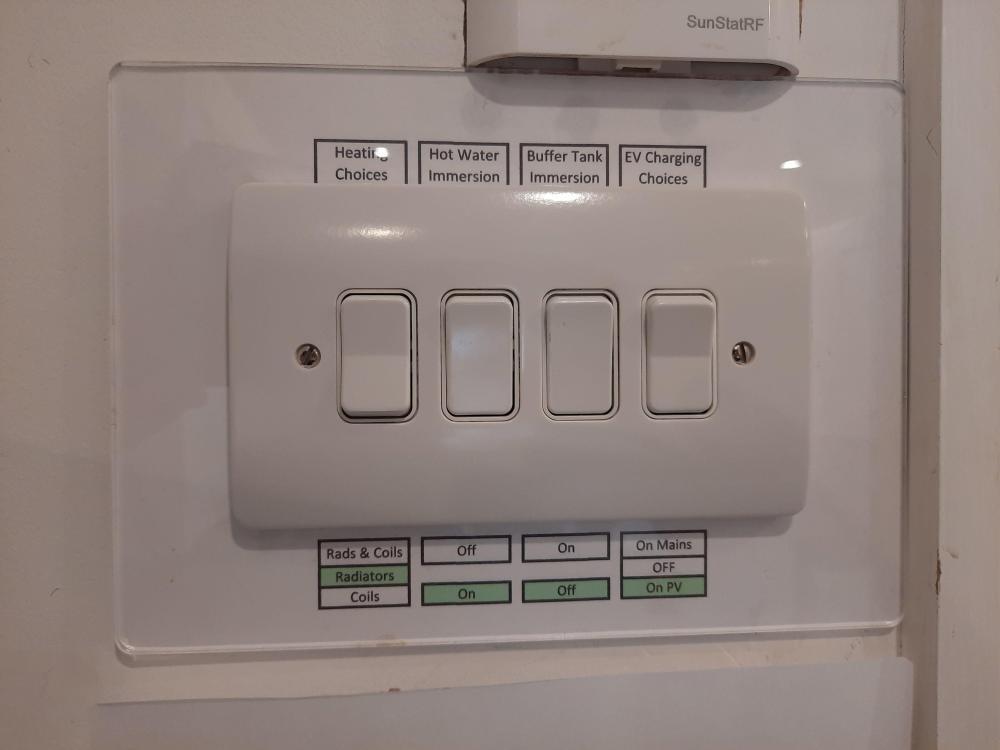
PV to hot water and heat storage controls schematic: This system only uses the excess PV power (unless the Solic 200 button to use any power is pressed, and then it will allow any power for 90 minutes). There are three output choices. Firstly to the hot water tank immersion until the tank reaches the temperature set point, then to one of the two storage heaters as chosen. Although some people have mentioned that the Solic 200 (other types I cannot comment about) will limit the power through it, this design is limited to one output at a time which is a maximum of 3kW. When the hot water tank has reached its target temperature the controls automatically offer the excess power to the MK 3 way switch( K8). This part of the system is designed for our home. The choices are power to the hallway day storage heater or power to the timer which switches between the hallway and living room one. Today we stored about 2.8kWh for overnight heating. Any questions, let me know. Marvin
-
PV EV charger control schematic
Marvin commented on Marvin's blog entry in ASHP, MVHR, PV and EV combo
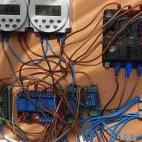
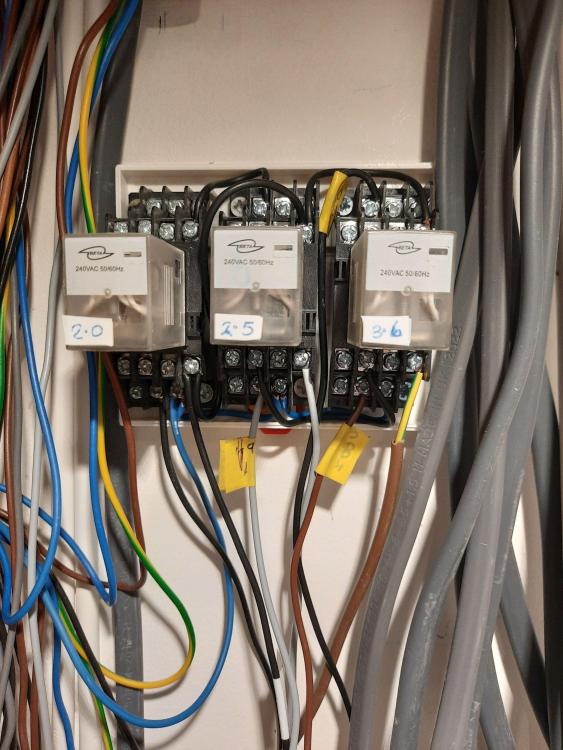
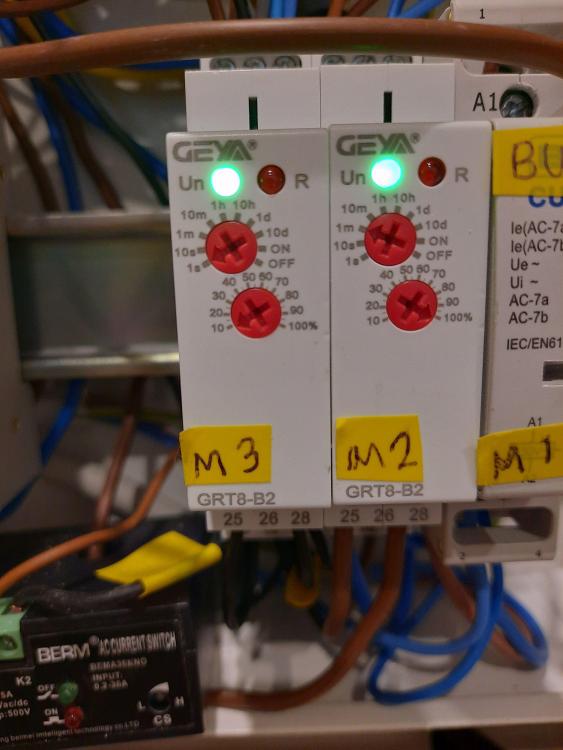
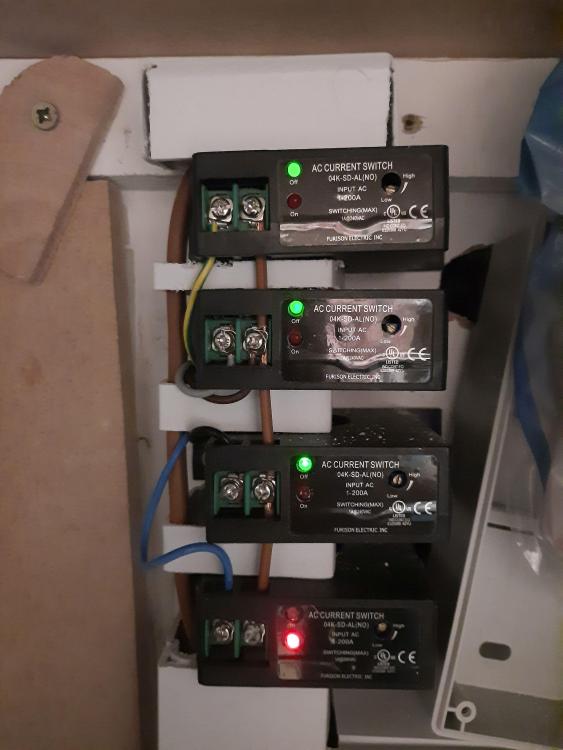
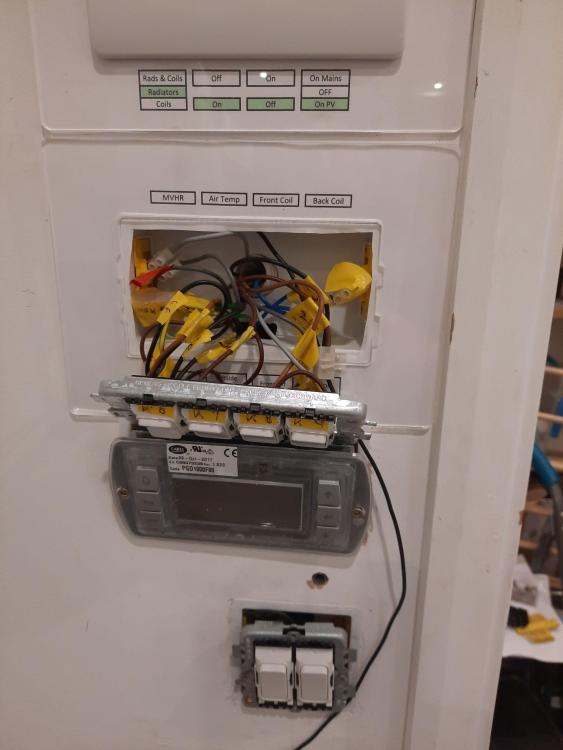
Hi @TonyT It may be relay based but the whole system (MVHR, Hot water, ASHP central heating, day storage heaters, EV charging and PV monitoring, with battery back up still to do) is now about 120 wires, 12 switches and 20 relays. I am still designing and writing up the shoulder season heating which is run off our Solic 200 at the moment, however this will take a few days. We have 'day storage heaters' relayed after the hot water reaches temperature! Checked this out with the manufacturer and they do the same in their showroom office with an oil heater but I wanted it for the night when paying for the power to the ASHP. CT adjustable relays showing supply of over 1kW CT adjustable relays behind protection... Relays to the 3 CT adjustable relays. Far MK 3 position switch (K5) to choose EV charging options Second MK 3 switch (K9) out at the moment: Choosing what level of power to turn the EV charging on with. Switches M2 and M3 and CT Relay which activates green light when car charging. All of this could be installed in one box but we have no room and K5 and K9 switches in kitchen for easy access and the rest in utility room all over the place.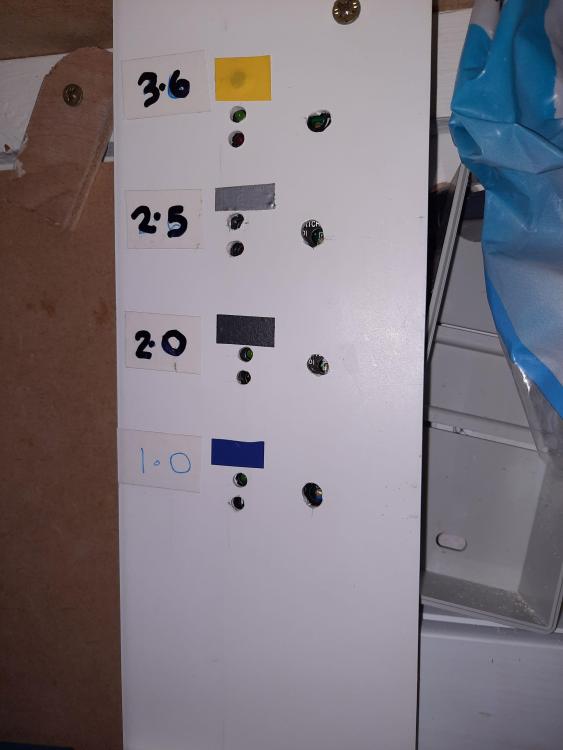
-
This is the latest system we have: There are 4 CT relay clamps, 3 for the EV charging, (and one will be for battery charging), which are set at different PV output levels depending on the month of the year which decides what rate of PV needs to turn on the charging of the EV. This relates to a 3kW charger and the expected power requirement for the EV on a particular month and the expected production using the PGIS web site calculator. The summer 3.6kW rate is because the house typically uses about 0.6kW and during the summer there are plenty of hours when the power is over 3.6kW. There is of course an override for when we will charge irrespective of the PV supply. When the mains option is chosen a red light indicates this choice. When the car is being powered the green light indicates this. The theoretical result is not as good as I hoped as M2 relay is time delayed to stop the charging going on/off quickly during cloudy/sunny days, and because of the lack of supply during deep winter, however for 4000miles we hope to use about 730kWh PV and buy 70kWh from the mains. This will improve if we manage to obtain a bigger power storage EV as the PV history for hear over the last 15 years shows good days are usually grouped together meaning during winter we might not have used up the power in EV before another glorious day comes around and then have a week of cloudy weather. The only works because the car is plugged in to the EV charger most of the day time. (like today). I'm hoping someone can use this to help them develop a similar system. If you need any info on the parts are, ask. Good luck Marvin
-
We had the glass oven door suddenly explode! No one near it. Oven not being used or just used. All sitting in another room when it happened. Dry cleaners were informed of imminent arrival.
-
Side extension to the front of property
Marvin replied to Mahak's topic in House Extensions & Conservatories
Search the term Permitted development technical guidance make sure its a UK government site that you go to... or use this link: https://assets.publishing.service.gov.uk/government/uploads/system/uploads/attachment_data/file/830643/190910_Tech_Guide_for_publishing.pdf Good luck Marvin -
Side extension to the front of property
Marvin replied to Mahak's topic in House Extensions & Conservatories
Hi and welcome @Mahak There are lots of rules about permitted development including: the limit of floor area of the building in relationship to the site. the 'original' size of the house when first built. The location of the building in relation to public highways I will try to find the link to the full details. Marvin -
Some people take plasterboarding to a whole new level
Marvin replied to Pocster's topic in General Construction Issues
Hopefully it only has chickenpox.... -
Some people take plasterboarding to a whole new level
Marvin replied to Pocster's topic in General Construction Issues
Gonna need a s*** load of joint tape! -
Substantial Extension Project Manage by me = novice
Marvin replied to StevenM's topic in Introduce Yourself
Welcome. There are some very helpful people here but just remember, the only silly question, is the one you didn't ask. Marvin- 1 reply
-
- 1
-

-
Prices of building materials moving forwards
Marvin replied to James Frome's topic in Costing & Estimating
Contacted builders merchants beginning of the week. Me: Any room for a delivery next week? Answer: Yeah, you can have the delivery any day next week did you want am or pm? -
Hi @jayc89 Adding to @markocosic very good analysis, I would say that energy in = energy out, and so if your using 70kWh a day then its going somewhere. I know this is obvious, but there is also the thought, where? In my humble opinion: This suggests that the pipes betewwn the boiler and the UFH are loosing the heat: Boiler runs longer trying to keep the heat up. This suggests that the floor is already quite warm around the pipes. What floor coverings do you have. It can also mean that the floor is taking a time for the heat to rise. What are the pipes in? Screed? Concrete? Or the radiators are too small to supply the heat that the rooms are loosing. i.e radiators full on room not hot enough water flowing through back to boiler before loosing the heat. Airtightness and insulation are the main thoughts, but also over heating to areas of the building caused by exposed pipes or unregulated radiators. To go much further really needs info from you regarding the building size and thermal elements and how the building is ventilated. There are heat requirement calculators on this site that can help to understand what would be expected energy use. I don't know where they are as I have my own. Best of luck Marvin.
-
No. Er, excess power gets sent to day storage heaters unless the water temp is below set level when digital thermometer powers the relay switch to the immersion.
-
Hi @SteamyTea No meter on them but I will bung one on. Tomorrow a dull day so expect little....
-
So, due to day storage heaters using only excess PV power we still have not turned on the ASHP yet. Works well through diverter. Set to hot water until temp met, then on to day storage heaters.
-
Ours didn't, we used bottled gas for our boiler because we have no mains gas.
-
A filter
-
Because the installation instructions discusses problems when the voltage drops, we had installed the next size cable up for the distance and ampage to reduce the risk of voltage drop and installed a type C RCBO
-
Another 'Cool Energy' heatpumps thread
Marvin replied to HughF's topic in Air Source Heat Pumps (ASHP)
I had to move the sensor on the ASHP out of the sun to stop the under heating... -
Hi @MortarThePoint Well, it would depend on the 'AIM' Airtightness, Insulation, Mechanical Ventilation with Heat Recovery But the main thing people don't understand is that the bigger the number between the temperature outside and the set water temperature coming out of the ASHP the lower the COP (efficiency). This does not happen with a oil or gas boiler. ( it may to some degree but never twice or four time the efficiency, always below 100% efficiency) My last boiler was rated at high 90s% efficiency as long as used correctly. My ASHP is capable of efficiency from 180% to 634% efficiency depending on the difference between the temperature outside and the set water temperature coming out of the ASHP. If the outside temperature was -3C and the water temperature coming out of the ASHP was 35C and sufficient to heat the building, my ASHP would achieve a better COP (rate of efficiency) than if I ran the ASHP at 45C for a shorter amount of time to achieve the same heat output. M
-
hi @SteamyTea Yes for your home but not for this house! Just like an ASHP installation, the results are affected by the ASHP model, installation, insulation, presumably an MVHR, shadowing of solar, wind, rotation, airtightness, quantity and habits of occupants and finally if the occupants have actually been informed and understand the best way to run an ASHP. Hence the problem when trying to answer the questions people ask like: "Is a ASHP cheaper to run?" or "Will an ASHP work on my house". and to get back on subject, in my humble opinion, both ASHP and Oil have their challenges and the answer depends on many individual specific items.
-
Hi @Onoff head, nail, hit. If only it wasn't everything! Sadly your dealing with human attitudes and the opportunity for some to take advantage of us which don't seem to have changed since Plato. It could be worse!!!
-
Floor loading understanding check please (long(ish) & maths content)
Marvin replied to dnb's topic in Boffin's Corner
Hopefully across the joists and not along the joists.... -
Floor loading understanding check please (long(ish) & maths content)
Marvin replied to dnb's topic in Boffin's Corner
Hi @dnb Your calculating ability far exceeds mine, however my thoughts are: In a home it would make a difference as to where the floor load-bearing supports are. Towards the ends of the joists the limiting calculations may become the crushing strength of the joists the point load capability of the flooring and the load bearing capasity of the supporting wall below. Most people load books around the edges of rooms. The UDL figures you quote seem standard loading design figures. So no more than a typical house with typical contents. However if anyone knows otherwise, I'm sure they will let you know. M