
saveasteading
-
Posts
10106 -
Joined
-
Last visited
-
Days Won
82
Everything posted by saveasteading
-

Scotland - Ban on stoves in new build houses lifted.
saveasteading replied to ProDave's topic in Stoves, Fires & Fireplaces
It's a good morning for lessons from Prof. @ProDave. If we wanted the generator just for hunkering down in a corner for a couple of days, then what size of genny would suffice? Freezer, kettle, a few lights, battery chargers, tele, maybe an air fryer can cook everything. Not all on at once. Does a running genny need a minimum load? -
My logic is this. The timber is for aesthetics purposes only, and is a luxury that will have costs. The ceiling above it should be constructed to provide whatever performance for fire, sound and heat loss is required. Plasterboard finish if internal, but it doesn't need jointing so is cheap. You may want a black paint on the pb for shadow gaps. It may not be a requirement but I think an intumescent varnish may be prudent, for spread of flame, not as a barrier. If there is no likely source of a fire and it is not above a fire escape route, then don't worry about it, but a cooker beneath would preheat the wood then a fat fire could light it. Timber on walls and ceilings can burn very fast.
-
Interesting reading on the website. I had never heard of UCEM. Seems to be registered as a charity. Distance learning. £20M assets. £10M per annum wage bill. To be fair it has a "good" ofsted report. So it is legit. Good means passable.
-
@Jon Eco ResearchDo you have anything to declare? Allegiances, commission, end purpose?
-
@torrehas reminded us of the degree of slope. It is extreme. Can we just confirm that this is not a local blip but continues over the width? so if the house is say, 8m wide the slope is 150mm ish. And is it the original house and the extension? In which case movement has occurred post extension. You have just bought this based on a surveyor's report. Presumably a properly qualified specialist. Now you must write to the surveyor , probably through your lawyer, to confirm that you have found this issue. It has to be on the record ASAP. I have never known a surveyor put a spirit level on the floor, but that is their decision. This is important so that 1. Your house doesn't fall apart, now or in the distant future 2. Remedies are carried out. 3. The house is saleable in future. Your lawyer will advise further, and all costs will go against the surveyor who will be insured for this. If I was near you then I'd give an off the record opinion. But I'm presumably not. So you need expert inspection and advice. Again ask the lawyer what to do next. And do it on Monday.
-
As @ProDave says. Make a sketch now of the distances from skirting to plates and pipes. It's easy to forget. Post it on here for comment and it won't get lost either. There will be a solution with noggins or similar. Or using a wider or narrower board so that they are jumped.
-
For the concrete floor you can latex screed it to level. I once used the same on a dmall area of boarding, and was surprised to find it stayed put. It was a very flexible finished product, almost like a foam shoe sole. But it does sound a little concerning. An inspection and verbal overview from an SE would be my recommendation. OR contact your house insurer.
-
road planings --experience of them over time AS
saveasteading replied to scottishjohn's topic in Driveways
I once knew all about it, but it was hot and flexible stuff then. I sat on a Blaw Knox paver for months. I don't know the new chemistry or the principles....so I'll say nothing. Perhaps a little. Maybe it is too stiff. Our ground moves a lot, not just at trenches but everywhere and constantly through nature and vehicle load. The old bitumen stuff was very flexible indeed so would bend and stay intact. I daily saw a pile of removed road, perhaps 300 thick. One cantilevered lump, overhanging 600mm, rotated 90° in a summer and stayed in one L shaped piece. I'm suggesting, in all ignorance, that the new make-up is harder. Without an independent research body (old TRRL) we may not find out. -
road planings --experience of them over time AS
saveasteading replied to scottishjohn's topic in Driveways
Good point, neither am I. But it should be better than just a loose filling on top. -
Drainage pipe depth. Minimum 600mm or is that unnnecessary?
saveasteading replied to saveasteading's topic in Boffin's Corner
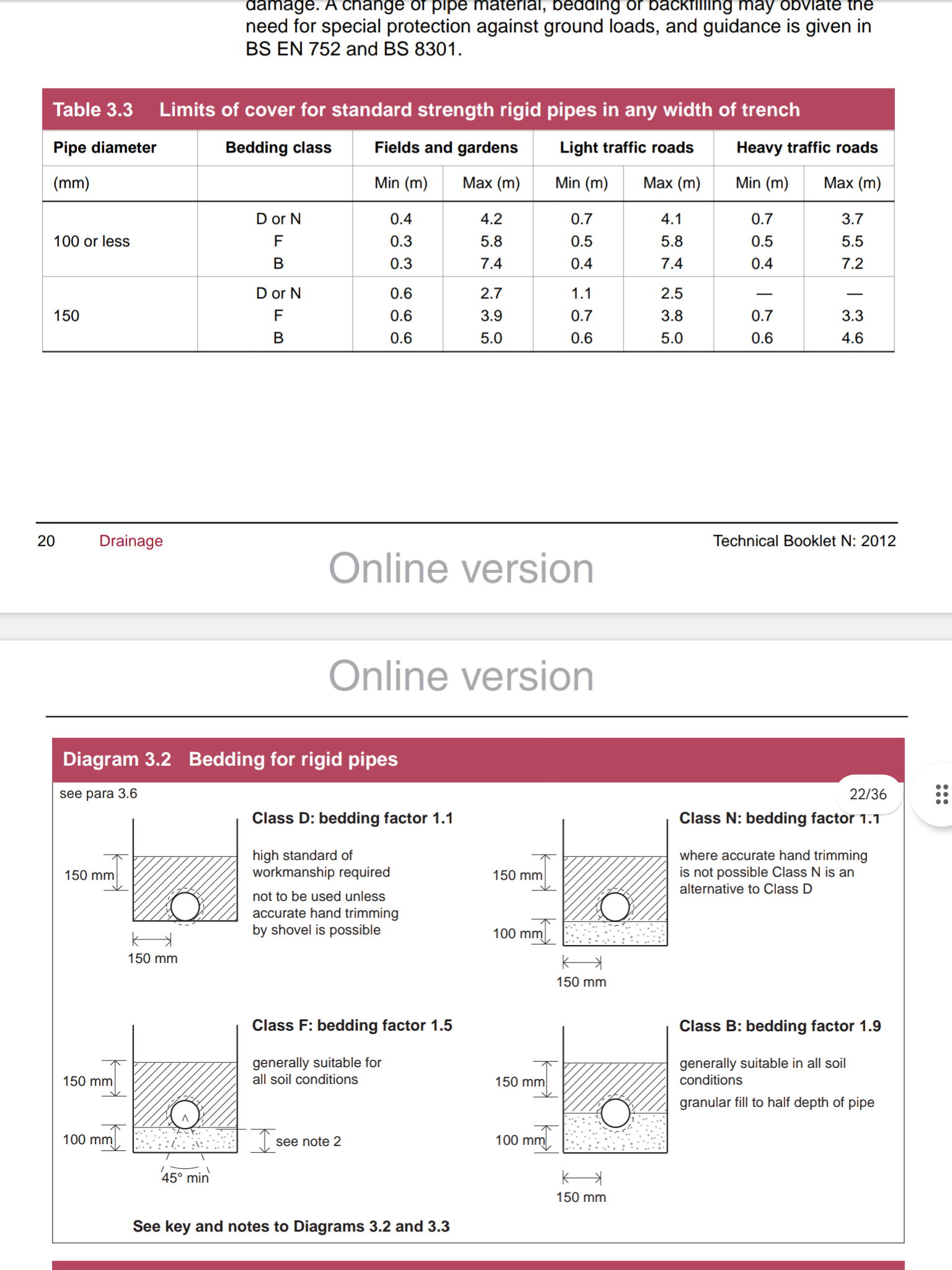
Thanks for that @ETC. The page and the link. This NI version I have not seen before. It very sensibly allows the shallower depths of 0.3 and 0.4 according to different bedding standards, on the pages before the one you swiped. This shall be the reference from now. The English and Scottish versions don't have this, but imply 0.6 whatever. This table is for rigid pipes but it goes on to discuss flexible pipes and is consistent. I will be reading all of this fine document. The week ends well (not just this). So well that I'm now expecting our home rugby teams to win too. this.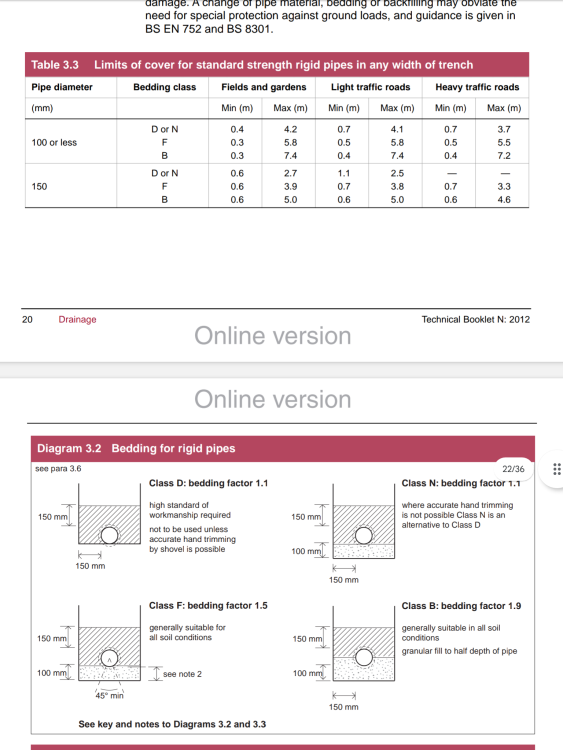
-
Drainage pipe depth. Minimum 600mm or is that unnnecessary?
saveasteading replied to saveasteading's topic in Boffin's Corner
Agreed that Is sensible. Is that written down formally anywhere? -
Drainage pipe depth. Minimum 600mm or is that unnnecessary?
saveasteading replied to saveasteading's topic in Boffin's Corner
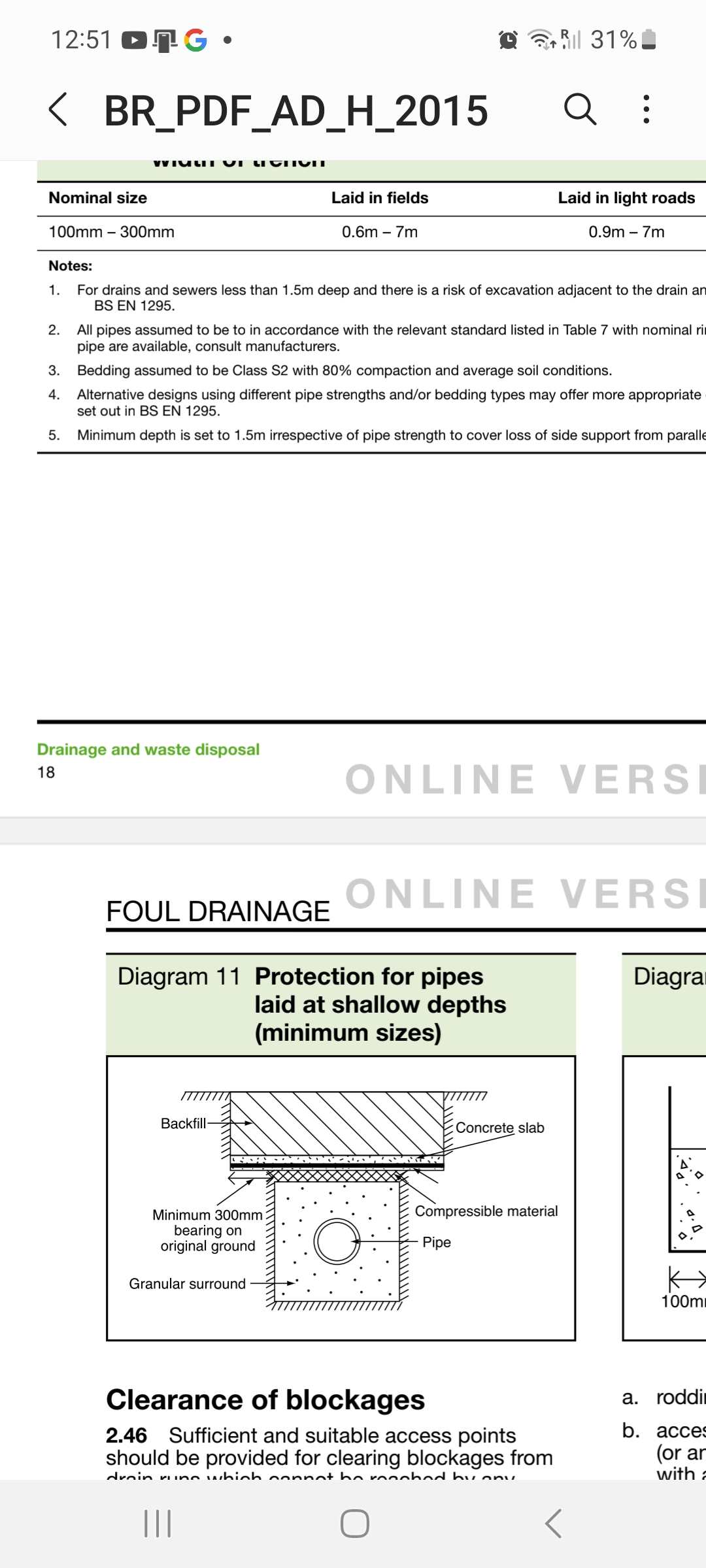
I meant to attach this for anyone interested. It shows depths are to be over 0.6. Anyway I have prevailed and it will now be " as appropriate". If I need an easy argument, it will be that "in a field" implies that it can be ploughed. In a garden isn't covered in table 10, So panic over and 50 years of drains can stay where they are.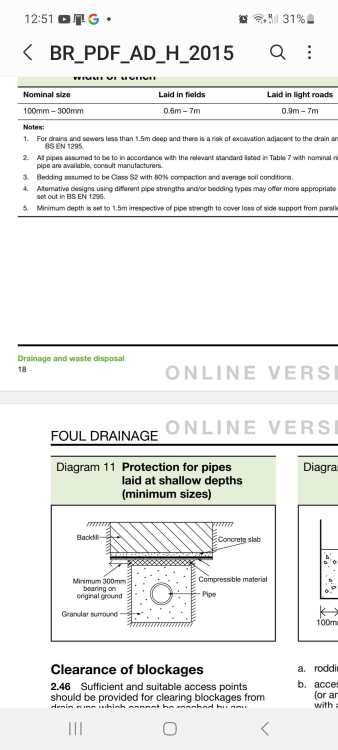
-
road planings --experience of them over time AS
saveasteading replied to scottishjohn's topic in Driveways
It shouldnt be getting ripped up yet. The bitumen (or other bonder) is only surface coating the aggregate so it will be good, blended stone, whatever. -
Drainage pipe depth. Minimum 600mm or is that unnnecessary?
saveasteading replied to saveasteading's topic in Boffin's Corner
That is my view entirely. As "the Engineer" that's what I have designed and nobody has ever objected. And there have been no problems that I know off. In so doing, several km of drains have been 200mm less deep and without a concrete slab over. Consequently so has every rodding point, manhole and sewage digester. But someone is pointing out table 10 of Doc H. That is the only point of reference. There are contradictions too eg the drawing below and the term "where necessary" I'd rather not respond " because I'm the Engineer and I know better". I really want to find something definitive. And so would everyone about to start a project. -
Buying a SDS+ drill - how many joules needed?
saveasteading replied to Sparrowhawk's topic in Tools & Equipment
Makes space rather than money. I wouldn't buy a second hand Titan or equivalent own brand as I've had some fail prematurely ( hardly used, guarantee passes, use again...falls apart) -
road planings --experience of them over time AS
saveasteading replied to scottishjohn's topic in Driveways
Be a neerd and watch the highways people. A patch won't stick, so they cut a rectangle out and fill it tight. Then wheels are pushing the material sideways against the vertical face, not scrubbing it upwards. Meanwhile you could make the pothole cleanish then apply bitumen tacky stuff before the infill. A tamper will be helpful. -
Buying a SDS+ drill - how many joules needed?
saveasteading replied to Sparrowhawk's topic in Tools & Equipment
I don't know when I last saw a subby using mains tools, other than 110V heavy breaker. As above. I have a suite of tools (Einhel) with the same batteries in 3 sizes for power v weight. They need changing a lot on the bigger tools.eg chop saw / vacuum cleaner. Plus some 240V for really heavy stuff, but seldom used: Titan sds breaker used once and was worth having. A bosch drill, just for the pleasure of the smoothness, but it is good for deep holes in timber or mass production. I will build a charging gantry in the site office so that batteries just slot in whenever passing. -
-
road planings --experience of them over time AS
saveasteading replied to scottishjohn's topic in Driveways
Best put courser cheaper stone down first. Then 50mm minimum 100 better. -
road planings --experience of them over time AS
saveasteading replied to scottishjohn's topic in Driveways
Road planings are a favourite material. It is a highly controlled product as if type 1 with added sticky. So if it is well broken up into being like a load of stone, and is well spread and compacted, it will be very strong. I can't remember the bitumen content but it is a small %. About 3% maybe? ie lots of good stone. Then you get a hot summer and it adjusts and sticks even better. BUT make sure you aren't getting footpath surfacing. It is not strong and not a good surface for traffic. The only downside of planings is that it used to be cheap but now is popular. And quite rightly it can now be recycled for roads...it used to be designated as waste. -
Is it just the floor that isn't level? What about wall verticality? If they are vertical then subsidence is unlikely. There are some very bad builders out there, especially on developments. I'm including site management here. So it is probably a floor poured without care. I once was called out to advise why a house ( 1m of brick walls at that stage) was out of kilter ( something is wrong!). I found that the brick coursing was a spiral. At least they had someone with a level check it, unlike your slab.
-
Drainage pipe depth. Minimum 600mm or is that unnnecessary?
saveasteading replied to saveasteading's topic in Boffin's Corner
That's sensible if it might ever get some load. But the regs say a reinforced concrete slab. Imagine thd maximum load on that footpath...what possible risk is there to that pipe? I'm looking at garden though. 300mm for a garden fork risk. 450mm in the Cairngorms for frost getting into the ground. 600mm? Not "sustainable design". I'm still thinking it is crazy overdesign. Maybe the code compilers assume that trenches are never compacted or all have driveways over them. Or maybe they have never been out of their office. A search threw up a previous BH discussion. 450mm quoted by some, and that appears in some unofficial advice elsewhere too. -
I've been designing drains for nearly 50 years. Wrongly perhaps. Today I've been told, and referred to document H, that there must be at least 600mm cover. And that less than that needs a reinforced slab over it. Its only a reference in a table, and nowhere else is it mentioned. The actual regulation doesn't mention any minimum. I can see no purpose in that depth in a garden. A foul drain isn't going to freeze at any depth. Elsewhere online, 450 is mentioned. It matters especially on long runs. I have been avoiding pointless expense. Nobody has ever said it should be deeper. I am allowed to over-rule this but perhaps there is a good reason I've missed. Any thoughts or better if it's definitive? I've lost my BS on the subject.
-
They were not uderstanding physics in the first place. It’s a shame that … it’s expensive to run. All that fancy functionality comes with an added energy cost. At least this article measured how the heat spread. I have recently read similar reviews where the lowest powered one is automatically rated the most economical. The previous day the review would be leggings or toys or some such, and maybe fashionistas would despair at my ignorance if i wrote it.
-
How about normal concrete with crushed stone, severely tamped to bring the fines up. Next day pressure hose or brush the surface to expose the stone. OR sprinkle grit on and tamp in .