

saveasteading
-
Posts
10065 -
Joined
-
Last visited
-
Days Won
82
Everything posted by saveasteading
-
A word about concrete slabs, especially in hot weather. Concrete is a highly sophisticated product, and with proper handling it produces effectively rock to the shape you want. Many things can go wrong, but they can all be controlled. The principle is that we are gluing together bits of rock, back into the form we want, using cement. There should always be a proven formula for the mix. For a bridge or multi-storey it is very much more precise and controlled than for a garden path, but it is always worth attention. The main thing that most public don't realise is the difference between cement and concrete. Cement is ONLY the dust that goes in the mix to make mortar or concrete. The biggest important thing that many in construction do not know is that concrete is strong through curing, not drying. Do not assume that your groundworker knows all, or much, of this. For a strong concrete mix there are large stones, with all the gaps between filled with small stones, and the further gaps filled with sand. Every surface is coated with the slurry of cement and water that has been carefully mixed in. There are no pockets of cement, it is all aggregate to aggregate contact. A chemical reaction then happens that makes the cement stick everything together, and water is used in this reaction, and taken out of the mix as a permanent part of the matrix chemistry.. Any additional water will simply sit in the mix, until it evaporates, leaving lighter concrete and miniscule gaps. It is essential that there is the right amount of water. a) enough to allow the chemistry to occur. b) not too much that it spoils the mix and eventually leaves voids in it. The chemistry takes many days, and concrete gets harder for at least a month, if properly looked after. For this to happen, the laid concrete must not be allowed to dry out, so it must be covered with plastic or wet hessian. Once the surface is hard, water can be sprayed over it. Don't use too much water, and don't allow the concrete to dry out through sun or wind. If it is very hot or windy, postpone it. (Frost is another matter). Why do supposedly expert groundworkers have problems with cracking? Mostly because they add extra water, by hand or by asking the delivery driver*. This makes it much easier for them to handle. Secondly because they don't know the difference between drying and curing, and want it to go hard so they can go home. Thirdly incorrect use of steel mesh (which is for cracking control not strength), dpm, and joint preparation. (* A readymix company will allow water to be added, but will record this on the delivery chit, and thus it is not their problem. They may also takes samples and make cubes for testing, and store them in a tank of water for ultimate strength, for 7 and 28 days.) All concrete cracks. How and how much it cracks is the skill. Enough for now, do ask for clarification or more information.
-

Early thermal cracking in newly poured external concrete slab
saveasteading replied to kxi's topic in Concrete
You may be able to scabble the top off and lay a thin layer, but that is expensive too, and not a proper job. A rebuild is the proper solution if it is a problem to you. Otherwise, plan to tarmac over it in a few years. -
Early thermal cracking in newly poured external concrete slab
saveasteading replied to kxi's topic in Concrete
Concrete too wet when laid, then dried too quickly. And esp too much wet paste at the top. Probably inappropriate reinforcement, and lack of debonding at joints. Hot day and fast evaporation. (The difference between curing and drying is for another essay). This is a very common problem and I am constantly amazed that groundworkers do not know this. I can only assume that they have not been docked for it before. Adding extra water makes it much easier to move around and level. But then that water evaporates and leaves voids, where there should be concrete. In any ready-mix delivery there is a space on the chit to record added water, and the driver will fill it in and want it signed, because the supplier knows this can cause problems, and they don't want the blame. A concrete mix is an exact science. When 'just right' for strength it is awkward to shovel, so they will add water, without asking anyone in authority.. They may well have sprayed some sealer on top, supposedly to keep it from evaporating, but it hasn't worked, probably because it has just sat on the free water. polythene/wet hessian are more fool-proof. It may not fall apart, or maybe it will. As stated above it will let water through the cracks, and that will freeze, and that will break the concrete. I think the top surface of paste (no stone) will abrade quite quickly. Also, all concrete cracks, and it is a matter of controlling it to a minimum and to multiple invisible microcracks. The reinforcement , and debonding at earlier edges, helps with that, and I can't comment on what you have in that regard. whether it was appropriate, and whetehr it reached the edges/ overlapped etc. The choice of appropriate steel mesh is well proven, but I have no idea with 'thickish basalt' mesh. Certainly plastic fibres don't work as well as was originally trumpeted, or as steel mesh. More info would be interesting. I would worry that a small mesh would reduce bonding at the layer. But it is new to me and I don't know. Depends what you have paid really. If you have employed a bunch of labourers who don't know the science of it ( and simply have not been paying attention) then perhaps it is your problem, and is decent value, as you have saved 25% oh and p, and management. If there is a specification or a known performance requirement then you have an argument. If this was for a formal contract it would have to come out and be redone. as a private job for yourself it is up to you. Whatever, keep the whole roadway damp throughout the warm weather and for a month in total, as the cement needs that time being damp to do its job. -
As stated above, 2 samples from different batches can look very different together. If you watch paint being mixed, there are sometimes miniscule amounts of a certain colour added, and if it drips in completely or some sticks to the nozzle, there will be a different colour. I know that when you buy metal cladding in a standard colour, factory dipped, it has to be single batch or the difference can be unacceptable. so replacement of a damaged one is a problem. If buying coloured paint try to get it all at once in a single mix. So colour matching is not a problem, the colour is not patented, only the name. The same paint on different surface materials will also look different. I have recently seen a kitchen system being repainted a different colour, diy with 'proper' paint for the job. Looks good, but does look painted, not factory coated. that was deemed to be ' a good thing'....rustic/artisan.
-
Has my roofer put my tiles on properly?
saveasteading replied to Azrim91's topic in Roofing, Tiling & Slating
This is within that useful document:: Mortar bedding should never be laid directly onto the lead, as the expansion and contraction of the lead with temperature will quickly crack the mortar. Instead, the mortar should be laid onto an undercloak of slate, tile or fibre-cement board to allow movement between the lead and the undercloak. Presumably there is a formal version of this somewhere. either from the tile manufacturers or a BRE doc or similar. Seems pretty fundamental. Do not lay mortar on lead. -
Has my roofer put my tiles on properly?
saveasteading replied to Azrim91's topic in Roofing, Tiling & Slating
Apologies azrim91 (presumably very old or very young) for slight hijacking of this, but it may be useful, if there was a better way as a standard technique. Makie, do most tile ranges include half tiles, if not 1 and 1/2 ? Would it be possible to add a half tile as the penultimate in the row, then cut a full tile to a bigger size? If there is no other option but to use a small triangle, what do you do? drill a new fixing hole? Bed mortar onto the roof deck? Glue? -
How to fit acoustic insulation to Posi joists
saveasteading replied to Hilldes's topic in Sound Insulation
I don't fancy doing that from underneath. Revert to plan B or C. Secondary floor if headroom allows, or extra large and efficient radiators to compensate for the lower temperature water. Think of low temp rads as a good thing....in schools it is necessary to build guards over hot radiators to protect against burning of little people. -
Has my roofer put my tiles on properly?
saveasteading replied to Azrim91's topic in Roofing, Tiling & Slating
I know more about English building than Scottish, and still not a lot. This looks southern Spanish.....mortar everywhere, nice and thick: it doesn't matter that it soaks up the rain because it will soon dry again. For my own benefit, though, when approaching a cut, do you not avoid a tiny piece by using a bigger tile , ie exchange the previous tile for a one and a half, and cut a small piece off that? Same principle as for concrete slabs, block paving, bricks? Excuse my wobbly line sketch: just discovered this tool.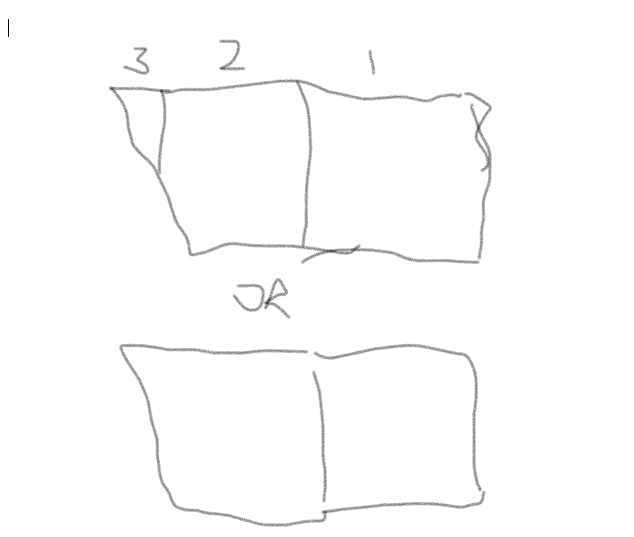
-
Has my roofer put my tiles on properly?
saveasteading replied to Azrim91's topic in Roofing, Tiling & Slating
https://redland.co.uk/settings/resources/files/documents/redlandcasestudy_heathrow-amended0.pdf That is a similar tile, and the valley does not look like yours. I couldn't immediately see a 'how to' document. Perhaps email Redland (or whoever) and ask. -
Has my roofer put my tiles on properly?
saveasteading replied to Azrim91's topic in Roofing, Tiling & Slating
That photo won't appear in the tile manufacturer's brochure. Have you looked at it to see what they suggest? I imagine that only the little upstand holes at cuts should be filled with mortar. My suspicion is that this great splodge of mortar is to conceal a very wavy line of cut tiles, and some broken corners, and to secure little triangles that are insecure. Someone with more knowledge of tiling can answer, perhaps, is there a minimum cut size of tile, so that tiny pieces are not used to dress into the flashing? Would that require some half / 1 and a half tiles, and planning ahead? -
My daughter took on a house with a stair lift. Put it on line for 'free to collector' but nobody response. I think eventually through Age Concern or such, a need was found and it was taken away. So try both as sources. They really are as simple as that wonderful technical drawing above, although it omits the motor for clarity.
-
Dropping SSE cable into the ground
saveasteading replied to Deacs's topic in General Self Build & DIY Discussion
A few thoughts from experience. Make sure you use the dia, make and colour of duct they specify or they will refuse to use it. It is something to do with heat generation. The specified duct is more expensive than others, and than you will like. Also use only straight lines or the cable may snag. Don't forget a draw cord. there will be a mx length between drawpits. Often they quote a high price to cover risk of obstruction, and will rebate if it goes smoothly. Don't fall out with them. You have nowhere else to ask. And a word about the original post. Best not be rude, however justified, on here. Google picks this all up. I did a search recently and my own earlier Buildhub post came up on page 1. Therefore I ty to avoid quoting manufacturers or businesses names, or referring to recognisable persons if it is a negative matter. -
How to fit acoustic insulation to Posi joists
saveasteading replied to Hilldes's topic in Sound Insulation
I realise notching joists is not to be encouraged....even when it is ok it encourages plumbers and sparkies to cut anywhere they feel like it. this was only suggested if there happened to be a comfortable overlap of the bearing wall (ie not working past that point0. or if there was an actual gap between end-to-end joists or joist to wall that would allow a turn. ONLY with permission of the joist designer. -
Not an expert.....BUT If your current insurance does not already cover damage to neighbouring properties, then I would be surprised, and concerned. I think this is more for commercial construction where a small builder may not have enough cover for damage beyond the project value. Insurers will sell you this happily whether you need it or not. So I suggest check out your current cover, and ask the broker to confirm. And best not be (or let workers be) negligent, or you don't have any cover at all. Many insurers' priority is to deny any claim, and one even boasted to me of how little they pay out.
-
How to fit acoustic insulation to Posi joists
saveasteading replied to Hilldes's topic in Sound Insulation
I hope you don't mind a wild suggestion....isn't that we are here for? I have never done UFH except in concrete floors, so may be wrong....but hoping to learn in time before having to do it to an upper joisted floor BUT I do like the answer above of putting it on top, assuming you have the headroom....we do not.... and may use big rads upstairs. My off the wall thought.....multi-conditional....is that if the UFH pipe went parallel to the joists , then only at the ends could there be an issue. IF the joists have plenty of bearing it MIGHT be poss to notch the tops to cross the pipes to the next gap. Only at the ends though , where the stresses are dwindling. Needs approval from floor designer. You still have to get the pipe to the location too. -
Building up ground with rubble
saveasteading replied to cwr's topic in Landscaping, Decking & Patios
Glad you are not paying for the blocks, but somebody has done. It has all the signs of being built for the ease of the bricky with no regard to waste. Every block costs what? £1.50, then half a skip to get rid of it all. Unless I wanted them there I would tell the bricky to take it away or pay for the skip. Had a site manager once who called me the skip inspector. They had to learn that whole bricks and blocks, or even half ones do not go in the skip, ever., and any waste has to be taken to a pile, not the skip. An MD of like mind used to only put small hippo bags on site, as batten offcuts would not fit, so it was easier to keep them on the roof and use them. Re hardcore. The suggestion above is ok, that you lay them all flat and infill with stone. but you should also then break them up more, as they lie. Good exercise with a sledge hammer. Skips. I went on talks, and then conveyed it to all staff (admin as well as site) that the real cost of a skip is not £250 but £1,500, because of the stuff in it that you should not have bought. Then each job had a target number of skips, about 1/4 of the nationally accepted rate. Most of the time it worked, even if partly due to pressing down with a digger. The estimator and buyer had to get it right first, then the workers be told they had to use offcuts. esp plasterboarders who like a new sheet every time. -
Will widening my connection to Thames Water make a difference?
saveasteading replied to hendriQ's topic in General Plumbing
If you ask the water co to change it, I think they will increase your standing charge. The old pipe is likely furred up and bent anyway, so the restrictor might not be making so much difference. -
I have one experience with this sort of floor, using a manufacturer that is not the biggest name. Had seen it in a busy cafe and it was standing up well, so asked what make it was (which I cannot remember. It had 2 years of use with baby/toddler and a cat. No sign of wear or problems, and later the house sold v quickly. There was a hardboard underlay and screed to ensure flatness, so the labour and prelim was as much as the supply.
-
Answering my own question fyi. There aren't many companies to choose from. Had a visit from one company who agreed to waive the fee, as we did not want a survey, just a quote. Quite a thorough report, a mixture of relevant and generic. Interestingly he described the treatment as a caution rather than necessity, I suppose because the worm will all die when the heating goes on. Very, very expensive quote. Included 10 year guarantee, but then said that this was not usually sufficient , so could make it 20 years for an extra £800. Some people might think this was opportunistic. Another contractor, selected by looking at time in business and location, quite reasonably said he would have to charge to visit as it was 40miles each way, but instead quoted from a drawing , description and quantities. Less than half the price, and including 20 year guarantee, and in line with my original estimate, which was just time/material/equipment/oh based. I will not quote the prices until the job is done satisfactorily, but happy to do so then. Or PM if you need to know.
-
Soundblock plasterboard AND acoustic mineral wool insulation.
-
What Gus says is all correct. Also we don't know enough about your circumstances to give a definitive answer. As it is an outbuilding, you may be allowed/ not silly to under-spec it. If it is very rarely occupied the rules don't always apply, eg garden shed. I don't think it has been mentioned that you might build your pier outside. Then you can take it down to founds. there will be a top ledge that you will have to weather.
-
Is Kwikstage still extremely heavy? I have struggled with the weight of the sections at height. it may have been a v old model.
-
Can I just suggest that you don't push your luck. Water is not sympathetic. Also I work it all out myself as have not found many in the industry, certainly not groundworkers and plumbers, who really understand how water works. Easy, it runs down-hill. Not so easy, is that it builds up, goes under and through, and stops and reverses when there is an obstruction. What I do, even if people laugh, is once I have worked it all out, I go back to the start of the run and imagine a rainstorm. And I use a golf ball (snooker better) to check where the water will actually go, not the theoretical flow. best of luck...report back when successful.
-
V interesting and useful to know. You have £200 budget to buy some planks or boards to walk on or protect from dropping bricks.. Choose something you can use later in the construction and you win it back.
-
Planning...the answer to almost every question.

