
saveasteading
-
Posts
10067 -
Joined
-
Last visited
-
Days Won
82
Everything posted by saveasteading
-
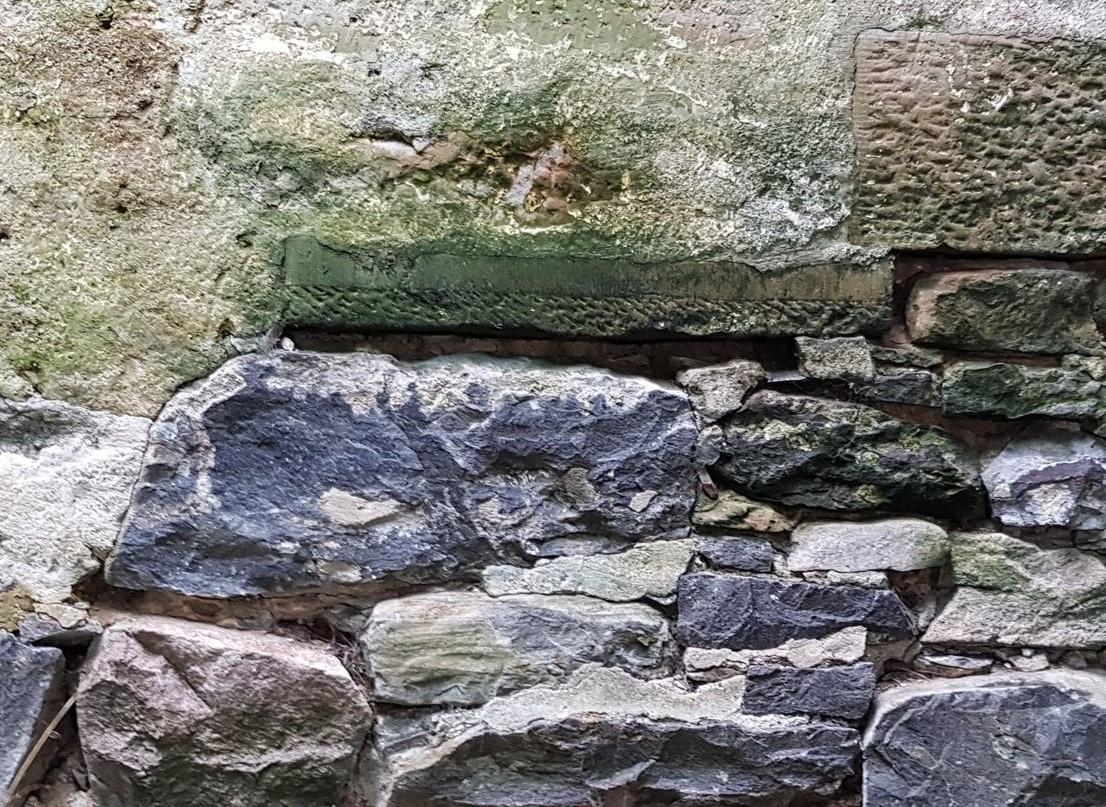
I wouldn't. The air is helping and any infill would have to be pumped polystyrene beads or cellulose (which concerns me a bit). Cavity wall with 50 insulation and 50 air, and the 100 of outer insulation is pretty good. Retain the air bricks if you have a suspended floor. Insulation no use below the floor level, so stops off as on Nod's pics. 100 is a lot to stick on the outer face, so the windows/gutters geometry etc need looking at to check this all works.
-

Capital Gains on self build value increase
saveasteading replied to puntloos's topic in General Self Build & DIY Discussion
That would count against you as presumably you have built at low cost. I would hope it was accepted to allow for your own labour as a 'cost'. if disputed perhaps a valuation of what it would have been worth at the time? But all that assumes reasonableness and logic from HMRC which is not always the way.. -
Foul Treatment Plant advice - choosing the right one!
saveasteading replied to Dale Hesketh's topic in Introduce Yourself
I think it simply keeps bubbling away without problems. Might be different if not used at all for a prolonged period. On the other extreme, an overused tank will spill nasty stuff out to soon, so is much worse. The mix of contents also makes a big difference as the tanks are designed for a normal balance of urine, faeces and waste water. This shouldn't ever be an issue in a house, unless lots of water is sent there for obscure reasons (or connecting a rainwater pipe). It does matter for other types of buildings where use is different....eg a sports hall / gym has more urine and water, which doesn't favour the bugs, so it needs monitoring. Airports have the opposite issue apparently. -
The original question was effectively 'is this pointless when I have an air gap and air bricks?' The air bricks are there to ventilate under a suspended floor, so should stay uncovered IF you still have a suspended floor. The 50mm air gap is to stop dampness moving from outer skin to inner. It also assists the thermal insulation considerably. There is no appreciable air movement within the air gap, although you wouldn't design a new house this way. It can remain and does not preclude extra insulation outside. As to how to do it, I defer to Nod.
-
How true. They fill with stuff so quickly. Some of that is decent material that you have paid for, and some you will not recognise as it comes from another site. And then there is a LOT of air if they are filling it unsupervised. The waste centres that sort it make half of their money from collecting the disposal charge but not then sending so much out again. I was on a course some years ago, where we established that a skip costs you £1500 (prob £2000 now) because of the decent stuff that goes away in it. Another contractor on the course changed to hippo bags, sorted by material, and found that roofers who used to let the cut end fall to ground (thn to skip) suddenly preferred to keep and use the ends of battens rather than collect and cut them small enough to go in the small bag. One of site managers called me the 'skip inspector'.
-
Two ASHPs. How best to use them?
saveasteading replied to saveasteading's topic in Underfloor Heating
I came across Willis heaters elsewhere in BH. Are they an option to either boost the hot water after the tank, or add to each shower for use in high demand? I am thinking worst case is all the Christmas visitors came back cold and wet from a walk (or kayaking) and all head for the showers. -
That sounds sensible. Uplift/overage clauses tend to be about future change of use from commercial to housing, or demolishing one unit and building several: unlikely to apply here. But the clause will cost next to nothing to add, so don't fight it if suggested by the other party.
-
That's what I meant. Did it once with surplus 8 x 3 (took them to the supplier and asked them to split) into 8 x 1.5. Very twisted timbers.
-
They would probably twist horrendously and need very vigorous insertion of noggins (dwangs).
-
Yes please. Any ideas for swallows/house martins?
-
Welcome. Lots of advice available here once you have any plot in mind. Most people avoid precise details because it is all public.
-
Partitioning Garage for Utility, ideas?
saveasteading replied to JKami84's topic in Garage & Cellar Conversions
Correct. The rules are not that you insulate a building but that you avoid wasting energy. Therefore an unheated room does not need insulation at all, so you can allow whatever you choose. It is also permissible to have heat from infra-red that heats the person rather than the room, but that should not be overdone (ie don't cheat) So it absolutely depends on the purpose now (for regs) and in future (as common sense to save energy). Also you can use more insulation where it is easy, and less where it is not practical. The bco would want a statement on purpose/heating strategy/insulation. You Got It!. that would be space heating and require full insulation. You are going to get waste heat from the boiler anyway, and that doesn't count. The smaller room and doors will reduce heat waste from your boiler to the big space and cold door. I would add some insulation to the walls (and internal stud wall) of the rear portion. You are making changes that potentially alter the energy loss principles, and you are also changing means of access/escape so it is possible that you should apply for regs, ad then that is also available at any future sale. But I have checked my LA page and it says 'conversion to a habitable room'. Perhaps email your LA and explain the purpose of each room and make them decide. If they reply 'no' then that equally satisfies anyone in the future. The following table details the standard charges for certain extensions and alterations. If the work you are undertaking does not fall into any category please contact Administration The fee is higher than I thought! £363 Conversion of garage to habitable room(s) £363.00 -
Ground sub floor insulation advice
saveasteading replied to KillyfadNewBuild's topic in Heat Insulation
About half the price and half as effective. -
Two ASHPs. How best to use them?
saveasteading replied to saveasteading's topic in Underfloor Heating
Building a new one, about 20m away and at about ridge level. Can be any size as we are still designing it. From once having a rainwater harvester I am aware of how easy that was: the pump in it kicked in whenever a tap was turned on, and it was sheer pressure and no tanks.. On the other hand, the pump failed in 2 years, so the tandem idea is good. -
Two ASHPs. How best to use them?
saveasteading replied to saveasteading's topic in Underfloor Heating
Private water supply gurgling slowly to a storage tank. From there a pump, either to a header tank or hard into the system. 4m x 1.5m -
You don't get RIBA lightly. 7 years and some rigorous exams that include contract administration and law. Somebody without it could be as experience but you would find out by reference. Re fees try this as a guide. https://www.bparchitecture.co.uk/downloads/arch_fees/RIBA_Fee_guide_Graphs.pdf I suggest probe hard re build budget and ask what is not included. I have known jobs that were double the client's fixed budget at tender. Oh but I didn't include services, other consultants, externals etc. One where I said the job was gong over budget, he relied that the client always finds more money..so I walked away. But yours might be wonderful, good luck.
-
Correct, thanks for reminding me. The designer remains the designer and nobody can, in theory, copy it. The owner can use the drawings for anything to do with the building, now or future, but can't necessarily build another the same...that would be interesting....or use extracts for another project. In theory designers are entitled to put their name visibly on the project, as seen at the centre of big Victorian bridges. But I have never had a client who would accept this.
-
A good Architect can see things better in 3d, but surprisingly few can. Yes, I have been called a philistine many a time, for questioning how something is meant to be built...physics or funds not having being considered. Can you do this for 2/3 or half the cost of the quotes we have received? Yes but we have to start from scratch, and we will not work with the previous team who did this for you....pay them off. With Engineers there is more interest and willingness to discuss efficient ways of doing things (my contractor half of brain) BUT it is great working as a proper team with a skilled and interested Engineer and/or Architect. Challenges can become opportunities and still look good, or better.
-
Two ASHPs. How best to use them?
saveasteading replied to saveasteading's topic in Underfloor Heating
It is possible that at the end of a long, muddy, winter's walk, they are all used within a short time frame. ProDave has mentioned adding an inline heater for times of extreme use which is perhaps worth a thought. But I think we need generous hot tanks, and efficient shower heads. -
Welcome. Sounds like you can tell us a lot from hands-on experience.
- 1 reply
-
- 1
-

-
Two ASHPs. How best to use them?
saveasteading replied to saveasteading's topic in Underfloor Heating
6 en-suites, 2 wc, 2 kitchen , 2 utility. -
Trimless Plaster in Downlights/Spot Lights Spacing & Quality
saveasteading replied to revelation's topic in Lighting
Interesting. These are new to me. Very tidy. I am guessing that the bulb is in line with the finished ceiling. If set back there will be some shadow. You need to draw this up showing light radiating down at whatever angle the bulbs say is their spread, to ensure even coverage. That would be at just above worktop. They must be over work surfaces not heads, or there will be shadows. Does that work if there are cupboards? You will have a lot of them. 1m centres? so 35 of them! -
The design is yours. You commissioned and paid for it. Presumably you eventually got the drawings, but were they any use for the other parties? I (as Engineer and contractor) have had clients' architects erase all dimensions before handing over. Also many errors in both draughting and in being buildable. In any case we would always redraw in 3d as you have little idea if the drawings are correct. This was rightly an issue on our current 'Buildhub self-build'. Our appointed SE would not commit to using our Architect's drawings until seen. As they are Revit 3d he is now happy to do so, but I acknowledge his concerns. The whole point of detailed 3d designs is to share drawings and have one set of common information. The big companies do it and it works. Any consultant should be happy to share their drawings....it is a concern if they don't trust their own work.
-
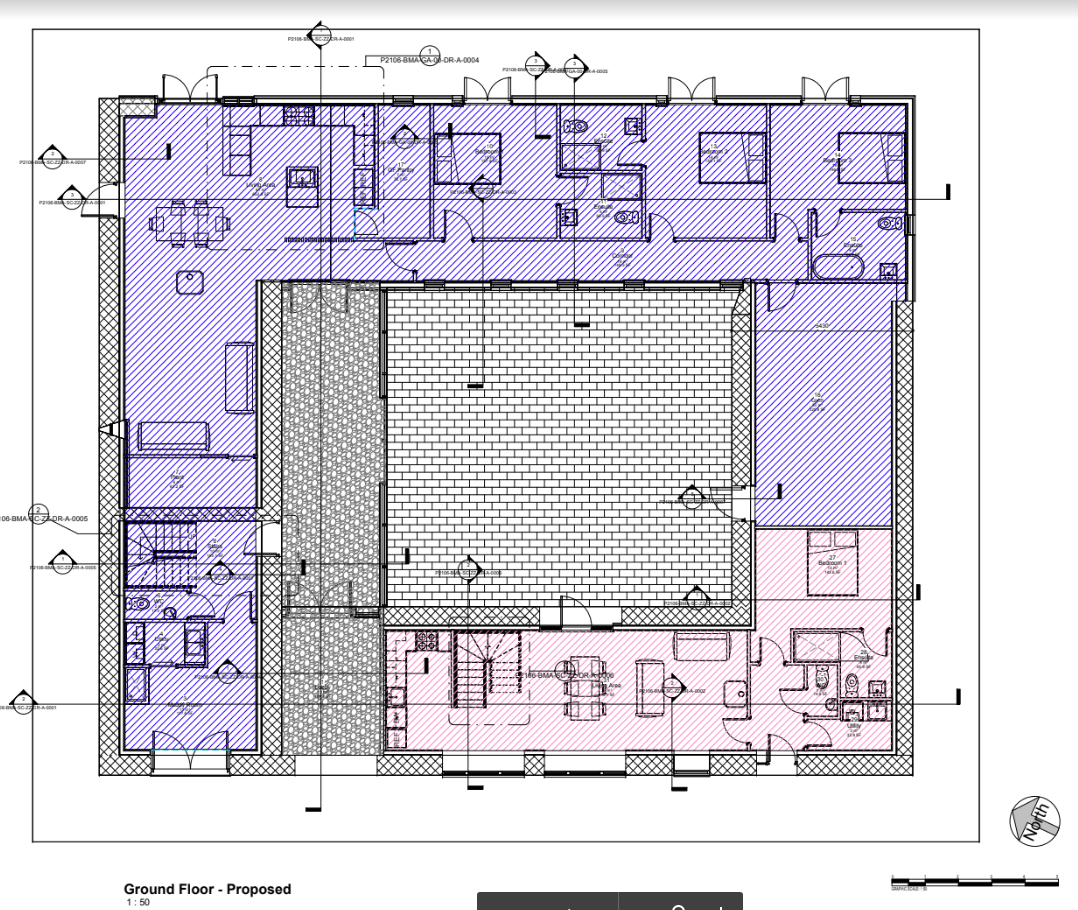
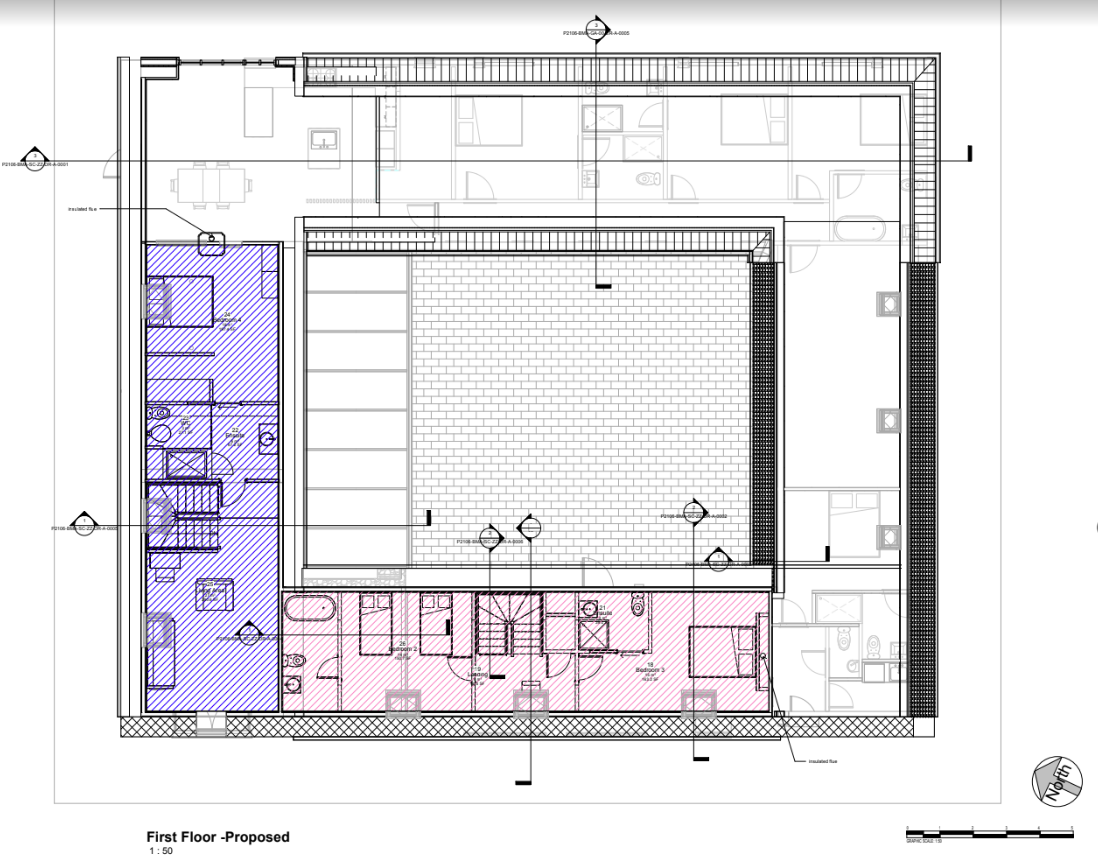
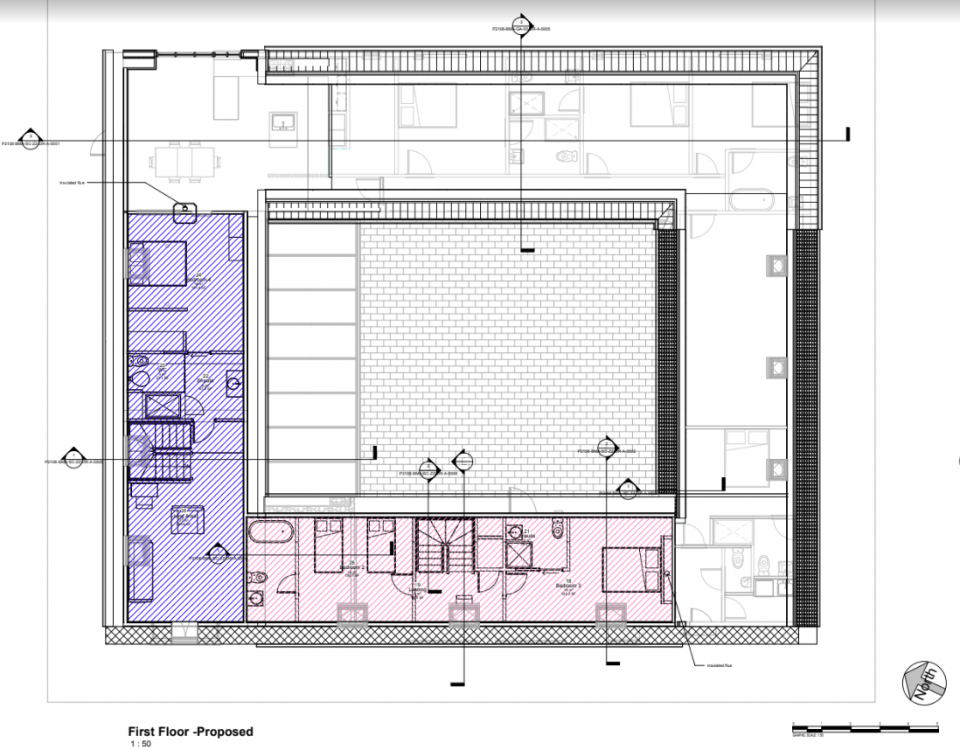
Based on info on Buildhub I estimated a 15kW ashp, but a local specialist says it is not enough. Also the floor arrangement requires a secondary feed and manifold to reach the distances. The building will be in the form of a main building and an annex (for us old ones and b&b). Plans below shows the layout, with central courtyard. All the GF to be ufh. The upper areas (front and left wings in roof) to be radiator (headroom is tight). Outside is 21 x 19, inside 18 x 16 approx. Insulation will be very good, to new-build targets, although some trading off for practicality (esp headroom at existing doors), so the floor will be 125 to 150 PIR. Our thoughts are as follows. 1. 2 pumps needed so do they both feed the one plant room or 1 for main build and 1 for annex? 2. If the former, do they work in tandem or split to space heating and water heating? 3. Split the load as 2 identical pumps sharing the load, or large and small? 4. Best to have 2 water tanks anyway, for volume and to avoid arguments between the 2 spaces? 270m2 GIA ground floor, 110m2 upper floor. The plant room is shown, to the left next to the stairs. There is a roof void at bottom right that could house more plant. BTW the current favourite installer seems good, but it is early days and I like to understand and question. Any comments welcome, not just as my 1-4.
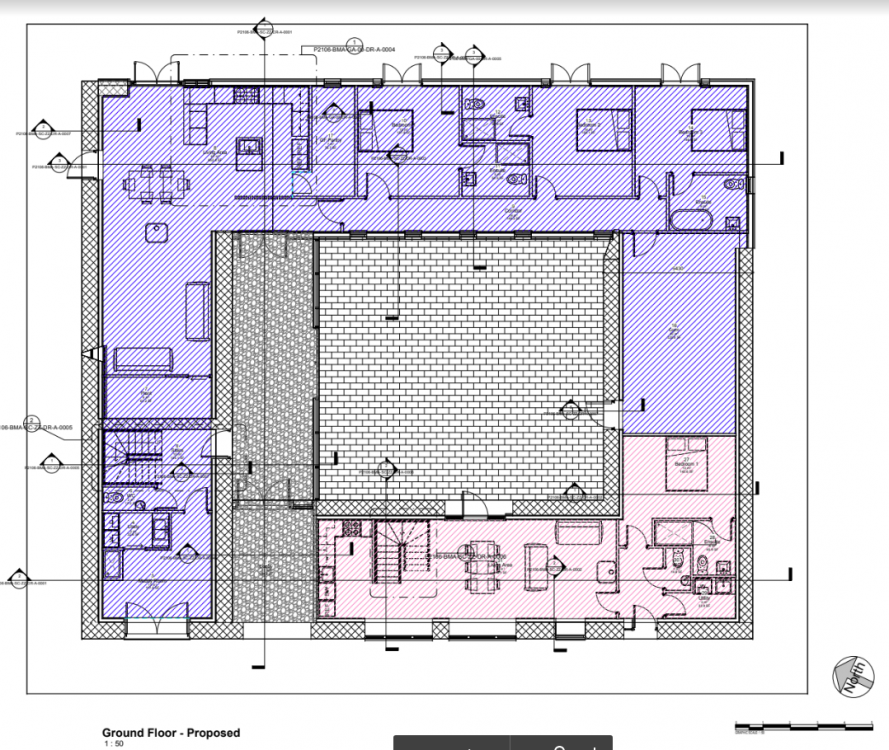
-
Ground sub floor insulation advice
saveasteading replied to KillyfadNewBuild's topic in Heat Insulation
What do you mean by 'polished floor'. Some people mean a beautifully smooth concrete floor with exposed aggregate. Others simply mean smoothed and polished as in an industrial context, for another floor covering. What is the construction of the floor? Raised or ground-bearing? Your 0.4 PA would be right for a 10m x 10m building. If bigger this will improve, but if less square it will be less good.