markocosic
-
Posts
979 -
Joined
-
Last visited
-
Days Won
1
Everything posted by markocosic
-
Set the cylinder to be nominally <48C and be done with IMO. Sack off the legionella cycle entirely. Not required. The only real risk to normal people is really the shower (cold pressure drops; hot water red hot; jump out of your skin and whack your head on the shower valve as you slip before getting scalded whilst out for the count) If you were old and demented you might leap into a bath you've just filled at 60C; or if thick you might fill a bath with scalding water at then throw a baby into it; but 48C isn't going to save you from either of those anyway. I think most all scalding is now in "care" facilities with shonky recirculating hot water systems dialled up to 11 to try kill legionella; or scumlord properties with dodgy immersions in direct electric tanks sat at 80C with non thermostatic mixers for showers etc.
-
IMO it's about unwanted heat loss and dew point. Aircon - always insulate else you'll get condensation / drips Domestic cold water - suggest insulating if it's in a bathroom for the same reason Heating primaries (before they ranch for space heat / hot water) - insulate to avoid summer heat gain Domestic hot water primaries (from branch to cylinder coil) - insulate to avoid summer heat gain Space heating primaries / pipework - I would say NO unless they will cause excess heat gain (tap dancing on UFH in a hallway for example) or you're using bits of insulation and then clamping around those to allow pipes to expand/contract without rubbing/squeaking Domestic cold water elsewhere - meh Domestic hot water - definitely the bits that are always hot such as a manifold above a cylinder that heats by thermosyphon; probably good practice to insulate the rest Cooling with a heat pump - now you do need to insulate your heating primaries as they become your cooling primaries @Nickfromwales?
-
Polyphosphate dosing as above is the appropriate option here IMO. It's that or a full blown ion exchange unit. The rest are magic beans with wishful thinking reviews.
-
Structural engineer for a passive house basement
markocosic replied to WisteriaMews's topic in Basements
If you're disposing of the earth. Reread the description and I'm describing what folks do here in the cold flatlands. Digging out a half storey; building from below the frostline (which they'd need to do anyway); then banking the excavated earth up against the house so that ground floor ends up half a storey above the surrounding land. Free of mosquitoes. With a view. Free of water on the ground floor etc. In the cities there's also an argument for it. Half basements for the cars, pushbikes, strollers, electric wheelchairs etc. In the space that you've had to dig down to for footings. Aartments above them. Density the city without losing amenity. Does involve muckaway though. But meh if that building is still there in 100+ years. Also meh if it's that basement that saves you a from Russian invasion etc. Check out Finland for planning policies that consider legitimate military interests. They've got some of the world's most over specified underground parking/gyms/bats etc all in the name of good effing luck if you make it past the swamps sunshine. -
Structural engineer for a passive house basement
markocosic replied to WisteriaMews's topic in Basements
Why so? Digging a half storey hole to get your foundations below the frost line, allow entry of your water services etc that are buried two meters deep in cold parts of the world, building a basement in it, and levelling the spoil around the house to raise the ground floor up out of the summer mosquito altitude, is a great idea in many parts of the world! -
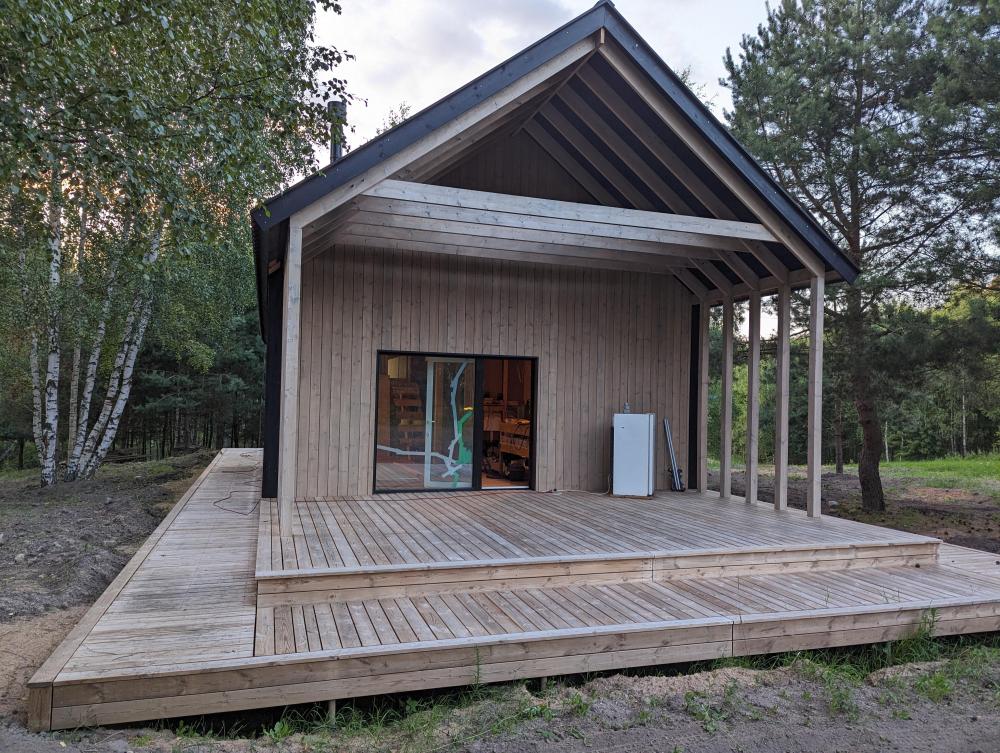
We also considered this. Rejected it because it's an invitation for wasps/hornets etc to make home behind the boards; and those little swines will much straight through any membranes (which must now by UV proof) that you have behind there. We used decking on the deck (120*28 mm nominal) and square edge overlapping cladding (145 mm; overlap meant for 10 mm nominal space between boards) on the walls. https://www.statybumedis.lt/lygi-terasa-28x120mm-ab-kat-iki-5proc-c-kl-pusis-impr-giluminiu-budu-ruda74576-1-65886.html https://www.statybumedis.lt/vertikalios-su-5mm-tarpuku-20x96120145mm-c-kl--egle-siurkstus-pav74541-1-60518.html Wound up like this. Decking still to be cleaned/coated. (we were waiting for excess brown dip coat to rinse off and weather a little) Cladding for a tinted acrylic dispersion from Cetol; to keep it "weathered look" rather than they "mmmmm yellow" that it would turn if given only a clear coat.
-
Small ASHPs / Units primarily for DHW
markocosic replied to Conor's topic in Air Source Heat Pumps (ASHP)
Nope. It's useless for this. You need to be returning at below 30C for CO2 to shine as a refrigerant. Radiators at e.g. 60/30C will have a similar output to radiators at 48/42C. A propane heat pump at 48/42C would have better performance here. It's good for a main dish ofnhot water production with a side salad of heating/cooling. -
Small ASHPs / Units primarily for DHW
markocosic replied to Conor's topic in Air Source Heat Pumps (ASHP)
Nice one @T M It's not obvious wheat one ought to do in a modest home. On the air to air side: The most basic worth entertaining: https://orostudija.lt/oro-kondicionieriai/midea-orokondicionieriai/oro-kondicionierius-midea-xtreme-save-eco-09 sCOP4.1 / SEER 7.4 €450 The premium end: https://www.aircon.panasonic.eu/LV_lv/product/heatcharge-vz-inverter-r32/ sCOP 6.2 / SEER 10.5 €2500 These will heat ok in a space that doesn't need too much heat. They will dehumidify in addition to comfort cooling. On the water side you can use an air>water unit drawing form interior air I think: https://www.theheatpumpwarehouse.co.uk/shop/heat-pumps/air-source-heat-pumps/vaillant-arostor-200-litre/ https://www.heatershop.co.uk/dimplex-edl200uk etc It will tend to cool and dry the interior air if drawing from inside. It's also tempting to use an air to water monobloc for everything. https://www.theheatpumpwarehouse.co.uk/shop/heat-pumps/air-source-heat-pumps/vaillant-arotherm-plus-5kw/ https://www.theheatpumpwarehouse.co.uk/shop/heat-pumps/air-source-heat-pumps/vaillant-arotherm-plus-5kw-with-unitower/ It can heat a simple hot water cylinder Underfloor heat is nice and comfortable Ceiling cooling is nice and comfortable You can do it with plasterboard such as: https://www.variotherm.com/en/products/modular-wall-heatingcooling/technical-information.html Wall heating/cooling could also work in some applications The Mitsi unit linked above looks fun. It really comes to life when producing HOT water with a LARGE temperature rise. (CO2 heat pumps best at say 60/30C) https://refrigerationcomponents.co.uk/ecodan-4kw-monobloc-air-source-heat-pump-with-thermal-stove-quhz-w40va.html Can they do cooling? If hot water temperatures are more modest a basic R290 unit will do almost as well. -
How long left on fit? I'd you can get a bigger energy density setup installed (more watts per M2) it may well pay to replace the lot; aiming for 4kW(peak) panels on a 3.6kW(peak) inverter...
-
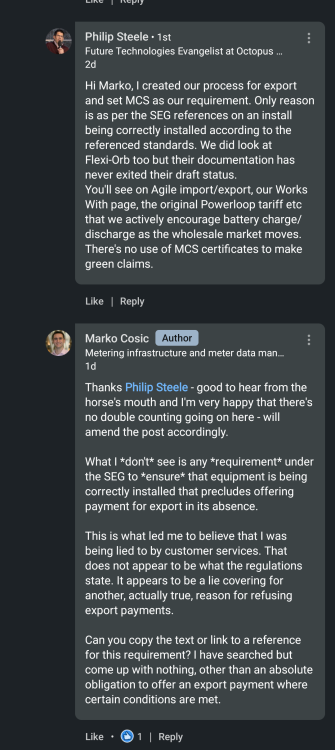
Why? They're completely dishonest little swines that tell bear faced lies to consumers... For example, that regulators require MCS certification for export payments; whereas in truth they simply don't want to pay for PV export unless (a) they're legally forced to by virtue of there being an MCS certificate or (b) you're part of their completely artificially priced and R&D /Marketing programme in load shifting (flux etc). See exchange with the octopus chap below. If they bare face lie to you it's only fit and proper that you return the favour IMO.



-
Some design strategies please
markocosic replied to Nic's topic in Energy Efficient & Sustainable Design Concepts
They sell woodfibre as sound attenuation. I think it's this absorbent surface rather than the "hollowness" of drylining per se that creates the audio effect. -
Rads with centre tappings and other questions
markocosic replied to sharpener's topic in Central Heating (Radiators)
Quinn made the last ones I saw. Not in business now. Looks like Myson make the same style: https://www.monsterplumb.co.uk/radiator-central-heating-plumbing-round-top-myson-premier-metric-double-convector-600mmx1000mm-4pm60dpc100 -
Rads with centre tappings and other questions
markocosic replied to sharpener's topic in Central Heating (Radiators)
They'll be cheaper at their trade prices from wolsley. They'll also be on extended credit. Stelrad homeline from wicked are ok. They're fecking hopeless at delivering them in non banana form though so order well in advance, check delivery, and be prepared for lots of returns. City plumbing et al are much better at delivering in one piece. The stelrads they sell will also have three brackets rather than two at the larger sizes. -
Rads with centre tappings and other questions
markocosic replied to sharpener's topic in Central Heating (Radiators)
Some "compacts" are round top on one side and square top on the other. Fit one way up for round top without grille. Fit the other way up for square top with grille. -
Rads with centre tappings and other questions
markocosic replied to sharpener's topic in Central Heating (Radiators)
Stelrad radical was the name. -
Any details on these that you can share? What prevents bedroom cooling from the corridor in your experience? Closed doors in the daytime when unit is running or something more subtle? Did any have US style transfer grilles for airflow in the doors / above the doors?
-
Ditto for conventional builds. 3.5 kW for an apartment of 75 m2 and 3m ceilings with a bucketload of South and West glazing is more than you need. Oversized units have two failings. 1) Efficiency at minimum turndown often isn't great But the main one is actually 2) Dehumidification capability is compromised Much of the comfort benefit comes from drying the air. You do that by cooling a piece of it, condensing/dropping out the water, and mixing it back in with the rest of the air in the room. The runtime needs to be long enough for droplets to form and drip off the coils and down the drain, and for the amount that evaporates back off the coil when the compressor stops to be trivial. Oversized units don't run long enough to dehumidify. We find the 3.5 dehumidifies better if you overcool (to get it to run hard enough long enough) then allow the place to warm up again afterwards before the next cycles. A 2.5 kW unit would have been a better choice. I'll be fitting a 2.5 kW unit in the cabin build (not passive but not nasty either) in light of this learning by mistakes method!
-
Horizontal cylinder in the loft, good idea?
markocosic replied to Post and beam's topic in Boilers & Hot Water Tanks
Horizontal cylinders are naff for stratification. Hot things in uninsulated spaces are naff. First floor is often closer to taps than attic. -
Business partner, in Hertford, has an ASHP. Vaillant jobbie. 7kW nominal into their 250 litre nominal cylinder. DHW nominal setpoint 45C. In practice this means a max of 53-55C from the heat pump and the top of the tank at a shade over 50C. (the coil-through-tank arrangement results in a stratified charge) The 250L cylinder was chosen for its coil size not because he needs 250L, but in practice this allows for a lower operative temperature without running out. Summer COP for charging like that is of the order 4.5; winter (average in UK is 7C; DHW reheat timed for hottest part of day) ought to be over 3. You can use the zoom function on that heatpumpmonitor dataset to see how other units perform. Suppressing reheat until the tank is materially emptied materially bumps COP (3.5>4.5 in this weather) Legionella disabled. Tanks turned over often enough are not at risk. It shouldn't be a major part of your usage anyhow.
-
Price. Not cheap to buy. Like, really not cheap by a factor of almost two. Be you deciding everything on £? Margin and credit terms. Mitsubishi offer good discounts to the trade and extended credit. Be these more important to the installer than performance? Newness? Not willing to fit the S2125 until it's been in use a few years? (same reason to never buy first year production of any new car e.g. early S2125 had some exploding inverters) Ask the question - I'd be interested in the answer!
-
The issue with R290 is flammability/explosion risk. Can't safely use vast quantities of it indoors. Which is most VRF/VRV air conditioning systems. So the vendors aren't geared up for using it. All are headed in that direction for small packaged units now though. It'll be the units rather than the gases that are optimised for heating operation. Suspect the difference between the Nibe unit and the Vaillant unit is stuff. 115 kg vs 165 kg of stuff. Some will be the case. The rest will be larger heat exchangers with smaller temperature drops that bump COP. When it comes to pure £s though it probably isn't worth spending on a premium unit. £1000 over 20 years saving? Meh. Hence the proliferation in so so units that if you're purely £ driven will work out annoyingly more cost effective. Assuming no change in energy costs that is. I haven't seen good explanations for why the ecodans that are monitored do so badly (typically) than notionally lesser performing units by vaillant though. And that's what bugs me about them.
-
My take on the Ecodan: Ecodans do fine on the "euro tests" for sCOP. The euro tests for sCOP test the unit at a few fixed points that are representative of perfectly weather compensated heating of an old-build in one of three climate zones. This means: - They have a "long and low" space heating season (heating well into the shoulder seasons and relatively more of this vs heating during the coldest snaps) - They don't capture domestic hot water production - They don't capture how well the built in controls on the unit do, or don't, work (the tests are at operating points fixed by the test rig) It isn't the highest performance unit on the market. And it's also an FGas based unit. High temperature capabilities are limited. In the real world you see a very mixed bag on the results. The majority are fairly poor. (if we believe heatpumpmonitor results) This could be because the people who typically choose Ecodans don't know how to install and operate them. This could also be because the controls on the units are poor and they don't operate anywhere near the lab test conditions in real life. If you dig into the results, the top ecodan is...delivering space heating ONLY (so no high temperature operation to produce domestic hot water) in an old build (so extended heating season) with UFH (so in effect it never operates hot). It comes close to the test results. The second ecodan...essentially uses uses solar thermal for the domestic hot water and tops out at 38C at design condition in an old build property. So again t's doing nothing hot. The third ecodan...is more normal (providing heating and lukewarm water - 42C) but read further and it's operated by somebody who gave up with the OEM controls being being excrement and wound up rolling their own to try get the thing to perform. Only by the time you get to the fourth ecodan do you see something "normal" but again I'd caution that it's an old build with extended space heating. The rest get progressively worse; with Ecodans occupying too many of the bottom rungs on the list for there to be no correlation between the unit (or the people who choose this unit) and performance. You have a passive house. The heating season will be MUCH shorter and harder (there won't be the long shoulders of low grade heat and relatively high ambient temperatures) and hot water will be a MUCH higher proportion of overall demand. You will want to pay a disproportionate amount of attention to the high flow temperature DHW production performance of the units. That will likely favour the newer R290 based units over R32 units. You'll want to be MUCH more careful about designing an overall system (both heat pump itself and the heating system controls that couple this to the thermal storage of your pipes/floors - no stupid hysteresis stats on 101 zones etc) so that it can operate at part-load. I don't think an Ecodan ticks those boxes particularly well. It's long in the tooth. Naff OEM controls (read through the trials and tribulations of the openenergymonitor folks trying to control these) and what looks like narrower operating window (look at the minimum flowrates etc required) compared with other units. The Vaillant units aren't anything to write home about on paper. They look like they don't work as well as an Ecodan. Yet they're disproportionately represented on the upper part of the heatpumpmonitor charts. Probably not a coincidence. Perhaps due to an "ok" unit with superior control when it comes to heating. Perhaps due to those designing these installations being better at it. Performacne oriented units? Perhaps Nibe S2125? Rated with a sCOP of 5.0 on the average climate and 6.4 on the warm climate for underfloor systems (35C peak flow temp) on the euro test cycle. https://www.nibe.eu/en-gb/products/heat-pumps/air-source-heat-pumps/s2125 https://assetstore.nibe.se/hcms/v2.3/entity/document/319563/storage/MzE5NTYzLzAvbWFzdGVy (The south of the UK is warm climate. The north of the UK is average climate.) Don't get confused by the nameplates. 8 kW nameplate on Nibe is about the same at 5 kW on Vaillant. (Nibe quote the "max" heat output in warm conditions; Vaillant quote the "design" heat output at the cold/design condition; both are similar) Perhaps a Lambda unit if you're feeling brave enough to try a low volume unit? https://lambda-wp.at/luft/ https://zewotherm.com/de/produkte/waermepumpen/zewo-waermepumpe-lambda.html Rated at sCOP 5.7 on the 35 degree *average* climate cycle. Similarly impressive sCOP on the 55 cycle infers decent DHW performance too. Quiet courtesy of both the sheer size and blowing through the heat exchanger to muffle fan noise rather than sucking through it and giving you direct fan noise. (at the expense of being somewhat more difficult to clean) Three options for PV diversion 1) run at a set output when digital contact bridged 2) measure the actual excess export and run at as close to this as possible using a meter 3) get told what to run by an external device using a modbus input Also tall to avoid getting buried in snow; buried in cold lakes of air; and designed to thermosyphon from the house (needs heat pump higher than the house) in the case of a power cut etc. Relative to this kind of thing the Ecodans aren't a performance oriented unit. They're so so. Robust but not lighting anybody's pants on fire. And in practice most appear to be towards the bottom of the league tables in real world performance vs other similarly "so so priced" units. I'd at the very least want to know why my designer were picking this over other units and what they do differently to ensure that their designs aren't at the bottom of the league tables in terms of performance. It doesn't appear to be a given that these perform well.

-
Mad idea for DHW retrofit based on Mixergy?
markocosic replied to JamesPa's topic in Air Source Heat Pumps (ASHP)
Yep. Winner of the show at ISH this year. https://www.qvantum.com/ISH23/GSHPM It's a thermal store with DHW produced on demand by plate heat exchanger AFAIK. Allows you to run the store even lower than 55 whilst still producing useful DHW. -
Mad idea for DHW retrofit based on Mixergy?
markocosic replied to JamesPa's topic in Air Source Heat Pumps (ASHP)
Not necessary - buffer intelligently instead if you must. -
Mad idea for DHW retrofit based on Mixergy?
markocosic replied to JamesPa's topic in Air Source Heat Pumps (ASHP)
Appropriate flow. A 3, 5 or 7 degC dT (probably the same dT both sides unlesss primaries are particularly long?) at the target power output ought to give optimal COP improvement for minimal pumping power increase. You can't run at part part part load though. And not do you necessarily want to run at 11/10ths either.