

ProDave
-
Posts
30674 -
Joined
-
Last visited
-
Days Won
423
Everything posted by ProDave
-
Just go and say hello? Ours was a bit different, our first plot was large enough to have a static caravan on to live in during the build. The first time we met the neighbours was when we had just completed the purchase and came up for a week and stayed on the plot in our touring caravan.
-
The house I am wiring at the moment has the floor slab cast as one, with no expansion joints. There are two large cracks visible in the slab, and not at the points where you would think was a "weak point" As he is planning to polish the concrete and varnish it, an expansion joint or 2 would probably have been better than 2 cracks.
-
I watched the first of this series last night. They were trying to say that "floating homes" is a new concept, but houseboats have been around as long as i can remember. the only difference this time was they were trying to make a nice looking well insulated home, compared to some houseboats that are just slum boats. As usual over played drama, and lack of any details. What they were building looked like a standard SIP construction with 100, maybee 150mm thick panels, and they claimed it would not need heating as the 700W given off by two occupants would be plenty to heat it. No details of how a houseboat on a permanent mooring deals with waste water for instance.
-
 Well I have just "ordered" a new one from flea bay for £15 including postage. I will let you know how I get on. If it lasts 4 years again at that price, then a £150 Grohe one would have to last 40 years to be better value.
 -
It's the way it was always done in the 1960's, known as the spider method. There is nothing wrong with it apart from you have to put the junction box somewhere accessible. The wiring regs don't specify how to wire a lighting circuit so still perfectly legal. Make sure you label everything and do all your switch drops from the junction box in 3 core & earth in case that switch is ever used for 2 way switching, and label every cable as it enters the jnction box, a sharpie pen is good.
-
I will be interested to see what render system you are using and how it compares to what I have used. All looking very good so far. Are the hen's laying?
-
I would take the Frametherm and Celotex topping all the way down in the habitable bit of the roof, thus insulating the voids. Then no need to insulate them as well and it gives you a warm storage space if you care to put a couple of trap doors in.
-
Nearing build completion - key steps?
ProDave replied to ragg987's topic in General Self Build & DIY Discussion
Re the warranty, we used NHBC last time and their surveyor had to comer for a final inspection before they issued their completion certificate and start of their cover. for some reason it took them 6 months from the final visit to produce the paperwork which effectively meant we got 6 months longer cover. -
But my point is BC have approved nothing more than 100mm of insulation, so why would I bother with all sorts of extra bits of fiddly metalwork? If the furrings on their own were a "solution" then I might have considered that as it would leave the void clear so future cables might be possible, but if it's furrings and insulation then why bother. I am not a "typical tradesman" it is just in this case I don't have a problem, so I am being forced to "solve" something that is not a problem to me and just looking at what I thought might have been an option.
-
Nearing build completion - key steps?
ProDave replied to ragg987's topic in General Self Build & DIY Discussion
For completion, your BC officer would normally inspect it and draw up a list of anything he feels does not comply. to move in before it's finished, up here in Scotland, you can request a "certificate of temporary habitation" from BCO. for that the house does not need to be complete, but basically safe. It has to be wind and watertight, have a staircase and banisters that comply, have at least one functioning bathroom, a kitchen, and functioning heating. In our present house we moved in like this with just one of the 5 bedroms and one of the 3 bathrooms in a working state. -
Personally, I have never had a problem with sound insulation between upstairs and downstairs. I don't have a "complaint" with just plasterboard direct to the joists, floorboard on top and nothing in between. So this is one aspect of the regs I find is "solving" a problem that I do not have. My spec says 100mm and that is what I will fit, though I see it as an unecessary expense and it will be in the way if I later decide to add extra cables for anything. I was merely asking as what I understood was being proposed in this new build I am wiring is just these furrrings and nothing else extra.
-
This is for ceiling sound proofing. so are you saying as well as the furrings, you need a rubber strip AND 2 layers of plasterboard AND insulation batts? If so I won't bother. Mine has been specced (and approved by BC) as one layer of plasterboard direct to joists and 100mm insulation. I was just looking if this was an option to avoid fitting insulation.
-
I have not come across these before. but the house I am wiring at the moment is using them. It appears to be a thin steel "top hat" section strip. You screw it to the underside of the joists (screwing through the two sides of the "brim" and then the plasterboard screws into the flat part. It's supposed to be a sound proofing measure and this apparently obviated the need for any actual acoustic insulation. Anyone used these? does it really work? I am skeptical myself as I would have thought the surface of the plasterboard would transmit sound just as well and can't think transmission via the joists (posi joists in this case) would contribute much to sound transmission.
-
The house I am wiring this week (my plumber friend) he wants to do this. He has had a go DIY with a hired sander for a weekend and barely scratched the surface (literally) The thing that strikes me however is there are two big cracks in his concrete slab. I assume he should fill thee first, and even then they will surely show in the final finish.
-
Hello and welcome, glad you found us in our new home.
-
Here's my dilemma. I can get a real cheapie from ebay for £25, I think the present one was £35 from the bay 4 years ago. That lasted 4 years. If I spend £70 will it last for at least 8 years? I can get a Grohe for £150, would that last 16 years or more to make it a worthwhile purchase over the cheapie? We are still trying to sell so that bit of me says buy another cheap one and surely wer will have sold by 4 years when the next one fails? SWMBO is trying to convince me to buy a better one as if she thinks it will help the house to sell. Does the same thing happen to mixer valves that are built into the wall? If so then that must be a real megga PITA when they go. That alone has convinced me that exposed, easy to swap mixers are the way to go for maintenance reasons. Any thoughts on trying to "unclog" one of the failed ones or what causes them to fail? the failure mode seems to be initially they still regulate but you can't adjust the temperature, and then a bit later they fail to regulate and it's pot luck what temperature comes out.
-
Present house has a themostatic bar mixer valve. when it works, it is great. BUT... The present house is 12 years old. At 4 years old, the mixer stopped regulating properly, so i replaced the thermostatic cartridge. At 8 years old, it failed again. Although the original cartridge came out easily, I had to press VERY hard (vice) to get the new one fully home, so I thought the chance of getting it out to replace it again was slim. So I bought a whole new bar mixer. Now at 12 years old, it's failed again. So is 4 years the "normal" life? is it considered normal to have to repair or replace them every 4 years? If so I will be lookinf for something different for the new house, something that just keeps working. SWMBO of course blames me for buying the cheapest. That is true of the current one, but not the original. Is it really true that if I spend more, it might last longer than 4 years? Is it a problem with our water? We have very soft water here so I can't think of an issue, but clearly something is gumming up inside. Is it worth digging out the original one, giving it a few days soaking in something like Viakal and trying it again? Ideas and observations please.
-
... plumber, joiner, kitchen fitter, chief tea maker and several others no doubt. I have tried plastering and rendering and I just can't do it. We can't all be good at everything so I am paying a man that can.
-
The wood fibre board is rated by the manufacturer to be exposed to the weather for 3 months before being covered. I have not exceeded that yet. However the roof (which is also covered with wood fibre) was closer to 6 months with only the breathable roof membrane protecting it without leakage before I got the tiles on. In fact the garage roof has only just been tiled and that is a year since it was put up, again only the breathable membrane protecting it. Not a drop of leakage inside.
-
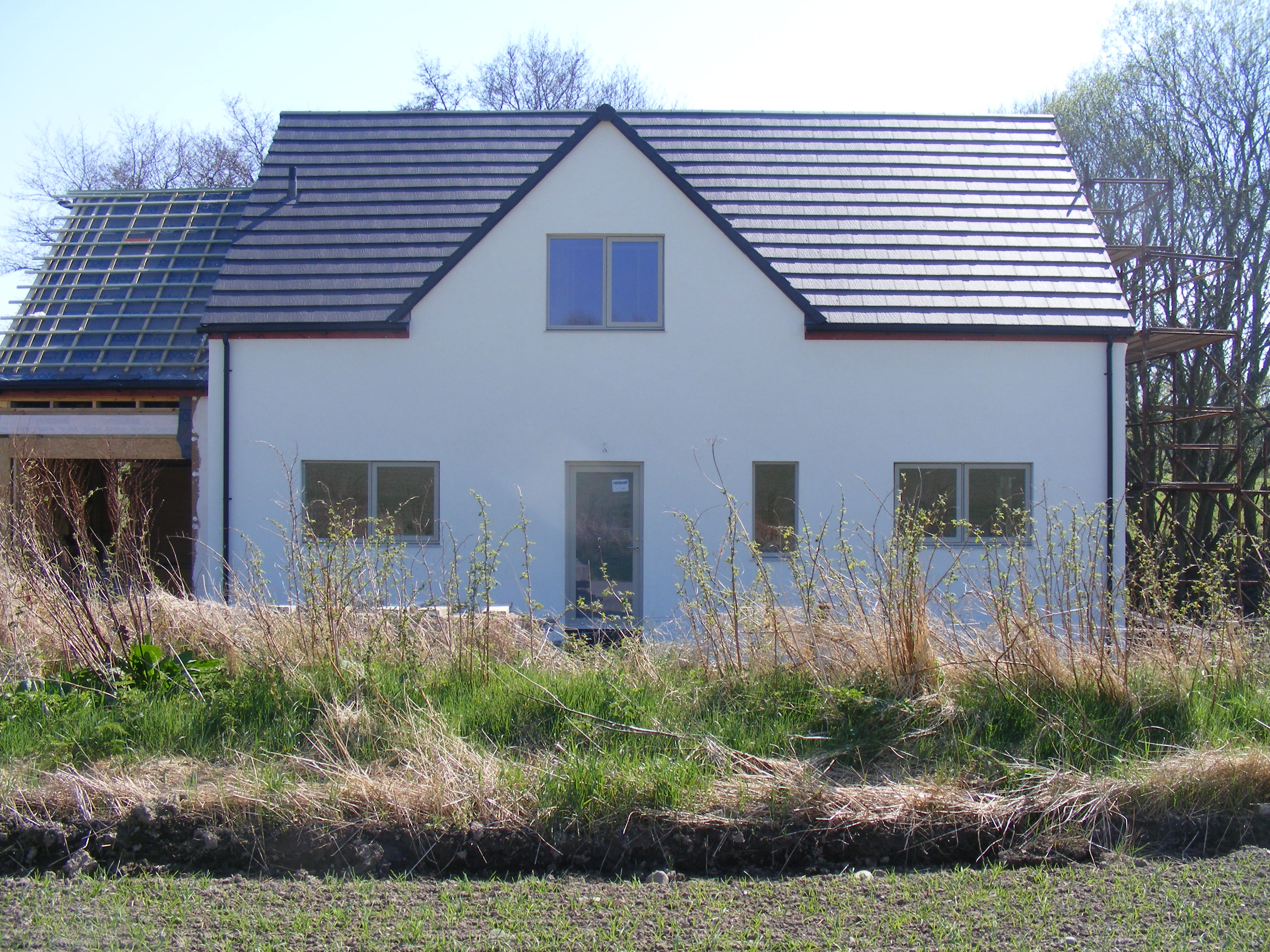
Well it's nice to have the doom sayers telling me my house is not approved and will rot and fall down in no time. Yes, I appreciate the render is what keeps the rain out. So attention to detail is important, as is keeping en eye on it. So if in the future I see cracks then I will need to fix them. With a masonry wall you can let the render blow and half of it fall off and apart from looking tatty, nothing much will happen. With my build it will be more important to repair any defects quickly. Having had a good look at and spent a lot of time working with this wood fibre board, it is actually very surprisingly resistant to water. The outer layer has coating that makes it waterproof. I have had some bits left exposed while waiting for the renderer, and rainwater just runs off. compare that to bare timber where the water soaks in and wicks deep into the timber. The firm that dis the design on my house have just built some flats in town using this method, so the housing association involved are happy with the risk. As to vapour barrier. the condensation analysis and approved drawings show just the OSB layer as the vapir and air tightness layer. But when I do the interior I am likely to also include a air tightness / vapour membrane on the inside.
-
Well if you really want cheap http://www.ebay.co.uk/itm/LED-Voltage-Tester-Pen-90-1000V-AC-Non-Contact-Electric-Volt-Detector-Sensor-UK-/131754093686?hash=item1ead27ec76:g:bTwAAOSwmmxW6Wph
-
All that matters to me is building control have accepted.the design drawings and as long as it's built to the drawings will sign it off for completion. I am not using the services of nhbc so if they don't like it, that's too bad but not a problem. i don't want to stay in the past and am happy using a modern building method that's been in use on the continent for some time.
-
Tou need a voit stick or voltage detector pen. Something like this http://www.screwfix.com/p/fluke-1ac-ii-voltage-detector-pen/85949 Turn on circuits one at a time and use the pen to see which are live, and them label them with a marker pen. Note for lighting circuits, turn all the lights on when testing as some lighting cables will appear dead when the lights are turned off. This, imho is the only use for these devices, they should never be used to prove a circuit is dead before working on it.
-
I would have a serious word with the council. It is the School project that is causing the "issue". I would respectfully point out that YOUR plot did not have a problem, you already had an ecology report, and you have STARTED your development. Any newt problem that now arises, is clearly the result of the school project and the relocation of the pond, and I would poin tout that it is the contractor responsible for that work that should take all precautions including a newt fence along your plot boundary.
-
That picture is quite shocking Jack. It shows the builders regard fitting insulation as a "box ticking" exercise, rather than actually giving any thought to making it well insulated.
