


allthatpebbledash
-
Posts
69 -
Joined
-
Last visited


allthatpebbledash's Achievements

Member (3/5)
1
Reputation
-
What’s the most cost effective way to have ground and first floor decks installed? The project is a retrofit as that would be the word best describing it. Not chasing numbers. Except the current shell as it stands is the only existing thing remaining, everything else is being replaced. The current floors are suspended timber decks. There is a void of approx 500-900mm as the site slopes a little. Both are being taken out as knackered. The walls outside will be having EWI. A new well insulated roof is being installed. The question is, what type of insulated floor is most effective and cheaper to do relatively? The plan is for UFH on both floors. We think the wet overlay type upstairs, but would it better to have wet in screed downstairs? On what joists, timber? Posi? Lewis deck? It is unlikely to make this a ground bearing slab as lots of void to fill and site is on clay.
-
Just another follow up topic from my previous as even though the nature of the question is same, new facts. Say you were building a new cavity wall using dual leaf brick. New foundations. Width of wall to be constructed not an issue, as long as it’s not like 600 or something. What size cavity would you have if you were intending to full fill with mineral wool batts? Wall would need to achieve 0.18w/ but lower the better. The question is what’s the sweet spot for performance vs cost vs cavity size? I’ve learnt DriTherm 37 is more cost effective to buy per sqm than the 32 slabs. Almost 50% cheaper online in some places. But when I run a calculation it shows I would need almost double the quantity to achieve the required performance. Kind of makes it the same then and not as cost effective as I’d read on here. Or is there something I’ve not factored in? Thanks.
-
Using a dense block external leaf, and lightweight block internal seems to achieve 0.18 with 32 batts in the cavity I just seen. Are the lightweight blocks terrible as I’ve heard of them cracking and crumbling easily. Using dense blocks both leafs and 32 batts gives 0.19 which is so close. Would it not be possible to do this and say increase u-value of floor or roofs? Or windows? Anything to compensate for such a small nominal. It’ll allow for using the much cheaper and better dense blocks for walling and go with fully filled cavity mineral wool. For now taped PIR at 140mm is being planned.
-
Ice I’ve had a go at using the calculators on rockwool and knauf websites and I can’t seem to replicate the results. I get 0.19w and no where near the number shown here. I’ve already said to the architect we should go with 140mm Recticel with 10mm residual as well as I couldn’t replicate the numbers using products available. Ooops.
-
PIR above rafters only with dMEV
allthatpebbledash replied to allthatpebbledash's topic in Heat Insulation
Oh. I have all moisture areas located either side of say a large rectangle. To have them extract through one roof outlet would mean I would need to run a duct across the attic space which isn’t possible due to raked ceilings and through runs. So it’ll have to be 2 roof outlets. I suppose I can still run a MEV this way, but what advantage would that have over a dMEV stacked and vented vertically through roof in same way? -
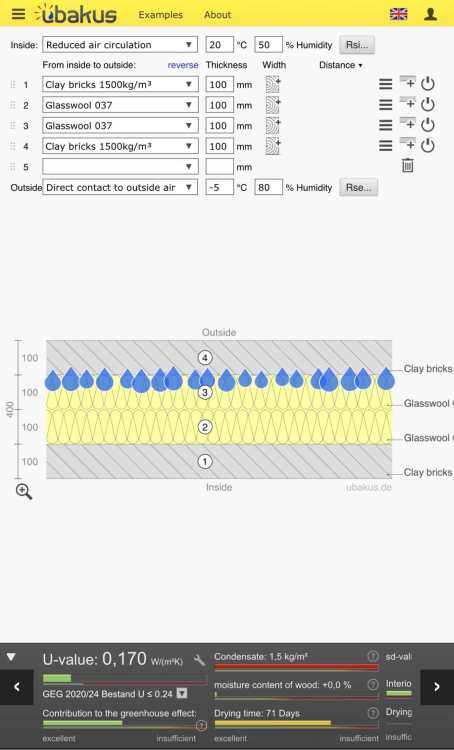
Ah. Yeah so with the “035” wool at 150mm thickness it gives a 0.15w/ wall which is good. But it also shows a heavy set of rain drops suggesting huge condensation risk.
-
Run cables in external wall cavity
allthatpebbledash replied to allthatpebbledash's topic in Electrics - Other
In the cavity. -
PIR above rafters only with dMEV
allthatpebbledash replied to allthatpebbledash's topic in Heat Insulation
Tell me about this, if I’m venting through roof are you saying I should be looking at MEV? Like an MVHR system? -
Porotherm/Poroton clay blocks
allthatpebbledash replied to allthatpebbledash's topic in Brick & Block
Interesting. I’ve seen them used in a few projects in UK, one is an award winner. The block type would be the ones with mineral wool infilled. They give good u-values off the pallet so to speak albeit you need a wall that’s like 400mm thick. No warranty here. I’ve read the opposite. Airtightness is easier as blocks are continuous with thin profile joints and have an ecoparge coat on them. As for expense, I’m thinking this could be counteracted with no need for wall ties, lots of mortar, no insulation boards to cut shimmy fill, and speed or build. Hoping the 3 members tagged can chime in, can see from searches they’ve attempted this method. -
PIR above rafters only with dMEV
allthatpebbledash replied to allthatpebbledash's topic in Heat Insulation
Theres no EWI. Anticipating a concrete block cavity wall with cavity fully filled 100-150-100mm. So is it possible to avoid the filling between rafters and just place boards above them? -
Run cables in external wall cavity
allthatpebbledash replied to allthatpebbledash's topic in Electrics - Other
Yeah so you’re actually right. I asked and got answers. You run cables through a flexible metal ducting behind the cavity walls or any walls for that matter. Then pull through, cut brick, always at joints for easier installation of back boxes. -
PIR above rafters only with dMEV
allthatpebbledash replied to allthatpebbledash's topic in Heat Insulation
Would that mean I’d be looking at a between and above solution then, like hybrid roof? Forgive my lack of understanding, I was under impression you could just plonk a ton of board on top of the rafters reducing the need to cut and fill? Aesthetic reasons, the soil stacks are also venting via same method so no visible pipes externally. -
Currently exploring this by use of them clay blocks which don’t require EWI either. What would a proposed build up be for single skin concrete blocks wall with EWI, lay flat on belly?
-
After reading quite a few previously asked questions, would I be allowed to assume the easiest and least faffing way of insulating a roof is to go above rafters all over? New pitched roof, covered in slate. Gable end to end, simple form. Probably hand cut timber rafters. Intergrated PV panels. Loft boarded for storage with hatch. New ceiling joists below. Was considering cold roof with mineral wool above new ceiling joists as cheaper but being advised it’ll open up potential to damp and mould. Told to go warm roof instead. Either between and below, between and above, or all above. The latter seems most simplest to not go wrong. Therefore, if I throw 140-150mm Recticel Eurothane or something above rafters, and as I have 2 ducts either end coming up from wet rooms on floor below for the dMEV units to extract via the roof, could I install an additional 2 units in the loft space on either side to tap into existing ductwork for any possible moisture to be extracted? Need to achieve 0.15W or better.
-
Hmm I can see the advantages definitely. But that leaves me having to find someone in the North who can do this and to a good standard. What about using Recticel 140mm with 10mm nominal gap as a way of rigid PIR and having a fully filled cavity?

