ProDave
-
Posts
30861 -
Joined
-
Last visited
-
Days Won
427
Everything posted by ProDave
-
 So we have a plan to fix the planet, but even now, nobody knows if the plan we have will work, will it stop warming, will it cause the planet to cool, etc. So in spite of being certain it is man made CO2 that is causing the problem they don't have a scoobie if stopping all man made CO2 will make any difference or not. No wonder some people cannot take this seriously.
 -
If it's below the bottom of the trench, how do you know it is there?
-
Newbie Question - 1/2" female adapter onto 15mm compression
ProDave replied to crispy_wafer's topic in General Plumbing
I'll give my reply and let the proper plumbers come in a minute to agree or disagree. It will work, BUT it is not right. The fitting your HEP adaptor is intended to connect to looks almost the same, but the edge of threaded pipe it fits to has a pretty square edge. Your fitting intended for a copper pipe with an olive has the end machined out to match the olive so presents just a very thin edge of pipe. -
It helps working in the trade. I had worked with the builders we used for the frame construction and erection before so I knew their standard of work and what they were like to work with. Same with the joiner we used for a few of the harder details that I did not feel up to myself, I chose the one joiner out of several I know, that I thought was good enough for the job.
-
Start by doing a map search on the land registry and see who owns it if indeed it is registered. Also download the title deeds for your neighbours properties (£3 fee) and see if they own it.
-
Do come and post pictures when you have done that. I will be surprised of you find a 13A socket that will actually fit two 10mm cables.
-
I would get rid of both those tall corner units, just removing one destroys the symetry. I did think they would be hard to access storage.
-
We have 1.2 metres between the island and the main units, I would not want to go less. We chose granite on the main units and Oak on the island with nicely rounded corners and round corner units to make it more user friendly. Where is the dishwasher going? Don't forget when that is open it will all but block access past it with an island there So you need to get from hob to sink to dishwasher all with the dishwasher open. And do you really need 4 ovens?
-
How are the rafters fixed to the ridge board? I don't see any brackets. Normally with a roof hung from a ridge beam, which is what that is with the steel beam, there is some form of substantial bracket or strap to stop the rafters sliding down away from the ridge beam. The lack of that fixing would worry me more. What do the drawings say? and why were the builders building without the detailed drawings?
-
One of those heaters is certainly worth a try. It will certainly be silent in operation. Interesting about your dry eyes. Both SWMBO and PD Junior are complaining about dry eyes and blaming our house for being too dry. According to my (uncalibrated) hygrometer, we are about 55% RH inside at the moment. I don't know if that is considered "dry" or not? Outside RH currently about 90%
-
A screwless faceplate still fixes to the back box with standard screws, and then a decorative cover clips on to cover the lot hiding the screws. Some of the Varilight stuff is a king of low voltage master / slave unit.
-
We have no issues with stoves or similar. But just over the neighbours boundary is his discharge from his septic tank. On one of those dead still nights the "pong" from his ST hangs around and gets drawn in by the mvhr and the air in the house starts to smell stale. If we notice that I turn the mvhr off until the wind picks up a bit. Clearly the filters are doing nothing to stop that sort of pong.
-
Site Insurance - The first or final hurdle?!
ProDave commented on mike2016's blog entry in The Fun Irish (House)
Odd. When I got site insurance I was not asked anything about the build method. -
My plumber did not think so. He did not even ask if my ASHP had a backup heater. He just expected the cylinder thermostat so shut the motorised valve feeding the tank. Perhaps he is just a typical old school plumber and cannot understand the difference between a 5kW ASHP and a 20kW gas boiler. Perhaps more modern plumbers would not insist on that?
-
The safety feature is one of the things the plumber checked before giving me G3 signoff. You might argue an ASHP cannot possibly heat the water anywhere near boiling, but my ASHP as a 3kW backup heater inside it and a possible fault condition is that gets stuck on. In normal use, my tank does not use the traditional tank thermostat. It has it's own temperature probe in a thermostat pocket. The traditional tank thermostat is only there to shut off the 2 port valve if the tank goes over temperature, and the temperature it is set to is much higher than the normal tank operating temperature.
-
To clarify if everyone is making the right diagnosis, can you post some pictures of the plumbing, in particular what motorised valves you have, both general views and close up views so we can read the model numbers. My preference is not to allow a 3 port valve into my house. I much prefer 2 or more 2 port valves. But basically an ASHP should NEVER fo heating and DWH at the same time. It is always one or the other. That does not mean you have to set the programmer so they are on at different times. Usually when both are on, DHW will be priority, so when the tank needs some heat, it will stop heating the house. My own LG ASHP will set time limits on how long it will spend at a time doing DHW if you think there is any chance of the house cooling down while it is heating the DHW.
-
Hi and welcome. Your plan there is on the right lines. As you have already identified, the key to success is good detailing. So well fitting panels of insulation fitted and all imperfections filled with foam and taped. As to is an additional 25mm enough, many would argue not enough. How much celiing height can you afford to lose? 50mm would be better. But whatever you do will be vastly better than nothing. Re detailing the plasterboard when finished. Look at dry lining it aka tape and fill. You only fill the edges and joints between plasterboard and screw heads. I am the first to admit I have tried and failed miserably at plastering, but I can tape and fill a wall quite reasonably and can give my opinion on what products are good. Out of interest how old is the house to have been built like that?
-
That is very disappointing to hear it is not as described. Do keep us posted.
-
Screw the discussed L shaped bracket to the wall into each stud, and then down through the L shaped bracket into that cross bar at the top of the unit. What is so difficult?
-
Standard practice to fit dwangs (noggins) at just below worktop height and top of wall unit height before fitting plasterboard for that very reason.
-
Site Insurance - The first or final hurdle?!
ProDave commented on mike2016's blog entry in The Fun Irish (House)
Is this liability insurance for a self build site you can't get? Or a structural warranty for the building? -
Your reed switch is rated at 1 amp. Your light driver is rated at 0.65 amp. So in theory you might be okay. BUT that will be a switch mode power supply so the input circuit us usually a bridge rectifier then a smoothing capacitor. So on first power up there will be a high starting current to charge the capacitor quickly. It is likely that high starting current has welded the contacts of the reed switch. Seriously, i would look at a little mechanical switch of the type used for limit switches on machinery that will be activated when the gate gets to end of travel. Or hack the existing circuit to find a way of triggering a relay from the existing switch. Do you have a picture of the insides of the controller?
-
Assuming these are tall so you can't look down on them. Screw an L shaped bracket to the wall at each side, dead level with the top cross member on each cabinet. Put the cabinet in place, a single screw down through the L shaped bracket into the cross piece at the top of the unit.
-
That just strikes me of a lousy design.
-
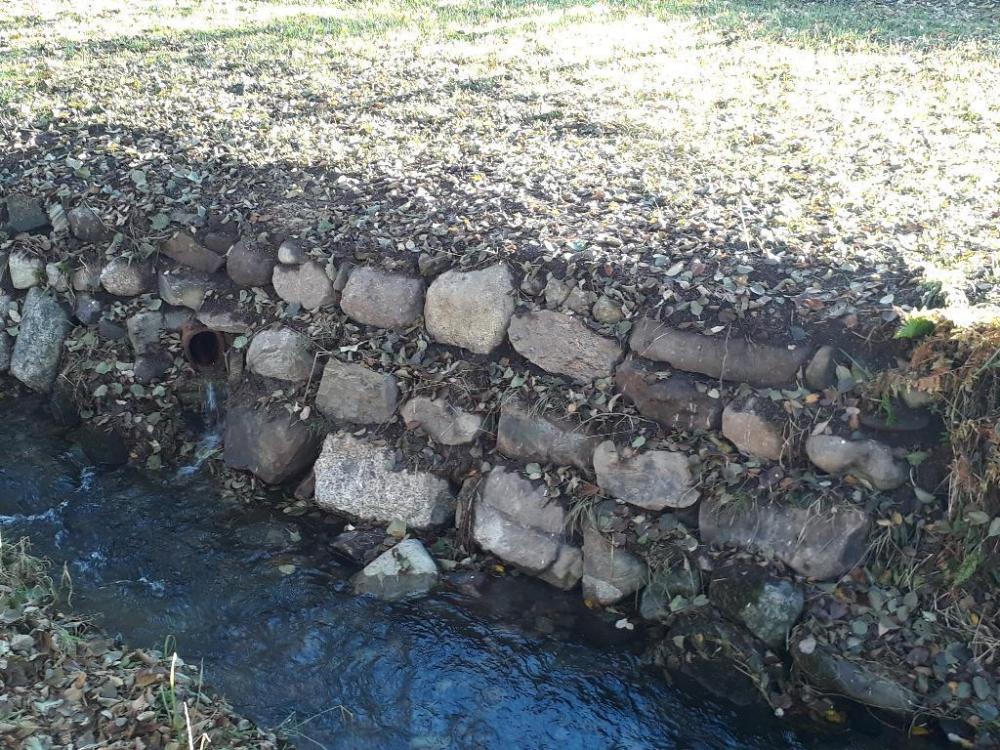
And the repaired section of the bank completed. Land drain pipe still flowing.