


mafaldina
-
Posts
94 -
Joined
-
Last visited
Everything posted by mafaldina
-

Wooden Window Frames - which wood?
mafaldina replied to LeanTwo's topic in General Construction Issues
Peter, I beg to differ. https://historicengland.org.uk/advice/hpg/has/listed-buildings/ -
In thirty plus years for myself and same for my husband (plumber) we have never encountered BC doing an air test on drainage. suppose there is always a first time...
-
Wooden Window Frames - which wood?
mafaldina replied to LeanTwo's topic in General Construction Issues
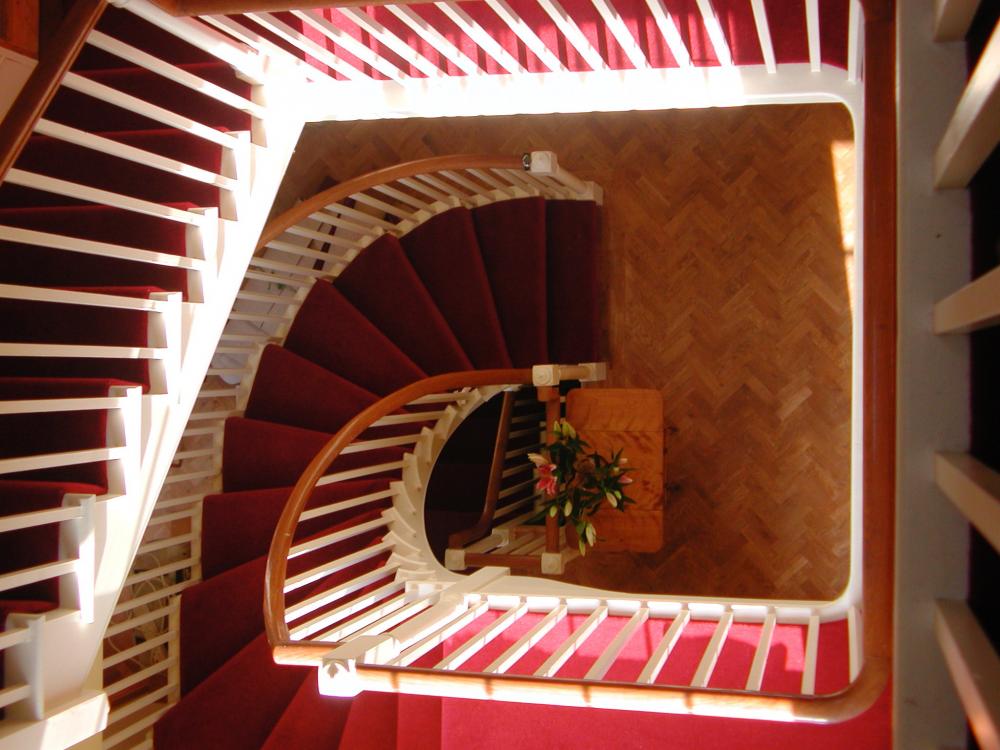
That's not entirely true I'm afraid. It is true vis à vis the normal planners but not Listed Building officers. If a building is grade 2 (any grade really) listed it includes all elements, internal or external, even down to door handles/light switches/wall coverings/lighting etc., if you are unlucky. If it is not listed but in a conservation area then it is, usually, just the exterior (often only the facade) that they are concerned about. The best is to set up a meeting with your BCO and Conservation officer and negotiate. You can work this both ways. Either to dispense with some elements of BC – I managed to get an open 4 storey staircase (without sprinklers or fire protection) through by using Listed Building against BCO (see photos), you can work it the other way too as I did with the glass doors.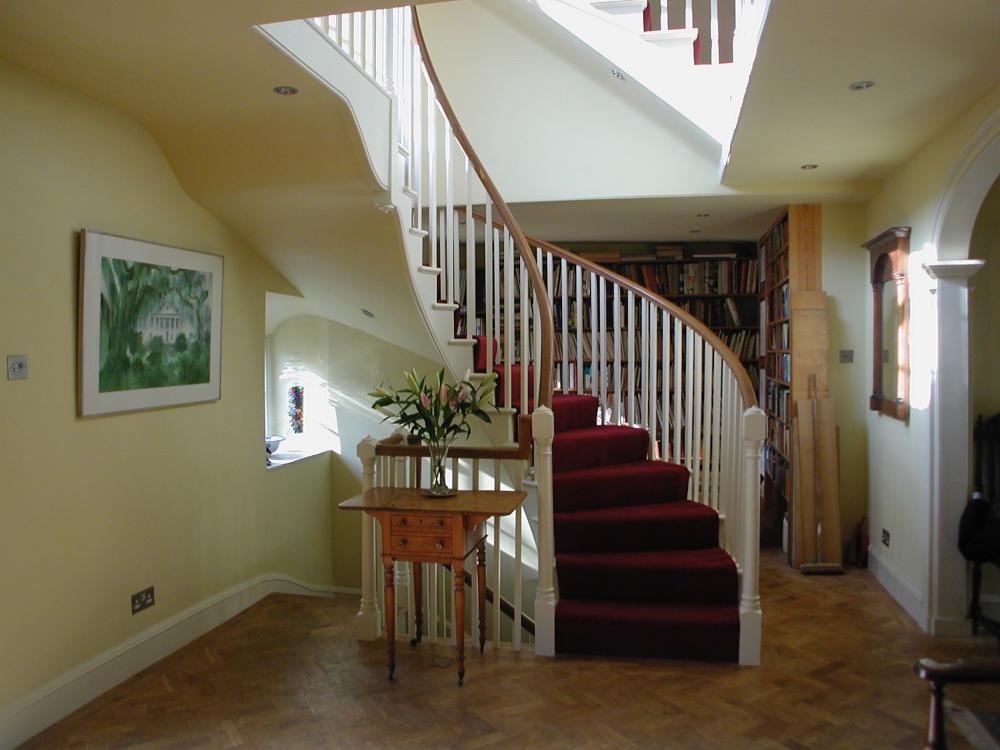
-
Wooden Window Frames - which wood?
mafaldina replied to LeanTwo's topic in General Construction Issues
I think you will find that what they object to is glazing bars stuck on on one side only. I had this problem on a listed house and they let me install french windows with the glazing bars stuck to both sides so it looked like they went right through. Proper Georgian period glazing bars are much thinner than the more usual Victorian style ones that most people/manufacturers use. We had to copy the ones that were in the existing windows, installed c.1770, made from yellow pine and still intact. Go for high quality pine, much more resilliant/longer lasting than any hardwood. -
Toupret Murex (Toolstation do it, other outlets are also available) works. You will nee to angle grind the crack to make it wider and try and undercut the fissure a bit. The trick is to overfill a bit and feather out over the surface and get as smooth as possible. It sets relatively quickly. I damp sponge over as well. You might have to orbital sand back a tad when it has set, don't leave too long. It will never be perfect but you can get a reasonable finish. I am presuming it is painted render.
-
Nick, you are so helpful. Do you have time to eat, work and play?
-
That looks really great, well done. Also, thanks for the pictorial diary. What did it come to per m2 in the end?
-
You don't need planning for changing/modifying internal layout. So you can stick with whichever scenario is most likely to win your planning application. The drawings for building regs will need to reflect the internal layout, up to a point as you shouldn't need those for an internal lightweight stud wall either. Building regs and planning are separate. They don't communicate with each other much, unless you force them to, as in a case of a listed building, as I have had to in order to get building control to back down on certain points because of the listing.
-
I wasn't suggesting the cables or connectors, but sheathing/sleeving to sheathe the new wires right through over the appropriate lighting flex so one cannot see the join (which should be made with appropriate connectors, wire and insulation beforehand). The automotive range has the advantage that it comes in various diameters/colours/styles. Was thinking more of the convulated tubing or heat resistant sheathing or similar so it could cope with the weight.
-
You could also use a butt splice connector and then sheathe the lot, automotive suppliers for that such as http://www.vehicle-wiring-products.eu/section.php/58/1/sleeving/232dcdf00605ee60f109a33df88f76b6. The sheathing will be taking the weight. Or go for lighter sheather and use a chain wrapped around the cable and ceiling rose with hook, or twisted wire cable, or indeed a metal tube. Look at someone like Christopher Wray (admottedly not what they used to be) for inspiration.
-
Private drainage (sewage treatment plant) into a stream offsite would be ok, think Jeremy Harris @ Mill Orchard. He managed it and his site is quite small.
-
I only use roof water for the farm and watering, tens of thousands of litres a year, not for the house. If I didn't have private drainage then the water bill would be more like £6-700. Maybe my meter is reading under, I'm certainly not going to query it with SWW. I obviously get the £50 government rebate, which, as I don't pay for sewerage pays for a fair bit.
-
Recycled roof water makes sense if one is on mains sewage (Steamy its 2/3 of your bill), less so if one has private sewage. I have a metered house with 3 of us living in it, at least one shower/bath a day each, sometimes more if my son is milking (cows are mucky, plastic parlour clothes are sweaty). Washing machine on at least once a day, dishwasher every one and a half. My bill is around £200 a year, in Cornwall. I do use roof water for the cows though.
-
That's why Kodatrace was invented and used from mid 70s, together with CS10 board. Takes me back, whatever happened to all those rapiedographs (remeber the ink lines on the back of you finger?).
-
Nice wallpaper! And matching pink carpet, is there a candlewick bedspread to match?
-
I'm sure others will be along in a moment with appropriate suggestions, but if you are keeping your rads (or even just the pipes) you will have to powerflush anyway.
-
I looked at them, dubious on several counts: replacing medium, guarantee only valid if they install and maintain (yearly, even though blurb says not needed),; very (too) deep for infiltratration (I don't have ditch/watercourse).
-
Why don't you go and have a look at what Helen and Alistair did in their blackhouse (Tigh Dubh). Can't remember the detail but similar size and issues.
-
You sometimes have to wonder...
mafaldina replied to PeterW's topic in General Self Build & DIY Discussion
The eye make up remover is the oddest item. Is this someone doing a refurb who's run out of cash? -
You can always cut down some panels if they don't make deeper plinths. Also bear in mind that a 5mm gap at top of plinths, which you could cover (for dust otherwise) with some form of plastic ovo (or wood) would not be visible unless you make a habit of lying drunk and prostrate on the floor looking up under the cupboards. And if you are, who cares!
-
Also to add, most worktops are now above 890, normally 900-920,so a bit weird to be at 890. I like them this height but then I am a short ar*e at 5'2"!
-
This is often an early decision. If you want the cooker to line up you need to add 5mm (difficult, probably easiest with additional, possibly loose laid tiles{or minimal fixing} or a piece of ply, neither ideal but would work) to space under it or increase worktop depth. Check that the cooker cannot be adjusted 5mm down, many can, even if the blurb sys not. 20mm worktop is thin. The rule is work to whatever has a minimum/maximum height first.
-
Quiet bathroom light switch suggestions please
mafaldina replied to readiescards's topic in Electrics - Kitchen & Bathroom
Just detach the cord on the pull switch to disable it. Why have two switches if you have a perfectly good one outside the door? -
If your soil is free draining, say 20secs then it would work out at 28m2, if you use the 36 it is 51.Good scenario 28 = 31m2 of 900mm trenches. Worst case scenario 51 = 57m of 900mm trenches. If the trenches were say 10m long then the total area would be around 10x10m, if you herringbone you can reduce that a fair bit something like 10x5ish (either way round). I can see your thinking on 'trees good', and they would be for uptake of water but, and very big but, their roots destroy the leach field. So no trees within the area, and leave a good gap around the edges too. Hope this helps.
-
Go to: http://www.britishwater.co.uk/Publications/consumers-guides.aspx First file, Flows and loads 4. Formula is: The calculation gives the area (A), in square metres, required for the soak away trench. V = The time in seconds for the water in the test hole to drop by 1mm. p = The maximum number of persons that the unit is designed to serve. For sewage treatment units Area (A) = Vp X 0.20 For septic tanks Area (A) = Vp X 0.25 Further calculations are required to give the length of pipes required depending on the width of the trench, e.g. for a 600mm (2ft) wide trench, the area would be divided by 0.6. For guesstimate make your V=36 (worse than average, should cover you). You can make trench up to 900mm, minimum between edges of trenches 1m. Must use perforated rigid pipe. Max length of pipe 30m, must run in a loop not dead end. Hope this makes sense.


