Tom
-
Posts
866 -
Joined
-
Last visited
Everything posted by Tom
-
Thermal bridge on ground floor under load bearing partition
Tom replied to davejura's topic in Heat Insulation
Ummm, isn't that what I said? But as I, and subsequently others, have said, the thermolite blocks are significantly thicker, so the actual performance of the insulating layer is about as good. For a lot less bunce. -
Thermal bridge on ground floor under load bearing partition
Tom replied to davejura's topic in Heat Insulation
We went for thermolite instead of marmox for our build. U-value about twice as much as the marmox iirc, but they are twice as thick, so in the end it all worked out pretty much the same -
Great, thanks everyone, got a clearer idea of it all now
-
OK, but where it passes through the internal plasterboard and then the composite panel, if there is a 50mm gap all around is this sealed in some way?
-
Thanks Dave, is there a grommet? I'm struggling to see how the penetration is made through the various layers to ensure it is all air tight.
-
Afternoon all There's an outside chance, if the stars align and with a following wind, that work finishing our roof might begin in the next few weeks. I'm now thinking about the opening I need to make in the roof for our woodburner flue. The ceiling is vaulted and the roof make up from outside-in will be: corrugated tin-felt/batten-composite PIR panel (metal clad PIR, 150mm thick)-rockwool(200mm)-plasterboard. Can anyone advise what size hole I need to make in the composite panel to take the flue? Does 300mm sound right? If we are some way off actually installing the flue, what would you suggest we do in terms of preparatory stuff while the roofer is up there? Make the hole in the composite and just felt/batten and put the corrugated over - to be finished at a later date, or actually make the hole proper through the felt and corrugated tin etc? Is there a grommet or something that goes in the hole through which the flue passes and could this go in now? Guess I'm just trying to get an idea of what we can do now to make it simpler/cheaper when we actually come to install the flue. Thanks all!
-
Bit of a weird first post if you don't mind be saying! Are you a bot Zinnia?
-
joists - fixing to Nudura and blockwork
Tom replied to Tom's topic in General Self Build & DIY Discussion
Gonna go for M12 studs I think as I'm not such a nutter. Just to confirm that the 75x200mm joists are good to use for the wall plates too? -
joists - fixing to Nudura and blockwork
Tom replied to Tom's topic in General Self Build & DIY Discussion
Another quickie: what would you overlay the joists with? T+G chipboard? -
joists - fixing to Nudura and blockwork
Tom replied to Tom's topic in General Self Build & DIY Discussion
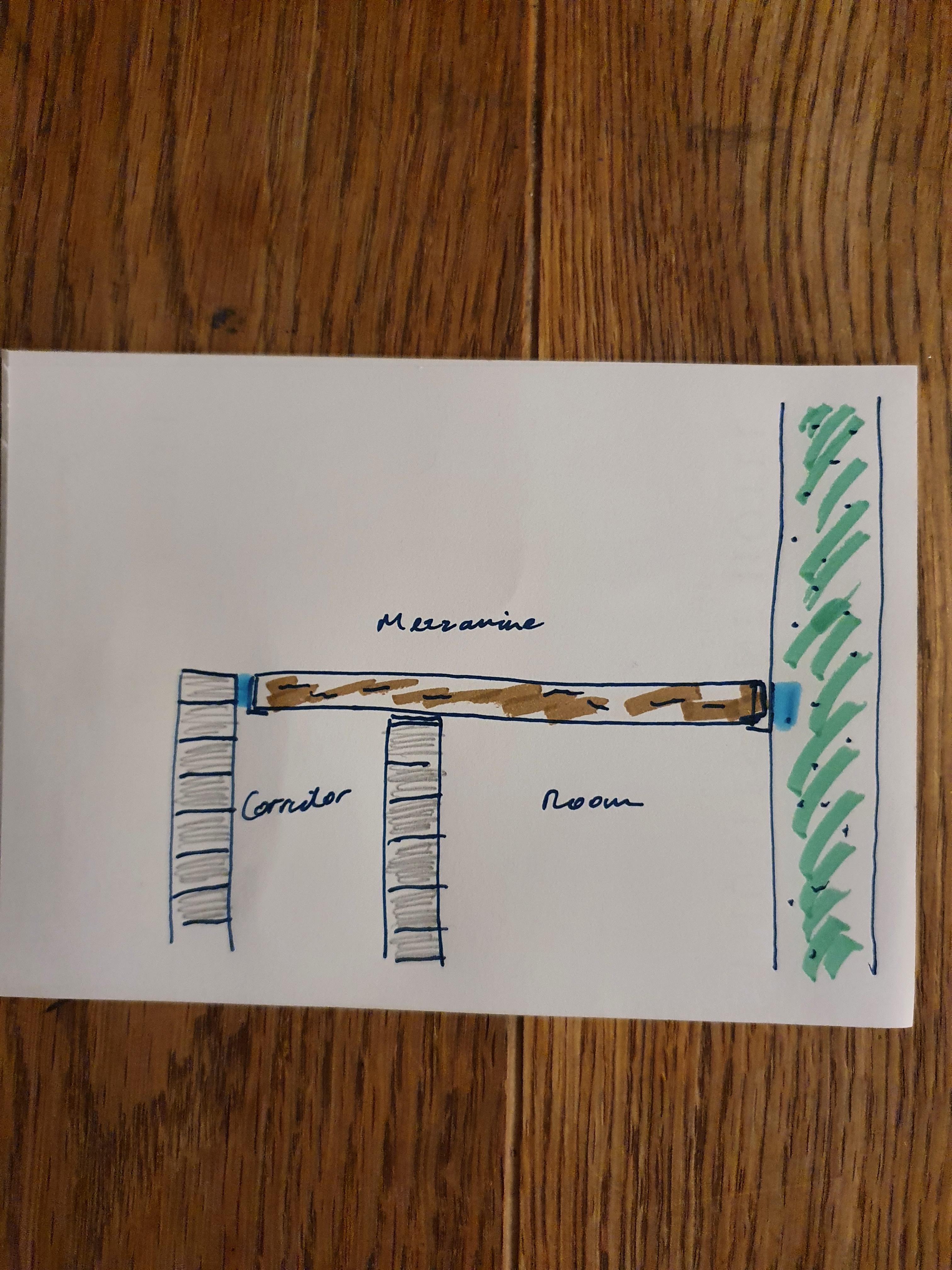
Thanks both. James, pic below. Green wall on right is Nudura. Joist goes over one block wall and hangs off the other. Timber wall plates in blue. Hope it makes sense!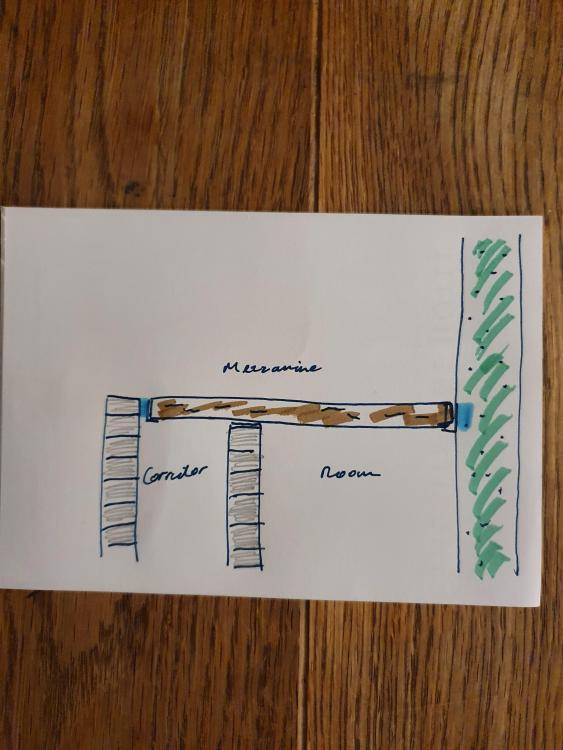
-
Hi all - quick question, blockwork internal walls going up now and will in the near future reach mezzanine height, so I need to think about the floor structure for this. Plans indicate 75x200mm joists at 400mm centres. At one end of the joist will be an internal blockwork wall that come up to the height of the floor and stops, the other end will be the exterior Nudura wall. I'm planning on using the same 75x200mm timber to attach to the Nudura wall (insulation taken back and fixed directly to the concrete) and the internal blockwork wall, then hangers nailed to these. Is this right? What fixings should I use to fix the timber to the walls? These things? https://www.toolstation.com/rawlplug-r-lx-zinc-plated-concrete-screw-anchor/p83182 Thanks all
-
Wrong insulation used, Small claims court or not ?
Tom replied to GaryM's topic in Party Wall & Property Legal Issues
How well would the PIR have worked with the open web joists anyway? Sounds like it would be a pain to fit to ensure no gaps - and chances are, left to their own devices, the builders would have done it badly. So perhaps mineral wool isn't such a bad substitute after all. -
We've got 4 layers of A393 in our 200mm slab!
-
internal door apertures in blockwork walls
Tom replied to Tom's topic in General Self Build & DIY Discussion
I think probably 2x narrower lintels for ease of getting them in position. I don't quite follow your idea for the linings - are you suggesting doing away with the architrave? This would leave 10mm of the compriband visible - not sure re the longevity/practicalities of cleaning, dust collecting etc - though I do like the idea of deleting the architrave, cleaner look to it. -
internal door apertures in blockwork walls
Tom replied to Tom's topic in General Self Build & DIY Discussion
Like the idea but would need architrave to cover the carcassing timber on the hinge side of the opening - assuming 18mnm ply not thick enough on it's own? I was planning on glueing strips of ply to the outside edge of the ply linings to cover the junction with the carcass/blocks, in essence making the lining look like even thicker ply. As above, some margin for error if I add ply strips for architrave I guess. The blocklayer comes highly recommended so I hope he can make the opening accurately without frames to work to. -
internal door apertures in blockwork walls
Tom replied to Tom's topic in General Self Build & DIY Discussion
Thanks both. The openings will have a depth of 215mm, as the blocks are being laid on their flats, and will be fair-faced/painted (no render). I can screw a 25mm x 215mm carcassing timber to the hinge side of the opening then put ply over this and on the header and opposite side/vertical. This would mean the timber would have a thickness of 25mm + 18mm + 18mm = 61mm, plus 3mm + 3mm gap = 67mm. Giving myself an additional 10mm each side to allow for adjustment/packing gets to pretty much 90mm. Does this sound reasonable? Do I need "carcassing" all round or would the 18mm ply be sufficient on the header and one side? Is 10mm all round for packing overly generous? -
internal door apertures in blockwork walls
Tom posted a topic in General Self Build & DIY Discussion
So, blockwork starts for the internal walls in the next few days and just setting out now. I'm going for 826mm wide doors - how wide should I be making the apertures? I plan to line the openings with birch ply. The plans show an aperture of 916mm - so 90mm wider than the doors. Is this right? I was guesing I'd line with 18mm ply - is this thick enough to take a rebated hinge? Two layes of ply would be 36mm so would leave a 9mm gap each side - which still seems a little much. Or perhaps should I line with a cheaper/thicker bit of timber first then a final lining of say 12mm ply? Any advice gratfeully received! -
Can you tell me about brushed/rubbed wood finishes?
Tom replied to Adsibob's topic in General Joinery
TBH I always thought you shouldn't use wire wool on oak - something about microscopic shards of the wool left in the wood rusting or reacting with the tannins or something. I might be completely talking out of my arse though -
Pretty sure you can get UVCs with multiple heating elements at different levels to avoid this - correct me if I'm wrong though
-
I'm kinda with Spacey73 here, in that resistance heating seems just a whole lot more simple way of doing things - if the numbers stack up. Sure, 100% vs 300% efficiency for a heat pump can certainly sway the argument, but it would depend largely on how much PV you have that you could dump in to a store - whether thats a Sunamp or a UVC. We have a 12kW array and think that we would probably get away with resitance heating for hot water and our UFH (via a Willis or two) - but those all-in-one units you link to above Mark do look pretty neat. The heat pumps are only relatively small units buy the look of them (1300W for the Dimplex), so I wonder what the real-world cost of running one would be as I guess the immersion would have to take up the slack a lot of the time - and then of course you have the standby draw for the pump itself, servicing costs etc etc
-
How to fit flush shower tray level with concrete slab
Tom replied to markharro's topic in Bathrooms, Ensuites & Wetrooms
We're having our slab as the final floor finish too - it will be powerfloated on the day it's poured, but will then be ground back/polished about 6 weeks later I believe. How long you do the grinding will dictate the finish on the floor. We want a relatively satin/matt finish so I guess this will be minimal. -
Three voices of reason, Buildhub hath spoken. I'll keep it simple and worry about other things. Thanks all 👍
-
Hi All - we are going to start putting up internal walls in the next few weeks and so need to set the internal door sizes, which isn't clear on our architects plans. Ceilings in a few areas are going to be 2.4m, but in the majority of the build there are going to be vaulted ceilings - so we don't want doors that look to small and out of place. Looking at various places online I can see standard door sizes are either 2040 or 1981mm high and a variety of widths. I guess I was thinking along the lines of a 2200mm high doors in most areas. Our internal joinery (window reveals, skirting etc) is going to be in birch ply and I have been thinking about simply getting cheap doors and facing either side in birch ply to the required size. Is this a dumb idea? Am I making things more difficult for myself further down the line and should I be sticking with off-the-shelf sizes? Thanks all
-
Filling in around base of vertical structural steel beam
Tom replied to Chanmenie's topic in General Construction Issues
Aha! Definitely an opportunity there, tap in to the neurotic-self-builder market... -
Filling in around base of vertical structural steel beam
Tom replied to Chanmenie's topic in General Construction Issues
Sure, but being pragmatic I guess it's not just about overall thermal performance. Cold bridging in certain areas/circumstances might lead to condensation, corrosion etc