George
-
Posts
699 -
Joined
-
Last visited
-
Days Won
1
Everything posted by George
-
Not for free! But a box frame feels the right solution here. There's not much lateral stiffness in the structure otherwise and they could get the box installed first before taking out all the rest of the structure, and the other steelwork is tied back to it. With suitable trial puts I think I'd consider reusing the existing foundation.
-
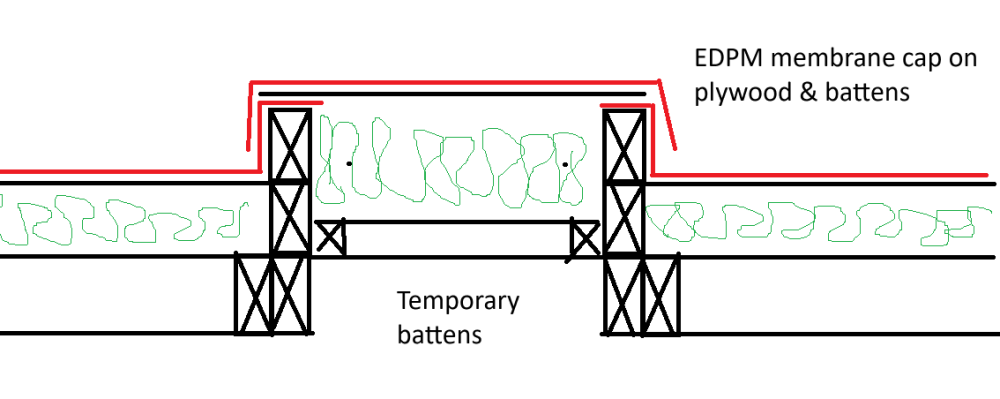
You could also put the openings and upstands in, then cover over with the roofing material. Gives you the option but saves money upfront.
-
The encasement and foundation are essentially the same thing, just depends how far down you need to go to get to competent ground. 700-800mm is thinner than the pad and should be able to be mostly not under the existing walls, which I would have thought was the main issue. Last one I did was 600mm wide but I think you've more load coming down onto that part of the building. Ultimately it will need to be what it needs to be.
-
Is attenuation always required
George replied to MoDo's topic in Energy Efficient & Sustainable Design Concepts
Driveway underlaid with type 3 aggregate wrapped with geotextile with a few overflow drains sounds good to me. Combined storage and soakaway. -
They can't really go less than 665mm without a steel goalpost or box. If masonry piers aren't acceptable then a steel box frame is likely to be a better option to reduce foundation size.
-
No they've suggested leaving a masonry pier at each end. It'd be a much cheaper way of doing things and architecturally would separate the living room off, which is a good thing.
-
Block masonry support over flat roof corner steel/lintel detail
George replied to PhilC's topic in RSJs, Lintels & Steelwork
Think I'd rather the simpler solution. Small thermal bridges can be mitigated with internal insulation or lowering the beam a little. -
Need for noggins in supporting wall?
George replied to Omnibuswoman's topic in General Structural Issues
All edges of a OSB sheet in a shear wall should either be fixed to a common timber (stud or noggin) to the next sheet or be a tongue & groove glued joint. This is a simplification method and is potentially a bit conservative, but is the assumed/default installation for a load bearing timber wall. From the IStructE guidance: -
No it's fine. The reason they did it in the first place is because carpet is stretched and held in place with grippers. If they cut the carpet you'd have to lay need grippers and restretch the carpet. Obviously this is the 'right' way to do it, but really, a layer of carpet beneath a non-structural stud wall isn't going to cause any problems and it saved hundreds of pounds of work. Equally, leaving it there is fine. The new carpet fitters will install new grippers alongs the walls and install the new carpets normally.
-
A box frame as mentioned above - keeps the foundation much narrower, but has a higher steel cost. You'd only be able to do it for B1 but I'm guessing that's the problem one.
-
Timber Frame Soleplate overhanging cavity
George replied to john0wingnut's topic in General Structural Issues
It depends on the details. It might be OK, it might not be. Sitting a 140mm sole plate centrally on a 100mm blockwork should be OK. But the eccentricity of the 40mm overhang could cause problems, unless the 100mm block is held in place with concrete cavity fill and the floor. -
I had a similar but financially less significant mistake. I'd asked for a mix of white windows on part of the house and grey external and white internal in another part. When the windows arrived they were all grey external and white internal. When I'd checked the order, the description was 'windows grey/white' which I'd taken to mean as a mix of grey and white windows. It actually meant all the windows would be grey external and white internal. (I should note, I did not check any of the measurements because my view on that is measuring windows is done in a certain way - usually it is to take three measurements, use the smallest and deduct 10mm - but manufacturers and installers may vary and how should I know that as a homeowner?) In the end I split the cost of replacing the frames I wanted in white, which, pre-Covid, was only £150 of the £300 total cost. I probably would have won in a court case if I'd refused to pay, because the surveyor checked and said he had written down what I'd wanted. But that is hassle and I appreciated his honesty after he checked his notes. Soooo... I think it is their mistake. Seems to be entirely theirs except for the 'sign off', but to avoid a court case it'd be better to come to an arrangement for the window to be modified.
-
Weights of Different Construction Methods
George replied to Paul K's topic in General Construction Issues
Why do you want this information? The way to do it is from first principles - add up the weight of a particular build up. -
Just to add to this, you can make your own flying ends with a angle grinder in a few minutes. We flipped the mesh to maintain cover until 4 sheets overlapped, then used the angle grinder.
-
This is just a terminology issue. That's not underpinning ... that is forming a backfilled opening for a service penetration. There, problem solved. Underpinning is, correctly, a method to improve the load bearing capacity of foundation by increasing the foundation depth, width or both. You're not doing that, so it isn't underpinning. It just looks like underpinning.
- 1 reply
-
- 2
-

-
incorrect scale within submission of .pdf drawing to Planning
George replied to Post and beam's topic in Planning Permission
The conversion to jpg will have mucked up the scaling but so long as you printed back to the same PDF page size it should have been OK. I suspect what you have done is print it back to a different page size, although the scale bar still should have worked the absolute measurements would have been off.... but really, the planners are being finickity. If you drop me a message I can run it through AutoCAD from the original PDF and reprint. -
It's not a CDM Regulations thing, it's a Building Regulations thing. It's a declaration to say you haven't knowingly cut corners and not met the Building Regulations. I agree your work should not need the form because it was submitted before 1st October 2023 and work started before 6th April 2024. (See Regulation 22(1)(b)(i) & 22(3)(a) of The Building Regulations etc. (Amendment) (England) Regulations 2023, which therein disapplies Regulation 6 of the said Regulation and that is the one that adds Regulation 16(5) to The Building Regulations 2010 ... phew)
-
That's not the same building? i can't remember why I formed that opinion but I think it was on the strict interpretation. And something without foundations and a naff roof is not convertible without substantial works. That is not to say that after an initial visit, some unsolicited hints from the SE and some DIY 'repairs'... so when they come to do the actual visit the SE can say yes, this is convertible.
-
Combining EWI and Cavity wall construction on a New build
George replied to Iceverge's topic in Brick & Block
I'm not sure what the concern is - if the steels were dropped a bit then they'll be well within the thermal envelope. If you are concerned about the thermal bridge through the outer leaf then make the first few courses out of thermoblocks (the blue bit). It depends what the internal detail is on how challenging the solution is. Bringing in a different wet trade for rendering a small section does not sound very economical.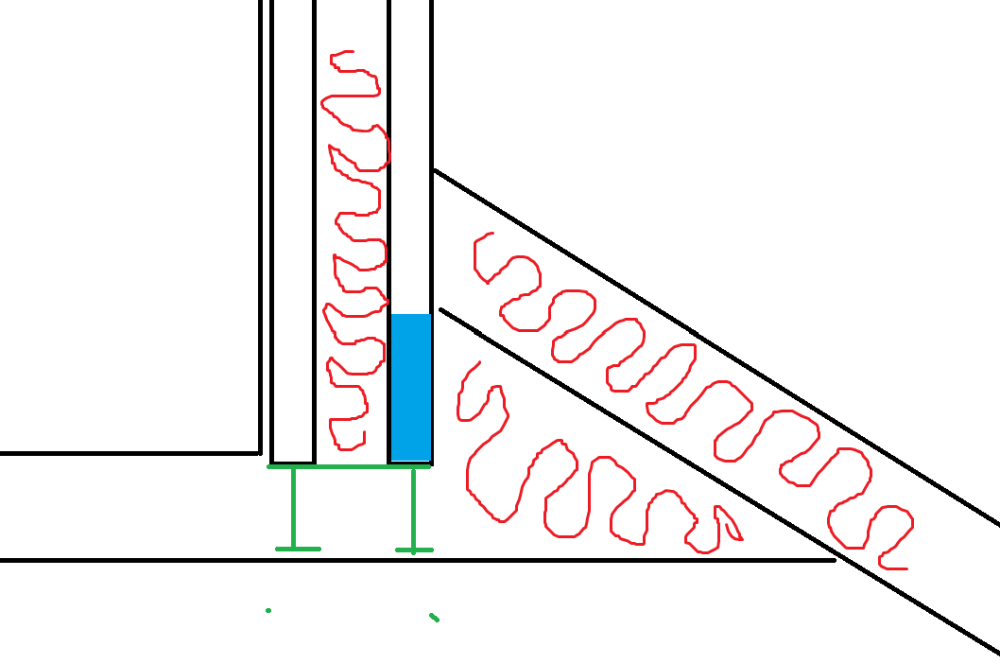
-
Thatched roof on a listed building - any thoughts folks?
George replied to Gus Potter's topic in Roofing, Tiling & Slating
Additional ventilation through the gable walls should alleviate issue with moisture build up in the thatch/roof space. You lose the insulation from the thatch but you could more than make up for it in the ceiling. Agree a MVHR system would give additional assurance (and maybe clear out any residual asbestos fibre that have floated down). -
Can you put a membrane and drain on the outside or is no access possible? It usually isn't good practise to seal from the inside because if the wall does get saturated then water will, eventually, find a way through. An internal drained membraned would be another option if the levels worked out.
-
Minimum distance between foundations and drains/services?
George replied to MattD's topic in Foundations
In theory they can be as close as you want... But what changes is the manner in which they are built, both in the temporary and permanent condition. Check out diagram 8 in part H of the building regulations for concrete backfill to avoid long term undermining. For temporary stability you may need to do short runs or provide excavation shoring if the foundations are undermined. Above foundation formation level there is unlikely to be issues. -
Basement redesign: Issue with structural engineer
George replied to JGR's topic in Building Regulations
In general, no you shouldn't have to pay for works you haven't instructed... unless you go on to use them. In terms of communication, the SE could reasonably have thought the basement contractor was an authorised agent (to instruct work), especially if they needed the additional designs for their work - which they were contractually obliged to deliver. And if you go ahead and use the SE's new design then you should be paying them. Especially if you want to be covered by their professional indemnity. I would view it as a complaint due to poor communication and ask for a discount. Without knowing more we don't know whether the SE did make a mistake or the basement contractor did when pricing. Too many variables. I'm sure a lawyer would have a more insightful opinion but that's the last person you want involved. .... ££££ -
Timber Frame Soleplate overhanging cavity
George replied to john0wingnut's topic in General Structural Issues
140mm block inner leaf with sole plate sat squarely on top. It seems like they're letting the normal assumptions for a masonry wall drive the positioning - but this is primarily a timber structure. This means the cavity can be squeaked about - so long as there is a 50mm ventilated cavity behind the cladding, and the u-value of the wall is met, the masonry cavity can be adjusted to suit the timber frame. -
It's not impossible but odds are they're a bit shoddy, or not quite in the right place or width or whatever else... so price for new. Beware that demo contractors won't usually price for ripping out foundations, so the groundworkers may end up doing it.