George
-
Posts
699 -
Joined
-
Last visited
-
Days Won
1
Everything posted by George
-
I don't think we disagree. I count that as reasonable.
-
Shed builders will often need to take an old shed down first. They do hold a reasonable amount of value.
-
This is most likely due to the concrete blocks shrinking slightly. This happens post manufacture and continues for some months, conditions depending. It can be dealt with by putting in movement joints when blockwork walls are 6m+ (although unusual in domestic settings), but cracks can happen in other circumstances. The line of the wall with a window is a relative weak point so has cracked along that line. Now the crack has occurred, ongoing movement should be minimal. But monitoring will help confirm that. The cracks should be ground out and repointed. If the crack has gone right through I would consider adding in stainless steel helical bars to crack stitch (aka helifix bars)
-
Low Level Brick Spalling / Brickwork Fracture
George replied to azureblue's topic in General Structural Issues
You need to take out some of the concrete and have a look at how far down the issue goes. The significant diagonal crack suggest an issue with the wall or foundation. It may be due to degradation of the bricks. The insurers should be able to send out an engineer to take a look. -
It could work - I'd want to know more about the foundation of the retaining wall and have the newly formed cavity to be drained. What you don't want to have happen is the weight of the new innerleaf wall on the retaining wall foundation causing it to rotate forward. It shouldn't happen (especially if the retaining wall has a large heel), but that is what I'd check for. Vertical strength wise it should be OK.
-
Wall 'strength' is a function of the normalised compressive strength (how to account for the different height / thickness - a 215x100 upright is approx twice the strength than when laid flat), mortar strength and bond pattern. A simple way to think of this effect is that a wall with blocks laid flat is weaker because mortar makes up more of the wall than when the blocks are upright. (Mortar being between 4 - 6MPa typically). This is part of the reason why blockwork of 3.6MPa strength have as much load bearing capacity as clay bricks which are 20 - 50MPa. Not sure I buy it as a significant problem in this situation but that is the technical reasoning.
-
How to work out what the kg/m2 of a stud wall is?
George replied to vcps2021's topic in General Structural Issues
I would usually allow for 1kN/m linear load. -
Is this something to be concerned about?
George replied to Romfordian's topic in General Structural Issues
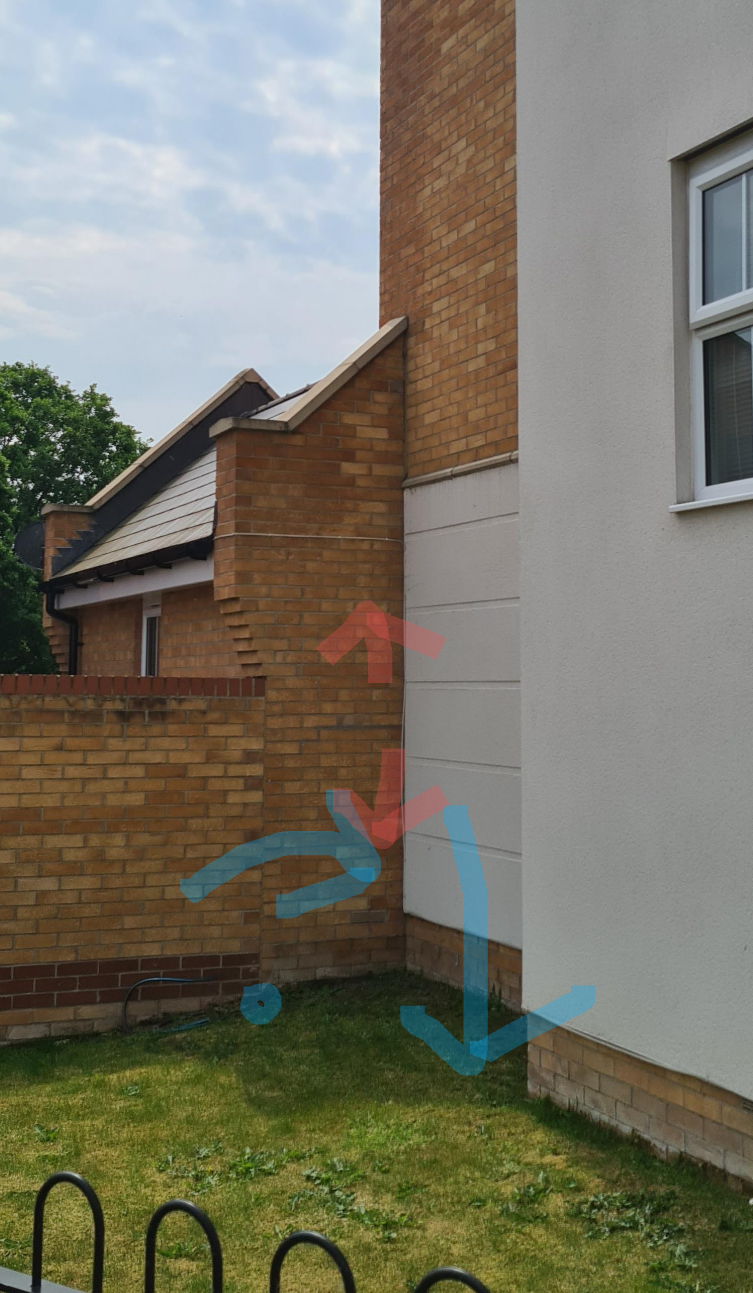
I wonder if it's settlement of the main house. If normal wall ties have been used and/or there's no movement joint then it's dragging the short wall with it. The horizontal crack is the rotation about the end of the side wall (cracks can only occur where there is tension) I would get some tell tales (like this but you only really need one or two https://www.ebay.co.uk/itm/124653827397) and take a photo of It every month for 6 months. Report back then . In terms of a fix, rake out the joint and repoint.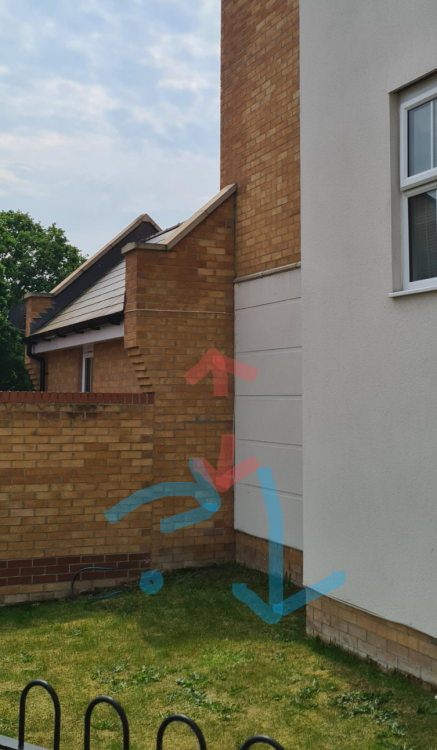
-
Is this something to be concerned about?
George replied to Romfordian's topic in General Structural Issues
That's an interesting crack. Could you post more photos a bit further away? Horizontal cracking is usually an indication of foundation settlement but I don't think that is what is happening here. -
Normally wind posts will go down to foundation and radon barrier is up near DPC. Which means you'd normally need to tape around them I guess. They'd be in the cavity though so any leakage should largely be ventilated to external air. +1 on the Section
-
Building regulations part O, should be called part Ohhhhhhh .
George replied to Big Jimbo's topic in Building Regulations
Make a conservative assumption and use the brickwork opening. But yes... this is why people pay architects to do this. It's the same with structural engineers and Part A (which is a dumbed down version of the British Standard and only refers to traditional brick and block structures). The detail is tricky and needs technical expertise and experience - else a lot of time and chocolate. -
Personally a 203 deep beam is a bit shallow for me on a 6.5m span (although previous engineer had drawn it at 7m). I also don't like to have any overhanging masonry when retrofitting - presumably this a 250mm wall on a 203 wide beam. Not outside the limits but like I say when retrofitting a beam, full width bearing is better to allow for any unknown out of alignment or dodgy existing brickwork. As above, 10mm deflection should be the target. Although it is a heavy section so it may be stiff enough to prevent excessive deflection. I would normally expect a 254x254 UC in this situation - this deals with deflection and the bearing width in one go and avoids any welding. But if you ask three engineers for an opinion you'll get 4 different options - there is no such thing as a perfect answer in engineering, it is what will economically work and fit most criteria.
-
Although it's the one under the wall, the 10mm deflection limit is still important for supporting existing masonry walls. Much more deflection and there is a risk of cracking. That would be my target deflection when retrofitting a beam.
-
- buy the blocks 6 months early and leave them under cover - put in bed joint reinforcement around the openings - leave the rendering for as long as possible so if any cracks do occur, they can be made good The render system will have its own MJ requirements.
-
I'd have thought UNESCO would have the definitive map for that.
-
Extension near oak tree. Piling? Soil investigation survey needed?
George replied to Mattg4321's topic in Foundations
You'll need GI if you have piles so I'd risk it and get one done up front - it may turn out that you do not need piles and if you do, you've already got the information ready to go. The key thing will be the plasticity of the soil. -
Ah ok that explains why it looked more substantial. In that case the retaining wall you need won't be too bad. If access is limited then look at reinforced concrete block systems. The blocks themselves are the formwork and otherwise are as robust as a reinforced concrete wall.
-
What is the wall at the back - it looks a bit more substantial than a fence...? Is it also a retaining wall? Beware doing any new retaining works that could undermine the foundation it Anchor systems are good but you will need to stay within your property boundary.
-
Foundations for a small out building next to a plum tree
George replied to Adsibob's topic in Foundations
You do need to go deep enough to get to clean sub-soil but you don't need to build back in concrete. 150mm layers of compacted stone is a lot cheaper. -
Foundations for a small out building next to a plum tree
George replied to Adsibob's topic in Foundations
Think I'd just get a portable BBQ! Agree with saveasteading mostly (mesh > fibres everyday). Foundations aren't magic, they just transfer load from surface level to competent sub-soil below ground. Buried, compacted stone is as good at doing this as concrete. -
Foundation near tree line - raft? Systems available?
George replied to Pabbles's topic in Foundations
You need to know what the soil type is. If it is clay then potentially a problem, but if it is low plasticity clay then the impact is reduced. It is a slight gamble but a ground investigation up front (which would be needed in any case if you are piling) would give you a lot more information and more certainty on the issue. Piling I would tend to dis-favour for an outbuilding where the consequences of failure (which for foundation problems are slight movement and cracking) are less than for a house. In addition to the GI, a combination of a root barrier, vegetation management and heave protection I would consider sufficient. In terms of a raft, the rule of thumb is that you need to dig out and replace soils with volume change potential half what you would for a traditional foundation. So, a equivalent of 2.5m strip is a stone mat 1.25m deep. This depth reduces as you move away from the trees but some sort of stone layer does need to be below the entire footprint of the structure. I would get in contact with a structural engineer as they should be able to save you some money compared to following the building control charts. -
Probably just a typo but not sure which way. Mind you, unless it's some sort of blast door (or maybe which thick glazing) it'll probably not weight more than about 30kg in total.
-
Was this specifically in relation to pocket doors?
-
I can't be definite on what loading is correct based on an internet forum thread - but there doesn't appear to be any arithmetical mistake in their work and their assumptions look reasonable. They have only allowed for roof loads from the main roof and the extension roof and a small amount of blockwork. It is the beam span which is the primary cause for a large beam - stresses in a beam increase as a square of the span. And while beams can reduce these stresses in a cubic relationship, they can only do that by increasing in depth. I do feel for you and the engineer should have prioritised head room over steel weight (although as others have pointed out this is not usually entirely the role of the engineer), but if you are looking for any other significant mistakes or omissions then from the information posted I do not see any.
-
They are derived from the standard list of loads on the previous pages. They look about right for loading on a domestic beam.