George
-
Posts
699 -
Joined
-
Last visited
-
Days Won
1
Everything posted by George
-
Type A + C for me. And over a long time period the Type A is essentially just slowing the amount of work the Type C needs to do. Main thing is to stick to a single warranted system.
-
Sounds quite a lot of mesh but unless there's a good reason not to, I just revert to the hollowcore manufacturer's detail.
-
Yes - you need to bind the slabs together to form a two directional diaphragm. This is similar to the grout on beam and block - hollow core slabs always have an upwards deflection. It's fairly minor on short spans but still too much for tiling. The cost of floor leveller would be eyewatering
-
The ends kick up because the gable is masonry so doesn't settle. Sometimes changing from clay to concrete tiles can exacerbate the sag or it just happens over time. So long as there's no signs of distress in the timber and the roof is watertight, it's usually not a problem .
-
Simple pitched roof on timber building
George replied to Kombi Camper's topic in Roofing, Tiling & Slating
That is talking about shallow pitched roofs. The other reason for a ridge beam is if you have a vaulted roof. In which case the roof pitch is irrelevant (unless it's flat!). -
Simple pitched roof on timber building
George replied to Kombi Camper's topic in Roofing, Tiling & Slating
You cannot built a vaulted roof in the same way as a traditional or truss roof. You should talk to a structural engineer about what you want to do. Essentially you need a ridge beam (not a ridge board) to carry the rafters to prevent lateral thrust on the walls / reduce it to a manageable level. -
Yeah although that's always an issue. If cover is tight you can do flying ends or use loose bars to lap the mesh layers.
-
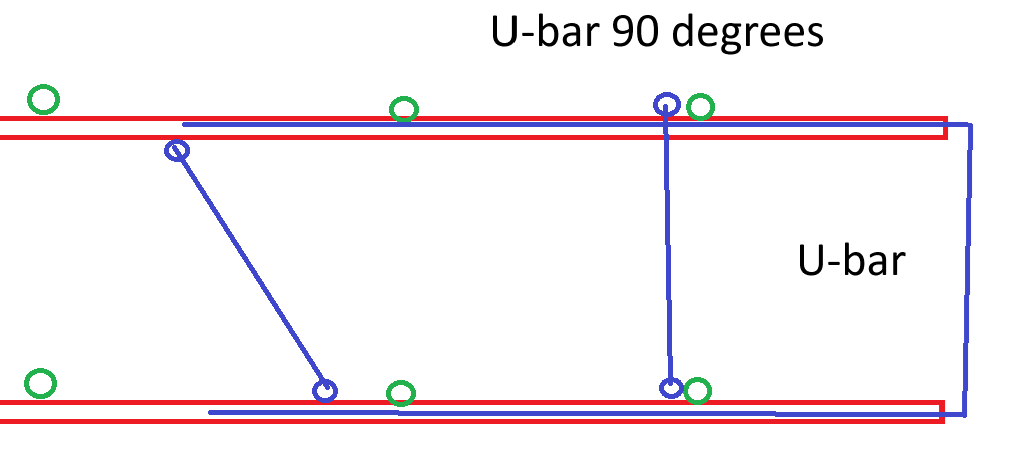
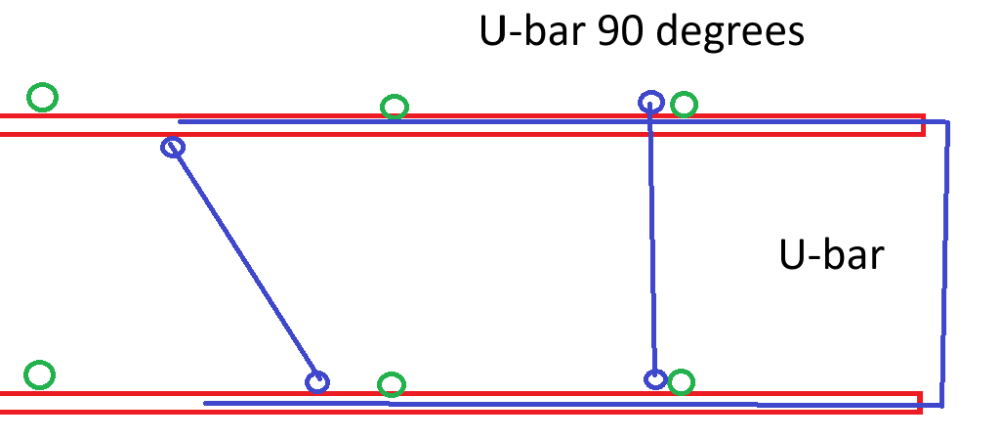
The high chairs are for within the mesh. At the very edge the u-bars will do the job of keeping the top mesh supported.
-
Therefore I assume that the U bar must sit alongside one bar of the A393 Yes HOWEVER if i have U bars around both sides of the mesh (perimeter of the foundation) the U bars on the x/y axis will then hit the horizontal bar... So the u ar can sit alongside on the one axis but not on the other....??? Really they should have been 150mm U-bars so they can fit within the mesh layers. However, if the mesh are the same way up you should be able to slot them in on both orientations. It's also not the end of the world if you angle them so they can fit in.
-
It's usually just 4x1" planks, double nailed and lapped to the underside of the trusses. https://nhbc-standards.co.uk/7-roofs/7-2-pitched-roofs/7-2-9-bracing-for-trussed-rafter-roofs/ https://www.tra.org.uk/download/2572/
-
I can't see any diagonal bracing or binders. I suspect the roof warped a bit and was straightened/strengthened with the extra timber. The 'noggins' are especially suggestive of that. The survey will probably advise bracing is added.
-
That's bonkers and in a concrete with 20mm aggregate, not compliant to the standards (smallest gap needs to be at least agg size + 5mm) On the topic of fibre reinforced rafts - I don't see them as a complete replacement to steel mesh. If there's any potential spanning (which is usually what rafts are designed to) I do not see how they can be made to work. That's not to say they won't work/will fail (esp for domestic rafts) but I think they are not 'working' like a raft and insteads are like isolated foundations and ground bearing slabs bound together with fiber reinforced concrete. I wouldn't want it on my PI. On the topic of self-compacting concrete - this is not a use case I would normally expect to see it. A poker and polishing is more normal. However that's not to say it doesn't work and if they are passing on the savings and can guarantee the work then crack on.
-
A bit pessimistic on ashp lifespan but otherwise it probably doesn't make sense to use a ashp. If heating with resistance heating is cost effective then ashp does not have a place. How is your hot water heated?
-
Best off contacting a local structural engineer.
-
If you mean can you hang a mezzanine from roof trusses then almost certainly not. If you mean can you use an inverted bowstring truss as a mezzanine beam then yes, so long as it is designed (or is adequate if it is recycled) properly for the span and loading.
-
I'd argue you are likely to be a Domestic Client, if you are just employing contractors for these two phases and are not directing or supervising works (other than normal Client interest and oversight). In which case all duties sit with the PC. I agree it is fine to do this and very common. For large commercial demolition & construction jobs, very often the demolition contractor with be the PC for that phase and the construction contractor will be the PC for that phase.
-
'Permanent' shepherds hut type thing which will have use afterwards. Or a gym. Or just a fancy shed. Craning is in the 'anything is possible with enough £££' box. The caravan company should have contacts to see whether it is possible but I suspect you'll struggle to get a 32ft 2/3 bed one lifted at that radius with the trees. Not cheaply, anyway. We sold ours for £500 more than we paid but that was all part of the covid madness.
-
Agree piles and cantilever beams the most likely viable solution. Rafts wouldn't be suitable as although they wouldn't damage the sewer, the water company is more concerned about getting access to the sewer in future and they wouldn't want to undermine a raft.
-
We've moved them for housing estates but not for a single house extension. Essentially it's the same process but the costs are dramatically higher for bigger sewers - they are much deeper! They might go for build-over (cantilevered) but it is not a certainty. Is there any scope to change the floor plan to avoid it?
-
I haven't really paid much attention to this thread but this jumped out at me. The minimum formation depth for any foundation is 450mm to get below the frost depth. Are you going to insulate the surrounded ground as well as raising the level (this is commonly done in America but not so much here)?
-
Oversite is a layer of concrete about 50mm thick to cap the soil beneath the suspended floor. Sleeper walls are walls which just support the suspended floor. They may be added to subdivide the spans of the beam and block
-
It depends what your tolerance for risk and any differential settlement is. You can pour slabs in stages. Connecting them isn't strictly needed for a domestic slab, but is easily done. Drill 10-12mm holes in a plank of wood at 600mm centres and shove 500mm length of reinforcement bar through. One side will get cast in and the other side will stick out read for the next pour. You sometimes have to cut the timber out but it'll work OK. You can even get fancy with slip bonds. But for domestic loading and with some acceptance of differential settlement (or which a build up above the slab) you could just pour them adjacent with no dowels. They should be level though - string lines or lasers are cheap and easy. Compacting with a bucket isn't an accepted method but again, would probably work well enough. Mind you hiring or buying a compactor is pretty cheap and easy so personally I'd try and mechanically compact it.
-
If they're like me it's because surveying and drawing up floorplans is a bit dull and not the value we add! If I get a set of plans from an architect my profitability and job satisfaction is much higher. I will do it... but begrudgingly so I'd have done the same and suggested an architect in the first instance. But agree overall, there's no reason the engineer can't do it.
-
Building new build on coal mine post subsidence
George replied to ColdOutside's topic in General Structural Issues
Too many variables to say - is it shallow mine workings, a shaft, has it been treated, is the surrounding area made ground. You might be able to get some advice from the Coal Authority as I've always found them to be helpful. -
The height is the issue here. Part A building regulations says wall below 2.5m can be 90mm but with piers. So reverting to the general rules H/16 = 2.7/16 = 170mm thickness.