


Stones
-
Posts
3762 -
Joined
-
Last visited
-
Days Won
23
Everything posted by Stones
-
Glad to have been of help. Hopefully the actual blog is as well! And welcome.
-
One of my friends cut up an old pine wardrobe for his window cills. Being 500mm deep there was plenty of timber available and in good lengths. Something that otherwise would have been a pain to dispose of ended up saving him money. Worth considering if you have similar furniture to get rid of, or can source from gumtree etc.
-

Wall vents for mvhr
Stones replied to ProDave's topic in Mechanical Ventilation with Heat Recovery (MVHR)
We had under eaves air intake on our last house but one, and found little difference in terms of the mesh clogging compared to previous houses where the intake had been in the wall. We used lead roof vents on our last house. They didn't clog at all but didn't have mesh, rather a series of holes punched through the lead roughly 5p piece sized. The result was that the internal filter ended up taking the strain but as this was easy to get at and pennies to replace, seemed to be a good way of dealing with the issue. Using a second inline filter seems a very sensible addition. We are using plastic roof tile vents for our current build, and given the smaller size of the inlet holes (greater number, significantly smaller diameter - large mesh in effect) suspect there may be a degree of clogging. One thing I am considering is to arrange the ductwork such that I can easily swap over supply and exhaust to reverse the air flow and clear the roof vents that way. -
Wall vents for mvhr
Stones replied to ProDave's topic in Mechanical Ventilation with Heat Recovery (MVHR)
Was it concerns about noise or purely down to airflow that made you double up? Out of interest, what is your internal house volume? -
At that sort of money, it's a non starter. Thanks for the input.
-
planning I am deeply deeply angry: so I need your advice, please
Stones replied to ToughButterCup's topic in Planning Permission
I think this point applies equally to the middle way suggested above as well as the nuclear option. You are going to need all your energy for the build, I think pursuing this right now would be a detrimental distraction. Build it right, then fight! -
planning I am deeply deeply angry: so I need your advice, please
Stones replied to ToughButterCup's topic in Planning Permission
I'm a bit late to the party so I'll keep it concise, +1 to Terry's comments and analysis. -
One of the options flagged by my plumber when discussing my heating and DHW was installing a Mitsubishi Ecodan and pre-plumbed cylinder https://heating.mitsubishielectric.co.uk/Products/Pages/Monobloc_Pre_Plumbed_Standard_Cylinders.aspx as a simple all in one solution. Sounds and looks great at first glance, a nice neat and easy solution, both heating and DHW from the same cylinder. The red flag for me was when he said the cylinder operates at 60C, which to my mind either means significantly reduced COP in respect of the ASHP, or that electric back up (immersion) is being used to top up the cylinder all the time. TBH, I can't really see any advantages to using such a set up, other than speed and ease of installation. Comments?
-
Overhanging tiles on roof - not.
Stones replied to TheMitchells's topic in Roofing, Tiling & Slating
We have rendered right up to the underside of slate on our last three houses. A 50 mm slate overhang is critical (and insisted upon by BC) and ensures water drips off the edge of the slate. I would suggest what you have needs remedial work asap to prevent (further) water ingress. -
Wall vents for mvhr
Stones replied to ProDave's topic in Mechanical Ventilation with Heat Recovery (MVHR)
No can do - they are boxed up awaiting uplift by courier - BPC realised their mistake before everything had actually arrived and asked me to box them ready for collection. -
I was speaking to Joan, but was having a bit of difficulty in pinning down what they could and when, so I ended up speaking directly with Andrew. That conversation clarified what they could supply and a price, but I will be following up with Joan now. As above, I have a couple of technical queries to run through with them before I commit (as well as the considerations of my DHW indecision topic).
-
Wall vents for mvhr
Stones replied to ProDave's topic in Mechanical Ventilation with Heat Recovery (MVHR)
150mm pipework is what was specified for our house (by BPC) and we have an internal volume approaching 480m3. I recently took delivery of all my ductwork and MVHR unit. They had included the S/S external cowls pictured by Jeremy above which do look nice and smart, albeit for various reasons we are going out through the roof using 150mm spigot tile vents. -
Update - Sunamp asked me not to give the figure they have quoted, but I don't think it unreasonable to say more than a single unit but less than their current buy one get one half price offer (basically what they are proposing to supply is a complete 2 cell unit, and a second without the hydraulic components). They suggested anyone interested contact them directly to discuss their requirements. I still have to speak to them about some technical queries. Further info to follow in due course.
-
In our last house we kept our cylinder at 50C. Cylinder and pipe losses (similar to pipe runs I initially proposed) were 3.5kWh per day, so that is what I have been basing my calculations on. For 6 months of the year, possibly more, those losses would be useful, but otherwise they have the potential to add to overheating, although given the very interesting discussions elsewhere about the impact of solar gain on houses built by the same company and to the same standard, I think that has the greater potential to be problematic rather than cylinder losses per se. I am working through the options using the method you suggest, but the additional variables over which I have no control, do complicate things. It does indeed tick a lot of boxes, and probably makes more sense as house occupancy reduces (when losses become a bigger share of DHW energy requirement). I think the biggest issue is the limited availability of E10 tarrifs, how long they will be available for and how pricing will change with smart metering. I need to be able to charge my DHW store prior to morning showers and again in late afternoon ready for the evening. The choices before me: SunampPV charged directly with off peak electric (hopefully excess PV in the future), Direct UVC charged with off peak electric or Indirect UVC charged using ASHP. A Direct UVC represents the lowest capital cost option, but highest running cost. next up is the Indirect UVC and ASHP. The interesting thing with that option is that upgrading the size of the ASHP and cylinder from Direct to Indirect, adds another £900 onto the cost of a Direct cylinder, significantly reducing the gap between an ASHP set up and the SunampPV. Even so, it still means quite a number of years before the savings repay the additional capital cost. One of the reasons I was looking at going with the Sunamp was that I could locate it in a bathroom cupboard and reduce pipe runs from the original cylinder location (20+ metres) to as little as 2 metres. Looking at my plans again, I'm wondering whether locating the cylinder next to my UFH manifold in the hallway cupboard might be the best solution. Puts the cylinder in the centre of the house, pipe runs reduced to 8 - 10 metres. Decisions, decisions...
-
The trouble with constantly reading about different ideas, is that you begin to question decisions that you have made, and in my case, the thing I'm currently questioning is DHW provision. I had initially planned to have a 300L UVC in our utility room to service all our DHW needs, heated by an ASHP then topped up via immersion or an inline heater. When I sat down and worked out the pipe runs involved in getting DHW to my bathrooms, I concluded that it wasn't the most sensible location for our cylinder. Having made the decision to locate the main DHW store to a cupboard in our en-suite, which significantly reduces pipe runs, pipe losses and time taken to deliver DHW to the taps, I began to focus on a 4 cell SunampPV as the DHW store of choice. After a bit of back and forth, Sunamp confirmed they could supply a 2 cell unit and an additional 2 cell booster pack to give a 4 cell capacity. A 4 cell Sunamp would give me the capacity I need, and eliminate 80% of our anticipated cylinder losses, which over the course of a year adds up to a fairly tidy sum. I'm just waiting to clarify a couple of points in respect of the price they have given me (more than a single unit, less than 2 units at their current buy one get one half price offer), but needless to say, I'm wondering again, whether I'd be better off going with a straightforward set up of 300L Direct UVC for DHW, with a smaller 15L point of use DHW heater for the kitchen and utility, and spend the rest of the capital on a 1.5kWp or 2kWp ground mounted solar PV array. Cylinder losses in winter would be useful in terms of heating requirement, however in summer, of no real benefit. My heat loss calculations (which include incidental and solar gains) suggest that with summer bypass on the MVHR, I shouldn't have any significant overheating issues - I do have the 'luxury' of fresh summer breezes that I can take advantage of by simply opening a window to help cool the house down if required. Solar PV would offset the wasted summer cylinder losses and still leave a healthy amount of generated electricity that could be used in the house, perhaps saving £100 a year of my electricity bill with any excess diverted to DHW, saving another £30 or so. I'd be interested to hear thoughts on my current thinking.
-
Roof tile vents for MVHR
Stones replied to Stones's topic in Mechanical Ventilation with Heat Recovery (MVHR)
Any chance you could post a picture for me? -
Our build uses the Amvic system. Don't see why you couldn't screw direct into the plastic ties (albeit longer PB screws needed) if you wanted. I'm guessing my contractor has stuck with battens and a service void as it is easier / more cost effective (as he believes strongly in both!) from his perspective.
-
Could do, although I suppose it comes down to preference. Both will take time to do. I suppose the main advantage of battens is there is then something easy to put fixings into, and makes screwing on plasterboard easier?
-
Having made the decision to go through the roof with my MVHR air intake and exhaust, I placed the order for my MVHR ducting and unit with BPC, which was delivered on a 8' high pallet a couple of days ago. However, the roof tile vents supplied http://www.harcon.co.uk/slatetileridge/cowlvents.aspx are not IMHO, that inspiring, either in terms of appearance, or materials used to make them - it is made entirely of plastic. I had the vent on site this morning so i could see it against the roof tiles. I can certainly live with it, but given the challenging weather we get up here, I'm not entirely convinced a plastic tile is the best idea. I can get a Redland tile vent formed in a concrete tile to match the mini stonewald roof tiles i am using, but that only has a 100mm spigot, as opposed to the 150mm on the Harcon. Whilst both sizes would be able to cope with normal ventilation rates, I suspect the 100mm would struggle to get enough air in when the MVHR was on boost. On our last house we used these: http://www.justlead.co.uk/product/lead-roof-vents/ which worked really well, and looked really good against the slate roof we had. My concern is that it wouldn't look nearly as good with tiles. Has anyone experience of or fitted the Harcon roof vents and in a position to offer feedback?
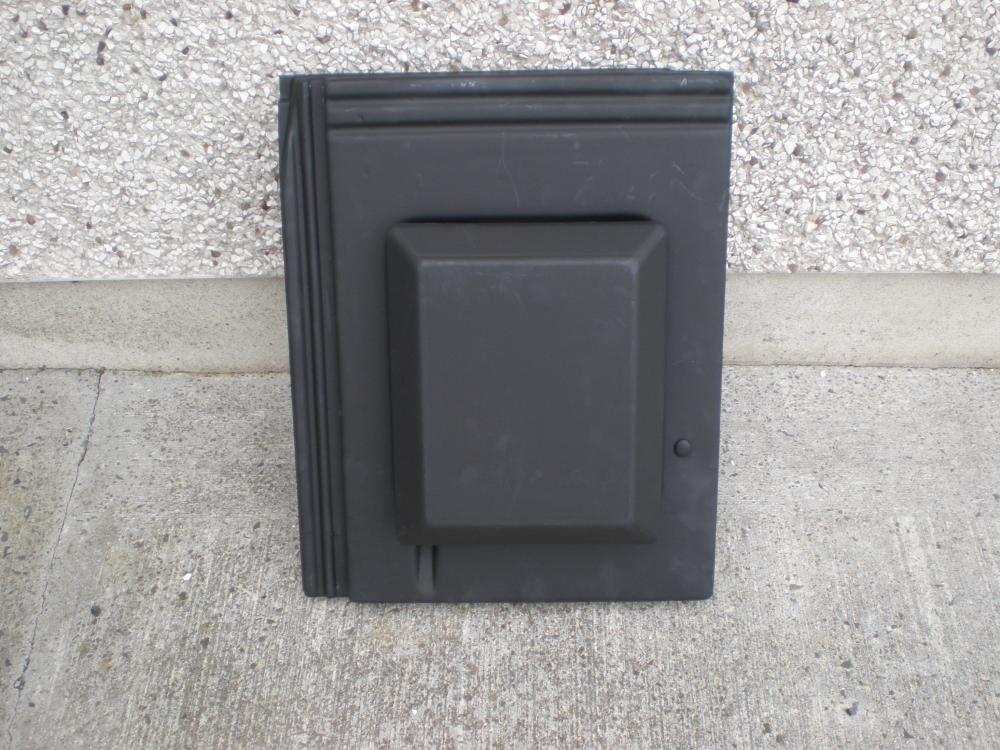
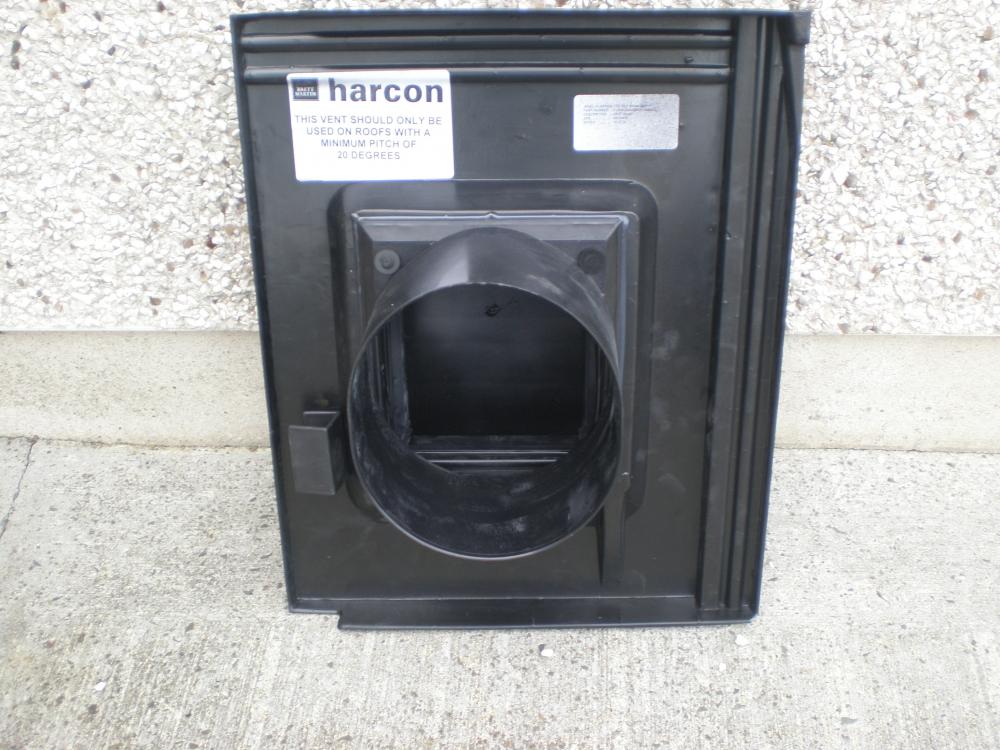
-
From the date stamp on the bottom of the film, I'm guessing the same as me, a Brinno. I bought their construction camera, which gives you the camera, waterproof housing, SD card, batteries and an adjustable mounting. https://www.amazon.co.uk/Brinno-BCC100-Construction-Camera/dp/B00EA1EODE/ref=sr_1_1?ie=UTF8&qid=1467896104&sr=8-1&keywords=brinno+bcc100
-
No, not at that stage yet, however it isn't especially complicated. Battens will be fixed through the polystyrene insulation into the plastic ties that form the core of the ICF block. My contractor is going to be using 25mm tile battens.
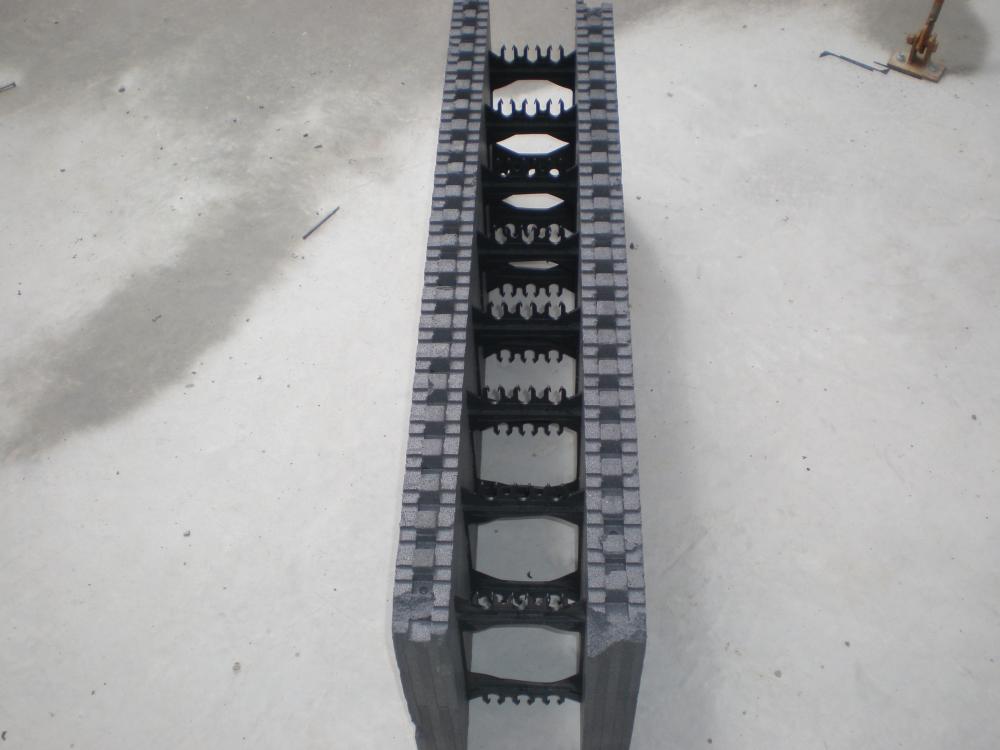
-
We are running the main runs of our pipework and wiring in the roof space, dropping down into a service void created using battens onto ICF exterior walls, or through internal partitions as appropriate. My contractor certainly believes battening out to create a service void is far quicker than chasing out the ICF block. We also have a kitchen island, and as suggested above, we have run two ducts in the under slab insulation to get electricity and water to the island. The water duct is a length of drainage pipe so should be big enough to take both hot and cold water pipes that have been insulated with armaflex or similar. You can see the two ducts sitting in the underslab insulation ducts in the picture below.
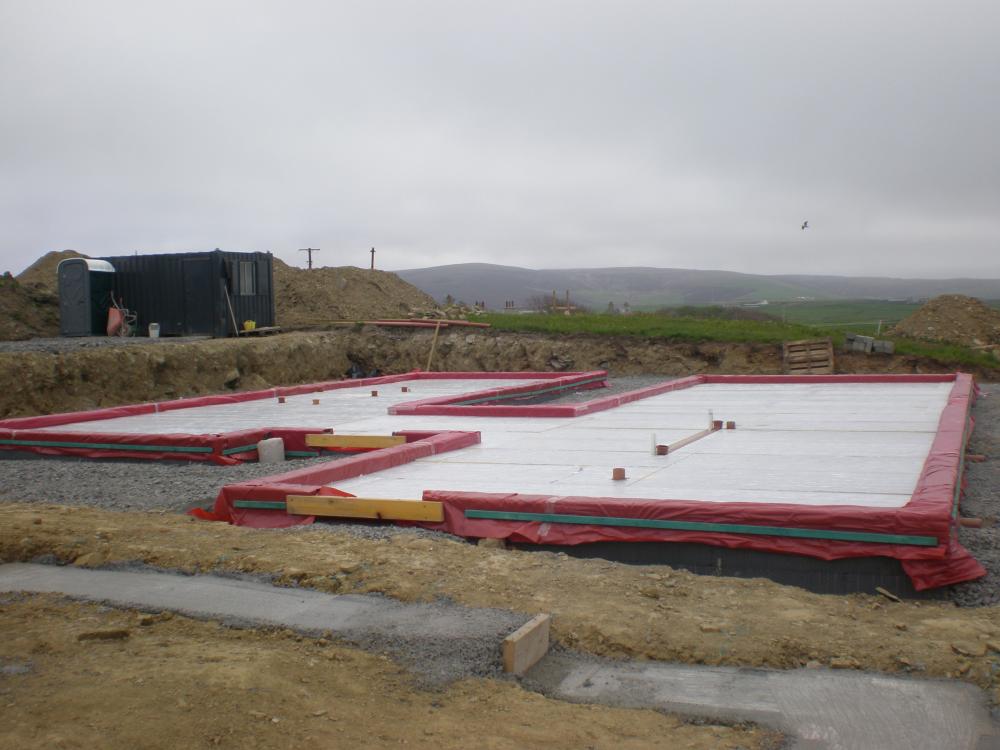
-
I seem to remember Sir Humphrey giving the game away on this one - staff growing mushrooms to stop themselves getting bored!
-
Yes, although i do have to get a couple of things clarified. Will post when I have done that (on the to do list for this week).
-
Unlike Scotland, I don't think sarking is a requirement in England, so it may be they will just felt and counter batten that area. I'm just finalising the insulation of my roof, and one of the options is 2 layers of 90mm knauff frametherm 35, and 50mm PU beneath rafters. Taking into account roof timbers, gives a decent enough U value of just under 0.14 for us. In my flat ceiling section, I have 420mm of earthwool specified (3 x 140mm).



