
Stones
-
Posts
3761 -
Joined
-
Last visited
-
Days Won
23
Everything posted by Stones
-

MvHr in cottage refurbishment
Stones replied to Cpd's topic in Mechanical Ventilation with Heat Recovery (MVHR)
Sorry @joe90, somehow managed to delete your post when trying to quote it. -
Do you have a link to what you are planning to install or are you making it yourself?
-
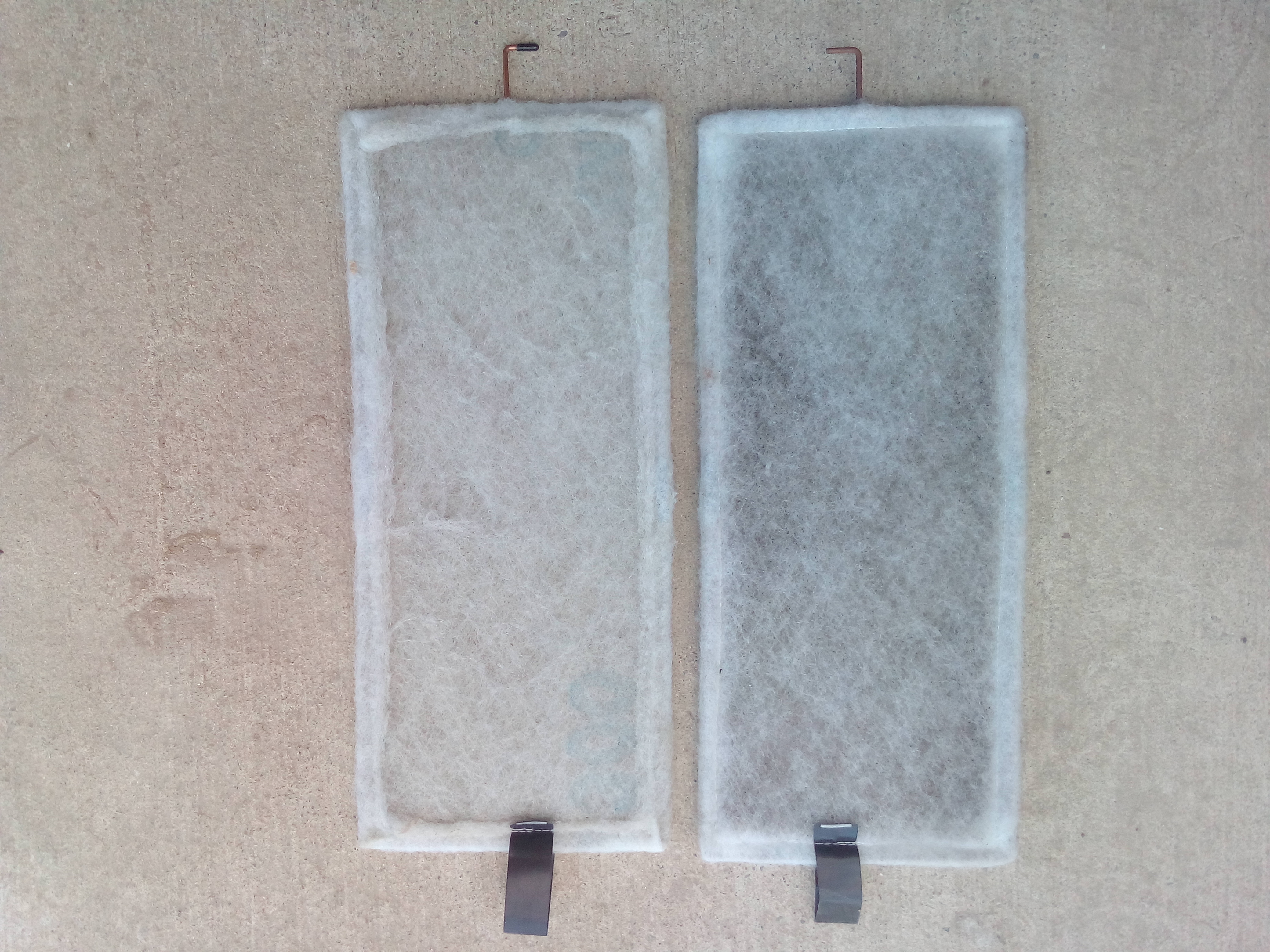
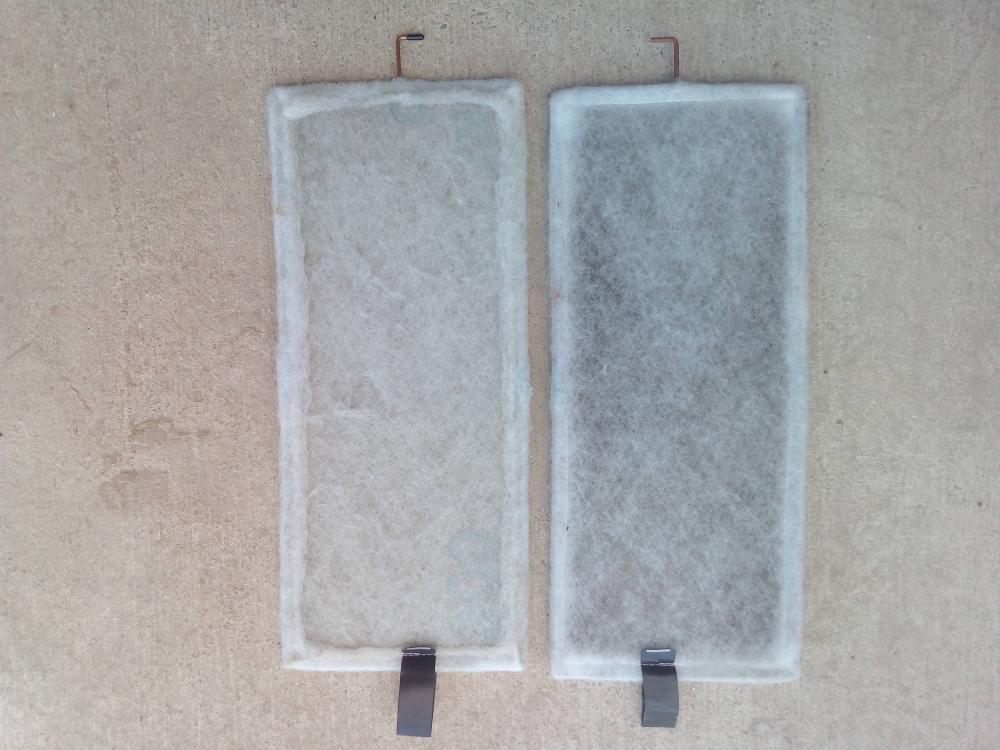
@JSHarris and @pulhamdown, attached picture of the original filters I replaced last year. I would describe the fit as having a bit of wiggle, and as you can see no neoprene seal. The replacement filters I used were actually meant for a bigger unit but do have a snugger fit. Same filter material on metal frame. The darker of the two filters you see was on the air intake so caught all the insects. I'm not convinced many got round the filter, but suspect in removing the filter to clean some will have got shaken off or into the core while the filter was out.
-
Interesting. We likewise had a few dead insects in the core, but otherwise the water was pretty clear when washing out. The biggest issues were the mould growth, and I can only attribute this to water condensation sitting at the base of the core before there is enough to drain out. How encrusted with dust was the extract fan (our supply fan was clean)? Perhaps our damper marine climate has something to do with it.
-
MvHr in cottage refurbishment
Stones replied to Cpd's topic in Mechanical Ventilation with Heat Recovery (MVHR)
Roughly speaking then your duct was about 1/3 the cost of the slightly larger bore stuff many of have used. Well done! From what you say similar 1/3 - 1/2 the cost for the other comparable parts? -
MvHr in cottage refurbishment
Stones replied to Cpd's topic in Mechanical Ventilation with Heat Recovery (MVHR)
How many metres of duct have you used? How have you secured / fitted the ducts to room terminal plenums? The steel room terminals are nice. I used them in all of our previous builds and they are a lot less intrusive / better looking than the plastic ones I currently have. I've still got one spare somewhere, will have to dig it out and see how good a fit it would be with our terminal plenums. -
MvHr in cottage refurbishment
Stones replied to Cpd's topic in Mechanical Ventilation with Heat Recovery (MVHR)
I don't think there is a right or wrong answer. All our previous installations used a main duct with branches off to individual rooms. Ducting was a mixture of plastic and flexible. I know many will be some sharp intakes of breath that I used flexible duct, but you know what, it worked. The smaller bore semi rigid stuff I used in the current house was a lot easier to install, but I do think its the reason I've needed to install a (large homemade) silencer. My neighbour has just installed a system using main duct runs of polystyrene duct with branches off, a silencer at every room outlet / inlet. It's yet to be commissioned but it will be interesting to see how that performs noise wise. -
I think I'll drop Vent Axia a line to see what they say about the mould growth (and the front cover fixings). I'm not overly concerned by its presence but it would be interesting to hear what they have to say and if there is anything I can do about it. Quite a useful step by step here (I really should have taken pictures myself):
-
@JamesP I built a home made silencer and fitted it between the unit and supply manifold. There's a post on my blog about @Declan52 how long after commissioning did you leave it before first clean of the core?
-
Only out going extracted air. The heat exchange core fins are housed in a hexagonal shaped body, so there is a small surface area where fins meet body where water can sit before presumably there is enough water to force it over that edge and drain away. Like a shower therefore, it is the place that remains damp or water is always present. At most the mould growth covered around 5 mm or so around the body / fin junction.
-
It wasn't the whole core, but the base of the fins where water / condensation drains out. I would liken it to the growth in a shower at the junction between wall and tray. From a health point of view, I'm relaxed about it as the growth is at the exit point of the extract side of the core meaning it doesn't mix with the incoming fresh air. @Declan52 did you see any mould growth in the core of your unit when servicing?
-
I'm reasonably happy with it. The summer bypass and humidity functions work well, and as @Declan52 says, it just ticks away. I've had MVHR in 4 houses now, but this is the first I've had to fit a silencer. Not sure if its the MVHR or type of ducting I used this time (semi rigid) around. Glad I'm not the only one who thinks the front cover is poor. The previous MVHR units I had, the front cover was hinged at the bottom and secured with two quick release catches - really simple and really effective. @Declan52 did you simply swap out the screws or to more inside the unit to secure the cover?
-
Members' experiences of Timber frame and slab suppliers
Stones replied to TerryE's topic in Timber Frame
The topic is currently hidden on the basis that it potentially breaches 6.5 and 6.7 of the BuildHub Terms and Conditions. -
One year on from first install, I set about servicing my MVHR today. Aside from cleaning and replacing the filters, this is the first action I've undertaken with the MVHR. First off, the front cover is secured in place by a series of screws with a mortorq head. Quite why they have used these rather than the Philips head used elsewhere, I'm not quite sure. Fortunately, I had the appropriate bit, but unfortunately, the screw heads are that soft that one of them stripped. Gravity came, in a way, to the rescue. Whilst I was considering how to proceed, the cover fell forward and broke the flimsy plastic fixing through which the screw secures the cover to the body. So, with front cover now off, I pulled out the heat exchange core ( its a very snug fit so needs a firm pull). I anticipated that there would be some residual water / condensation in the core as it wasn't long after morning shower time. Best advice is therefore to keep the core level until you are somewhere safe to drain any water out. I washed out the core using the shower, and there was a bit of dust / gunk etc that came out of it. To dry, I left it outside and the wind did the rest. Aside from the water / condensation in the core, there was some black mould growth where any water would normally drain out of the core into the condensate drain. Bleach and a toothbrush dealt with that particular issue. Having dealt with the core, I wiped down all of the internal MVHR core housing and duct outlet surfaces. Generally speaking they were pretty clean. The summer bypass, which consists of plastic louvered fins, required a bit more cleaning, as the fins all had a coating of dust that had stuck on. Likewise, the extract fan impeller blades were covered in a coating of dust that had stuck on. I'm guessing that in both cases, the moisture present in the extracted air made the fins and impeller blades damp enough for the dust to stick such that it wouldn't simply brush off. The dust deposit did however, wipe off fairly easily. Finally, I checked the condensate drain, making sure it was free of blockages. After cleaning the two general filters, I slotted the heat exchange core back in, replaced the filters then refitted the front panel. Fortunately, despite the damage described earlier, there were sufficient screws left to secure the front panel and seal the heat exchange area. In summary, easy enough to self service, just be wary of the screws securing the front panel.
-
Vacuum cleaner recommendations?
Stones replied to Jeremy Harris's topic in Kitchen & Household Appliances
Just reviving this as looking for a replacement household vacuum. We currently have a 'Hetty' (Henry in pink clothing) which is a solid a reliable bit of kit, but as pointed out previously by @TerryE whilst great at removing coarser dust, does end up recirculating fine dust into the house. My good lady had also suggested an upright style may well be a bit easier to use. No plans to get rid of Hetty, great for really messy jobs, the car and for the two deep pile rugs we have. Otherwise we have all hard flooring, a mixture of tiles and engineered oak. Suggestions? -
Appliances
Stones replied to Woodgnome's topic in Self Build VAT, Community Infrastructure Levy (CIL), S106 & Tax
No, it's quite clear, you cannot claim for the integrated appliances. As you have already pointed out you can claim the VAT back on the extractor. -
Following a recent post which also discussed House Naming application : I thought it might be worth exploring the subject a little more. Of the various comments, the main objection about having to go through the Council to name your house, is the cost, which varies quite significantly from council to council. There was in addition some comments expressed about why an official should get to approve the name of your house. Previously if course, this was a no cost service so there was very little reason not to fill in the form. Many have said that you are still going to get your mail, and over time your new address will start appearing on various databases even if you don't go through the local council, so given some councils are charging up to £150, why bother? For me, there is one very good reason, it will get your house mapped on the GIS system used by the emergency services. Think about it, do you really want to be in a position where you urgently need an ambulance or there is a fire and the crews don't know where your house is and they cannot get directions from their mapping systems. I've been in the position of trying to respond to 999 calls and being unable to find an address and not been able to get directions...something to consider. For those that object to paying the fees being charged, perhaps the way forward not only for yourself but the benefit of others would be to challenge the fee, which should of course only be on a cost recovery basis. Even assuming an hour of admin officer time in total for each application, one would of thought total employment costs wouldn't exceed £35 per hour. Anybody up for the challenge?
-
My father used to chair a local valuations appeal committee. He was very clear, current house prices and working backwards to get the notional value in 1991 would not be accepted as evidence. It may well give you a starter for ten, but the only way to get useable evidence to convince the committee is to identify houses in the valuation area, preferably as close as possible to your own house, that are directly comparable in terms of size and accommodation. They assess the ground floor size from the external footprint rather than internal. Remember that the thicker walls many people now build due to insulation will add notional floorspace and therefore value compared to a 1991 build with a slimmer wall construction, so its not unreasonable to make that adjustment when comparing. Also bear in mind the assessors do not want to lose an appeal (as it would be a negative KPI) so if you have good evidence they would likely settle on a reduced banding. If however you have no evidence and just feel it's too high, they will let the appeal be heard as they know without credible evidence the appeal committee would have no option but to side with the assessor, who will present stacks of evidence.
-
In our last house, we had an Exhaust Air Heat Pump, which exhausted air at -8C, and that certainly was enough to cause condensation problems on the exhaust duct, which was initially flexi duct with the rockwool sleeve insulation. That issue was solved by replacing it with rigid ductowrk and insulation. All of the other ductwork in that house was under the earthwool insulation in a cold roof space, without issue. In our current house, the ducts run under the earthwool insulation in the cold loft and are uninsulated within the heated envelope. No issues whatsoever.
-
Ours is very quiet in heating mode, noisier for DHW when running full tilt, but in both cases no more than the noise from a gas boiler flue.
-
+1 on the Osmo. Great product and so much easier to use compared to varnish. I finished our doors, facings and stairs with it. Very hard wearing on the stairs. I went with unfinished doors rather than prefinished to ensure I had a matched OSMO finish throughout the house.
-
When I looked into installing a GSHP at our last house, changing the antifreeze was one of the 'service' issues mentioned by both installers that I had approached. The most interesting piece of information that came out of the exercise was confirming that if your heating requirement was less than 5000 kWh / yr, a GSHP would cost more to run, as the additional electricity usage of the pump used to circulate the ground loops outweighed the saving from improved CoP (compared to an ASHP). The only real benefit that the installers could offer, and their main sales pitch was look at the money you will make from RHI.
-
Kingspan heating (or lack of) issue
Stones replied to Lynford's topic in Air Source Heat Pumps (ASHP)
Just to add to what has already been said, we had a radiator based system fed by a heat pump in our last house. 15mm pipework to the radiators which were massively oversized (around 3 times the size compared to a conventional high temperature system) to allow them to emit the low temperature heat - in our case a flow temp of 33C when it was 0C ambient. A lot of early ASHP installation, the ASHP was touted as a direct boiler replacement. Whilst they can produce highish temperature water, they do so at the cost of efficiency. Failing to upgrade the DHW cylinder to one with a 'heat pump' coil, i.e. massively increased surface area compared to a standard cylinder, and not replacing radiators with correctly sized ones / keeping existing microbore pipework were common problems. -
I can't give any figures as I no longer have the quotes from previous builds. TF was very popular where I lived at the time (Perthshire) and a lot of builders were geared up (and preferred) to build with TF. Joiners were plentiful but brickies less so IIRC. It may well have been the lower availability of brickies and therefore the higher salary they could command was the difference. I simply went with TF as it was cheaper at the time.
-
Welcome @Fredd I've built six houses over the years, 5 timber framed (4 kit one stick built on site) and the current house using ICF. I costed block built on the first four houses. For three of the houses it was marginally more expensive, and the forth the same cost. Where I currently live TF is popular because there are a large number of self builders who do the work themselves. It comes down in part to the design of the house being built (as it may lend itself to a particular construction method), the availability and cost of trades, and for self builders how much input they want to have. I could have built my own TF if I had wanted. One of my friends has done exactly that and has 'saved' a lot of labour cost by doing it himself.