


SuperPav
-
Posts
224 -
Joined
-
Last visited
Everything posted by SuperPav
-
Looks great. Having grown up in Cyprus, the UK apprehension of fitting ASHP always amuses me. In most of Europe, you fit ASHP's literally anywhere - walls, roofs, gardens, patios! We're future-proofing our build to get an ASHP (we're on gas at the moment and) so running all the pipes/provision as required and ours will also most likely go on the flat roof (but above the garage in our case, so the noise issue is even less of a concern). I assume you've had no trouble with vibrations/structural noise from your current setup?
-
Not very clear from the post (or maybe it's just too early in the week for me). Have you been doing works to the shared party wall - i.e have you removed a chimney breast from the wall joining your house to the neighbours? Same with regards to installing steels? If so, this should have been covered by a Party Wall agreement and if it hasn't, then you need to be very careful as your neighbour has some rights. What I will say having done a averagely-constructed 1930's house is that it is entirely possible for (superficial) cracks to appear from even relatively "low impact" work -e.g. percussion removing plaster in one room or chiseling out socket boxes created some cracks at joins e.g. ceiling to wall in the adjacent room. Removing or changing structural elements such as lintels/beams is even more likely to result in a crack appearing. On the flip side, the cracks can appear on their own with nothing related to the building work, so as per some of the above suggestions, don't offer anything in case she's chancing it, but equally, I wouldn't so readily dismiss any possibility of your works having had some impact. And if you've not followed the Party Wall act, then tread very lightly.
-
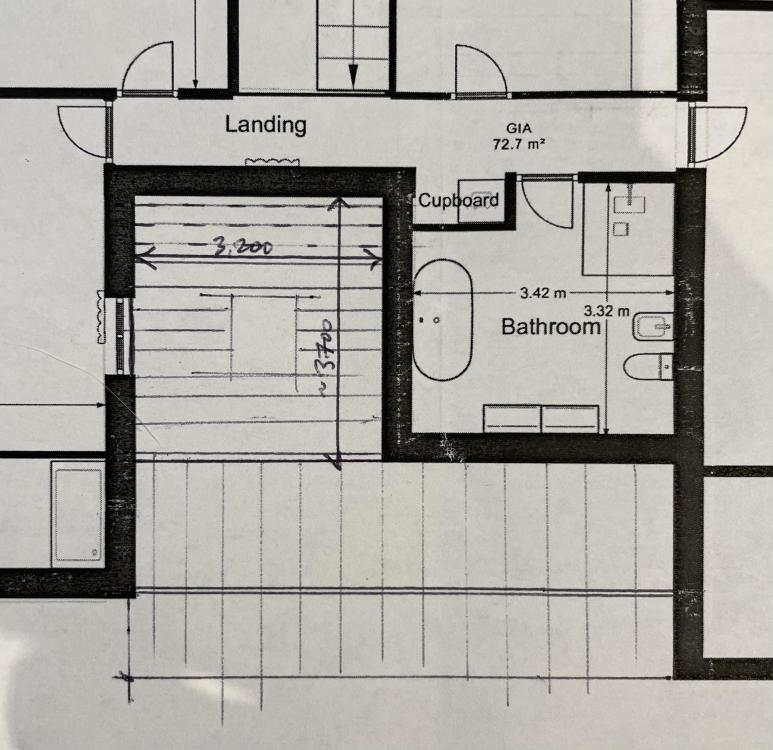
So the builders have (very slowly) started building up the walls of our bungalow extension (upwards). The house is a U shape with a flat roof in the "middle" of the U, which is higher than the main ceilings of the house. What i'm finding now is that I only have approx 200mm to play with in the U-section as the distance between the top of the flat roof joists, and the bottom of the 100mm deep stone cill of a window facing the flat roof. If we install firrings (running across the joists) that'll be borderline in terms of the space available for insulation (100-110mm at a push with two 18mm OSB decks). The length of the flat roof is approx 3.7m, (by about 3.2m wide), and the window is in one of the side walls, about half way along. Trying to get as much insulation in there as possible, and respecting the falls required, I am now looking at just getting sheets of Kingspan 30-50mm (1:60) insulation. It's a small enough area that the cost of two packs (~£500) isn't too much of a concern (at this stage we've spent far more than that fixing much more avoidable builder's problems). This would mean that we'd have 190mm down to 130mm in that middle section. Just looking for a bit of a sanity check that the following build up makes sense and that I've not made some stupid assumptions: Liquid roof (brand tbc!) 18mm OSB3 TG4 deck tapered insulation: 50-30mm PIR. 50mm + 20mm + 20mm at the "inside/top end", 30mm at lower end 100mm celotex VCL 18mm OSB3 TG4 subdeck PS10 Posijoists 12mm plasterboard ETA the bit further down in the image where the joists run perpendicular is also flat roof, but with 8x2 (cantilevered over the steel) so a smaller depth, so no build-up challenge there can can use firrings.
-
Paranoid about spontaneous failure of large skylight
SuperPav replied to hendriQ's topic in Skylights & Roof Windows
I personally wouldn't want any roof lights that weren't laminated on the inner pane, having had a large pane of toughened glass shatter (from impact), while the risk of serious injury from toughened glass shards is very small, it is still highly unpleasant.. If you got one that is toughened on the inner pane, then as someone else suggested, I would get a clear film and stick it onto the inside surface - this will stop shards flying down if it does spontaneously shatter.- 49 replies
-
- 1
-

-
- skylight
- heat soak testing
- (and 1 more)
-
You can solder or braze to cast iron relatively easily without any risk of future stress cracking, that's what I'd be doing as it's clearly a non-load scenario. Bit of shaped tin/copper/steel patch to sit flush with the hole, then simply tin and solder? If it's literally a tiny crack, then a couple of spot welds can also be done fairly easily. The cast iron in a gutter is so thin that you don't have the same issues as welding 4-5mm thick cast iron where you need to preheat it all around to avoid the localised stresses.
-
Hi all, what's the recommended sealant/mastic to use for sealing joist ends built into blockwork in a cavity wall for air tightness? I can get to both sides of the leaf (inside and outside) so can seal from both sides. I would've thought something non-setting is better, but if normal silicone or EB25 or CT1 or whatever posh stuff is recommended I'm happy to get it. Thanks
-
OK so I can now see why nobody uses thin-joint here! To be clear this is for finish cracking reduction and not "structural" as such. The builders (who have built lots of one-off houses locally with thin joint) said they don't bother with the tape at all as they dry-line normally and the settlement cracking isn't an issue, and building inspector isn't fussed either. So I'm doing this primarily for my own peace of mind and trying to I guess overengineer to remove any potential for bad cracking. Hopefully this helps others too in the future: H&H have provided me with a product recommendation (Bekaert CCR Compact A). I started looking for this and basically failed to find anyone who supplies it (and even the Compact C and Compact I is hard to find). Then 30 minutes later they emailed me to say that was the wrong product, and actually what i need is Bekaert Bricktor CCR (stainless steel) and this should be used if a wet finish is installed. This stuff seems COMPLETLEY unobtainable. They've also said that fibreglass tape can be used to limit cracking for dry finishes, any product/manufacturer, subject to it being suitable in this installation. Good luck with that. All the alkali-resistant tapes are primarily for cement board installation and obviously not tested or certified for wall reinforcement, even though they would most likely be 100% fine and H&H's own youtube video from 10 years ago shows them just using generic fibreglass mesh. Bekaert themselves have flat stamped Brickforce Stainless reinforcement marked as suitable for thin joint. I can get hold of this and it's relatively reasonably priced but total height is 2.7mm which to me is still too much for a 2-3mm nominal bed. I've now got hold of a local supplier who specialise in Thin-Joint installation supplies, so will see what they can offer.... I'll post back once I've sorted it!
-
If this is a case of design then your architect needs to lead this and absolutely needs to establish "what would make the proposed development acceptable" even if what they come back with is unreasonable to you. This gives you a strong base from which to then work towards an approval - whether it's via amendment or a new application doesn't matter too much. If, however, it's a fundamental case of planning policy (i.e. you want to build a house or rocket factory where it's not allowed by policy), then the architect will offer little help I suspect and you need a planning consultant.
-
Hi all, we're about to start going up with Celcon blocks (630x215) on thin joint mortar. Where bed reinforcement is specified (every other course/above windows etc.) I'm struggling to get my head round which product is required. The H&H manual doesn't help much, neither does the airtec one, mentioning "a proprietary fibreglass mesh may be used" without any further info or offering any of their own products. Presumably the long straight steel ones are no-go as they are over 3mm in height, so won't work with thin joint? Is it a case of just getting some 100mm fibreglass tape as you'd use for joining cement boards when tiling? Presumably it needs to be alkali resistant if used with thin joint mortar on concrete blocks? If anybody can direct me to a product, that'd be great!
-
Can anybody please advise on the following: Zehnder 350 vs Q350 Am I right in understanding that the 350 cannot have the fan speed set on the actual unit, and requires an additional external controller, whereas the Q350 can be set on the unit itself? I don't plan on having lots of controls in the house, the idea would be to just have a timer boost switch in the kitchen and bathroom if required, but I suspect we'll just run it on a preprogrammed mode most of the time. The price difference between the two units I can get for is about £500, but if I need a Comfosense C67 controller to set up the fan speeds on the 350, that is £130-odd just on its own so the price comes down even lower so it makes sense to consider the newer Q model...
-
Cheapest 22mm Egger extra peel clean T&G supplier right now
SuperPav replied to Adsibob's topic in Floor Structures
Just looking on the Egger website, it's the 18mm that comes palletised in 80 per pack, the 22mm is 64 per pack, which I'd obviously buy if that made the price better! Just need to find someone willing to supply. -
Cheapest 22mm Egger extra peel clean T&G supplier right now
SuperPav replied to Adsibob's topic in Floor Structures
Protect (or Norbord's equivalent.. Cabershield? although that seems even thinner on the ground in terms of availability!) At the moment I can't get ANY prices - TP are still quoting me a decent price but can't get any supplies. Jewsons have only got stuff that's already committed to projects. There's a few online merchants selling it at £20+ but that's not realistic. I'd buy 80 if that made it easier - the builders use the stuff on other projects so would probably have the remainder off me. -
Cheapest 22mm Egger extra peel clean T&G supplier right now
SuperPav replied to Adsibob's topic in Floor Structures
Sorry to bump, but easier than creating a new thread. Is anybody still able to get this at the moment? We need 55 sheets pronto, and were quoted £12 ex per sheet a couple of months ago, now that it's come to order it, literally nobody has it in stock as all the merchants are refusing to pay the wholesale price it seems? Builders are offering to source for £18.50 ex but that's a heck of a premium we can't really afford at the moment. -
Possible future changes to rooms in roof layout
SuperPav replied to Deejay_2's topic in Planning Permission
You can label those rooms as whatever you want on the planning application. Change of the rooms at a later date would be a building regulations issue (fire escape etc.) and not a planning issue. From a planning point of view there is no change of use of the dwelling/site/property and there is no change to the exterior. Now, if you need to make changes (e.g. new openings or windows) in order to meet the building regs, then yes planning may come into it. Just treat them as bedrooms from the outset so you then don't need to run new fire alarms, change all the doors etc. etc. when you eventually decide you want them as bedrooms. -
I see nothing of particular concern there based on the limited info to go off. The 45 deg thing is surprising though, they normally only take them from the near edge if assessing impact of a two storey extension. This is obviously not a hard and fast rule and does vary between LA's so depends who you're with. My advice would still stand though to keep it square in the initial app. Depending on your LA, they might be allergic to 45 deg cutoffs along window splays anyway I'd advise a few minor tricks in case the planners get funny, but you should be OK to crack on if your neighbours are on board. Remember you always get a freebie re-submission if necessary.
-
Depending on what the neighbour's house is like, and what the rest of the plot is like, and the general sizing of the house/elevations, that may/may not be allowed. If you have PD rights (i.e. not removed - check this), it will help as you can always fall back on permitted rules as a bargaining chip. But for what you're proposing, planning will be required regardless. Presumably both the rear and side extension will be single storey. Any objections from the neighbours from early chats (if any)? Regarding that little cut out on the 45 degree line, I'd suggest you lose that, and make it square - it should be measured from the centre of their patio/window, not the near edge. This should give you a bit more wiggle room.
-
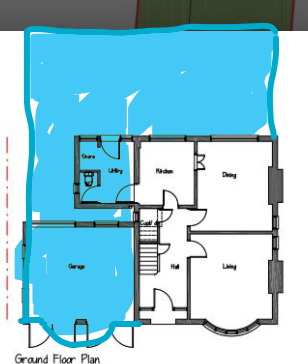
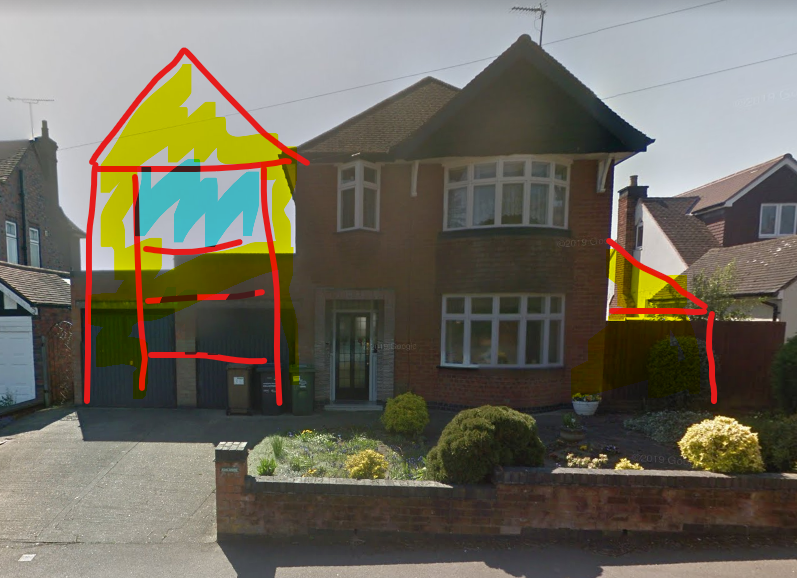
I've had a look at this including the houses either side and the planning history, and as some informal feedback my thoughts below: Both comments by the neighbours are reasonable. The fact that the last application was also rejected on overbearingness (rightly or wrongly) means you're off to a bad start in terms of getting your proposal through as is. The fact your house currently sits so near to #16, with a tapering/diagonal plot is always going to require some compromise as you extend rearwards. Some of the proposed works seem somewhat inefficient from a cost/work vs value point of view - is the garage wall to #16 really moving by about 500mm? Where do all of your services currently run? If it were me, I'd be tempted to lose the garage in its current location, put a second bay to match your current one to that side, over the existing footprint, then extend rearwards in the current width, perhaps by more than you have currently (8-9m?), and then bung an attached garage on the side facing #20. Even if you had a double length garage here, it would only be a single storey side extension to #20 which is a material improvement over the last application. I would also advise you to keep the garage wall to #16 in its current position - putting foundations right up against current ones right on the boundary (+ ripping out the old ones for the new floor), + limited access for building and maintenance is going to be a real pain. Worse so if there are any services or even rainwater drainage running along this wall. Apologies for the MS paint quality of drawing, not on the good computer at the moment!
-
Are any of the following documents on the planning portal: 1) Requisite Site Notice 2) Documents uploaded by the planning officer 3) Documents uploaded by statutory consultees (e.g. Highways Agency, Environmental Agency, Conservation Officer, Ecology/Biodiversity officer, Parish/Town council)? 4) Public comments on the application?
-
Aircon 1st fix
SuperPav replied to SuperPav's topic in Mechanical Ventilation with Heat Recovery (MVHR)
It's a (very extensive) development of an existing dwelling, so no chance of 0% VAT unfortunately. We can of course work out the cooling requirements now, but we aren't currently in a position to buy the units at this point in time, so there'd need to be an element of retrofitting. It's just how do we plan for the retrofit in advance, particularly those rooms which will be on the other end of the house from where the external heat pump will sit. -
That is very bizarre. What documents/if any have they uploaded onto the planning portal for the application?
-
Have you had the site notice put up? Have there been any comments submitted? Have any of the statutory consultee responses been uploaded? Depending on the above you'll know whether they've been working on it quietly or not at all.
-
You can go right up to it, technically.. you just need to do it carefully. Step 1 would be to plug the existing hole with some strong mortar, next you'd get a piece of ply or similar with a tight hole of the correct diameter drilled through it to use as a guide/support, locate it so it's exactly where you want the new hole to be, then fix the ply to the wall using plugs/screws in one of the other holes you've got around you (or worst case drill some new ones which you'll fill after). Then get a nice sharp drill bit and start drilling through the ply into the new hole, keeping the drill straight or slightly angled so you're drilling away from the old hole. Once your hole is done, remove the ply.
- 1 reply
-
- 1
-
-
Thanks, I'm not completely sure whether reading that's made me feel better or worse!
-
The usual advice of get a planning consultant would apply Hard to comment on some things here with the limited information and lack of elevations. 1) What is the footprint of the original house, specifically what (if anything) can you do using PD rights. There could be some games to be played here. 2) What/if anything has your neighbour said about it - both to you directly but also as part of any comments on the planning application? Do they have any *specific* concerns? 3) What is the current boundary treatment - fence etc. 4) Appreciate those drawings may be a bit distorted, but how much are you going out rearwards as it almost looks like you're doubling the depth of the house? Your questions about how the corner window should be treated from a planning assessment are a bit irrelevant to be honest - it looks like there's more than just the corner window on their eastern elevation anyway.
-
The drawing is based off us doing a CCTV survey and joining the two manhole locations with an aerial photo (taken ourselves). The sewer is most likely not EXACTLY where the line is drawn, but even if its location is slightly off, it will 99% lie within an affected area of that extension shaded in yellow. Wanted to avoid digging down over 2m as the builders doing it with a digger will most likely smash through the sewer, and manually will take forever with shoring the trench etc, but looks like might not have a choice if ST won't accept a raft foundation for that bit - I have asked. I wanted to avoid the raft there since it'll be more likely to result in differential movement to the rest of the house, but the same is probably true of having 2.25m footings on that bit compared to the 1.2m footings elsewhere.

