


SimonD
-
Posts
2215 -
Joined
-
Last visited
-
Days Won
13
Everything posted by SimonD
-
I've got a Plumbfix account and can't say it has really benefited me that much at all. I tend to get better prices elsewhere, like even Toolstation, and the 10% discount I've found is only on a small number of products I've needed. They've offered to provide a quote service for larger orders but haven't tried that yet. One thing I found a couple of times was that when buying in person I got a better price than ordering online for click and collect, but maybe that's just my imagination or wishful thinking..
-
I think @nod sums it up. I was recently asked by someone to look over a quote they'd got from a local contractor known in the area. At the bottom of the quote it said the company is fully insured. The next page detailed the insurance cover which amounted to public liability only. No all risks, no professional indemnity. My sister was once getting some extensive renovation and extension work done and the builder who'd quoted and she preferred was adamant he had all risks cover. He told her to ring his insurer if she didn't believe him. Low and behold the insurer told her he didn't have all risks but only public liability. He then replied that he knew he had sufficient cover, she didn't know what she was talking about and wasn't prepared to take out anything else. Obviously he didn't get the job. I do however know a tradesman who did successfully claim after dropping some heavy wall tiles into an expensive new bath and cracking it. The insurer paid out for a replacement but all in all it took about 9 months to get it all fixed. I think if you want to make sure your contractor is fully insured you're gonna have to comb their paperwork ?
-
My understanding is that there are sometimes gaps in cover when a contractor only holds Professional Indemnity and Public Liability insurance and that the part of contractors insurance that's important is cover for unforeseen loss or damage to the construction work. This covers rebuild costs, for example. This part of the insurance is often arranged in joint names between the contractor and client. Contractor's insurance is also referred to as all risks. Not all trades need this as the extent of the work being done doesn't necessitate this type of cover. The problem is that contractor's cover isn't always a uniform policy but can be based on multiple separate policies depending on their operating model, so I'd be inclined to go back to the insurer and ask them to clarify exactly what they mean and what that level of cover has to cover!
-
When I look over this detail I'm most troubled by the box gutter arrangement and cavity. I don't think that woodfibre is suited to this situation. With the box gutter sitting on top of the woodfibre as it is here, there's too much risk of moisture damage as it needs at least 2 or three layers of protection.For example, flashing and membrane/aluminium tape/epdm tape on top of the woodfibre. As far as I'm aware, woodfibre is also not suitable for use in wall cavities, only as external or internal wall insulation, or behind a ventilated rain screen. There doesn't seem to be any ventilation provision here which would need to be in place for the woodfibre. You also don't have easy access if there is a problem at any point. I think in this instance, you'd be better off looking at a mineral wool like Rockwool, for example. This would be cheaper than the woodfibre. HTH
-
Hi Ollie, Yes, ideally you want to insulate the front of the block wall. This should be down to a minimum of 215mm below the top of your floor beams. EPS would be fine, or XPS. It's common to find EPS 200 or 300 rather than 70 detailed here for the perimeter board. As @Mr Punter suggests you might want to look at your insulation thickness all over and also consider whether rigid insulation is the best option for you in a timber frame - it's more difficult to fit and detail between the studs compared to flexible insulation materials.
-
Did this detail come from the timber frame company? I think the design is problematic. You don't have necessary bottom ventilation gap for the cladding and you are lining yourself up for water problems both at the bottom of the cladding on the outside and because any water ingress behind the cladding has no way to get out. You can completely remove the 'splash' course as it doesn't appear to serve any particular purpose and will only cost you extra money in both labour and materials. Is your cladding to be installed vertical or horizontally? If it's vertical you need counter battens. You also apper to have a cold bridge problem at your wall-floor junction.
-
Ah cool. So now I'm itching to ask how you did the curved section? It's very nicely done. I've got curved ceilings which are to be finished with Birch ply too where the curve is created by the glulam beams.
-
Viessmann Vitodens 200-w - initial impressions
SimonD replied to larry's topic in Boilers & Hot Water Tanks
I've just been scanning brochure and installation docs and it does have immersion available. They also sell a PV kit. I haven't read in detail but remains promising. -
Is that a plywood finish ceiling? If it is, did you have to use an intumescent treatment?
-
Viessmann Vitodens 200-w - initial impressions
SimonD replied to larry's topic in Boilers & Hot Water Tanks
Great stuff, thanks for the heads up on that. I've been looking for boiler and thermal store setups for a while now and this looks ideal. -
That's been my motto too, although I did get some friends over to intall my 200kg and 300kg 1st floor windows. You're actually not too far from me. I've got two hoists, one electric, one chain knocking around. Let me know if you want a hand and when and I'll see if I can make it over. I'm sure we could figure something out. My main problem throughout the whole of my build has been how to get things up inaccessible banking!
-
Of course, Peter. I used Robbins Timber in Bristol for most of my timber supplies. For my Glulam beams it was Buckland Timber (I needed bespoke curved and straight beams). I actually tried to use Colorcoat Urban. I found that both tech support and sales were so inadequate, that, as you know, I went elsewhere. I'm now very glad I did. There's no way the Tata proposition would have cut the mustard for our project. @Kevin J will no doubt hate me for saying this ?? but I didn't go with Metal Solutions either, even though I did speak to them about my project - they were also kind enough to test whether their snaplock product would work for my roof (sadly it didn't due to curve radius). I used The Metal Roofing Company which supplies the Lindab Greencoat PLX, which is basically rebadged SSAB Greencoat. This, however, is old school either hire in a roofing contractor, who they'll put you in touch with, or DIY from coils. Re toys, I did my entire frame using a Festool HK85 together with a cross cut rail (attaches to saw for all manner of mitres up to 60 degrees) and 2 1400mm rails. I don't think I'll ever go to using chops saws or table saws again as I can just take the tools to the materials and cut everything on the pack..or the floor..or wherever it's lying. I did also use a pheumatic framing nailer, positive placement nailer, hammer, spirit level, and a cheap Erbauer impact driver. Oh, and a tape measure ? Probably most underrated of the toys is my Nilfisk M class extractor which is pretty much permanently attached to my saw - OMG is that one of the best buys I made. That was pretty much it for that part of the build.
-
Thanks Peter. Is that still the case with cls, blimey. It was an issue when I bought all my cls for partition walls and I bought the last stock from my timber merchants. That was back in December.
-
Normally the cls comes untreated but I asked for it treated so my timber merchant sent the whole lot off to get treated before devliery. I think a lot of merchants will supply to you treated or untreated.
-
Nice, I bet that was fun! I loved the framing part of my house.
-
And store it out of direct sunlight, especially if the sunlight is likely to hit only part of the stack.
-
Soil stack arrangement for ensuite, kitchen & utility
SimonD replied to SimonD's topic in Waste & Sewerage
Yes, it is. I'll have to have a chat with BCO as it now looks like any amendments won't be to regs and if I've got to dig new drains to correct dpeth, I'd have to install a pump because the mains is 8 meters into the hill behind the house. -
Get in touch with the EPS manufacturer you've used as a few of them now have recycling schemes to reduce wastage and get recycled into fresh boards. You may have to pay but it's likely to be cheaper than a skip or other waste service.
-
Soil stack arrangement for ensuite, kitchen & utility
SimonD replied to SimonD's topic in Waste & Sewerage
Thanks for that. Good suggestion on moving the stack to east face wall. I've dug out around the existing drains today and it's so shallow that when calculating for a 1:80 fall the crown of the pipe will be no more that 25mm below ground level once round the corner. What I have thought is that about 2.6m downstream of the old vent stack is a junction that went below the walls to serve an old loo as per photo below. I was going to replace this with a straight drain section. Now I'm thinking I might just plumb the drain through here and run a pipe horizontally under the floor to the ensuite and then up to the kitchen internally. Hope that makes sense.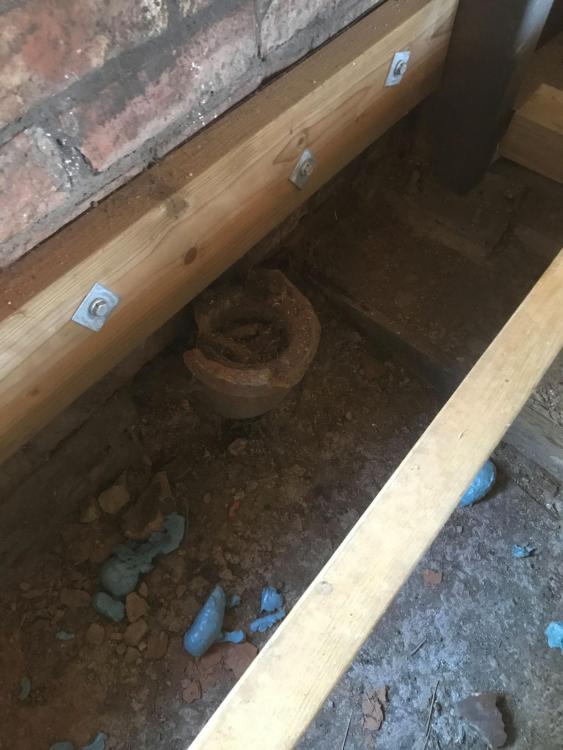
-
I've hit a brick wall inside my head and every time I read Approved Document H I find my eyes glazing over. I'm sure the solution is more simple than my mind is telling me so I thought I'd put this out here. Ideas and suggestions welcome please. This is all retrofit with some annoying limitations. I'm trying to figure out the best way to deal with the waste from new ensuite, utility and kitchen. Ensuite and utility are on the ground floor. Kitchen is above the ensuite. Waste from kitchen will only be from dishwasher and sink. The drains are all existing and shallow clay pipes. The manhole sits near the soutwest corner of the house. From this I have a drain going halfway along the west face of a house terminating in a soil stack. This deals with waste from 2 bathrooms. I then have a drain extending 3/4 the length of the south wall which has a gully and then terminates in what used to be just a soil vent pipe. I need to get rid of these as they're too close to the house wall and get in the way of the external wall insulation. This bit it fine as I'll replace with new ones. Ideally, and because the drains are already vented to the other side of the house I'd like to plumb the ensuite straight into the drain (layout for all this works fine). The utility would feed into a gully. In the kitchen I've got about 3.6m height to drain invert. My question is around how to deal with the waste from the kitchen. I really don't want to have an additional exterior soil stack for this as this would cause problems around windows and a bridge extending out from the 1st floor of the house - and it would look very ugly. Photo attached shows the south face where the kitchen is upstairs on the right hand side of the house. External soil stack would come up between downstairs back door and window to the right. I can at a push install the soil stack internally and bring it up to kitchen level or there is decent space to bring an external soil stack up to the bottom of the bridge and install with aav (this would terminated less than a meter below the highest point of any kitchen waste). So, in this instance, do I have to install a soil stack and/or is there a clever and neat way to bring the kitchen waste water down that I'm currently blind and ignorant to?

-
Disposing of large amount of garden waste
SimonD replied to gdal's topic in Landscaping, Decking & Patios
Ah, blessed be. I can sleep soundly now ? Now you're talking. Have you been off experimenting again? A friend of mine knew a farmer who had put a load of water piping through one of his massive dung heaps and used to reliably get 60 degree water out of it. Not sure of the flow rate, but by all accounts it was very useful. I'm no sure he even knew who Jean Pain was but just thought that the steam was heat going to waste. You are very kind,sir ? -
Disposing of large amount of garden waste
SimonD replied to gdal's topic in Landscaping, Decking & Patios
It's both funny and sad how it gets to that point. For me it was the proverbial straw of having loads of annoying timber offcuts everywhere. Too little for a skip, a hassle and cost to get a rubbish collection company and anyway how eco is this for a small load of waste? It was too much to take to local tip without being sent to the weighbridge for payment (they've already warned me about this). Garden incinerator won the day and I'm racked with guilt.. -
Before going out and buying a load of panels, plus everything else you need, I'd highly recommend you get yourself a spectrum analyser. There are apps you can download onto your phone. You also need to work out the room's frequency response. This way you'll have any idea of the frequencies you need to target within the room to get the best results and know whether the room is likely to amplify certain frequencies. You can also measure ambient background noise produced by mvhr, pumps, washing machoines etc. so their noise gets dealt with too. Looking at the acoustic panels, they provide very good noise absorption around about 1k Hz and above, but because they're thin their effectiveness will be reduced for lower frequencies (the sharp edges help a bit for refraction) as you'll see by the graphs produced by the manufacturer. TBH it is a bit pointless to spend loads on targeting higher frequencies only to be left with annoying low freguency hums, or the bass of a male voice. You can get free software to help calculate the room modes, like Modecalc, which also has a tutorial. Otherwise, there are products like Celenit and Savolit wood wool boards that have acoustic certification. Celenit has a calculation service to help with room design. Here's also a link to a document that shows some common absorption coefficients of materials so you can compare to the products you're looking at. Noise control in Rooms HTH.
-
I frowned upon mine because it was horrible, inefficient to use and annoyingly noisy (constant ratatatata). It also broke very quickly. I threw it in the bin and bought a proper positive placement nailer.? About the only thing it had going for it was access to some tight spaces. Once you've done a few joist hangers in a row, I'm sure you'll know what I mean ?
-
I have some recent experience and knowledge with this. For the most part you'll find the timber frames designed with cripples and jacks as per standard framing convention. The 'California,' 2 stud corner is now a standard detail. Yes, you can of course start removing jacks and cripples, but it may not always be the most helpful thing to do. You'll have to know that your windows can be side fixed with no support below to remove cripples and in some case, if you have a large span, your removal of jacks for header hangers will necessitate double kingstuds, sometimes even triple, so you lose a couple of studs in that arrangement, but again it depends on the loads. If your designer is thinking ahead, you can design openings to fit within the stud spacing, which makes things easier and more efficient. With respect to your top plates, if your rafters are aligned with the studs and the frame is stacked, there's no need to double up your top plates. I've seen so many over here that are doubled up, even when there's no need, so I think mostly it's just habit. As for using 2x6 at 600cc you'll find that the goto wall is insulated between studs with some internal insulation to reduce cold bridging. If you really want good thermal performance, then filling and wrapping the frame externally with insulation is more sensible, like they do with wood fibre, and/or use a double wall, which is fairly common in the rest of Europe. I see you're in South Glos. That's not too far north of me. I found it difficult to get supplies of 38 x 140 cls as no merchants around here carried them, other than B & Q but they're only 2.4m long and stock is erratic. One merhant in south Wales that did hold some stock, told me not to bother with what they had as it was only fit for kindling. So I had to order mine by the full pallet, but then at least I knew it was decent quality as it was delivered by the merchant straight from the supplier. I can give you details of a good merchant depending on where you're based, if you like (prices were very good too). With all the local suppliers of 47 x 150 carcassing timber, many store it so badly, I wouldn't want to frame my walls with it. The other thing to keep in mind is that around here, many merchants supply osb sheathing in 8 x 4 sheets, not 2400 x 1200mm (as they do osb floor boards). In my case, the prices I got were so good I framed my house in imperial rather than metric instead of going to the bother of ordering in the metric sheets.



