SimonD
-
Posts
1941 -
Joined
-
Last visited
-
Days Won
10
Everything posted by SimonD
-
I'm sure there must be, but I'm not familiar with the process. You can see and feel the difference where even though it does cause staining, the black mould sits and grows on top of the wood whereas the blue stain kind of fungus seems to sit within the wood. Difficult describe really, but it also doesn't respond to treatments like oxalic acid which people often claim it does. I've had it happen on glulam beams that got wet and had been treated with a borax preservative solution, for example.
-
I wouldn't worry, get the wall up and just shim and use non-shrink grout where necessary, like you would finish under the base of steel columns.
-
What metal cladding are you using? Basic corrogated sheets or standing seam? If it's standing seam you need a board directly behind the cladding, ideally with a membrane behind it. You also need to make sure you have a continuous 25mm ventilation gap at the top and bottom of the cladding. Check curb looks good but you can also rip some chamfered timber and take the epm over that. That would be my preference as you then don't need the rubber water seal or mastic sealant.
-
Have you double checked to make sure this is mildew? I.e. is it slimy/fury and does it sit/grow on top of the wood? I could be wrong but something about the photos makes me think it's more like blue stain, where there is a certain type of fungus that feeds off the sugars in the wood. This does happen when there is excess moisture together with a sugar rich timber, but the difference is that whilst it leaves an ugly surface, the growth dies down naturally once the sugars have been consumed within the wood and or there's a moisture reduction. There isn't typically any damage to the structural integrity of the wood. It would be interesting to know if you've done a moisture test on the plywood itself to know whether it is actually damp? Yes, it can, but the blackness may not be causing harm to the plywood, just that the wood used in the plywood is susceptible to this kind of growth. It may be that it is a pine based board, like Radiata, or Elliottis as pine. Just a guess...
-
The only time you need to double up sole and top plates is when studs and rafters don't line up. + 1 to that. Don't add any osb until you've got at least some cover from the roof. I wouldn't brace until it's upright as it can then be trued up in all directions. As for 9 or 11mm it would typiclly depend on what the SE specifies. Same for the the roof. And to risk being picky, you'll either be building using 38 x 140 cls (50 x 150 unfinished) or 47 x 150 (45 x 145 nominal finished) carcassing, these differences will make a difference to your frame and subsequent dimensions. The cls can be ideal because you can get it at 2.7m lengths too. . That's very neat. Still lots of stick framing going on in Sweden mind you, it's seen more as the diy route nowadays but it's understandable given the climate why they like to go indoors to make their houses. I'm still bemused why there isn't more in the UK. Instead there seems around us to be a massive growth in the use of tin hat scaffolds at major cost to the customer. I have a slight hybrid of the framing method where I have a glulam ring beam and my 1st floor joists hang off that rather than penetrating througth the tf.
-
Airtightness tape for windows and doors
SimonD replied to Adsibob's topic in Mechanical Ventilation with Heat Recovery (MVHR)
They are expensive, no getting around that. I've been using Gerband tapes for my 1st floor timber frame from Passivhaussystems.co.uk You can get window tapes from Siga at airtighttapes.co.uk and Green Building Store sell Tescon Vana and others. One other alternative that I'm using around all my wall to floor junctions and around the window reveals in the old masonry part of the house is Saudatight LQ liquid membrane which can also be used with a geotextile tape for large gaps. I've been buying mine from Platinum Chemicals - Soudatight LQ - Geotextile -
Those are the kind of moments you want to shrink into the ground ? Absolutely, definitely the best approach IMHO and glad you got it sorted, plus you've got someone to help you going forwards!
-
Yeah, and the terminology gets pretty mixed up in those debates too. Totally, E F Schumacher in the 1970s who was known for highlighting that one of the big mistakes we make in international development is to focus on large-scale, high capital value, complex programmes that yield underwhelming results. This often requires expertise to be flown in to run the things and doesn't fit the local culture. Instead he said the development efforts need to be smaller scale and more appropriate for the local environment and population, which would not only be more effective but cost a lot less money. I think that your differentiation about where the waste happens is really important; they tend to lose at the early stage of production whereas we tend to waste at the later stage. The UN's figures are something like European and US populations waste between 95-115kg per capita but sub-Saharan Africe, South and South East Asia it's 6-11kg. I'm sure it'll happen one of these days in the not too distant future. A previous client of mine was involved in a tech startup attempting to raise funding and develop community co-operative solar energy generation within a couple of countries in Africa. But currently there are multiple & serious problems rolling this kind of thing out due to the complexities shall we say of regimes, wildly different jurisdictions and cultures etc. not to mention investment and investment risk (I also know someone who was quite burned by a solar investment in South Africa). My client was from an African background and explained to me that one of the problems with Western Aid and development is we assume Africa is some kind of homogenous mass of land and people whereas even on a small local basis, it can be pretty much the opposite. This has massive implications when doing work out there. He actually moved away from this work to lead solar development within a large established energy company. One positive side is that it is possible for many of these countries to jump a whole stage of development, with the right kind of approach. Lets hope. ?
-
I disagree. Yesterday's and today's technologies could have been implemented in such as way as to avoid where we are at today. We've had both the technology and knowhow to avoid this for a very long time. The problem has been entrenched thought and behaviour, socially, culturally and economically especially in the western developed nations, together with a serious lack of ability to learn from previous mistakes. You only have to go back about a hundred years to look at the environmental consequences of using horse transport en masse to see what happened then, only to replaced by short term thinking around the benefits of the internal combustion engine and thus the rapid transformation of transport to what we have today. Back then there were some fierce critics who foresore where we are today but of course they were silenced... Again, I disagree. Our behaviour drives what is causing the environmental situation we're in. For example, the agricultural sector around the world produces more than enough food to feed the entire world's population, yet we're still destroying the environment to produce more and letting vast populations starve. The only reason we need to produce more is due to the wastage caused by both inefficient systems (which claim they're efficient) and a lack of awareness on the part of those populations who waste so much unnecessarily - e.g. mostly the western developed nations. The same goes for so many other natural resources, including fossil fuels. Now one of the major hindrances of progress towards environmental goals again has nothing to do with technology but a fear by leading developed nations that moving from fossil fuel dependence might in some way lead to a reduction in GDP growth and that some other country might overtake them. i.e. ludicrous ideology like neo-liberalism. Unless you consider this forum a social network, thankfully I don't spend any time on them ? However, we can look to them for some very clever behavioural engineering, but with the unfortunate outcome of stoking the base instinctual emotions of anger and fear together with undermining some fundamental social structures. This is not too dissimilar to what is going on with net-zero and the environmental crisis, which I think is problematic and the wrong way to go with it. It's quite clear that our current goverment is relying a lot on behavioural nudging, but the fundamental problems are systemic, rather than individual.
-
What, the confusion? Yes, totally! But as a mix in the total energy supply system it makes a lot of sense. What doesn't make sense, despite whatever science might say, is looking at one or two global solutions whereas the sensible option would be decentralised and localised solutions that also reduce transport load. There are plenty of regional options available already based on concentrations of activity and resource. Yet if you were sitting on the other side of the table, looking at your current rubbish grid efficiency figures, you'd probably take it as a starter. Those kind of figures are only taking us back to better than what, early 1990s grid efficiency (?) but with a "green" label attached to it. With some technological improvement and tweaks over the next few years you might just hedge ahead of the current picture by a percentage or two. Even better. Given that policy decisions are rarely made on the basis of efficiency alone, I suspect it may not be the highest on the agenda ? ?? However, there's also a question of which definition of efficiency you take and use. Looking at conversion efficiency is simply looking at it from a perspective of physics, yet when the whole world has got to transform its reliance on such a fundamental and dominant source of energy such as fossil fuels, the scale of which most of us can't even fathom, it isn't just the physics definition of efficiency that applies, but also efficiency from the perpective of total resource use for instance. We're currently deficient of widely available information as to the difference in total resource allocation and use of many of the proposed solutions. Much of the discussion just looks at point of use or conversion which tends to take everyone down a blind alley. ? What I find particularly interesting about this whole discussion is that it almost entirely centres on climate change as an engineering or technological problem, which is culturally quite typical for countries like the UK and US. Climate change is just as much if not more a social and cultural problem, which is what is and has been hindering progress for so long and will continue to do so for quite some time. Heat pumps, hygrogen, gas, electricity, aren't the solution, people are. ? To speak such filth, I shall now go and duck behind a wall ??
-
I think everyone, including the government are just a bit confused right now. But the one part of the potential future energy mix being ignored for the most part, probably because it's smelly and not as attractive as shiny new bling tech is biogas. Lots of murmurings in that area and Norway's parliament has just voted for it to be included as an equal to hygrogen and electricity. It's buried in the recent government strategy too.
-
Hey Larry, no not a wizard at all, just a DIY self-builder who got sucked into particular building methods only to find a lot of the information is bull, or should I politely say misunderstood and at the very least incomplete? I've just gone into full blown nerd mode muddling through to pick the wheat from the chaff so that I can build my house properly. Previously I've also been through the process of retrofitting a mid-19th century place only to find out that even after adding ventilation measures the house is riddled with new-found mould growth, needing a weekly spray of white vingar, bleach, and other such things all over the place and having wall paper start to peel of the walls in places because of excess moisture. The other side to it is seeing my mother's house in the middle of Sweden, also built in the mid 1800s with timber frame and very well insulated with saw dust (which is typically topped up every decade or so), still function amazingly both when it's cold and during heat waves of 30 deg C - it's the exact opposite of damp draughty UK housing stock - and happily heated using a heatpump. Weirdly it is a house that breathes very well which you can tell by the pleasant indoor air environment when you're in it yet uses gypsum plaster throughout. I've just wanted to understand the building physics around it all. For me, the problem is going to be disseminating all the current techical information and research as it comes out in the hope that it can dispel the myths and is readily understandable for DIYer and builder alike. It's going to be especially important in the next decade or so as we try to upgrade thermal performance of existing house stock.
-
Surely you couldn't refuse that idea? You'd probably just forget there was any noise at all ?
-
Only in the UK, or maybe it's just England? Elsewhere they've been doing it since the early 70s and maybe even earlier ? But I do know what you mean. I had to deal with probing questions from building control re why I was wrapping the outside of my tf with additional insulation. From an energy perspective the double wall is better. a 6 x 2 does gives you a lot of repeating cold bridges. I reckon you've got 2 choices. 1 is to continue with what you're planning, so basically two timber frame walls decoupled and with this you don't need Tyvek on the outside of the inner wall. I would suggest adding a service cavity to the inside of the inner wall as it simply protects the vcl and you then don't have to worry about your services, wiring and boxes etc. having to be sealed up with your vcl. 2 is to build a full fill stud wall which could use a wider piece of ply or carcassing timber as sole and top plate and then fill the whole thing with either pumped cellulose, mineral wool or something else of choice. This would be like building a very thick single wall. This is similar to what you've suggested as an option but with a slightly different build approach. Like @tonyshouse I'm wondering why the different types of insulation, especially giving the total thickness of the wall you've got to play with.
-
It's incredibly difficult to use the appliance ratings to determine exactly how noisy an appliance is going to be when installed in your house because it depends on a number of things. First is that the frequency of the sound makes a big difference to both perception and distance of travel of the sound - e.g. low frequencies travel further than high frequencies. Second is the shape, size and general design of the room together with other background noise. There's also the actual space within which the appliance is installed which can either amplify or attenuate certain problematic frequencies. I spent a few years designing exhaust systems and silencers for motorbikes and in this area it's a bit different because you've got large pressure pulses of hot gas to deal with, but generally it's more important understand the frequency of the sound rather than just the spl as different frequencies will be perceived differently between individuals. As the only way you'll really know is when you've got it installed in a functioning kitchen and house, I'd go for the one that's most practical for your needs and then if the noise is a problem, you can deal with it through some simple acoustic measures.
-
+1 to going wider on the front door. We went for 1200mm wide door and it makes all the difference.
-
What is the full buildup of your walls? Recent research on gypsum shows that it is indeed 'breathable.' It provides some vapour permeability and it has very good moisture buffering values. The problem tends to be if it get too wet. But as you've mentioned the paint poses some questions and as @larry says you may have a dollop of pva in there too. Lime is actually not very good at all from a moisture buffering capacity, but functions very well in vapour permeability. The difference is down to pore structure with lime having macro-pore structure and gypsum having both micro and macro-pore structure, with larger macro-pores. Gypsum also has higher pore volume than lime. SPAB now explicitly differentiates between the functions of vapour permeability and moisture buffering/capillary action of materials and where they might work best in old buildings. The difference in how the materials work is that vapour permeability works through vapour pressure gradient and with hygroscopicity and capillary materials moisture transport is driven by relative humidity and capillary pressure. It's a thorny topic, mind you. My perspective is that if your whole wall buildup provides for the passing of moisture either as vapour and/or capillary action, then great. If not, look at how the external wall may perform outside of your gypsum layer with potential barriers of paint/pva to ensure moisture doesn't get trapped. Then you can utilise the moisture buffering capacity of your woodfibre and wall finish for indoor air quality - this can actually reduce ventilation demand in the house, but ventilation is nevertheless an essential component part in upgrading thermal performance in your home and should always be done in sync with the upgrades. Just make sure you do a condensation analysis on the proposed buildup before going ahead.
-
? Just wait for the dust & fibres when you start cutting the full depth of the boards ?
-
One length of cavity wall has 2 spirit levels somewhere. One quite used and one almost brand new that replaced the former and only lasted a couple of days in use. To this day the most bemusing is how I managed to bury a pair of metal roofing shears somewhere in the roof.
-
which invalidates the experience how exactly? ?
-
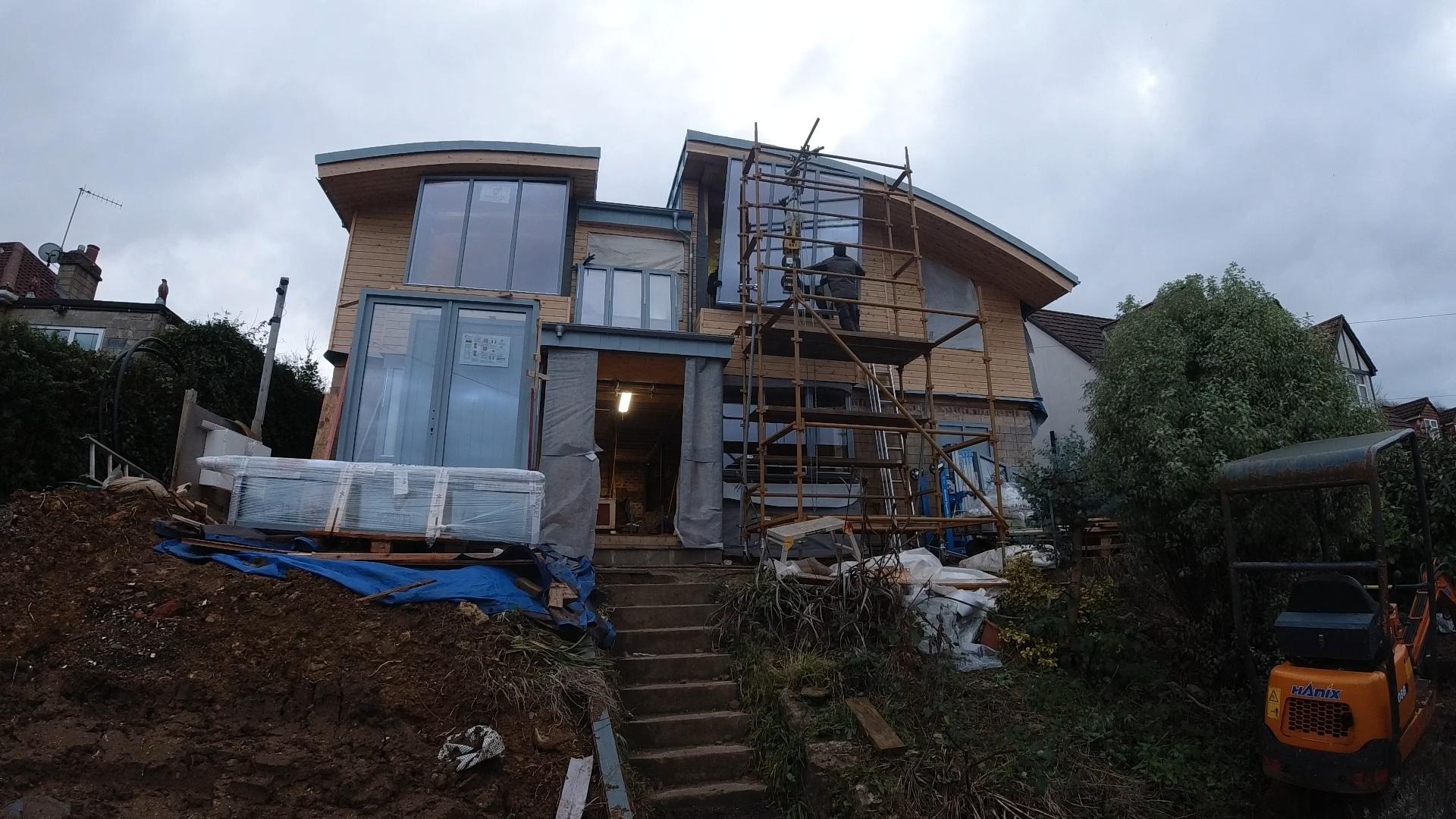
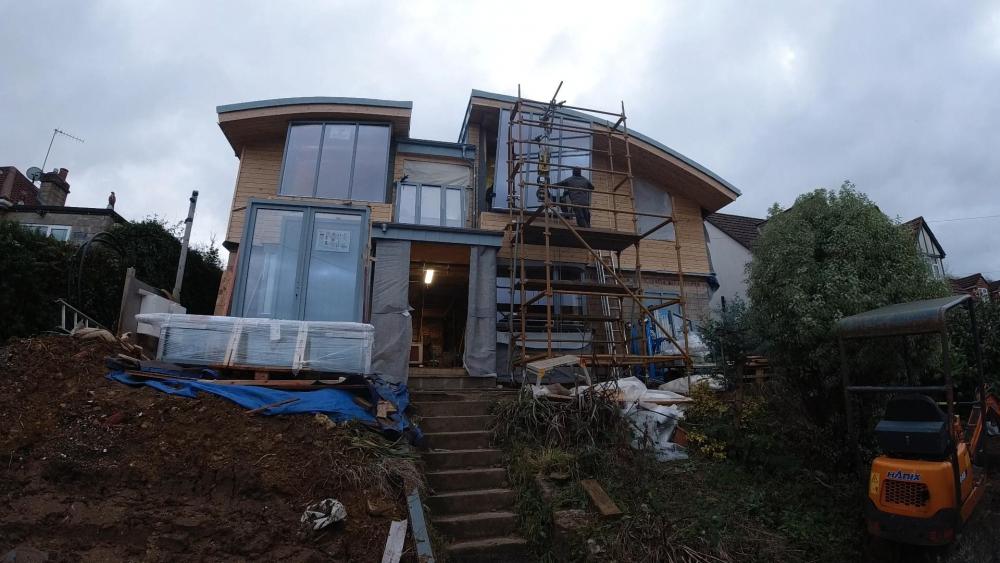
Having recently done my own windows, and mainly on my own, I'd would say it depends entirely on access and space around your house. With my installation it was such that I couldn't use any of the commonly available lifting equipment e.g. telehandler, spider crane, tracked lift, glazing robot, or a genie type lift (I hired one of these thinking it could work). I had to make my own lifts using Kwikstage scaffolding and an Elephant chain hoist using a hired in 4 pad suction lifter. I used Hird for my equipment hire who were very easy to deal with and much cheaper than GGR who I found wanted to over-sell equipment (and operator) and were a bureaucratic nightmare for a self-builder!
-
Even better I hope is a picture I found using the same solution to a roof almost identical in design to yours. In this one, they've decided to simply cantilever the ladder to be held by the roof deck.
-
Two ideas, just to throw them out. 1st is to modify your noggings for the overhang by ripping a firring strip at the same angle as the rafters and then you frame what are called gable ladders which provide you with the overhang - the gable ladder rests on the firring and is fixed to the rafter. With only 200mm overhang you might actually get away with it simply screwed or bolted to your final rafter and cantilevered without support if you're using 18mm plywood or osb roof deck. 2nd is to make the asymmetry a feature by create some boxing at the corner so the low soffit extends out beyond the wall to the same extent as the high soffit and then you have a box that brings the soffit round the corner and then up vertically to meet the higher soffit. Hope that makes sense.
-
Circular saw with connected extractor or jigsaw with long blade. I've used both the standard cross-cut and ripping blades on the circular saw with no problems but I'm using a Festool HK85 which is a bit of a beast - no real clogging problems even without extractor. On the jigsaw I used Bosch T1044DP blades the fibres do fill the teeth but you've just got to intermittently draw back the blade. If using an extractor stock up on dust bags, they fill up like there's no tomorrow! Can't believe how many bags I've filled up but the remains are great for lighting fires ? I've been cutting 140mm and 60mm thick boards.
-
Steico Flex wood fibre in short supply - what's the alternative
SimonD replied to Adsibob's topic in Heat Insulation
Don't worry about it too much, it's not going to cause you any damage or harm to your room. To explain: Many people think that 'breathable' equates to vapour permeability and vapour diffusion but in the the case of woodfibre, this isn't the benefit as you do install a VCL to the inside of the woodfibre buildup. But this vcl needs to be one that is compatible with the properties of woodfibre. Why? This is because the value of woodfibre is its capillary and hygroscopic capability that can absorb and take moisture through the envelope and out of the building, but it can also work in the opposite way to prevent overly dry air in the building during winter for example. This is why these buildups use osb or even clt as the vcl. If you add an impermeable or non hygroscopic/capillary material to the buildup this process is short circuited. So where and when do you get best bang for buck with wood fibre? In well insulated and airtight buildings with low air change rate, preferrably 0.5 ach and below. Also, in terms of decrement delay, the significant benefit comes not from the flexible wood fibre but the denser boards installed to the external side of the frame. In your example case, there is a minor reduction of risk in that if your vcl and pir layer is breached or incomplete in any way, any excess moisture coming through due to vapour diffusion in this case, will be buffered by the flexi wood fibre whereas a mineral wool could not do this. However, given your situation and buildup, it is more cost effective and practical simply to use a mineral wool. HTH