Alan Ambrose
-
Posts
3129 -
Joined
-
Last visited
-
Days Won
13
Everything posted by Alan Ambrose
-
Wow design without blowing budget
Alan Ambrose replied to Stonehouse's topic in New House & Self Build Design
I think you can do great things with a staircase regarding width, slope etc without spending a fortune. A couple of the 'statement staircases' I've seen cost a fortune and then look naff. -
This is not what you want to hear, so feel free to ignore >>> no roof overhang around the building Looks cool, but buildings have had overhangs for centuries for a reason - to keep the weather off the walls, so they're not regularly saturated. Similarly with the bottom of the wall, where upsplashes often rot the cladding eventually. >>> Is the EPDM roof covering that I'm using breathable. No, not at all. >>> 3. Do I need to lap the EPDM over the cladding and then drill vent holes in the cladding near the top (not preferred) I would definitely lap the EPDM over, preferably with some kind of overhang and/or kick to keep the water off the cladding. It also looks dead cool without gutters, but...
-
I've had a similar problem in the past - the LPA's pre-occupation with ridge height meant that our design was less than elegant. I think they shoot themselves in the foot sometimes. I had a similar problem with a cart lodge position one time - LPA's 'suggestion' was to move to other side of plot. I said I would investigate, produced a few sketch designs and was able to reasonably conclude that it would make access unrealistic. Officer accepted my logic. Maybe show willing, with a sketch for a lower roof line and reasons why it doesn't look good / has 'lower utility'? Push back a little to determine how important it is to the officer.
-
>>> They are located using a length of 20mm stainless round bar sticking up into a hole in the bottom of the post. Yeah, agree - I think I used 10mm last time. A4 rather than A2 SS would be good. This kind of relies on the structure being heavy-ish and stiff-ish in itself i.e. it is expecting to resist shear (crosswise, parallel to the ground) forces only. It looks to me like @machtucker 's structure is light-ish and not very stiff-ish, so maybe buried posts would be good after all. Being oak, they should last probably our lifetimes (making some BH assumptions here ) anyway. Whereas, I found recently that a treated softwood post with no other protection and in waterlogged soil gave up after 5 years.
-
Best underfloor water heating system brand
Alan Ambrose replied to KayleyH's topic in Underfloor Heating
I wonder whether the plumbing differences are marginal? The controller might be more important. I have Uponor plumbing and Heatmiser wired controller. Works fine. Also, half-a-dozen zones (some peeps have only one). This gives me full app control, but that does mean I'm dependant on the app supplier (Heatmiser in this case) (a) staying in business, and (b) keeping their server going. Having said that, it wouldn't be a big deal to swap the stats & controller, I swapped out from a Uponor non-app-based stats/controller to the Heatmiser one myself in a couple of hours. I forget the exact cost but it was around £400. Personally, I would stay away from the wireless stats/controllers - you'll see that some people on BH have had reliability problems with them. Wired also means you don't have to swap any batteries. -
That's clear then
-
FFTP/Openreach/new building regs
Alan Ambrose replied to Selfbuildnewbie's topic in Networks, AV, Security & Automation
@MikeSharp01 >>> We have all our services; Gas - not connected, Electricity, Water and the FTTP, to a services block at the front of the property Ah, I was thinking of using 3 glass fibre kiosks, but a single building/shed thing makes sense. Was there any problem having water & power etc into the same structure? Ta, Alan -
The traditional way to to do this and keep the post and dampness separate would be by using a padstone of course.
-
There's a kind of shrinkwrap thing you put on the bottom of softwood posts - meant to be good. As long as it's not waterlogged, being oak, it'll probably last forever anyway.
-
Foundation near tree line - raft? Systems available?
Alan Ambrose replied to Pabbles's topic in Foundations
@Big Jimbo- thanks for your very useful info, BH is great! >>> Have you dug any holes elsewhere? If so , describe in non technical terms. Only by hand to see the invert level of a culvert pipe to use for potential drainage. It was last year, I don't remember much about it except that it was xxxx hot and the ground was hard . We do have some services to run and a drive to dig though so I'll get some samples at a good depth while the digger man is on site. -
If I was fussed, I could see using cement board or stainless (or even standard) steel sheet, the former (plastered and?) painted the latter powder coated. FWIW I fired up the damn thing to max for a few hours after it was installed and measured the temperatures on all the nearest points - there's 'meets the regs' and there's 'should be safe' - not necessarily the same thing. That also, kept the BCO happy - don't think he had even seen an installer do that before. FYI we used a nest smoke/CO detector rather than one of the crappy battery operated things.
-
Combining 3 phase and 1 phase systems?
Alan Ambrose replied to Lemna gibba's topic in Photovoltaics (PV)
>>> Is it possible to have two systems in the same household with one on 3ph and the other a single phase? Assuming you don't have any actual 3-phase appliances (it is possible to get 3P heat pumps / inverters / EV chargers for instance) then 3P is usually actually just used as 3 separate phases for 220V circuits around the house. That could be 3P into a consumer unit which uses particular phases on each 220V circuits, usually with them vaguely balanced for current draw. That's what I have in my place, and I don't have any actual 3P devices to supply. In the common parts for this building the 'landlord's supply' has a 3P CU with a mixture of 3P devices (garage door opener, lift etc) and single phase circuits (lights etc). Alternatively, you can probably use your current single phase consumer unit and have say a 3P box for the 3P devices, or several single phase CUs on different phases - I don't have any experience of those last two set=ups though. A lot of domestic electricians don't have any experience of 3P though so expect some teeth sucking. -
Foundation near tree line - raft? Systems available?
Alan Ambrose replied to Pabbles's topic in Foundations
V. interesting thread....as I want to build within 9m of some fully grown Ash trees. I hope this moves the discussion along on the original poster's question rather than hijack the thread... Reading the NHBC guidance I see the calcs - which are completely new to me. On first blush, I'm getting about 1.4m foundation depth assuming I'm on a 'moderate' volume change clay. I'm looking at these charts: https://nhbc-standards.co.uk/4-foundations/4-2-building-near-trees/4-2-12-foundation-depth-charts/ Which begs the question - can I get a quick and dirty plasticity index reading by sending some soil in to, say, here: https://k4soils.com/ based in Watford. This is more for peace of mind than anything as I'll get a proper ground investigation done when we have a SE on board. If so, what depth should the sample(s) come from? -
Foundation near tree line - raft? Systems available?
Alan Ambrose replied to Pabbles's topic in Foundations
V. interesting thread... -
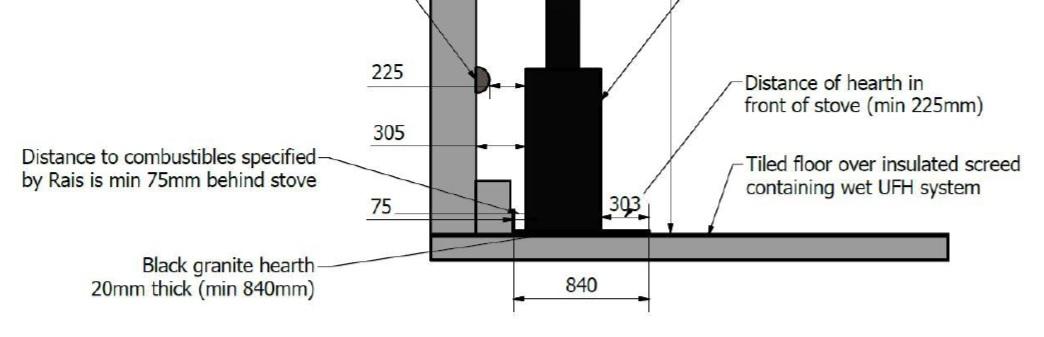
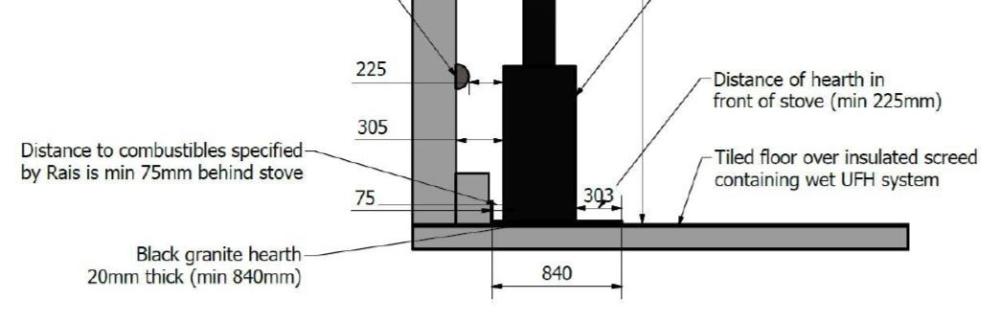
These are the sort of distances you're looking at, both for the 'rules' and for practical safety, but as others have said ... you need to check both the BC rules and those for the stove you're thinking of selecting. This drawing clip is for a Rais Viva 100L: p.s. plasterboard, in these calcs is not a 'combustible', wood for instance is.
-
Electrical or water UFH? If electrical, suggest there should be a layer of (probably thin-ish) insulation under the cable, and the probe can ride on that along with the heating cable. Even better - put in two probes, one as a spare.
-
If there an inline SAP calculator somewhere so that you can put in your current build set-up and verify the SAP numbers and then look at alternatives to see how they vary the score?
-
Is this something to be concerned about?
Alan Ambrose replied to Romfordian's topic in General Structural Issues
@Brickie - thanks for the extra explanation. So, it's all in the detail , but not a big problem and can be just scraped out and filled? -
Is this something to be concerned about?
Alan Ambrose replied to Romfordian's topic in General Structural Issues
Hi @Brickie, Sorry to be dumb, but would you mind explaining that in more detail. TIA, Alan -
Oxy-acetylene and/or angle grinder obvs. I know this is not what you asked, but there are ovens that have working pyro cleaning - a better long-term solution? Return the other for a refund as 'not-fit-for-purpose'.
-
Granted planning, but design is awful.
Alan Ambrose replied to flanagaj's topic in New House & Self Build Design
BTW the LPA don't care about the interior layout - assuming it's fairly 'home-like'. You can probably change that without a full application. -
Granted planning, but design is awful.
Alan Ambrose replied to flanagaj's topic in New House & Self Build Design
My feeling is that the architect will have done whatever he or she thinks will get through planning with the highest probability to secure the landowner their £ prize. That establishes the principle and a min GIA etc. If you don't like that, you can reapply with something you do like. A quick pre-app or informal chat withe the LPA if you can arrange it with an idea of what you would to get a reading. Even better if you can do that before purchase. Once you have drawings for planning, it might take anywhere between 8 weeks and a year for the LPA to process your application. -
>>> You could put it into an IP65 plastic box Yeah agree, plastic or fibreglass. Would be liberal with my use of glands, silicone grease, mastic etc. Under some overhang protection or a little roof to keep most of the rain off, if possible, have a slope on it, probably some drain holes etc. >>> our walls’ steel rods were acting as a faraday cage I wondered if something like that was the problem. >>> but isn’ta direct burial cable exactly designed for that? There are two sorts of outdoors cat5 - one is just standard cat5 with better UV protection, the second is the armoured stuff which usually also has a interference-resisting braid or foil screen. I still prefer to clip round the bottom of a fence etc or run in corrugated conduit rather than directly underground. I prefer to 'do it once, do it right' but there are no rules re cat5, so you can choose your own level of risk. If underground and in a conduit you can swap out the cable later if you need.
-
Are there any ‘assumed’ values in the current calc - they will generally assume ‘conservatively’ i.e. not to your gain. On a similar note I would double check all their input data. Stuff as simple as GIA can be substantially out. SAP calcs are fairly cheap and therefore often it’s a fairly careless procedure.
-
They do get logged on a .gov site - you can look-up the current sap for any building that has one.