Alan Ambrose
-
Posts
3130 -
Joined
-
Last visited
-
Days Won
13
Everything posted by Alan Ambrose
-
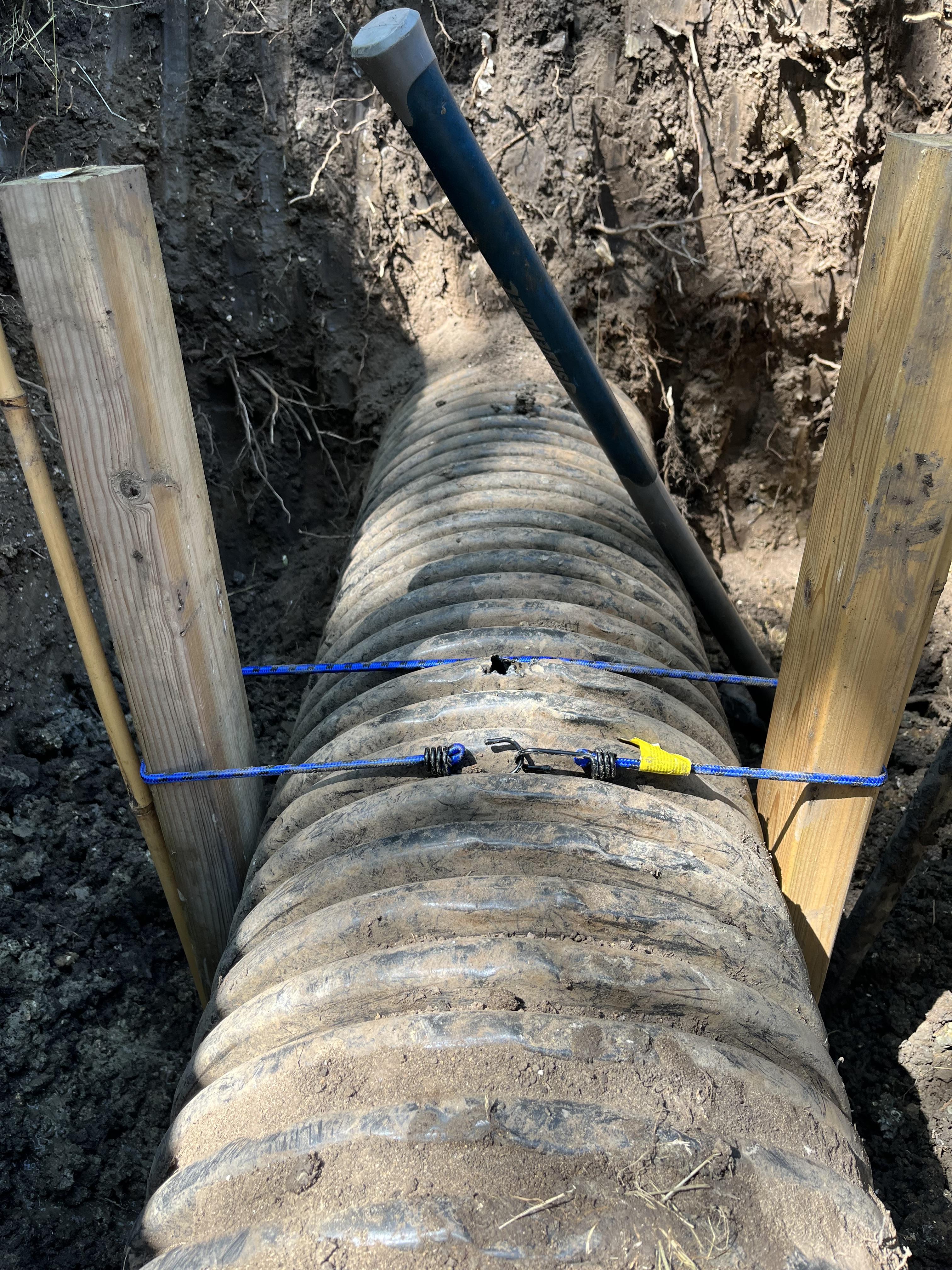
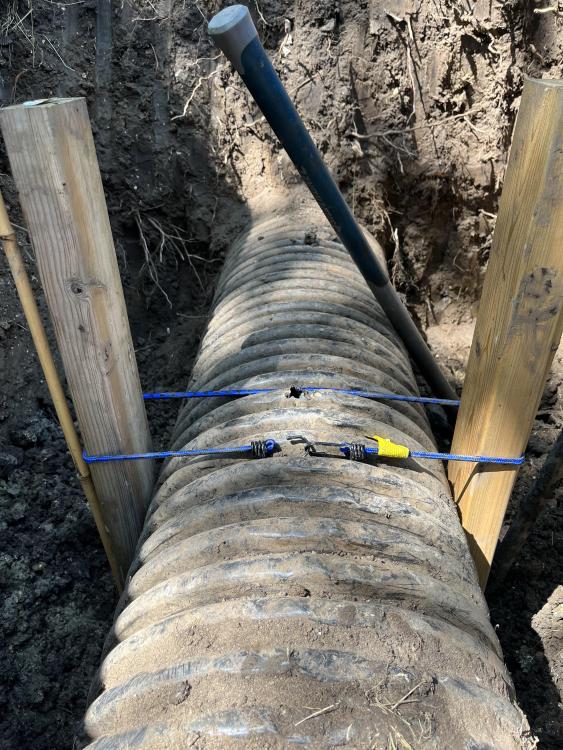
Ah, I've figured it out . I did this kind of thing (straight bits of wood held on with bungees, measure above and below the pipe and average the numbers). Then same from side-to-side. So, 373mm od side-to-side and 336mm od vertically - so, tada, the pipe is a bit squashed and averaged again the overall diameter is ~354mm i.e. standard size OD for 300mm twinwall. It was the obviously bigger diameter seen from above that was putting me off. Now all I have to do is fit the damn thing. BTW there are at least two suppliers of flexible rubber couplings & adaptors ... flexseal and VIPseal. You can pretty much attach any diameter to any somewhat-in-the-same-ballpark diameter. e.g.: https://www.vipseal.co.uk/product/vsc-standard-couplings-2 https://www.fernco.co.uk/assets/Data-Sheets-Folder/Flexseal-Standard-Couplings.pdf
-
Horizontal hairline cracks in 45x190 joists.
Alan Ambrose replied to Jawbkk's topic in General Construction Issues
>>> Is that almost as good as point loading Strictly speaking you would have to wear ballet flats, be in an en pointe position with one foot and the other raised from the floor - maybe in an arabesque position. First impression is that you are worrying about nothing (sorry to be blunt). Unless there’s a fairly obvious structural crack along the entire length of a beam or a big notch out, you’ll be fine. By all means examine and test by bouncing, observing, estimating deflection etc. Wood is a natural substance and subject to splits, shakes, cracks, warping, twists, knots etc. That’s expected and allowed for. There will be safety factors of at least 2 or 3 or more - and it will all be designed to standard dead and live loads. From memory, live load allowance is 1.5kN/m^2 i.e. ~150kg/m^2. If you really want to go into it, there will be a spec somewhere (maybe a british standard) for what is an acceptable level of cracks, twisting, notches etc in rafters. But in general - that’s just what wood does. And a good builder will have ensured that no sub-standard materials are used in structural positions. -
A good article on crack width & waterproof concrete...
Alan Ambrose replied to Alan Ambrose's topic in Basements
>>> a gold star The buildhub olympics, yeah... -
A good article on crack width & waterproof concrete...
Alan Ambrose replied to Alan Ambrose's topic in Basements
@saveasteading Thanks, that is interesting. The info I've been given is that it's largely down to the quantity of steel. Nobody said anything about the density of the mesh - although small mesh sounds logical. The bentonite filled sheeting sounds like Sika BentoShield or similar? Did that all work well? -
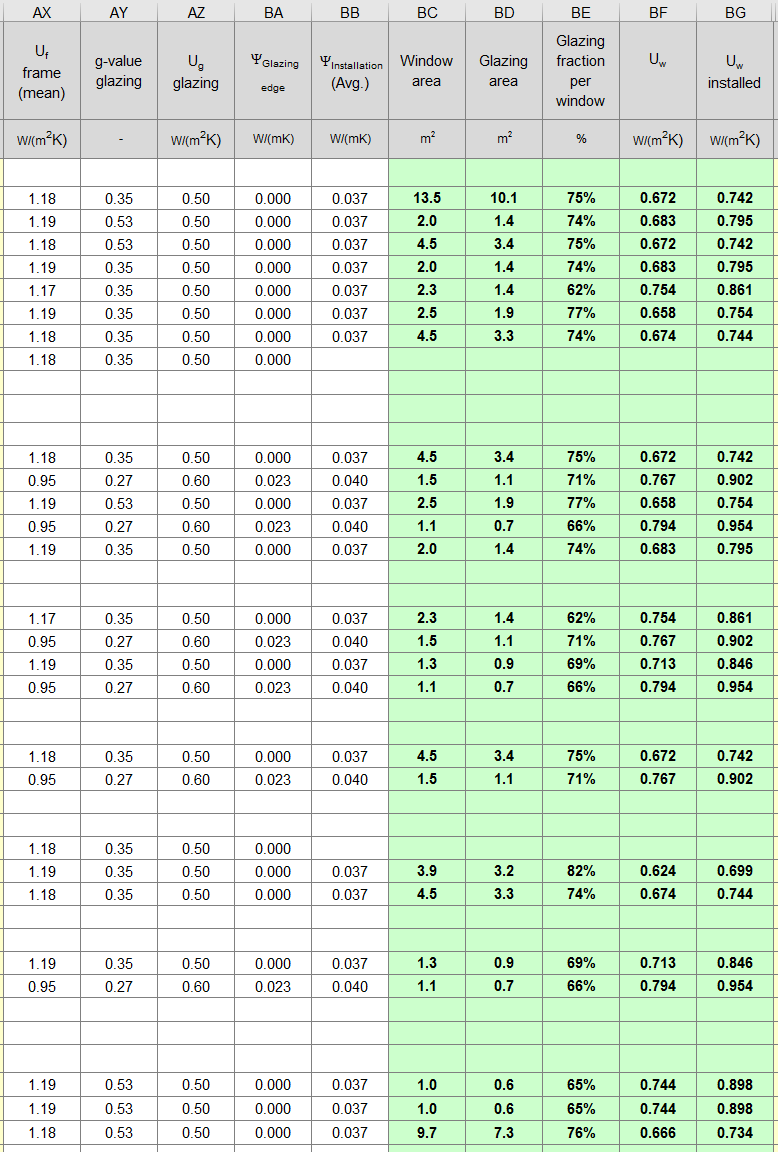
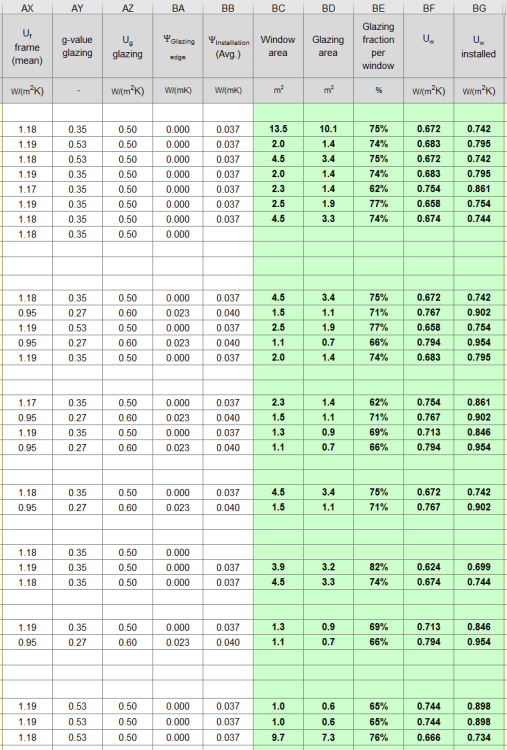
>>> Do I get a sweety? Certainly for effort . Well yes, given the data you were given, you're right. PHPP, for my windows, says Z is between 62% and 82% with an average of 71%. Not sure where the discrepancy is - I guess I was giving averages over a bunch of windows, so that's it.
-
Larger "Spark Gap" means fewer heat pumps
Alan Ambrose replied to LnP's topic in Environmental Building Politics
Seems reasonable (to me at least) that the long term direction of oil & gas is up, and the long term direction of renewables (i.e. electricity) is down. So, sooner or later the gap will narrow. -
I've seen it specified before for areas that would get some occasional traffic. Its probably good for the purpose if it's laid well. You can get a feeling for the load bearing capacity between types simply by looking at the weight of the grid per m^2. I wonder though whether continuous usage by a car (and therefore sun & rain shading) and 'poisonous' drips of oil etc. onto the grass would make it not great for heavy use.
-
https://www.si-eng.org/post/a-journey-of-designing-self-healing-concrete#:~:text=The allowable crack width for,are harder to self heal. Suggests, for the typical self-build single storey basement (say, roughly 4m deep & 0.25m walls - i.e. 'pressure gradient~=16'), the optimistic value is 0.2mm based on the old BS8007 and the new C766 and the pessimistic value is 0.15mm from EC2-3.
-
OK here's a few numbers - from my window schedule in PHPP nominally using Rationel Auraplus & Velux. S/W/E windows using Rationel Sun SKN176; N wndows using Rationel Auraplus 4/20/4/20/4; Veluxes using Velux Heat Protection Glazing 69: Average Uframe=1.132, Uglazing=0.522, Uwindow=0.712, Uinstalled=0.822 If I change all the glass for better stuff with 90% of the U-value (e.g. 0.5 glass becomes 0.45 glass etc), the numbers become: Average Uframe=1.132, Uglazing=0.470, Uwindow=0.675, Uinstalled=0.785 So, sounds like the Uwindow/Uglazing factor (the discrete derivative? ) might be around (0.712-0.675)/(0.5-0.45) i.e. 74%. Hope that helps . I guess you can also sometimes get this from the window frame supplier's various double/triple glazed offerings - if you believe their numbers... You can play these type of games fairly easily by mangling PHPP if you choose to.
-
OK maybe check out the Schiedel ICID Plus flue brochure - there should be something there that works. Also possible to get the twinwall in black I think.
-
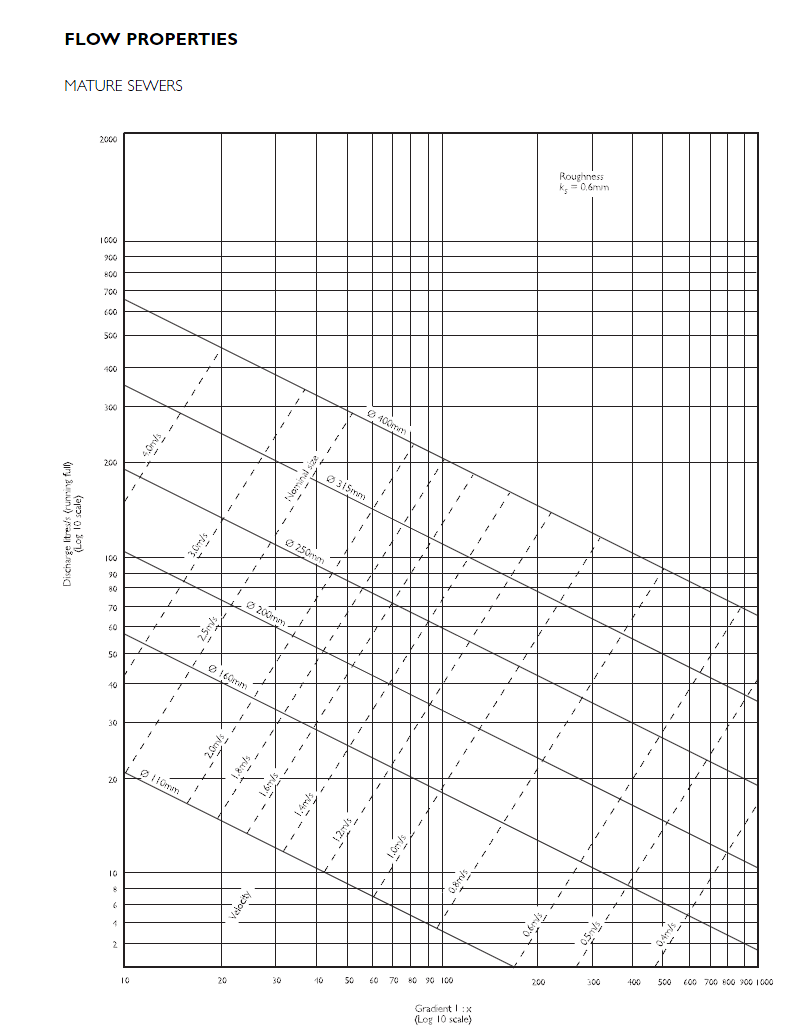
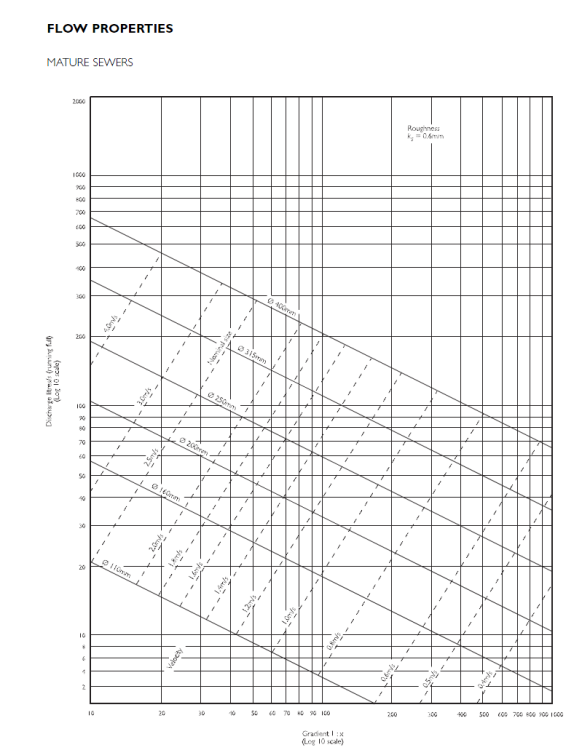
Not really It's an existing ditch that runs behind 3 properties in the countryside which we want to link up to. This was turned into a piped culvert about 10 years ago. I think this kind of 300mm twinwall pipe is the first thing that farmers/countryfolk think of when they consider culverts & ditches & rainwater. BTW in my twinwall travels I discovered this chart (below). The pipe is reputed to have an 1:80 gradient suggesting 1.8m/s & 150l/s. So, yeah, theoretically enough for 75 SuDS compliant houses if it was laid correctly and if the other houses used attenuation (they don't and one neighbour says it wasn't).
-
Thanks, but that's the Naylor stuff - I think this must be older or more obscure. There are some wacky rubber seal fittings to clamping sum close sizes together tho.
-
Anyone? I'm thinking, even though it was apparently installed less than 10 years ago, that the ~275mm id / 380mm od must be some old imperial size or old design. As far as I can see, the 300mm twinwall versions by Naylor, Polypipe, JFC, Wavin and Cherry (and probably Brett Martin) are all fairly compatible ... and not the same size as the pipe that is installed.
-
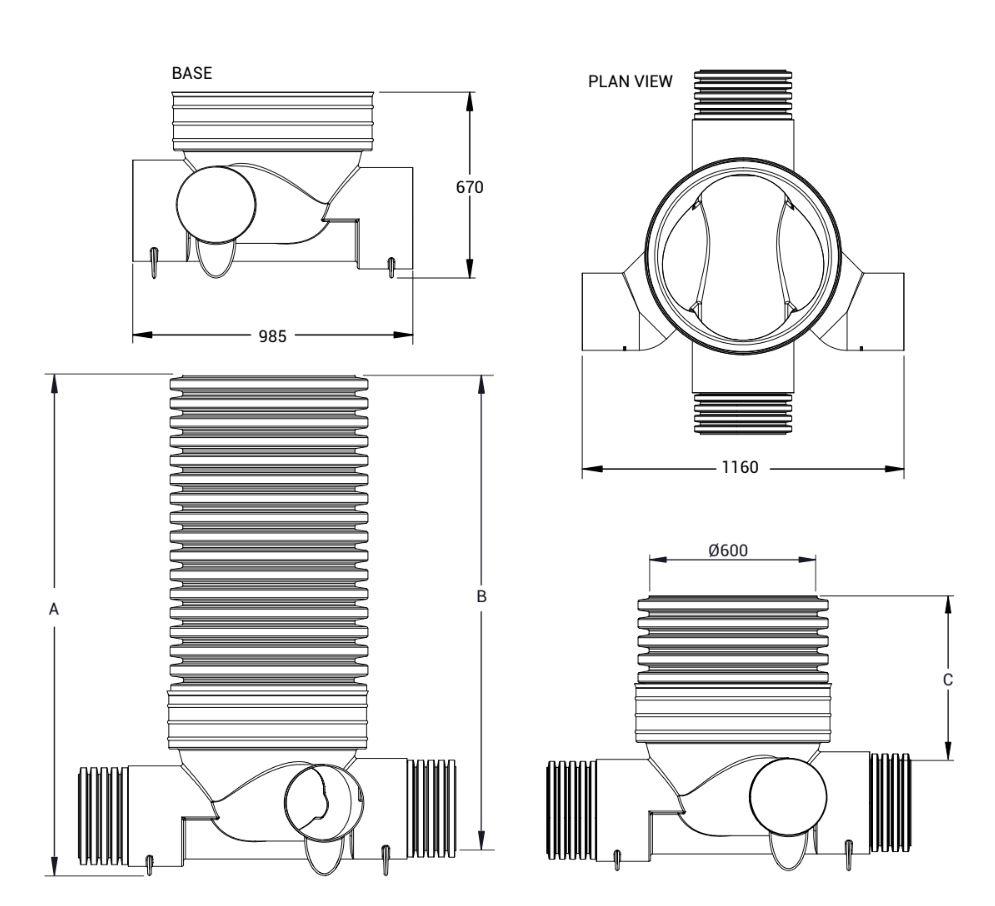
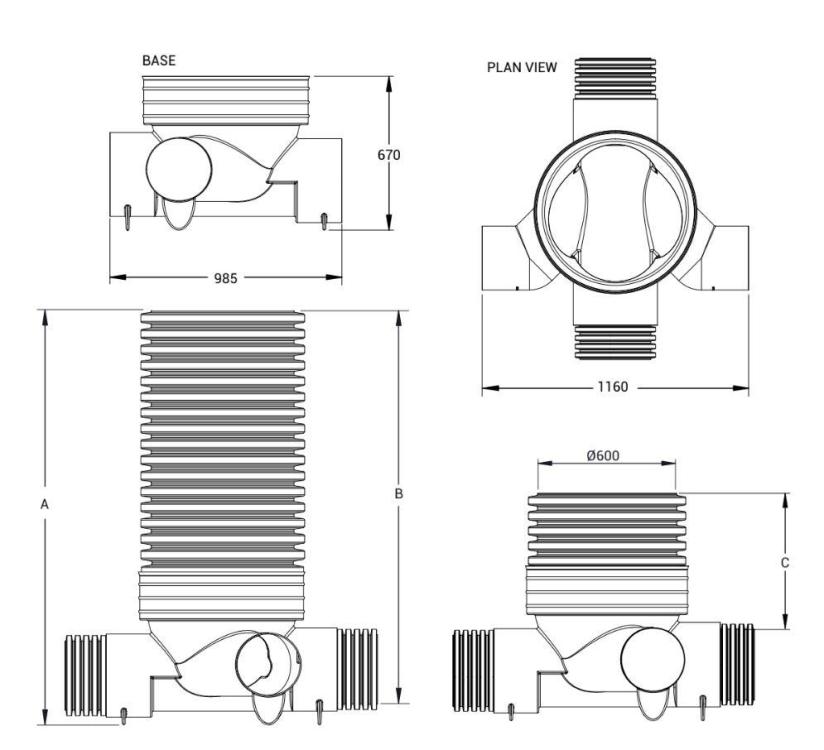
... I'm trying to join (as measured) 303 mm id / 352 mm od to ... 275mm id / 380mm od. The first one, is an Accesso inspection chamber, the 2nd unknown as yet. Just one of life's little challenges, grrr.
-
How to install external POE Camera?
Alan Ambrose replied to Andeh's topic in Networks, AV, Security & Automation
Maybe put in a small IP box, carefully spray paint that and the camera to match your eaves or whatever. -
In the UK I might take the twinwall all the way to the stove to make life easy. You’ll almost certainly need a telescopic section anyway and this is most useful just above the stove. V important to ensure the stove/twinwall join is airtight, of course. Does that work for you?
-
>>> can't select a sd=7.5m VCL BTW you can creste your own materials in ubakus.
-
Opinions please on this quote for substructure & drains.
Alan Ambrose replied to Tony L's topic in Foundations
Hi, @Tony L - is it possible to report back how this went, with any knowledge / tips that you gained? We may well have a similar situation. -
Building Dispute with contractor
Alan Ambrose replied to James Frome's topic in Costing & Estimating
>>> depends how mickey mouse the whole setup is from the start. Client - well meaning but properly naive and just hoping the gov will pick up any overrun. Gov funder - has a bunch of lawyers, contracts and procedures, is properly slow, and also fairly naive about the ability of the people they give the money to to actually execute the job well. Contractor: work a bit slapdash, spun the client a tale about not being able to know whether they were on budget/timescale until a few weeks before the original completion date. Contractor's QS now going for the jugular to the tune of £0.5-0.75m. It is government money after all and the bosses really want some new Range Rovers. -
Hmmm a bit of game that DNOs play, some more hardball than others. Yes, of course they'll remove their equipment / no, they cannot say how long before they get to it / yes, they'll be happy to give you a quote to move it in a shorter timescale. It is their business, and yes they're pretty good at this game. How long are the cables / what kind / how many poles? Before I bought it, my plot had some cables moved from overflying to underground and one new pole put in. Original overhead route was ~43m, new underground route was ~31m, one extra pole, cost £16.2K. This was UKPN.
-
Just leaving the epdm longer so water flows directly into the gutter would have been a good start.
-
Octopus Energy tariffs
Alan Ambrose replied to Adsibob's topic in General Self Build & DIY Discussion
>>> Apart from the reliability, and nuclear is very reliable, I cannot see a case for it in the energy mix anymore. I just read No Miracles Needed by Mark Jacobson, the Stanford guy, and he comes to the same conclusion. From memory: more expensive than renewables, to slow to build to make a difference to climate change and, of course, security and contamination risks. A weirdly written book though - it may have been pitched at the lowest common denominator of US Congressmen. In fact, on page 57, he says 'I agree with @SteamyTea on this'... -
How do these traps get emptied and how often typically? BYW re shape, you can almost certainly arrange these in any shape providing you stick to the right invert level for the inlet pipe.
-
>>> Any recommendations on which to get? Leica Disto maybe.
-
Yeah I have two bathrooms with electric heated floor and epoxy over. I quite like them. Would have been even better if I had worn my glasses so I could have seen the tiny bubbles on one side...