


Alan Ambrose
-
Posts
3392 -
Joined
-
Last visited
-
Days Won
15
Everything posted by Alan Ambrose
-
fitting seals on 300mm twin drainge pipes to bends
Alan Ambrose replied to scottishjohn's topic in Waste & Sewerage
Would this kind of thing help do you think? https://www.toolstation.com/arctic-hayes-silicone-grease/p45065 -
fitting seals on 300mm twin drainge pipes to bends
Alan Ambrose replied to scottishjohn's topic in Waste & Sewerage
I wonder whether the seals you have are correct for the pipe you’re using. Maybe the existing pipe is an old imperial size or something? For general groundwater drainage I don’t see much wrong with using, say, epdm rope or even no seals at all. In a recent thread, I found the existing 300mm twinwall had been squashed so was wider than it was high. I have not completed that job yet but anticipate using ratchet straps / levering with a fork on either side to make it rounder. That’s not your problem? I did spend a couple of hours measuring everything v carefully before I figured out what was going on. Another possibility are the rubber joiners - there are asymmetrical ones of those i.e. 300mm to 300+x. See: -
Pro forma invoice are not ‘real’ invoices in accounting terms - they’re a bit like quotes i.e. an offer to supply for that price - they don’t prove you accepted the ‘quote’ or paid or took delivery. While HMRC might not notice, they’re quite within their rights to reject. You should be able to get real copy invoices after-the-fact from reputable suppliers.
-
Personally I would use Bedec barn paint.
-
>>> Its more interesting too. Ho ho ho. By all means have 3P if you want and if there’s little additional cost. You can always use just one phase for the house if you like. There is a bit of an anomaly though - you want the 1000hp of a Bugatti veyron while supposedly running a passivehouse which is sipping energy like a Prius? There will also be additional cost and less choice and more complexity for 3P inverters, batteries etc - if you decide you need them. I think it’s possible also that we might all end up paying a premium for peak loads - it’s that that impacts the capital expenditure on the grid after all. France has this kind of arrangement in a basic form - with higher payment for a higher main fuse (and therefore peak load). Also, that’s how your fixed line internet works - you pay for higher max bandwidth. Once you have a smart meter, then all sorts of innovative charging schemes can by created with very simple software changes at your electricity supplier.
-
I asked the other 1/2 who works for central goverment. While the management can be asked to do all sorts of planning ahead of an election, it shouldn't affect the staff except for say, major planning decisions which might get held back to avoid rocking the political boat.
-
fitting seals on 300mm twin drainge pipes to bends
Alan Ambrose replied to scottishjohn's topic in Waste & Sewerage
They also sell some special lubricant although I'd be tempted to use washing up liquid otherwise. Can you twist them in by rotating on the axis of the installed pipe? It can get pretty messy when you're down a muddy hole wrestling pipe 😄. I know it's easy to say 'ensure the pipe & seal area is clean' but any mud, grit etc will increase the friction by loads. -
Electricity pole relocation
Alan Ambrose replied to flanagaj's topic in New House & Self Build Design
Impressed that they found the doc. 1956 I think rather than 1936. Are those numbers in shillings? -
Not a good start… https://www.planningportal.co.uk/services/weekly-planning-news/planning-news-29-august-2024 I’m on week 53 with one and the inspector just figured out the LPA didn’t file a bunch of docs they referred to - a dozen or more. So much for ‘validation’. Don’t know why ‘the election’ would hold them up.
-
>>> they couldn't offer advice on the regulations I don’t think that’s an acceptable stance by your LPA. What if HMRC said it couldn’t advise re taxes, the police said they couldn’t advise over crime, the LPA planners couldn’t advise re planning etc? Fundamentally we expect them to have a good level of expertise in the area they work in.
-
Foundation aerated blocks, marmox, beads below DPC
Alan Ambrose replied to SBMS's topic in Brick & Block
p.s. here are the the values for various kinds of aerated blocks compared to PIR i.e. you need between 3 and 6x the thickness of block as insulation vs. PIR / EPS etc. Obviously this is a tradeoff vs. strength.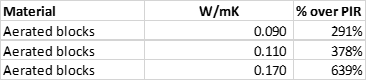
-
Foundation aerated blocks, marmox, beads below DPC
Alan Ambrose replied to SBMS's topic in Brick & Block
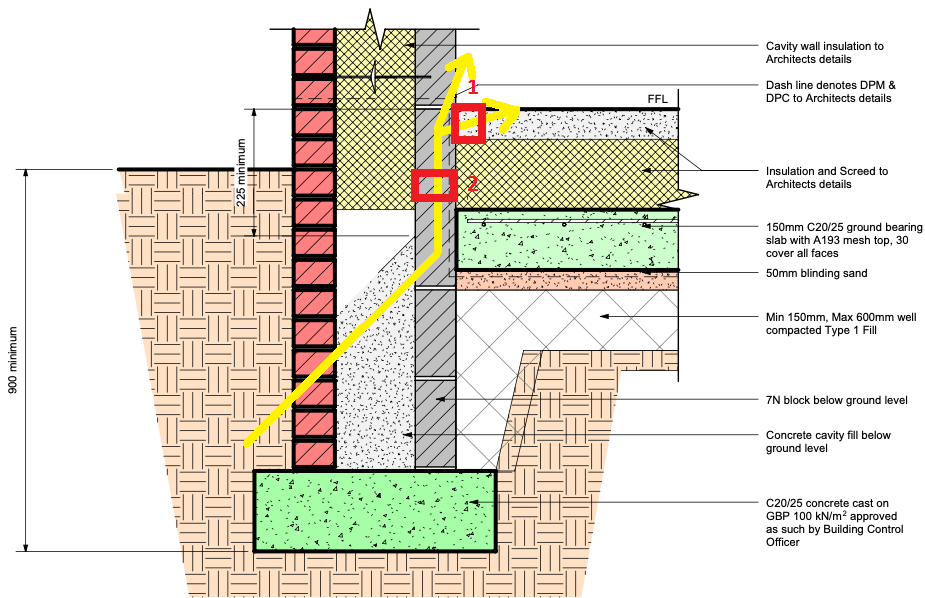
The way I look at this is that concrete, bricks, screed & standard blocks are very good heat conductors compared with any kind of insulation. See the yellow arrow below. From memory, by a factor of x50. You can model it all in therm, but that's the long and short of it. The task is to disrupt that heat flow by putting insulation across the good themal conductors. Insulation (1) at the edge of the screed helps, but you still have the path up the blocks and into the room. Insulation (2) blocks the path completely. You can estimate the U-value / psi-value by just taking the thickness of the insulation and ignoring everything else. Ideally, Marmox as thick as the insulation under the screed?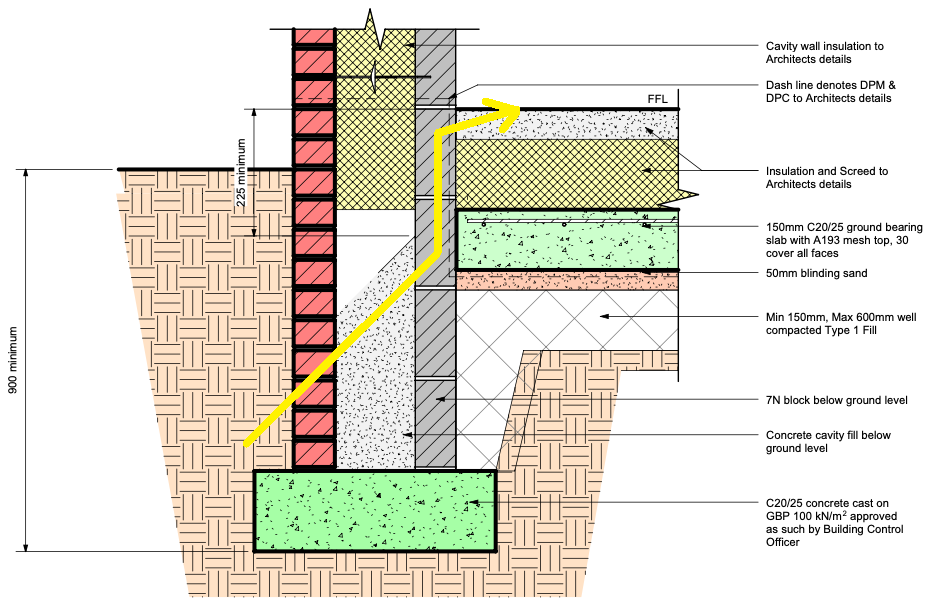
-
Electricity pole relocation
Alan Ambrose replied to flanagaj's topic in New House & Self Build Design
Yep, but a lot of the wayleave department's work at DNOs is smoke and mirrors, so I would keep pushing until you get to the actual facts. -
>>> I guess you could have two consumer units, a 40A one with and a higher power one without this UPS functionality. I don't think that's a big problem in practice. I plan to have 2 CUs anyway, one for battery backed stuff (fridge etc) one for stuff you generally wouldn't run off a battery - heating, car charging, oven etc - all the big loads.
-
Electricity pole relocation
Alan Ambrose replied to flanagaj's topic in New House & Self Build Design
>>> There is a wayleave agreement in place dated 1936. Yeah right, I bet they're not paying anyone for that. Did you get a copy from them? They may not even have a copy, in which case, it effectively doesn't exist. My general expectation is that you can generally rescind the agreement, especially if they're not paying for it. Then it becomes a bun fight over when the pole is going to be moved. You may lose that if you don't have years to spare, but it is a negotiating point. -
Protect TF200 Thermo & VC Foil Ultra
Alan Ambrose replied to G and J's topic in General Construction Issues
You can use ubakhus DIY for moisture (and thermal) analysis if you want. It's also a useful way to model the physical wall / roof / floor stack-ups. This kind of thing: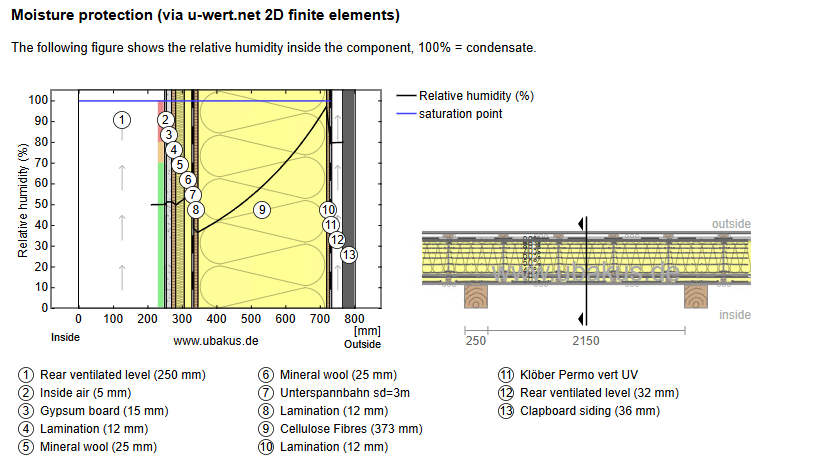
-
Outdoor area- stones/self binding other options?
Alan Ambrose replied to daunker's topic in Landscaping, Decking & Patios
Not all grids are alike - they vary in their load bearing from pedestrian to ‘truck’. You can get a good reading of the load bearing by taking the vendor’s claims with a big pinch of salt and just looking at the grid’s weight/m^2 i.e. how much plastic you’re getting per m^2. Ecogrid came out high up on my list. You could beat the £30/m^2 for materials by getting gravel in bulk - I got it in bags. Like everything, grids need a good solid base if they’re going to last. -
Grohe Toilet Cistern Abrupt Shutoff
Alan Ambrose replied to steveoelliott's topic in General Plumbing
Wow! Let us know how it goes. -
Grohe Toilet Cistern Abrupt Shutoff
Alan Ambrose replied to steveoelliott's topic in General Plumbing
>>> No expansion tank on the cold side, just on the hot for the unvented cylinder. Good point, but I think as they're linked through the HW cylinder, they should get roughly the same pressure variations. Mine hasn't mattered for a year or so , but I'm thinking I should get round to it. -
You just need a square rigger and some oakum caulking, a parrot and a tot of rum.
- 1 reply
-
- 1
-

-
If nothing else, it gives us a sense of how reliable LPA CIL advice is - i.e. not very reliable.
-
OK for anyone following along at home .... it's quite hard to make sense of the options. If you cross-reference their drawings and the price list, you're not left much wiser, particularly since not all the options shown on the drawings actually appear to be stocked. This is not helped much by human contact as MEA UK don't sell the lightwells and MEA Germany want you to reference a German area distributor to ask questions. However, here's a couple of pointers: + there's a price list which seems to have the commonly available parts: https://www.mea-group.com/content/uploads/sites/3/2024/02/PLBS-GB-2024-1.pdf + there are drawings: CAD and DWG files - MEA Group Germany (mea-group.com) + there are a few youtube videos. + there's a German configurator app: MEA Configurator (mea-group.com)
-
Outdoor area- stones/self binding other options?
Alan Ambrose replied to daunker's topic in Landscaping, Decking & Patios
That looks good, but not inexpensive - mine ended up being about £30 per m^2. Looks good though and think it'll last for a long while - mine won't have any cars on it. -
Grohe Toilet Cistern Abrupt Shutoff
Alan Ambrose replied to steveoelliott's topic in General Plumbing
Sounds like a tiny amount of water hammer. Agree with above. Problem may go away as the valve gets furred up. I have this problem too (I must fix it someday ) - caused I think by high mains pressure - it's 4 bar here. There's also an off-the-shelf version of B above - look for water hammer arrestor or similar. Just possible it's also related to the expansion tank - either the diaphragm going or set at the wrong pressure - so it's not absorbing any fluctuations. -
Anyone who has used MEA lightwells - can I ask which components you used? Standard multinorm or the meamax adjustable ones? Do you use MEA's windows and window casings too e.g. thermo window & luxit casing or third party windows?

