


Alan Ambrose
-
Posts
3392 -
Joined
-
Last visited
-
Days Won
15
Everything posted by Alan Ambrose
-
>>> So with a bit of forward planning, if you heat water and charge batteries around the high production times, your house will be less hot. Whoo that's v. clever.
-
You guys are fantastic >>> Are you talking of a totally off grid system? Probably with batteries? I was actually thinking of something like that i.e. without the 'luxury' of dumping excess power back to the grid. Seems then that the panels will just heat up more when the 'full load' is not extracted? Thanks also for the answer to the PVGIS question - I was quite liking the 20 degrees roof slope anyway as it gives max internal space with a nominal 1.5 storey / 7m ridge height - so that adds another plus.
-
(1) PVGIS seems to give me 67% power output for North (vs. South) for Suffolk. Is that really right? Azimuth kWh p.a. / kWp % vs. S Westerly 125 780 74% Easterly -55 986 93% Dead North 703 67% Dead South 1,057 100% This is for 20% roof slope. (2) What happens if you don't draw the max available power from your panels at any time? And you don't actively divert it to heat hot water or send it back to the grid? Does it end up as heat at the inverter or maybe in the panels themselves? Or something else?
-
Well there's a couple of other suppliers mentioned in the thread so far, and I, for one, would be interested to know who these great suppliers are. I need 3 replacement sashes atm.
-
For anyone based in East-Suffolk and/or thinking they might build there someday, the LPA are soliciting feedback on their 'Supplementary Planning Document?' re custom and self-build housing policies. So, this is your chance to have your input to 'the rules'. See: https://eastsuffolk.inconsult.uk/CSBSPDINT/ The consultation runs from 1st Feb to 15th Mar.
-
>>> plug-in Tuya style SSR with low-latency, zero-crossing switching It would be helpful if it switches cycle-by-cycle so you could have all the way from 0 to 100% of a 3kW immersion in, say, 2% steps. Two drives would also be useful for those of us that have 2 immersions in one tank. I think the electrics part (earthing / switching / fallback / wiring / temperature measurement etc) is more tricky than the electronics part - but then I'm an electronics/software guy. Current transformer sits in the meter box? Another on the PV inverter? Need to convert the CT signals to digital to send over wire/wifi?
-
Sourcing best quality sealed units?
Alan Ambrose replied to Alan Ambrose's topic in Windows & Glazing
>>> Air pressure making the glass flex and breaking down the seal? I think probably that one but I will take photos as you suggest the next time I have one out. There doesn't seem to be much rhyme or reason though - I can see one which was replaced over the last few years has already failed, whereas some older ones still seem to be good. The larger units seem to have tempered on at least one side. I did order some from Pilkington directly way back. Unfortunately my record-keeping isn't good enough to see which units were replaced by which supplier. -
New-build timber frame in East Suffolk
Alan Ambrose replied to Alan Ambrose's topic in Introduce Yourself
Well half-pints all round.... We completed on the plot yesterday. That only took a year and about 100 hours of my time. -
Yeah, I think the press was (guess what) a little sensational here. I suspect that given both parties have been a greatly disproportional here with costs, that the judge will order recovery at say, 60% (and the amounts probably not made public). So, say: + Mr Downing ('winner') - pays 40% of his own costs of £95K i.e. £38K. Plus he receives £32K damages to pay for fixing the knotweed. + Mr Henderson ('loser') - pays £32K damages + his own costs of £100K + balance of Mr Downing's costs £57K i.e. £189K. So it would have been far cheaper for either of them to pay for the £16K knotweed fix directly themselves or, even better, to split the cost. The great beneficiaries are, surprise, the lawyers - who do get to pocket £195K between them for arguing over a £16K problem. That is, unless the judge decides they were breaking CPR 44.4 (1), and gives them a little penalty.
-
Anyone know what these guys do with rainwater?
Alan Ambrose replied to Alan Ambrose's topic in Rainwater, Guttering & SuDS
@markc re: That’s a hidden gutter and the down pipes will be internal, common arrangement on industrial buildings. I'm interested why on industrial buildings - presumably some practical advantage? The engineer in me says 'no', but I do like the look - and the picture I posted above suggested they kindof built the building as normal 'and then put the cladding on the outside'. And as the cladding is largely just looking good and keeping most of the rainwater off the vapour barrier, then I guess it will work. I get the point re not getting the gutters blocked, but where I am now, they have never blocked anyway as we don't have any overhanging trees. I guess we're used to soil pipes boxed in on the inside and we're not paranoid about them leaking - we just take care to do the work well. -
Well the CPR says somewhere (I paraphrase) that, to encourage rational thinking, solicitors must keep their clients abreast of total cost estimates and likely cost recovery rates (from the other side). I just don't like the idea that the lawyers are left, like unsupervised kids, to run off with all the gold. I believe that the legal establishment should take more ethical responsibility than it seems to. In practice, the solicitor's decision choice is 'bill some more to fill up their own pension funds' or 'try and reach a compromise deal and close the dispute out'. I would like to see the solicitors take part of the hit if they let the billing get out of hand.
-
Plant room in loft, possible?
Alan Ambrose replied to jayc89's topic in Lofts, Dormers & Loft Conversions
It sounds good to me and I'm planning to put all our PV stuff in a similar space - and in the next place MVHR too. I don't know what geometry you have but it strikes me that this is potentially a very easy way to route MVHR ducting into some rooms. I guess it lengthens the UFH pipes a bit and means they want to be well lagged. The one thing you might need to check is adequate support for anything particularly heavy - e.g. cylinders and/or PV batteries. The gas boiler will, of course, need a vent / flue but shouldn't be generating a lot of heat when the weather is hot. Heat impacts the reliability of all modern-day electronics (e.g. the control boards), so it would be helpful to figure out a mechanism to stop them from getting crazy hot. -
What is disgraceful is that the solicitors were allowed to run up a joint bill of £195K of legal fees on a £16K dispute. I don't see how that's even possible in the County Court (as opposed to the High Court). Both sides and the judge seemed to have completely ignored Civil Procedure Rules 44.4 (1): Factors to be taken into account in deciding the amount of costs 44.4 (1) The court will have regard to all the circumstances in deciding whether costs were – (a) if it is assessing costs on the standard basis – (i) proportionately and reasonably incurred; or (ii) proportionate and reasonable in amount, or ... see: https://www.justice.gov.uk/courts/procedure-rules/civil/rules/part-44-general-rules-about-costs#rule44.4
-
Anyone know what these guys do with rainwater?
Alan Ambrose replied to Alan Ambrose's topic in Rainwater, Guttering & SuDS
>>> Care to expand on the question? I mean - "as none of these buildings have conventional gutters and drainpipes, what kind of arrangements for handling rain do they have?" And is it workable? Actually, there's an outbuilding near me that has an arrangement a bit like this. It does looks good. But, does anyone know what the engineering detail looks like?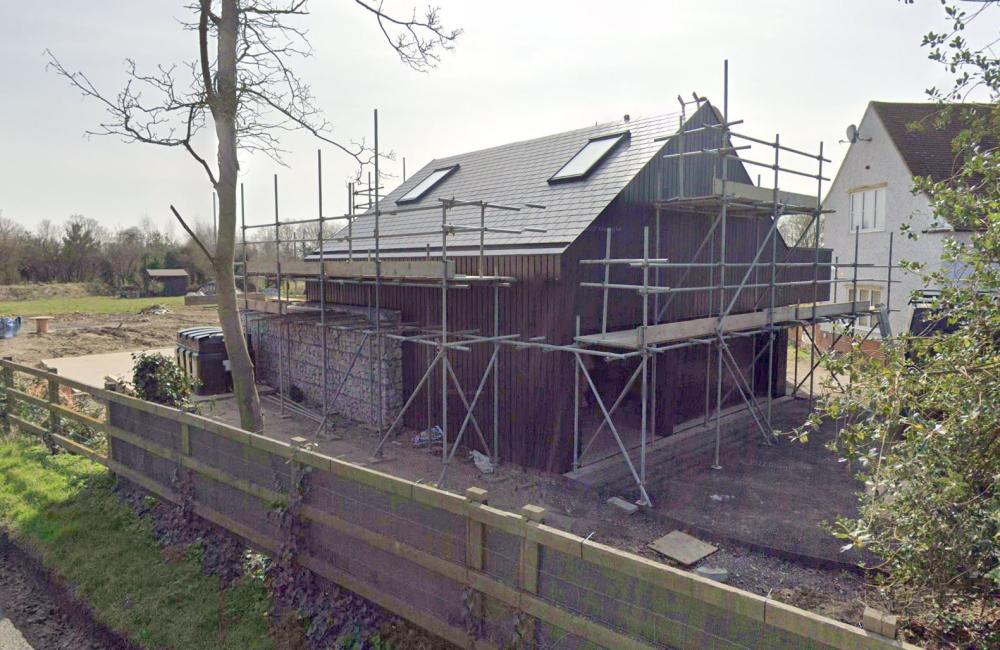
-
https://pb-architects.com/ ?
-
Best smart doorbell?
Alan Ambrose replied to ashthekid's topic in Networks, AV, Security & Automation
Somebody has to take one for the team... -
Design software again...
Alan Ambrose replied to Alan Ambrose's topic in New House & Self Build Design
Ah yeah, many thanks. -
Design software again...
Alan Ambrose replied to Alan Ambrose's topic in New House & Self Build Design
@KelvinThanks for the example. Do you think it is possible to dial down the colour saturation in Virtual Architect? -
Hi, I'm looking for software to do this kind of fairly professional graphic (below) and also the 'drop 3D design into context photo'. Anyone, done that, know how? I'm a dab-hand with Fusion 360 and other engineering-style CAD/CAM stuff but those don't do fancy renders with trees and shading and cars .


-
Best smart doorbell?
Alan Ambrose replied to ashthekid's topic in Networks, AV, Security & Automation
Yeah, me too. -
Best smart doorbell?
Alan Ambrose replied to ashthekid's topic in Networks, AV, Security & Automation
I can't imagine that the actual camera / push button part is any different - it must be the plug-in sounder which would presumably have a UK-style plug built in. Nothing that a EU-UK adapter wouldn't fix. Silly really, there are lots of well-trodden ways of designing that country-specific bit out. Actually I'm getting 'not available' for US and German customers too. Sorry, to keep editing this - available from Amazon US for £99 (US version of course) and Amazon DE (European version of course) for £113 - both prices include VAT, duty, shipping etc. -
Best smart doorbell?
Alan Ambrose replied to ashthekid's topic in Networks, AV, Security & Automation
It was meant to be Autumn '22 I believe. There were YouTube comparison videos 5 months ago - so they have at least got early models to reviewers. So, I'm thinking 'real soon now'. -
Best smart doorbell?
Alan Ambrose replied to ashthekid's topic in Networks, AV, Security & Automation
My vote is for the new Reolink - no subscription and PoE, so no problems with WiFi or power. And Reolink stuff is cheap (not that I'm cheap). -
Our council has a dedicated email address for CIL. Surprisingly as the rest of the planning department is crazy slow, you get speedy and helpful answers from the CIL people.
-
I know it's not just the size that matters...
Alan Ambrose replied to Alan Ambrose's topic in New House & Self Build Design
>>> Seems at lot of house for just 2 bedrooms? Ah 3 beds, the column headings didn't come out so well. We do have a crazy big sitting room now which we are quite used to - and actually like



