Alan Ambrose
-
Posts
3392 -
Joined
-
Last visited
-
Days Won
15
Everything posted by Alan Ambrose
-
Your thoughts on this design?
Alan Ambrose replied to Alan Ambrose's topic in New House & Self Build Design
@Iceverge thanks for the passivehouseplus links - they have some very useful detail in there. @Conor I'm researching the kitchen / open plan / stairs thing. I've seen some references to 'Type 3 open plan' / Approved Document B and some sense that it may or may not be allowed in 2 storey houses with or without sprinklers/mists. I've yet to find the definitive reference though. @ProDave yeah, let me mull over the stair location options, including your idea of putting the stairs on the other side of the hall. 'Make the wall either side of the stairwell a supporting wall' - I don't quite understand that one yet, but let me think about it. Thank you for everyone's comments. -
Your thoughts on this design?
Alan Ambrose replied to Alan Ambrose's topic in New House & Self Build Design
>>> We also have far too much glazing on the south elevation though. I was hoping to offset most of this with shades etc - which needs TM59 to check it. Did you have any calcs beforehand and did the real world not reflect the calcs? >>> What are the row of 5 small squares evenly spaced along the centreline of the downstairs? As JohnMo said, these are the centre vertical posts of the trusses. So there are 7 evenly spaced trusses in all. That's similar to our current barn which has 6 with about the same spacing. This might make you laugh - yes, the corner is leaning over crazily and yes, they did use any old bits of wood they could find.
-
Your thoughts on this design?
Alan Ambrose replied to Alan Ambrose's topic in New House & Self Build Design
Well thanks for everyone's fast replies - a bunch of things to think about. I've answered some of the questions below: >>> To get to the right hand study, you have to ascend the stairs then walk all the way round the gallery to get to it. Yeah, I had thought of this, but forgotten it again. >>> Our kitchen is open to the rest of the house, BC won't allow this, you'll need to close it off somehow. Interesting point - we expect to have sprinklers anyway as it's a big pile of wood. Is there a regulation somewhere? >>> Is that an existing entrance or new one? You look close to a road junction/laneway? An existing one and just a small bend. The road is a 'quietway' and gets v. little traffic. The plot does have existing planning, so in principle highways have already approved this entrance. >>> What going on with the roof? >>> Not sure of the mixed size of windows in roof and solar panels looks messy, try to standardize the sizes. 5 skylights on each side, otherwise PV panels. The skylights are the bigger Veluxes, otherwise standard solar panels. >>> Roof Pitch on both main roof and mid-stay porch, need to be steeper, in the 45°-50° range, and for a traditional timber structure it appears too wide. That looks good but to my mind wastes a lot of space / light / material. I should say that this roof pitch is 25 degrees and we live in a converted barn in Suffolk now, the original structure being from about the 1850's, and that is 20 degrees pitch - so I don't feel so bad about the slope. Our current barn, which is quite small for a dwelling is 6.5m wide (1.5 bedrooms, one shower room only). Next to the plot - there's another recently converted barn about 25-30m away (you can just see a corner of it on the block plan) which is single storey, 22 degrees roof pitch, about 8m x 22m. You are right though, the 10m width is pushing it a bit - 12.5m oak beams are the max that are commonly available. >>> I imagine you have a height restriction to combine the current width Yeah, effectively 1.5 storeys, say 7.5m, to be not taller than some of the neighbours. -
OK we think we're getting fairly close to submitting this. This is one of two designs we have - this one is parallel to the road as the planners prefer. The plot is in a small hamlet in Suffolk and the design is a modern take on a Suffolk barn. That's a style we like and we hope it should also go down OK with neighbours and planners. We want that the two of us can work from home comfortably and have friends & family to visit. We may go for a basement if the clay ground conditions and budget allow. This is planned on a timber frame - oak if we can afford it - hence the regularity of the plan. We've probably got too much glazing right now according to Part O, but expect to do a TM59 analysis later to optimise the glass. All thoughts welcome. TIA, Alan


-
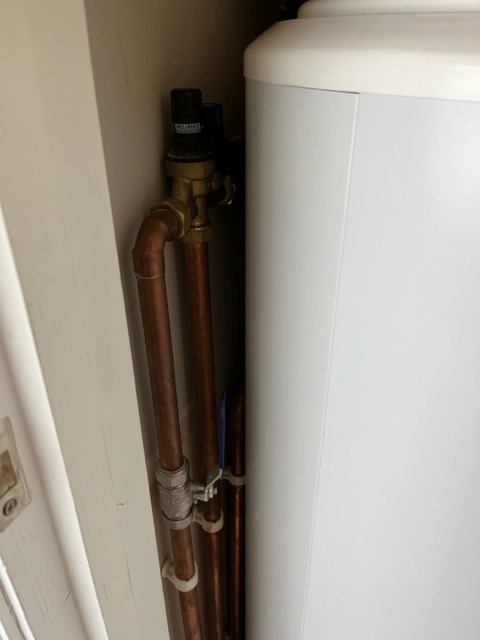
OK I finally found time to pursue this. I measured the pressures and did a bit more examination: The incoming pressure is 6.1 bar and, after the cold water shut-off ball valve, goes straight into a Reliance CWIC355090 Monobloc ( https://www.reliancevalves.com/sites/rv/files/2022-06/Reliance Valves 22mm Compact One Piece Inlet Control Group Data Sheet.pdf ) 3.5 bar PRV with 6 bar relief. This also has a 'balanced cold water take off'. The expansion tank air pressure was about 2.5 bar (with the hot water pressure released) and I topped that up to 3.5 bar. I see the hot water pressure itself is 3 bar normally. About 0.2L of hot water comes out when I shut off the incoming water pressure and open a hot tap. I sort of convinced myself the hammer was less when I topped up the expansion tank a bit. I see that some of the pipes could be better supported and I ordered this kit ( https://www.amazon.co.uk/dp/B0956LDKSQ ) which should arrive today. Then I had a bit of a brainwave - the hammer is largely coming from the cold tap but the expansion tank is on the hot circuit. Duh. So, its likely the HW set-up is fine. I should say that it's hard to see the exact pipe routing and connections as the pipes are mostly behind the HW tank. So, I may need a low volume expansion tank / arrestor on the cold side? The only problem is that it may be very difficult to fit with the pipes where they are.
-
Which drill bit type for steel beam?
Alan Ambrose replied to BotusBuild's topic in Tools & Equipment
Look at annular cutters - the go to brand is Rotabroach. I would rent a mag drill if you’ve got more than a couple to do. You need a slow speed, cutting fluid, to clear the chips out regularly (e.g. with compressed air) and to control the drill pressure. The forces are high so be careful as others have said. -
I think UKPN have a spec somewhere, concrete base etc - ask them. But this kind of thing: https://www.ebay.co.uk/itm/193232069236 not necessarily that size though. One option is to keep the meter in there for ever.
-
Thanks, some interesting insight. Clever to make the North facade the most glazed. I was surprised that you had to increase the size of the windows, my feeling (I have not done the ventilation calcs yet) was that I would be struggling to keep the glazing I want. The paper I listed above showed a comparison between IES VE and EnergyPlus and the conclusions included "Significant differences were recorded between predictions, with the EnergyPlus models recording a high overheating risk in seven out of the nine cases, while IES VE predicted a low overheating risk for all models." That suggests to me some TM59 game playing by choosing the package that comes up with the most helpful results? I can't help feeling that Part O is very badly thought out. I'm reading a bunch of stuff on PHPP & TM59 right now.
-
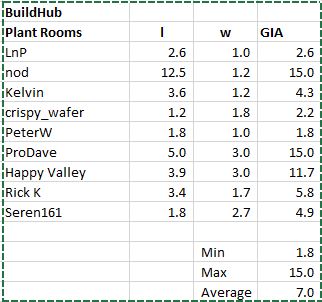
Ah, thanks I see you have an image in this thread: https://forum.buildhub.org.uk/topic/31617-ideas-wanted-to-pass-part-o-simplified-modelling-or-to-use-dynamic-modelling/#comment-467880 FYI another couple of things I couldn't get a clear steer from the 'regs' (in the Part O Guidance) are: + there doesn't seem to be any sense of angle to the sun in the Simple Method - so roof lights are a bit problematical. Which compass direction are they facing - well often mostly 'up' of course. + in a similar vein, if you have roof lights over a 1+ storey void, then do they 'belong' to the ground floor or to the one above? + re security - if you live in the countryside, is it considered 'secure' (only for the purposes of these calcs) to sleep with ground floor windows open? Doors? (As far as we're concerned we normally sleep in summer most of the year with ground floor bedroom windows open.) And general observations: + Part O is all about the problems of solar gain, nowhere does it mention or consider the benefits (economic / climate / amenity) of solar gain. + The actual TM59 software mentioned in the Guidance examples is: IES VE 2021 3.1.0 (this is 'send for quote') TAS software v9.5.2 (£200 p.m.) - it's curious that CIBSE has specified in TM59 some simulation and CFD calcs without specifying (a) exactly what those calcs are, (b) a list of software which is deemed to observe the calcs, (c) a verification method for that software. I see also that DesignBulder software claims to be TM59 compliant and uses the free US-based EnergyPlus for simulation and HVAC. There's some TM59 notes for using it here: https://designbuilder.co.uk/helpv7.0/Content/CIBSETM59.htm
-
@Susie - thanks is it possible to add an image of the elevations so we can get an idea of what that % of glazing looks like in practice? TIA, Alan
-
Well I've been researching this some more and thought I would post an update: + The headline is that this looks a significant can of worms for a lot of self-builders unless you have very mass market design sensibilities. Barratt home anyone? + This video by Pilkington says (about 1/2 way through) (roughly) 'yeah, if you want Grand Designs, then the Simple Method won't work for you'. https://www.youtube.com/watch?v=NrY7odmPm68 + I did a rough-and-ready 'Simple' analysis of our current design. If my calcs are correct, then we're way over the limits atm. + There's a lot of the 'Simple' procedure which doesn't make a lot of sense to me e.g. why would you want to limit North facing glazing? + @Susie - as you have pointed out, there's no allowance in the 'Simple' method for any mitigation like the various forms of shading etc. So the proven Mediterranean methods: outside shutters / awnings / vegetation etc etc etc are totally ignored as are modern methods e.g. Pilkington's low-transmittance SunCool glass. + That suggests TM59 modelling may often be necessary, which might be properly expensive if you get someone else to do it. + There's a comparison of a couple of modelling packages here: https://journals.sagepub.com/doi/pdf/10.1177/0143624418792340 + And I note that one of the two pieces of software mentioned there: EnergyPlus, is free https://energyplus.net/ All-in-all quite a complex headache IMO. Designed to protect city flat dwellers who largely have to live with what they've got (and cope with the window opening implications re noise / pollution / security / safety), I question the relevance for self builders who usually have control of their own building and can therefore retrofit (e.g. shutters / awnings etc) later if they find they have a problem. Also, bulk house builders will only have to model a 'sample of homes' (and Part O doesn't give hard criteria for the sample) and therefore they can spread the costs over an entire development, whereas the self-builder will usually need to do a one-off i.e. 100% analysis. Hmm, another little industry and new build tax has been created.
-
Well I think 'O' is badly thought out. 'No benefit from trees or curtains' is dumb'. Our present place was v. hot at times before we planted the garden up and put in some thick curtains. (We didn't design it and its a barn conversion, so lots of the design decisions were made in the 1850s.) It's fine now and the plants we've used love the sunshine. I think my strategy will be to apply for planning with ample glazing and then reduce glazing / add solar mitigation with non-material amendments as necessary. There's no point in doing all the calcs if planning hates the design for other reasons. And planning won't be that bothered if we want to reduce the glazing later.
-
Well I just read through part O - my first reaction was hilarity . The expectation is that you do this after you've adjusted your windows following your heat loss calcs and before your planning application? "Despite its name, the Simplified Method is not entirely simple". Yeah, well.
-
Full Planning Permission confirmation
Alan Ambrose replied to Jamc's topic in New House & Self Build Design
I believe so if you change the GIA. Maybe if you have a 'bit that you could chop off' or other simple amendment rather than a complete re-design you might get away with a minor amendment. In theory your planners should be able to tell you based on an simple description of your proposed changes. Depends on how helpful yours is. A number of LPAs have a description on their web sites of what they think is minor/non-material. -
>>> What is the benefit of a mortgage advisor specialist vs self serve. I think it boils down to how standard your situation is. If it's run-of-the-mill then self serve is fine. If it's a bit special, then broker. There's nothing to stop you doing both in parallel and taking the best deal.
-
If it's any consolation I have a bunch of pipe and plasson fittings which looks as messy. It would look better if plasson just made the caps in black or 'pipe blue'.
-
>>> Not worth a knitted flue cosy. I think that something striped and crocheted would be lovely.

-
>>> The law of conservation of energy A very clear explanation, thanks. And I thought that 'conservation of energy' was something to do with lying on the sofa and being too lazy to get the remote. I should have paid more attention in school.
-
>>> I thought it was around 15p/kWh? Yeah, I think you're right. BTW the Octopus Agile pricing suggests a 120% markup.
-
Oh dear, I seem to have started something...
-
>>> average wholesale price they pay is around 5p/kWh OK, well I guess it's about time I started my electricity markets education... https://www.ofgem.gov.uk/energy-data-and-research/data-portal/wholesale-market-indicators These do seem to suggest 3-5p per kWh. So, why are we being charged anywhere between 15-43p? The fuel markets seem to have only a 50% markup? https://www.racfoundation.org/data/wholesale-fuel-prices-v-pump-prices-data
-
If you can split your panels into groups that are shaded at the same time and this arrangement suits your inverter (number of input connections, min/max DC voltage in etc) then you should be home and dry.
-
>>> Just been onto Eon Next and they now say they need a photo on the electic connection in place before they will book a installation, which will be in 6-8 week wait! That's for meter installation on a new line, or just a meter swap? For a straight meter swap, I've contacted Eon.Next by phone and by email (different groups I think) and both told me 'someone would call to make an appointment'. That was a few weeks ago now. I got another couple of invites from Eon.Next for a smart meter install yesterday. I fall for it every time. Answer their questions ... then it thinks for a few seconds and says 'no meter installs in your area'. Well why did you xxxx send me an invitation then...
-
>>> I'm curious why you consider grid export a "luxury"? Well tongue-in-cheek i.e. giving someone else power at a small fraction of the price they would sell me the same thing. I don't have much of an understanding of the electricity markets, but the general feeling here, I think, is that the DNOs are taking the ... mickey.
-
Never one to miss an opportunity for analysis: