


Gus Potter
-
Posts
2155 -
Joined
-
Last visited
-
Days Won
26
Everything posted by Gus Potter
-
Fire protection of steels
Gus Potter replied to Post and beam's topic in General Self Build & DIY Discussion
I agree with you. there are a lot of conspiricy theories.. but I'm inclined towards looking at what I know. The fire protection got blasted off the steel.. it got hot, failed, which cuased the building to collapse. The planes impacted on more than one floor. Where the plane hit was at the height where there was a lot of dead load from above. Once that dead load started moving the dynamic effects were multiplied. You only need to lose say 1.0 or 2.0 metres of column fire protection over a number of columns to promote what we call disproportionate collapse. I still find it personally uncomfortable to distill and write about it in this way when so many people lost their lives. No is a hotpoint and looks good! I'm in awe of the Space X Engineering team. Stainless steel is a wonderfull material.. it's ductile, forgiving but comes at a cost. I love what Space X is doing.. they have the best Engineers.. we British used to be like that! For me it's about how the marry up the best young talent with old school testing engineers. -
xxx for you! Yes you are right.. I can't think of a time when you have been wrong! wish I could., just kidding. For low rise domestic design we try and limit the SE fee. At foundation formation level (the depth of the hole we dig) we dig a bit of soil out and put some concrete back in. But then we often make the founds wider for buildability and call it a day. Good point. We as SE's have a term called load sharing and load spread..,. similar to electrical diversity when sizing a supply or consumer unit. The piano and Eltons "charisma" gets spread about by the time it reaches the founds. While we do calculations some of these are based on a best guess and experience. The soil under the founds is variaible , best guess. If we are blessed with say 4 Eltons on a floor then that is where the safety factors come in. Anyway Elton does not stay more than a few hours which will not impact on the long term settlement.
-
This is a good point. On normal low rise houses we may go to site and dig a few trial pits and find CLAY soil. We can do some tests on the soil (or just look at and mould it in our hand) and based on that information we can calculate how much load we can put on the soil before it fails, like just totally gives up the ghost big time. We don't want that to happen so we may say let's put a factor of safety of 2.0 on that. An example would be.. say we calculate that we can put thirty tonnes (about 300 kilo Newtons kN) per square metre on the ground before it totally fails. Puttinga factor of safety on that of 2.0 and that gives us a number of say 15 tonnes a square metre. But CLAY soils settle over time. The next calculation is for settlement. In the UK for normal low rise housing we often limit this to 25mm over 50 years. This gives us another load that the ground can carry without settling excessively. We pick the lower of the two numbers.. and often you'll see on you SE drawings what is referred to as say.. "this design is based on an allowable soil bearing capacity of 100 - 150 kN/m squared which is about 10-15 tonnes. When we have a SAND soil ( I capitalise as the use of upper case denotes the dominant component of the soil) we carry out a similar calculation but are very keen to know about the level of the ground water and where it might be in the future as this can half the strength of a SAND soil. Ben. The biggest number on your drawings is 12.5 /5.0 unfactored load. Now take that as is and add the dead (the weight of things) and live load (people, snow, roof access and so on) together which give 12.5 + 5.0 = 17.5 kN per metre run of wall. Now say that sits on a simple strip concrete foundation with a bit of A142 mesh to stop it cracking too much. Also say that your soil can carry an allowable bearing pressure of 100 kN per metre squared. Let's see how wide the foundation needs to be to carry that load. 17.5 kN per metre run / 100 kN/ m squared capacity= 175mm! But that is the theory.. Incedentally if any of you have renovated old Victorian houses you may find internal walls that are just sitting on bricks laid sideways on a bed of lime mortar on the soil. So while the number above look crazy it's not actually in old money. Anyway back to your build Ben. You can't reasonably dig or fit a wall onto a found that narrow. When we go to set things out for a DIY self build found.. we may be not get the marking that straight. If your builder / you get a local hire JCB they often pitch up on site with a 600mm and 450mm wide bucket and a blade bucket for scraping the ground and tidying things up.. Thus on a house like yours I would say can we just do the narrower internal wall founds with the 450 bucket, the external walls with a 600 bucket. Make all the foundations 200 mm thick. Alan is spot on, this happens! In the UK we still use a combination of the British Standards and the Eurocodes. These codes have different factors of safety and we combine the loads in different ways depending on which code we are designing to. By providing the unfactored loads we allow the different suppliers / package designer more scope. That drives down cost.
-
Fire protection of steels
Gus Potter replied to Post and beam's topic in General Self Build & DIY Discussion
Good point, as aways. Steel is an elastic material, like all materials. In the UK we don't suffer from particularly low temperatures, but in some cases where we have structural steelwork that is exposed to low temperatures we select a steel grade that is more ductile (less brittle). Going in the other direction when we heat it up it starts loosing "strength" that give designers concern at just over 300 deg C. @saveasteading is correct about the oven There is some softening of the steel at 250 deg but it is for all intents negligeable. . Below is a typical fire curve for steel from the SCI. Simplistically when we design steel for fire we may pick the 550 degree curve. Work out the loads on the building during a fire. When we do this we don't assume the building is fully loaded in the same way as when we are designing for day to day use. Fire is what we call an accidental load case and we reduce the factors of safety and the loads to reflect that this is an accident. If we did not do this then building cost would often be prohibitive. Fire protection is about providing a protective layer of material that insulates the steel in one way or another. Or for example you can use say sprinkler systems that reduce the heat and duration of a fire. Fire is a terrible thing. What we aim to do is to provide warning of a fire first. Smoke and heat alarms say and this lets people exit the building. We aim to provide them a safe route to do so. Here we may see reference in the regs to escape windows and the like on a single story house, we avoid having a room off a room with no escape window for example. On a three storey house we often want to have a protected stairwell or a sprinkler system with an enhance fire detection system. Once buildings get taller (often 3 habitable floors or more for domestic use) we need to think even more about people that may be trapped. Here we want to further protect the floors, walls, the structure and so on to provide a safe shelter space until the fire brigade can effect a rescue. During and after the rescue we need to protect the structure so it does not collapse on the fire brigade or set light to any surrounding buildings.. and that is where the other structural aspect of fire design comes into play. Often if your house is well away from other buildings the fire brigade (if sure no one is left inside) will fight the fire from a safe distance.. or if in doubt just let it burn. I take Nick's point.. but at the end of the day it's often the insurer that has to pick up the tab. The more you can limit the extent of the fire damage the less they often need to underwrite and that is reflected in the premium.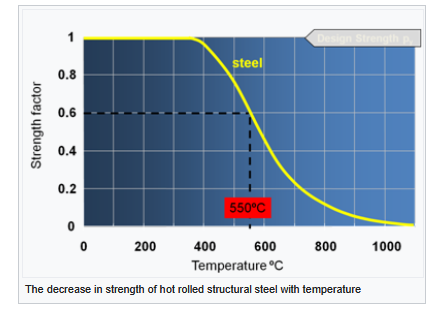
-
Fire protection of steels
Gus Potter replied to Post and beam's topic in General Self Build & DIY Discussion
Yes I agree. In simplistic terms there is chemically "locked in water" in the plaster board. The heat transfer is slowed as the plasterboard "soaks up the heat" as it is forced to change chemically. But.. often the fixings are the vulnerable point. An easy way of getting your head round this is to go to the BC standards. They talk about fire "resistance" and fire "integrity" The resistance bit is to do with a material transferring heat. The integrity is about making sure that the fixings and the things the fixings go into remain ok.. as if they fail then boards say fail also. The regs combine intergrity with resistance to give you the overall number. In summary though. Say you are completely new to this. I would explain that steel starts to lose its strength when it gets hot.. that can start at temperatures similar to when your oven is at full whack.. say 250C.. this lets the home owner get a feel for what we are talking about in terms of how quickly steel can loose strength when it gets hot. What we need to do is insulate it so it does not get hot. Then we look at the different ways of doing this. @saveasteading and others have pointed out the different ways we can go about keeping the steel cool. -
Wall ties question- slanted or level, does it matter
Gus Potter replied to ab12's topic in Bricklaying, Blockwork & Mortar
This is a tricky question. Time? The internet allows you to work in some places in the world as I've done for a long time. USA is a no, AU is ok... for now. We have large cavities due to say blown cellulose insulation. Thank you for the compliment, I like to have a chat as you know! Seriously though.. It's a very good question. I'll mull it over and try and come up with a coherent, reasoned and justifyable answer for folk to discuss.. I'm learning too folks about wide cavities, how they behave and how you insulate and so on! It not just the cavity width.. its the way the roof loads are transferred to the walls that is often changing, the way the floor joists / floors are connected in to avoid cold bridging is changing and on top of that we need to get it buildable, the works sequenced and cost effective. One of the things is that a lot of the masonry design codes are based on; calculation, partly emprical (call that Grandads rights) and partly based on test results. As soon as you go off "piste" in terms of the design codes you often need to go back to first principle design and that can be conservative and too conservative can add a lot of cost. -
Fire protection of steels
Gus Potter replied to Post and beam's topic in General Self Build & DIY Discussion
Hi @ETC there use to be a bloke called @the_r_sole who was a right down to earth Architect and massively experienced that gave up his time to contribute to BH. He really knew his stuff.. a bit like you. You can find his posts in two ways.. on google and with a BH search.. hard to find. Try and look them out. His writing style probably is similar to yours, no nonsence. I have my own informal style of writing / shite spelling ( story for another day).. it's ok to be different and give Clients a different offer. @ETC I'm chatty on BH, (just sharing my knowledge) when I pitch for a design brief.. I seem to win briefs.. but when I deal with industrial or hard nosed folk I can play that game too. I do now and again Claims work.. my head does not zip up the back. My style then is a different animal... but I'm confident in my ability... my style sets me apart from the competition. Even when I do claims and just day to day jobs. Over the years I've learnt my design craft.. but also try and improve the way I can communicate what are often complex design issues into simple concepts that a lay person can get their head around while enabling them to make informed financial descisions. @ETC that in my view thatv is the mark of a good professioal. I think the mods on BH are ok and if you get a bit of business, it's ok provided you don't take the pish. Now and again someone from BH engages me, often these are folk that are really stuck, bad builder. and so on. About two years ago I commented on a post about bad blocks from Ireland.. got a email couple of days ago.. can you help. That is the thing I love about the BH community folk will come back to you for help. My basic qualification is in Civil Enginnering and that key word is Civil.. we work for the public. For all I'm proud of that and will never forget my civic duty. @saveasteading has expanded on this civic duty. It's like being a doctor.. we have a duty not to harm, you as Client are lower down the list even thought you are paying the bill! The sole put his heart into BH but basically got hounded off BH as there were too many twats that thought they knew better, they thought all Architects were arseholes. So going back a bit and not picking anyone out in particular..I'm just saying remember when the sole was doing his best. @nod @MikeSharp01 and the rest of the mods. On the other hand @ETC what about using your own name like I do? I would like to see you tighten up many of you comments, you can't have your cake an eat it? For me I read what you write and think.. mmm here is a smart arse.. It would be good if you went on to reason out your comments so the lay person on BH can undestand.. that is what I try and do.. give it a go! -
DPC - BS6515 vs Zedex "high performance"
Gus Potter replied to BTC Builder's topic in Building Regulations
No, you need to go back to the SE AND the Architect or the person who made the drawings and ask why there is a high bond DPC. If you decide to swap DPC's then you are exposing yourself to a big risk. You could also be acting in a dangerous way. If BC come out and find you have swapped out materials then you could be in big trouble. Re read my post. Be safe and ask the question.. it costs nothing. It's OK to ask "silly questions".. what is stupid is not to ask the question at all. I think you are mixing up the different types of NHBC guidance. We used to make cavity trays etc out of DPC (folding it and so on to make a tray) and before that heavy duty bituminous felt. .. but modern brickies are crap at it.. at it so the NHBC are leaning towards factory made trays. The High bond Zedex is more associated with the structural performance of the walls and that is why I'm doing my best to encourage you to just ask question. -
ICF How much more expensive ?
Gus Potter replied to Dave Jones's topic in Insulated Concrete Formwork (ICF)
For me, in my last life, as a local building contractor I learnt to have a look at who was making the most profit. Business is a learning curve. You get subbies in.. say ICF.. tie them into a contract, learn and if it looks profitable then cut them out. There are no friends in the desert. Profit is sanity, turnover vanity.. especially if you are carrying risk for someone else's turnover that is leveriging that... you can end up being a useful idiot. Not just in the way that the finances work but as soon as they get enough well completed jobs they will ditch the local guy. The pressure to do this will come from above.. the folk that are making the ICF insulation. Now a case in point. Advanced Foudation Technology have got accreditation for their own product. This requires a serious amount of investment. I know about this kind of stuff as I've been involved in developing cold formed steel buildings and the raft foundations they sit on, be these insulated or not. I'll leave it at that for now other than to say I may have been into this for a long time... and spent a lot of time learning about what is cost effective or not.. I've made a few mistakes but that comes with the innovative process. The building trade is brutal. I work for contractors as an SE at times, we trade blows. Sometimes they say to me.. hey Gus I can get an SE for a few hundered less. I say go on then, give them a go on a few jobs.. I'll not get offended.. too old for that. Sometimes they come back..once they realise that others designs are not buildable.. but the ones that don't are probably cutting corners and being unsafe. Yes they will get away with it for a time but God or the tax man will catch up with them. For all I've touched on this before.. insulated rafts are not new. ICF is just permenant insulated shutering. I have serious doubts about the economics of this as there are just not enough contractors about to make it a competetive market. By all means if you want to go ICF, have the funds and it floats you boat then go for it. As a designer / SE advising a young couple with a few beans to rub together then I would look at other options rather than ICF, even if to rule them out. There are folk doing ICF in the North of Scotland.. great until you have an on site issue not least! These type of folk tend to have a large contingency fund.. but if you are a nurse on an average wage it's bollocks. But see in terms of getting paid as a contractor and on time .. the nurse is probably your best bet provided you do what you say you are going to do as as a contractor. If you are a building contractor reading this then don't feel unconfortable about making a profit. Many people work for the NHS like my wife. . some of the contractor profit allows them to go on holiday.. in the public service this comes with the job. But for all.. see when your builder is off on holiday they still need to keep the wheels running.. -
ICF How much more expensive ?
Gus Potter replied to Dave Jones's topic in Insulated Concrete Formwork (ICF)
I'll take that as a feather in my cap if you don't mind? -
Fire protection of steels
Gus Potter replied to Post and beam's topic in General Self Build & DIY Discussion
Hi all. This fire protection thing crops up often on BH. I'm going to pick out some of the folk that often chip in on fire design. Now you could be a designer, a contractor or just someone that has done a lot of self builds. What you see is a lot of is folk saying we did this and that. But if you are a newcomer to the self build or internal alteration / extension market then unless you all then go onto say why you did what you did / or do then it gets even more confusing? I've just copied a bit of an extract from posts. There is nothing wrong in the above or right. It's a best guess on limited info on a building forum. @nod you do this stuff as a day job.. time to step up to the plate design / theory wise? Now there are a lot of folk here commenting as above. What would possibly be more helpful is to say.. we had to do this because of this type of design. I use my own name. I write stuff., over time I've been a member I've said some daft stuff, BH members and the MODS have cut me a lot of slack. yes this is a place where as an SE you can shoot the breeze if off duty. BH is also a place where you can make mistakes and folk will forgive. So in that context folk surely you can go the extra mile and say.. here is why we think we did what we did. in terms of fire protection. In summary, folks who comment on fire protection often. We should be stepping up to the plate and saying.. this might work and here is why. We kind of owe that to new members? -
DPC - BS6515 vs Zedex "high performance"
Gus Potter replied to BTC Builder's topic in Building Regulations
@BTC Builder Well done you for spotting this and asking the question. Honestly I can't commend you enough. You have probably saved the SE's arse and most importantly made the folk / the public safe by asking this question. This is a bit long winded.. take what I discuss below and make hay! I'm going to try in laymans terms to offer up an explanation. For all, often when we design a masonry wall it often has downwards load that is a bit off the centre of gravity of the wall. There is sideways load from the wind. Sometimes these may be a masonry wall round a school playground.. big red flags! When we use plastic DPC's and membranes these break the small tensile strength in the wall that is required when we do the bending / stability critical safety check. This bending force in the wall arises when we take wind, and off centre grqvity loadings into account. Now many young SE's are under pressure in the work place. There is a small switch in most software that lets you select the type of DPC. A high bond Zedex is a highly specialised DPC that has not least a sanded surface top and bottom which replicates the way a mortar bed behaves. Thus in the software it appears as a continuous wall. Now technically I can design walls this way.. but first and foremost I would put a massive warning box on my drawings to say this is a critical element.. the contractor will often say to me.. Gus you are asking too much and I'm going to pass this high extra cost (the extra labour / brickie skill level required) onto your Client and I'll leave it up to you to justify this added cost element. As a designer I am responsible for not just the SE sums but also the buildability.. as per new regs on Principle Designers etc.. @BTC Builder That is why you don't find this product as an off the shelf item any more. For you if you agree to install it you have to follow the instructions. It takes time and care.. and that will eat into your profit. If you have signed a contract to install and your bollocks are up to the post then you might want to find a way to do a deal. If I was say acting for you then I would look at the radon barrier position.. there is a chance the SE has shot themselves in the foot! The may have changed the setting in the software and forgotten about the radon barrier which breaks the bond in the wall. In this day and age we avoid using DPC's that are able to act like the masonry bed as say Zedex.. it's just too risky. There are school walls falling down all over the place and compromised designs where SE's just don't have a clue about the costs on small self builds or extensions. Nod.. I know you have a pile of experience but this is something that is not bedtime reading.. you have to be a bit of an anal twat like me to pick up on this stuff.. but on the other hand we all need to realise that every day is a school day.. and the older we get the more we realise how much we don't know. And I'm saying to you.. I admire what you do but you don't know it all as I .. and small things like this if missed can be dangerous! as in using high bond DPC's can be very dangerous.. I know a lot about this to be blunt and that is why I'll have to sing @BTC Builder builders praises again. @ETC We get to a certain age where we are good enough at business to put the bread on the table. Then when we all put out heads together we have fun in designing particularly odd stuff which personally floats my boat, make a bit of profit, get to truck about and get invited socially into the things we have hand in desgining. Shite job eh? -
Structural warranty company dilemma
Gus Potter replied to Amateur bob's topic in New House & Structural Warranties
Hi bob. Hope this lift your spirits a bit. Firstly 99.99% of designers don't set out to do a bad job. Your friend has probably gone the extra mile with the details so there is probably some value in that. Also, if you have issues during the build your friend may become your best friend (if not already) as they will often be "on tap" so to speak and that, even in itself, could easily offset any money you have paid. In the UK (in terms of the building regs) it boils down to your design being undertaken by someone who is competent. In Bob's case his friend is probably highly competent. They can demonstrate this by producing drawings to a high standard, producing drawing details that identify critical parts of the design [could be structural (SE stuff) or weathering details (Architect stuff)] that lets someone who is checking the design see that there is competency in play. The crux of the matter is how warranty providers take a view on the risk they are underwriting. Yes, I think your SE will get you sorted.. see below... if you can hang in with my submission and observations.. To make headway here I go back go back first.... excuse the spelling and grammer folks.. please. I wear two hats. My main hat is the SE hat, the other is my Architectural Designers hat. My professional indemnity insurance premium (if I try and split it out) as an SE is about 4 - 5 times more than when I have my Architectural designers hat on. Each year, to renew my PI insurance, I have to fill in a form that splits up the design work I do into various categories, one of these is "Architectural" design. Now most SE's will allocate a percentage value to this more than zero, it might be only 1% but that covers you in case you inadvertantly stray into say @ETC's world. In my case the % is more but I'm not going to tell you what that is. In summary @Amateur bob this means that the SE may be able to say..ok.. I'll tack it all together and take the Architectural design liability on... with a few standard caveats. If you (bob) came to me out of the blue as the SE / Designer I would say ok.. lets have a look at what your warranty provider is asking for and is it reasonable. I would want to know a bit about you also. We would have a chat.. you want me to cover the design under my insurance. I might say, I'll cover you and our contract is between us only.. can you live with that, you may say yes and, that gets recorded. If it turns out later that you sold the house on promptly and I get some random chancer sending me notification of claim, then in the first instance I'll tell you to take a hike. If you want to do this selling on (developing) then you need a collateral warranty and that comes at a cost, its often not a crippling amount but what I don't want is some hard arsed chancer with a tame laywer running up my clock to get a few quid out of me. In other words if you want your pals SE to consider you then you need full transparency. Now for all. One of the privileges of being an SE is that the warranty providers know that we carry lots of insurance. If things go wrong then we are often the first target, they go for the low hanging fruit. Often other folk.. your contractor might have gone bust.. SE's and Architect's can be the last folk standing so we get the blame for everything. The easy way as others have said is to think about this in terms of gambling and bookmakers. Bookmakers and warranty providers will often lay off the risk... but they need the business. They can lay off the risk to the self builder and make conditions.. but then too many and the self builder will go elsewhere. There are plenty folk that do their own drawings.. or get drawings from sub contractors. For me I provide to my Clients a copy of my professional indemnity insurance on request. If the warranty provider asks for detail I can provide a bit of that also.. enough to show that my insurer's are actually covering the things I have designed. For example.. it's not worth my while designing swimming pools.. I have no cover for that. When I was younger I designed stuff for the Nuclear Industry.. but my employer held the cover..the premiums were I understand large.. but not as large as you think..say 50% more! story for another day. What I won't and are not allowed to do by my insurer to do is to provide you with chapter and verse of the forms I fill in each year. This has no bearing.. it's a private commercial transaction between me, my company and insurer. The warranty providers know the rules so don't let them try and pull the wool over your eyes. Ok to finish on a high note @Amateur bob I have a friend and colleague who was an outstanding award winning Architect but has got to an age where he wants to still keep his hand in.. but just wants to spend more time with his grand kids. To keep up his Architect's registration is a lot of work. I've done his SE designs for a long time. We are starting to change the way we work together where I take on more of the day to day tasks, take on more liability under my PI cover.. BC compliance etc. But he is still competant and see if I get stuck I'm straight on the phone for advice! If you have BC permission and sign off but no other designer that can take help lay off the warranty provider's liability then just send them the cv of your pal, state what the SE has done and what they cover and ask for a quotation. At least that gives you a benchmark. You'll be getting "the computer says no" treatment maybe.. but insurers are there to make money.. like bookmakers.. if there is a bargin to be struck they will do it! -
Correct from Ian. In the title box you need to say the drawing is this paper size if electronic submission. The planners are yanking your chain to kick the can down the road. You kind of need to suck it up and move on.
-
Ok what I do is this. I issue a pdf drawing with a scale bar. I put a numerical dimension on the drawing. This means that you can check to see if the scale bar matches with the drawing dimension. That verifies the drawing dimensions no matter how you print it on paper or look at it in pdf format if you are working from home as planner. I suspect your planner is kicking the can down the road and that is why I put on my site plan a reference dimension that they can check the scale bar against to head them off at the pass. But I round off the dimension to 100mm.. so I'll say 6.1m approx. Now the main reason for the rounding.. it is to do with the legal site boundary. I need to be really careful not to establish the legal site boundary by default as I could expose my Client to a property boundary risk.
-
Raft foundations. How does the mesh work in a slab?
Gus Potter replied to Gus Potter's topic in Foundations
The quote from Ruskin for me sums it up. I know we are all woke these days.. but that bit about "lawful prey" ..scary.. but even more true in this day and age. That is why I love Build Hub as I think it serves the public interest. A big thanks from me to the folk that are running this site. -
Anyone recommend a fire engineer?
Gus Potter replied to Alan Ambrose's topic in New House & Self Build Design
Had a quick look at Grant's offering.. seems like someone that has their head screwed on the right way. No fancy website... just someone that says.. here is what I do and I know my stuff? Now as an SE that sounds like someone I can relate to and have a sensible conversation with. -
Hello all. For my sins I was briefly a director in a double glazing company in my early 20's. I'm now 60. I was a daft lad back then with lots to learn. . I think that comes out when you do a director search on me on companies house! So in that context.. I write the following.. as I'm a bit of a poacher come game keeper. I work with some good glazing providers. Now we know that BC et al are getting totally anal about this environmental stuff and they have no clue as to the cost off that. Three or so years ago I spent some 20k on getting some sliding doors., windows and a roof lantern in my own house. I did my own SE/ Architectural and U value calcs.. as it is my day job. Now I know these suppliers so we share information. The latest wheese is that gas filled units are good for 7 years and the frames for 10. "Rational have agreed to replace and supply an engineer but want me to pay for scaffolding etc" That seems like a good offer. Don't push your luck .. there is often no natural justice in the building game! Look at the other side of the coin.. say Rational engaged me to evalutate your build.. I might find enough evidence to suggest that your build may have contributed to the faIlure, so now you get nothing. Recommendation is to accept thier offer if you are of pragmatic mind. OR you can go full pelters.. but you'll need to have at least 10- 15 k in the bank for my fees to try and fight what looks like to me like a lost cause. I would not even take you on as a Client as I don't do ambulance chasing.
-
The (not so) secret diary of two self builders, one aged 62 and a half…
Gus Potter commented on G and J's blog entry in Da Bungalow
Plus one to that. -
ICF How much more expensive ?
Gus Potter replied to Dave Jones's topic in Insulated Concrete Formwork (ICF)
Hi all. As an SE.. ICF is just temporary formwork replaced by permenant insulation. There is nothing here (for me) that is complex / more difficult in terms of structural design. The concrete wall does not know if you have fitted the insulation before or after! You have Kore etc but the real money lies in local contractor cost. All ICF walls are fundamentally the same.. yes the method of tying the outer and inner leaves of insulation may differ as does how the ICF system locks together but in the grand scheme of things it's a moot point. Often what matters is where you are in the country and access to builders that are familiar with how you shutter and support the different ICF systems. It's just not economic for a Contractor to do the odd ICF job in parts of the country as you need to invest in kit that can be used more than once. This is a major issue when selecting the best and most cost effective method of construction. Often to get best bang for your buck you need to look at contractor availability. In some ways it is a post code lottery in terms of build cost. As a designer and advisor I have to let you know how your location can dramaticaly influence the build cost. I'm going to pick out @Nickfromwales here as he is a go ahead guy with decades of experience behind him. I've mentioned Nick here as he has spent a lot of time demonstrating on BH that he knows his stuff. If Nick can see enough of a turn and repeat business then the ICF cost will come down.. Nick is from Wales... maybe not London prices but enough for him to make a good living? -
Raft foundations. How does the mesh work in a slab?
Gus Potter replied to Gus Potter's topic in Foundations
This is so true. For all self builders. My advice is to take time to understand what the drawings say. Make sure that gets delivered otherwise.. I have this on my website from Ruskin. Please take some time to read, especially if you are doing a first extension or doing some DIY with a bit of help.. It is even more applicable in this day and age. There is hardly anything in the world that someone cannot make a little worse and sell a little cheaper, and the people who consider price alone are that person’s lawful prey. It’s unwise to pay too much, but it’s worse to pay too little. When you pay too much, you lose a little money — that is all. When you pay too little, you sometimes lose everything, because the thing you bought was incapable of doing the thing it was bought to do. The common law of business balance prohibits paying a little and getting a lot — it can’t be done. If you deal with the lowest bidder, it is well to add something for the risk you run, and if you do that you will have enough to pay for something better.” -
Hi all. Firstly, thanks for you all for taking the time to write about this. I know many of these posts take a lot of time to write. I'm digesting this post. In my day job I try and introduce folk to underfloor heating, ICF, insulating house extensions / attic convertions and anything that I think can deliver a project. Some of my ideas are off the back of what folk are innovating on Build Hub. I look at what you are doing on BH and say to myself..what a great source of knowledge.. how can I implement this in my SE and general design and then sign off on that under my professional indemnity insurance. There are many of you that are contributing to this discussion and I try and chip in where I can to return the favour. Thanks folks.
-
Anyone recommend a fire engineer?
Gus Potter replied to Alan Ambrose's topic in New House & Self Build Design
Interesting question. A few observations. Take a single story timber frame (TF) house more than 1.0m away from the boundary. Let's make it timber clad. As an overview we aim to achieve a number of things: 1/ We want the interior of the external, internal walls and ceilings not to encourage surface spread of flame or emit fumes, like old polystyrene tiles to take an extreme example This protects the occupants and provides time to make a safe exit. A good material to use here is plasterboard. 2/ We also want to protect the Fire Brigade in case they need to enter the house. In the first instance we want to have a look at the roof. Say that needs 30 minutes fire protection (pragmatically) but on a single story house this may not always apply. Assuming we are complying with the English regs approved document B (dwellings). Our first port of call is section 5: Load bearing elements of the structure. To summarise clauses 5.1 to 5.3 and the attaching notes; provided the roof does not contribute to the structural stability of the house we can go for potentially less than the 30 min.. but as I said, pragmatically, we need to ask.. can we get 30min out of the roof anyway at no extra cost? Now we need to look at the roof and determine if it is contributing to the structural stability of the house. Importantly ask (an example), is the roof say attached to a long slender steel transfer beam (or an eaves / ridge beam) that relies on the roof to prevent it buckling? If that beam requires 30 minutes protection then so does the roof.. as it is now part of the structure. Turning to the walls. The first thing to ask.. what are the walls doing structurally. Are they holding up the roof or not. On a standard TF they normally do and thus commonly need say 30 minutes protection when measured from the inside. But.. if the walls are holding up the end of a steel beam that requires a longer duration of fire protection then you need to consider how much of the wall needs extra protection.. often we get round this by default as beams have heavier and more fire resisting supports running in the walls down to something solid on the ground floor. However, just say the walls are infill panels between a structural frame that supports the roof and any transfer beams. The structural load path is.. snow / wind and roof access load acting on the roof.. onto a structural frame on a raft foundation slab say. Let's avoid a steel frame (takes ages to write about) and say we have a chunky oak framed building. Here the wall panels are non structural in terms of bearing vertical load. Just to qualify.. when we are considering structural loadings on a building in terms of fire we neglect wind load and reduce the live (imposed loading.. you having a party or a biggish fish tank say).. in other words we look at the probablility of the building being fully loaded coupled with a fire breaking out.. if we did not take a risk based appoach then the fire design would often drive the design unreasonably and cost exponentially upwards. Ok I picked a chunky oak frame as it's easier. Oak is a great material.. when a fire starts you get a slow char which insulates the timber under. If the oak frame is chunky it will hang in there a lot longer than your 30 minutes. Infill panels: Just say these are a space frame / SIPS kind of wall panel fixed between the columns of an oak frame. Heb Homes et all do space framed walls. I'm being all inclusive so let's lift the bonnet and have a look at these. @Kelvinknows a lot about this so have a look at his posts, also I've picked his brains and learnt loads from him so you won't be the first! Now as a point of reference we know that a standard TF wall.. say plasterboard on a 95 x 45 timber stud (provided it is not too high) with OSB on the outer face gives you round about 30 min protection. On the inside the key thing is to make sure the plaster board fixings have enough penetration into the timber. As a rule of thumb if the plaster board is 12.5mm thick we need 2*12.5 fixing penetration into the timber behind for structure = 25mm. That is not something I'm personally comfortable with so let's say 40mm fixing screw penetration.. about the thickness of an engineered joist flange. Now we are making sure the timber and plasterboard will hang in there as the fixing heats up. On the outside of the panel, timber clad. Here we need to look at the surface spread of flame and select our cladding accordingly. It might need some treatment. Up in Scotland we have a company called Russwood, have a look at their website as they are full of ideas. Last but not least there is the fire stopping. For all when we have a cavity in a wall we must stop flames and smoke having a free run. Cavities are basically a chimney and they are not "passive things". As soon as you introduce heat convection air currents build rapidly and they promote fire and smoke spread. They must be split up and isolated into small zones. Now when we have say external timber cladding the inside face of that may be a bit irregular. One solution is to use fire socks around all openings (windows and doors), at eaves level and split the wall panels lenght wise into separate zones. One company, I like to brouse their offerings on passive fire protection is Tenmat https://www.tenmat.com Now you may not need one, much depends on the attitude of BC. For me as a designer I always want to make sure that what I'm doing is safe. On a low rise single house like this, say well away from neighbours then it's ok to work your way through the basics to get a safe fire strategy. Make no mistake folks.. if this was a higher risk building then I would be much more forensic.. but the Client would need to cover my design fee. Hope this helps a bit. -
Bite the bullet and post as many drawings as you have and supporting info. Don't hold back. If you want the best advice from the members then don't make us guess as we get fed up guessing when actually we want ot help you solve this if we can. Give us all the info so we can help you properly. You'll be surprised (happly) how much help you get!
-
ICF How much more expensive ?
Gus Potter replied to Dave Jones's topic in Insulated Concrete Formwork (ICF)
Much will depend on wall panel sizes and your attitude to shrinkage. I suspect he maybe qualifed that statement. A masonry wall is more forgiving.. that is why we make the mortar weaker than the masonry units. I'm assuming many here making comment are using ICF above ground and not using it to keep ground water out. Fair enough if your wall panels have a good aspect ratio and are not too large, it needs a lot of careful thought. One of the biggies is not just what it looks like on paper / calcs but how you are going to execute the pours on site. Get this in the wrong order and your SE will not save your bacon! To put this another way. If you ask me for the leanest design.. I'll maybe be able to give you that.. but then I'll say here is what you need to do on site and in this order. Your Contractor will say.. hey I'm going to have to make extra visits. The reality is that folk on BH will cut corners and think the can have their cake and eat it.. you can until something goes wrong and then you are STUFFED! If you fail to follow my instructions then you are on you own. Ask me about the best and balanced risk way of building something and I'll support you to the hilt.. even if you get into a barny with your contractor. Personally I'm ok with ICF. It's a concrete wall with permenant shuttering that is insulating. The shutters need tied together with insulating ties. The shuttering needs bracing more than traditional ply shuttering. If below ground we need to do some waterproofing detail.

