


Gus Potter
-
Posts
2383 -
Joined
-
Last visited
-
Days Won
34
Everything posted by Gus Potter
-
The mortar strength is far too much for these blocks. Politely ask your Architect if they can explain to you how the old and new building are doing to interact in terms of day to day movement and cement base blockwork shrinkage, that starts from the founds up. Then ask them to detail the movement joints in such a way that it also stands a good chance of meeting the Structural Engineers tying and stability requirements and explain to you how that all works. A competant Architect should take this in their stride.
-
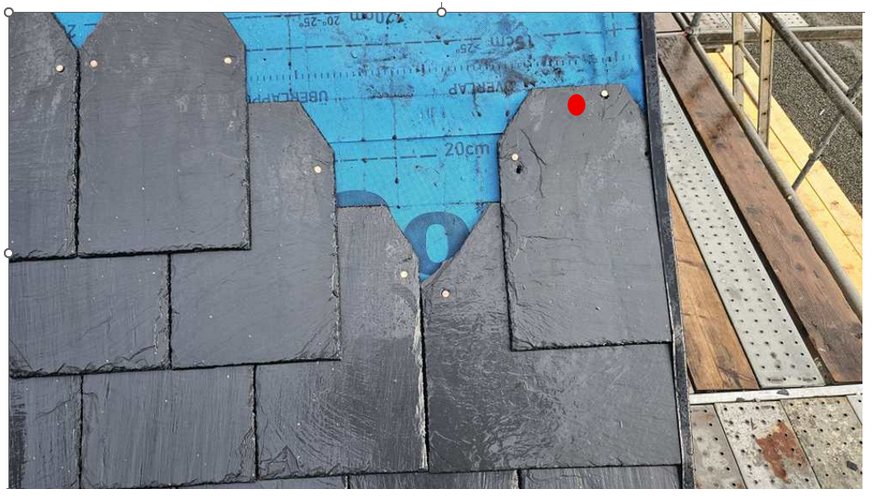
To add an unfortunate bit. Your verge closure seem incorrect. The vapour membrane should be under these. Traditionally these slates should be undertailed. Rather than write at length about this I've used AI and checked that what is says, I agree with. Copied below. I am of the view and have always done so when slating roofs in my last life as a builder that the verge slates should be tailed as well. In your Hhighland location we need to make use of every trick and technique. I wonder if your roofer can even beging to address some of the issues? AI output: The traditional method for "tailing" slates in a valley refers to a specific cutting and laying technique where the bottom edge, or tail, of the cut slate is inverted to direct rainwater away from the vulnerable valley lining and back onto the main roof surface. This is a traditional craft skill that employs the principles of capillary action and surface tension to manage water flow effectively. The Mechanics and Importance of Traditional "Tailing" Understanding how this intricate system works provides insight into the mastery of traditional slating. It's a method born out of necessity, predating the common availability and reliance on extensive lead flashing, and it continues to be valued in historic building conservation. Capillary Action and Surface Tension: The technique relies on the natural properties of water. When a slate is cut, it exposes a sharp edge. Normally, water might cling to this edge or be drawn underneath the slate due to capillary action, potentially dripping onto the underlying valley lining (often lead) or the roof structure below. The Inverted Cut (Tailing): To counteract this, the slater takes the slate that is to be laid on the rake (the diagonal line of the valley) and essentially cuts its bottom edge as if it were the top edge (head) of a slate, or by flipping the slate upside down to make the cut. This results in the exposed, raw edge facing downwards, towards the eave, while the smoother, "dressed" (original) edge or a specifically angled cut faces up and into the valley. Water Shedding: This subtle inversion of the tail ensures that water running down the face of the slate forms a meniscus and trickles along the surface, shedding water back onto the top of the adjacent, lower slates and ultimately into the main flow channel of the valley, rather than dripping inward or compromising the integrity of the lead lining. Why This Technique is Crucial The 'tailing' technique is not just about aesthetics; it has substantial structural and protective benefits: Protection of the Valley Lining: By actively shedding water away, it reduces the amount of direct impact and continuous moisture on the lead or metal valley gutter, which helps to extend the lifespan of the metal and prevents premature wear, corrosion, or pinholing. Frost Protection: A sharp, exposed edge of slate is more susceptible to frost damage and general maintenance-related damage. The 'tailing' method protects this vulnerable edge by tucking it or angling it in a less exposed manner. Preventing Infiltration: The primary goal is enhanced weather resistance. Traditional slate roofs are "water-shedding" systems, relying on gravity and precise overlapping rather than being a fully watertight membrane like some modern low-slope roofs. This meticulous detailing at the vulnerable valley intersection is essential for preventing water ingress into the building structure below. Traditional Valley Construction Traditionally, valleys were formed using skill and ingenuity before the widespread availability of modern materials. The slates in the valley would typically be laid over a robust wooden valley board, which was installed flush with the rafters. A metal lining, usually lead, was placed over the board. The slates from each intersecting roof slope are then cut and "tailed" to meet the valley line, creating a clean, weatherproof junction. Common traditional valley types also included: Double-cut valleys: Slates on both sides were cut to overlap a narrow strip of slates laid up the centre of the valley. Single-cut or half-swept valleys: Where one side (often the steeper pitch) was cut, and the other side's slates were swept across the intersection. The 'tailing' technique is a testament to the high level of skill involved in historical slating, showcasing how traditional builders achieved durable, long-lasting results through an intimate understanding of materials and physics. In summary, 'tailing' in traditional slate valley construction is a superb example of how traditional crafts incorporate subtle yet vital techniques to manage water flow, protect materials, and ensure the overall longevity and weather-tightness of a heritage roof.
-
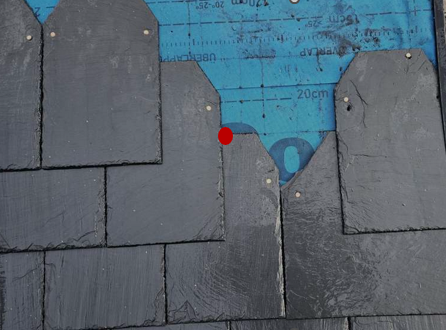
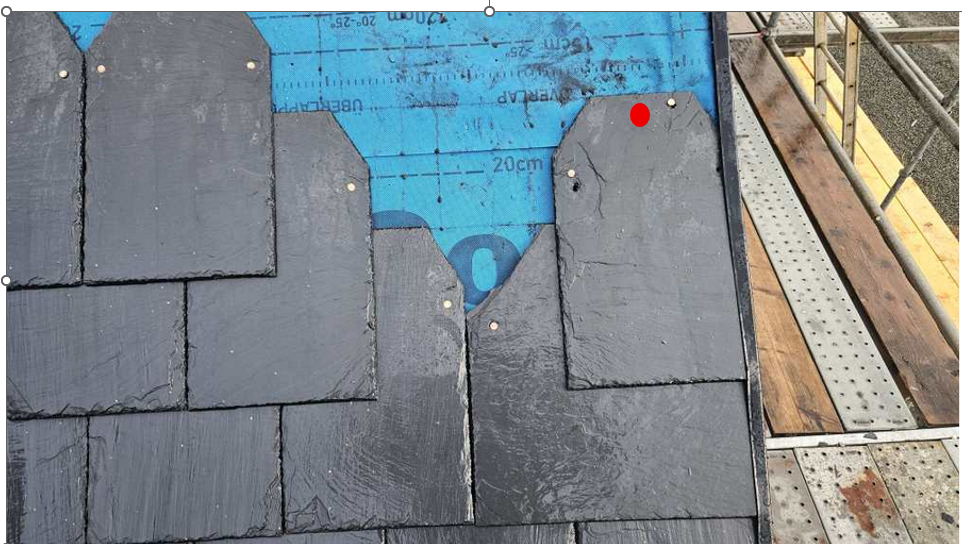
Hope this helps to give you a bit of an insight, feel free to discuss. Your Highland location is relative as its very windy often and coupled with heavy rain. But to start from not where you are! In the central belt and in the Scottish borders the general rule is if you were using Welsh, or Norwegian slate (these are a lovely green / blueish slate and very hard wearing, used in Edinburgh on high end houses) say was to single nail every slate but cheek nail every third course. A cheek nail would go where the red dot is below. The head of the slate is kept square. The nail head is big enough to lock onto the side of the slate. All these slates are realitvely thin. A hard Welsh slate can be very durable but workable, the beds split easily in the quarry. You would have a nail in the head of the slate. One inch down as below: Now the beauty of this is that it make the roof easy to maintain. If you get a broken slate then you can turn the slates easily to fix the broken ones. Traditionally folk would get the Slater in every so often to check the roof and maintain, clear the valleys and check any drip type flashingsl for holes, often at low cost. Now along came say the warranty providers. They are looking for say 10 years warranty. Now the cynical might say. See if we double nail every slate as above then the chances of a split slate falling out are slim as it very hard to spot a split slate from the ground. Scotch slates are a different animal. They tend to vary in thickness a lot and are smaller. Because they are thick they are heavier so tend to lift less, parly due to their own self weight and the smaller size increases the density of the nailing. The nails are still one inch from the head so the bending force in the slate is less and this stops the slate from breaking at the nail point. Where this happens is down to the skill and knowledge passed down from traditionally father to son / apprentice. A skilled person will know that eaves, verges are vulnerable, but also around chimneys and the like. The wind in the highlands can be ferocious! He should have graded them. Cupa's at the very least in my view should be graded into two piles. Thick ones at the bottom, thin at the top. Usually I would grade into three piles. It's important to understand what the membrane is supposed to do. Traditionally there was no roof felt or membrane. There are many roofs in Scotland that just have slates on timber sarking. This worked traditionally as there was no insulation in the loft and any water that got in quicky dried out. I sometimes get asked this question and am acutely aware that if I'm insulating this kind of roof I need be very careful, call it conservation design. In the (I think) 1930's they developed bituminous roofing felts, often called a type 1F today. These were water and pretty much vapour proof. So to make that work they introduced eaves and ridge ventilation. For all on BH.. Heads up! there was an invention of felt called ASTOS. Folk realised that you could use bitiminous felts for flat roofs but they burnt well. So they included asbestos. The clue is in the name. Your membrane is NOT intended to stop water ingress it's mainly there to stop wind driven snow, odd water mist and to let the roof breath. It's not like 1F felt and never has been intended to do so. Your starting point is to really understand the mechanics behind this, how your roof was supposed to work and then why it's not. Legal action is the last resort. But before you even go there you need to check that the roofer has some assets you can go after. With a fair wind if he is not limited and has other assets, other than a marital home. Seek legal advice pronto before going down this route.. to freeze assets say , that is not free and if you do it maliciously then the builder will come after you! Don't discount this. I had a Client that got trading standards involved in a case where the builder had been fradulent. If your roofer has stated that he has supplied, installed materials and billed you for it and it turns out that he never actually supplied the materials then that is fraud. Trading standards were supportive (the builder was already known to them as a chancer) so it might be worth calling them up to test the water. In summary though, you need to work out and check all your flashing and slate details and work out why the roof is failing in the geographic location, yes I know it's not finished.
-
Rear extension into a garden with a swimming pool
Gus Potter replied to Sidd's topic in House Extensions & Conservatories
Yes it's pretty basic stuff. The pool depth is only about 1.5 m say 2.0m to formation level, maybe the odd local sump. Not sure at the moment, would like to see some drawings. Most folk will take something like this in their stride. -
Have a read though this old manual. TRADA Timber decking The professionals manual 3rd edition.pdf
-
What is a UU?
-
Hope you can get your hand sorted out. That sounds like a bad accident, don't blame yoursefl, it could happen to anyone. To business. I think you likely have enough to evidence against the standards, so not subjective. Unless you have over egged your post. But you have not provided that many photographs. Your sarking boards are treated, so not rotting, so I would not want to hang my hat on that as as a basis. But here is a question. If the roof has a breathable membrane then we need to have gaps between the sarking boards. I specify 100 mm wide boards with a 5.0 mm gap. You don't seem to have this. A competent roofer should know that this is a general requirement and check that the membrane is ok and the sarking gap. As an art of slating the slates at the verges are not tailed to shed the water back towards the roof. But you have plastic verges, just a symptom of decreasing skill level in the slating trade. My gut feeling is that if I and others on BH were to look under the bonnet we would come up with evidence that supports the arguement that you should not pay this contractor the balance. I trust you have photos from the inside of the roof. Lets have a look at the Velux trimming and so on. What nails has the roofer used? Let us know so we can check they have used the right ones. How close are you to the sea? Legally what you might want to ( I'm not a Lawyer so don't come after me!) is confirm if the Contractor intends to return or not. If they say they are going to return then you need to spell out the defects you want addressed, at their expense and when they are going to do that. You might want to say that if you can't agree then you will both agree on an independent arbitor. Now there is a good chance that the Contractor won't come back as they have chucked their toys out the pram. But you have to go through the process so protecting yourself. The contractors wife may be a Lawyer and work pro bono.
-
Each time you use an abbreviation, use it then in brackets, explain the abbreviation, you only need to do this once. For new folk to BH this is important, as an SE I think it's just poor commuication. If you want to get your point over then follow this format, otherwise folk will lose interest. I agree the English planning system is a mess, the Scottish system is much further developed. It's still not easy, but much easier to navigate as it gives everyone, including devleopers better guidnce. It still has some major pitfalls for self builders. In summary it's about time the English system sorted it's self out. It's going to take time and some horrible things are going to happen.. but any reform of the English planning system is going to be painfull. The chances of delivering enough housing is limited, the best way to control this is to stop the population from rising! While this new document seems encouraging it does not address the elephant in the room which is the supporting infrastructure.. the drains, hospitals ect need to keep up. On a personal note. The strategy seems fundamentally flawed to me. This idea that you have to travel to work is mental. It does not make for social cohesion. I live in East Kilbride which was one of the first new towns, the idea started in 1947. The plan really started to work in about the late sixties when they thought.. lets build some industrial units and offer grants to multinationals to set up shop. The offer was, you come here and we will build the houses that provide the workforce. Motoralla were one of the first, Rolls Royce, the Department for international Development followed. The jobs were well paying, folk built lives and family in East Kilbride, small busdiness units were offered to provide the secondary support mechanisms that we all need. My father in laws dad ran the local shoe shop. Unfortunately this fundaments concept has been lost. Now I know lot's of folk are enthusiastic on BH about this change in the English system.. but what if it later this works against you and you ideal plot gets blighted by someone next door.. be careful what you wish for! In the round there is no point in building your dream home if the surrounding area has no community or just turn into a shit hole.
-
The key qeustion here is do you still own the Contractor money and if so how much? That will drive the rest of the conversation. Make sure you write to the Contractor and confirm that he has confirmed he is walking away form the job. I used to be a building Contractor in my last life, once I had a customer that was basically an out and out chancer and I wanted to leave the job. My QS told me.. on no account Gus chuck your tools in the van and walk off site as you will get absolutely hammered! The law rests firmly on the domestic Client side and they have an Architect who will back them up and they won't want to put themselves in the firing line. Make sure when you write to the Contractor, use the postal method also, don't just rely on email. This is a key step. If he is using wats app / text then say I've sent a letter and email to you, keep a copy. Ah.. best not to mention this anymore, it kind of undermines you taking the high ground. Ah... now the first response from Contractor on the defensive is to say "its my site" and you are not authorised to access the scaffolding and you inspected the work illegally! I have actually had similar from a major warranty provider where they asked me how I got record photographs without accessing the scaffold. I told them I'm an SE so qualified to make an assessment of your scaffold. I consider this a matter of saftey and it turned out I was right also, your ticket was out of date so lets start from here! Your case is a little different, but if the Contractor has previously allowed you to go up the Scaffold without supervision at all times, induction, then they are pretty much stuffed.
-
@Daniel H Have copied the link again from you other post. Well done with the commentry. https://assets.publishing.service.gov.uk/media/6941965758a21370f58f304e/Draft_NPPF_December_2025.pdf It's heavy reading, not in my immediate bag as based in Scotland. That said, still interested in what is going on in the south. As a quick skim though the authors have possibly been infected with the woke mind virus and have lots the art of communicating in plain English.
-
Yes I know I'm based in Scotland but similar rules apply UK wide re permitted development. One thing I often point out to Clients when you come to sell. The valuer etc might ask, what about this extension? You say.. it's under PD, they say prove it was ok at the time you did it. This can often cause delay in the sale or worse as you have to go back and demonstrate in full that you complied. In Scotland we have a process called the certificate of lawfulness which is a legal document that says what you are doing is withing your PD rights. Are you sure? https://www.elmbridge.gov.uk/planning/trees-and-hedges/building-near-tree Their link says this: Planning permission You must get permission for any permitted development scheme that may affect protected trees, which includes their root systems. If you want to build near a tree you will need to provide information in line with the British Standard – BS 5837:2012 ‘Trees in relation to design, demolition, and construction – Recommendations’ to support your application. Without this information, your application is likely to be invalidated or refused. We encourage you to seek professional advice from arboricultural consultants who will provide the necessary information and reports in line with the British Standard and our requirements. If you have confidence in your planning consultant then they should have no problem putting this in writing and signing. Mind you, folk don't live forever so if they pass and you come you come to sell then you'll maybe take a different view at that time.
-
I undestand you frustration. But this can be tricky work. The flashing details and how you marry that into the existing can be complex and very time consuming = cost. The you have the drainage.. do the levels work ok to make the roof work. The base can be easy or hard. If you have a vented solum to the existing house then you need to maintain that for example. It's probably not if you want a durable job executed by skilled trades persons. All companies need to make a profit, if they are turning over more than 90k then they should be vat registered so 20% goes on the labour plus profit margin as well as the materials. Most companies allow for a bit of contingency in the pricing. Very roughly if doing a very fag packet analysis of a price you have been given, say 14k then to strip out the vat, profit, contingency their in house cost will be roughly 40% less. So 14000.00 / 1.4 = £10000.00. Taking your cheapest material price of 3.5 k leaves 6.5k for labour but you still have all the flashings, mastic, fixings and so on. You might have to strip out some of the existing to make the weathering details and then reinstate. Once you put all that together then you might conclude that the lads are not on a CEO salary. If they are sub contractors / self employed then they also have to make their own pension provision.
-
I've started using AI more and more, mainly to help job my memory. I bit the bullet mainly due to encouragement form other BH members. Sometimes I ask it to do some calculations, often just to see the format or to see if it flags up something I've not thought about, or give me another verified reference I've not looked up. In that context it's a great aide memoir. BUT you have to really watch it! As an SE I've recognised that it can be downright dangerous in terms of safety. I was looking to calculate what sort of torque I might want to apply to resin anchor ordinary bolt the other day to generate a bit of pre load in masonry. I wondered if AI would offer up an alternative approach for example. It came back with some calculations.. they looked odd. I checked against my standard method and found AI was exactly a factor of 10 out on the unsafe side! I then told it was a factor of 10 out, it ran again and said your right, it often only appologises if you threaten to pull it's plug out!
-
I sympathise! What's you budget? In Scotland on something like this we have the Planners, who are interested, in not least, in what it is going to look like from the outside, how big and how high. Then we have Building Standards. On something like this one main thing they will look at are the fire boundary conditions. It's your responsibility not to set light to an adjacent structure. It would help a lot if you can post some photos of the site so we can see a panoramic view.
-
The basic architect questions thread
Gus Potter replied to SilverShadow's topic in Surveyors & Architects
Don't know as can't quite visualise what you have. Can you post some hand sketches of the elevations of both houses. Others on BH will likely chip in so you'll get a variety of views and comment. Glad the documents helped. Thee BRE on can be a bit heavy reading. For all. One way of keeping the professional design fees down is to try and get an understanding yourself of what he issues are and this save time / cost when discussing with your designers. Remember that designers need to know and remember a huge amount, it's just not possible for them to retain all that at their fingertips. what they do need is a big library and know how to find specialist documents when they need to. A well informed Client can thus often prompt designers and engage in a healthy discussion... you all end up working together as a proper team, sharing and discussing ideas and solving problems. -
I've recently been working with someone who has been using Protek. I have to be very careful about what I say here as I use my own name. One miss step from me here and I'll get sued and will probably lose any case. It's not just Protek it's also the NHBC, both will take my trousers down if I slander and rightly so. That said the rep from Protek told me the MD was a hands on guy and he would phone me. He did not and that was not good form! I'm not taking favour as many other warranty providers make caveats and have "fine print", insurance is a business, a very competetive one. I kind of know a bit about this as from time to time I advise Clients when they are claiming against warranty providers. To do so I have to understand just what was the policy covers and what it does not. To put this another way.. I pitch up on BH and folk are chipping in to say that SE's are crap, Architects are crap, builders are crap .. and we are all over charging you and not taking on any, or, reducing our liability. The warranty providers are fighting back to keep their premiums competetive. One way they are doing this is to pass the risk on to other designers, so thier risk is less and they can reduce the premium. As above I need to be really careful about what I say. My own view is that the warranty providers have recognised that self builders often just want to get cover so the can get lending it's almost akin to selling car insurance. Providers caveat this as the market is competetive. It's a race to the bottom. As a self buider you need to ask yourself. Do I want cover so the bank will lend to me or do I want cover that actually secures my assett and investment. So I'm going to quote Ruskin here: mull this over. There is hardly anything in the world that someone cannot make a little worse and sell a little cheaper, and the people who consider price alone are that person’s lawful prey. It’s unwise to pay too much, but it’s worse to pay too little. When you pay too much, you lose a little money — that is all. When you pay too little, you sometimes lose everything, because the thing you bought was incapable of doing the thing it was bought to do. The common law of business balance prohibits paying a little and getting a lot — it can’t be done. If you deal with the lowest bidder, it is well to add something for the risk you run, and if you do that you will have enough to pay for something better.”
-
Hi all. From time to time I commission a CCTV drain survey to get build over permission. It comes with a report and a video, attached. Once the works are complete we do another survey which shows we have not damaged the water board assets when executing the works. As an SE I'm responsible for designing the foundations so they don't damage the drains in the long term. Now, there are more explicit videos... but as BH is a family site... The video goes blank at times, even the camera has moral fibre. We can see quite a lot of ground water ingress at one of the joints, the water board still passed this as the structural integrity of the pipe was ok, I think. If they had admitted their joints were failing that could have opened them up to claims.. it's a weird world. Build over permissions can be serious if you come to later sell your house. Drain Survey 1 (Subclip #1).mp4
-
The basic architect questions thread
Gus Potter replied to SilverShadow's topic in Surveyors & Architects
I got timed out on adding a bit more so here it is which should be apended to my last post: To add a bit! Lots of younger designers, Architects included, have great ideas, some have good old common sense. But they lack the strength and depth of experience to comminicate that to you and then be able to present the business case to you and then explain how they are going to present a planning application, they forget who is paying thier wages... you! One fundamental that you need to instill in young designers is that.. you can be as talented as you like, but if non of your stuff can be affordably built then you are on a sticky wicket! But on the other hand if you sell yourself too cheep then that also leads to a hiding to nothing. I'm ah.. a little older, my problem is keeping ahead of the game as all these young folk are taking no prisoners! The rules change regularly, I have to keep up.. I can't claim grandfathers rights, it's an open competition. @SilverShadow Have confidence in your own ability. From experience I can tell you that many desingers will embrace an informed Client, builders also!. Yes, they may ask you for a bit more fee money but that is a fair days work for fair days pay. Builders like certainty.. if you have Client that keeps changing thier mind the cost often goes up, then they have the hassle of try to get paid for the extras. If the Architect /Designer has not done a detailed job then it all becomes tricky. Builders know this, I used to be one so sometimes added on a "fanny" factor if I though the Client could be a dick head. If I got the job and they turned out to be great I would often do some extras for free, then I stood a better chance of getting recommendation as.. everyone loves a builder that comes in under budget! Now if you think ahead to the build. By going through this process you'll possibly identify other potential savings. A good trades man costs say £ 250.00 - £300.00 a day. If you hit it off with your designer they could easily wash their face fee wise. Think strategically. -
The basic architect questions thread
Gus Potter replied to SilverShadow's topic in Surveyors & Architects
I've got a couple of projects on my books at the moment, one is a new build the other is a refurb / extension. The planners on the new build have opened the gambit by saying, they think the garden will be over shadowed, the planning officer said they had just been promoted, but here were initial comments essencially pre the formal application ( it's complicated at the council admin went of piste) it was a can kicking excercise. One the other project I have a privacy issue as I'm relocating a conservatory. Below is the kind of extra work I've put into my planning submission. Don't forget I had to survey the site so I could produce a drawing that will become part of the legal planning submission, that takes time and a lot of thought as the levels are not horizontal. One part of the art here is to recognise the obvious things the planners will clock, but not be too technical and indavertantly introduce things they have not thought of which can then invite them to use you as a "free training " excercise, part of their CPD. What I do in these cases is to lead and inform my Clients, each time I say, "I think this might work" I back it up by evidence. I provide info such as the attached so the Client can read and see for themselves the aguements I might want to put forward. I've attached two typical documents I sent to my Clients, one is Scottish based, don't knock it! It's easy to get your head round. This "easy document is based on the UK guidance, BRE 209 which is quite technical so to get your head round that you need to read the easy document first. Now all this does not come for free. There is mention of say getting an Architect for a few grand. But many desingers have special skill sets you need to be prepared to pay for and recognise that this strength and depth of design skill takes many years to develop. Best thing you can do is to read through what I've attached, use AI to help you on terminology, but always check? it's not always right! It's incorrect as it seems no one has spent the time or effort to put together and evidenced based design. At the end of the day you will probably kick youselves if you later find out you chucked in the towel before you even got started. You designers should know enough to say, this has got no chance, if so then why are you taking the risk. OR they should say we think this can be justified, there is latent risk and, refer to the documents I've attached. Now don't forget the Planners can't just run around being loose cannons. Some planning decisions go to appeal, this costs the councils lots of money in hours spent. If they keep losing appeals then their bosses hold their feet to the fire. In summary if you inform yourself a bit more then you'll find a design that embraces your enthusiasm and you'll likely make great progress. All the best and keep your heads up! Daylight and Sunlight guidance 17-06-21.pdf BRE 209 Site Layout Planning for Daylight and Sunlight BRE 2022.pdf

-
I'm going to be the devils advocate here and assume that the window installer thinks they are not to blame, they have engaged me to defend them. First I'm going to put my SE hat on. With that hat on I want to see if your house is a bit "flexible" and prone to sideways movement. @Balou can you post some full elevation photos. Now if it turns out that your building is flexible then I would, in the installers defense, start asking the SE type questions.. in other words is the building moving sideways as designed by the SE within limits and also vertically (withing limits) and causing out glazing to fail? as the glazing contractor has not accounted for the SE movement in their installation. I can't easily see how the bricks are supported over the bifold doors. Again here if defending the glazing contractor I would want to know about this and cavity tray design. I would also want to know if you have made later alterations since you moved in, have you done something that could compromise the building performance that has cuased the building to move and over stressed the glazing and this has resulted in the problems manifest. If you have not done any of the above then the glazing provider seems to be on a sticky wicket! I agree Craig. It could be that the window frames are absolutely fixed to the main frame of the house and as that moves about it's causing overstress in the windows and doors. By the sound of it the workmanship appeares shoddy, not maintaining air tighntess for example. In the round though there are so many issues it apears to me that the product could just be faulty and the installation is poor.
-
Hiya all. This post is intended to provide insight into UFH screeds, the build process and build tolerances.. which drives overall cost. The first part sets the narrative. The last sets out and describes what drives screed thickness. At the end of the day if you are building a new house or just extending then it is vital that you understand how each bit of the design works, how you are going to build it and the tolerances you have to apply to each element so you don't cause a later problem. On self builds few folk have the ability / time to ensure that the contractor is delivering what they say they will! To get round this we need to simplify the design so self builders / extenders can see that they are getting what they paying for, compare builders quotes. We need to build in tolerances that the builder can work to when the rain is pissing down their neck. This is real life in the building trade! With my SE hat on I want to make sure that the slab is thick enough, but buildable, so the slab could be 10-15mm high unless the Client wants to pay extra for the tighter tolerance! "But the Architect told us it would work!" It might but they may not have told you how much extra that would cost to work to a tighter tolerance! Oh no, if the slab is high that can't be as my UFH pipes won't fit! As an SE I want to control the level of the sub base, if sub base is too high the slab is too thin. Now in a stricty controlled enviroment with a traditional Clerk of works we may get this down to 10mm high on the top side, not an SE issue in the main. SE washes their hands at this point, but if they are nice guys like me they will alert you to the problem. Any more tighter tolerances than that and the Contractor will add cost. But the whole idea of self building is to cut out these middle men! The only way you do that is to keep it simple stupid! That statement is based on the what I've learnt from being in this business for 40 years! This is the art of design! See where you can save time on site, make it easily buildable, reduced Contractor risk ( so they don't inflate the price) then you can use the savings to deliver what you actually see as the end result. Many self builders just "hope for the best".. but this is the building trade and there are no friends in the desert. Once you get into this mind set then you are in a good position to "sell yourself " to builders. If you make it simple then the risk to them is less and the price will likely go down. If you take the time to understand what you want to build and how it is going to be executed then you are in a strong position. Your reward will be that you open up the field for the more builders to compete for the work not least. At some point you will find a builder that says, I want this job and can see how I'm going to make a profit as I can see that is is not diffucult and carries less risk. Now I've had a few Clients over the years. If you are smart enough to be able to think about extending / self building and have some funds then you are not daft. My role is to give you the information that you need to make an informed descision. If your advisors are not doing this then you need to ask why. Yes, this post is about screed thickness but it's actually about what is below that drives the equation. I design insulated rafts, a passive raft is just a nuance! have done so for decades, but always having in mind what we need to put on top of the structural slab. The tolerance on a structural slab or just the supporting floor is, having done lots of insulated build raft designs, is about 10mm plus or minus on a good day! I shite you not this is a good day! If you have beam and block then these have a pre camber and that inroduces another aspect. If you assume a flat screed at nomimal 40mm thick then you are likely on a hiding to nothing. DO NOT DO THIS SCREED AT 40mm. Its complete bonkers! Now I know that there are many folk on BH that advocate thin screeds, but my own view is that they may have only done one or two projects at most, some may have done more but have never checked or just put their heads in the sand and never admit they cocked it up! In summary my main gripe is: 1/ That there is a total lack of design coordination and this results in extra cost as many contractors and designers as covering their arses. There is this perception that what you are putting the screed on is going to be flat and level.. that is cloud cuchoo land! Any Architect that wants to dish out advice needs to have practical experience and an understanding of what the SE is doing, the complete process and the tolerances every trade is normally expected to work within...otherwise they are a potential liability. 2/ There are far too many folk poncing about on screed thickness without understanding what they are laying it on, structural slabs have a wide tolerance as do beam and block. 3/ You can use the likes of "Loop cad" as much as you like but in the heat of battle some UFH pipes may have to cross over one another. There is an old saying you can plan for war, but as soon as the war starts the plans go out the window, this happens from time to time when building stuff. That is why I'm advocating for the simple stupid,it at least give you a fighting chance. Please folk try and think about cutting yourself some slack, the tighter the tolerances you ask for the higher the cost.. in reality, I see it so many times unless you make it simple you'll end up paying for something that never gets delivered. Best to pay for something that is achievable, even if you need to make compromises? Good design always involves compromising to get the best overall outcome. This is often missed by novice self builders, its not a bad thing to have that enthusiasm.. what is bad is if they then chuck their money down the drain by not beaing able to recognise that design is about balance / the trade off.
-
What does this architectural symbol mean?
Gus Potter replied to Tony L's topic in Surveyors & Architects
Good approach, your efforts will reap rewarded. It's a very tricky detail. You have to balance cleaning with over hang, how you detail out the membrane under the roof cladding, if the gutters are long do you need or not an expansion gutter detail, the fall in the gutter, often over looked! The detail might look good at the gutter high end but what about the low end? Sometimes if I'm discussing gutters in the North of Scotland, Wales where we get iced snow that can rip pretty much any gutter off, but it does not snow that much often enough to warrant snow guards, we just set the gutters a bit lower, so from time to time the rains running down the roof over shoots. Design is about achieving the best compromise at times. -
Perimeter insulation - flooring butted up to or laid over?
Gus Potter replied to Dunc's topic in General Construction Issues
There is a discprecancy here. Go back and check what parmeters the Larsen truss designer was given. Ask; how do the Larsen trusses cope with the wind load. Larsen truss design is a bit of an art, it's a lot of fun mind and massively elegant, the wind loads get applied in a different way compared with a standard timber frame. The detail you show indicates that the outer and inner flange of the Larsen truss are restrained. It seems that your are on the face of it committed, but if there is an error then no point in compounding this. If I was you I would be confirming in writing to your Architect that a 40 mm screed is achievable, buildable at reasonable cost and it is going to remain serviceable ( i.e) not cause problems with the flooring. I've dabbled with this over the years and I feel that you tolerances are too tight and you are in for a nasty shock At least you'll end up paying for something that does not get delivered on site. My suggestion is that you get together with your Architect.. find out just how much they know about what is deliverable in reality. Give them a way to save face and see if you can change the levels. Bite the bullet now as later it will likely get worse. Well it will be a disater if what you are laying on is 5 - 10mm high? so now the pipe cover will be a bit of a joke. As an SE I'm very careful to set buildable tolerance limits. Ask your Architect how they are going to account for the variation in level and flatness of what you are laying on. In summary you take your chances! As an SE I'm not that fussed if your UFH does not work so well. With my desinger hat on I think this is vital to get it right, even if you have to go back and review the potential desing flaws which I think are there. It does not have to to result in a big falling out! -
This says lots in two sentences! It's well worth considering as written by a construction professional with decades of experience. This is great advice. To go into a little detail. If you are a builder and building things, like a self build project / extensions etc for Clients and employing or sub contracting then there three types of insurance that I want you to demonstrate and evidence to me (on behalf of my Client) that you hold. If you as a Client have a mortgage then your lender has in interest, thus you as a Client should make contact with your lender. It can be a bind but to tick all the boxes this is what you should do. 1/ The builder needs to hold Public liability insurance. This is actually quite cheep to obtain for a small builder as the policy terms are really restrictive. It basically covers them for saying leaving a barrow on a public foot path and for some drastic event where no other policy kicks into place. I have this type of cover as an SE, its cheep cf my professional indemnity insurance but if I damage someones BMW with my ladder it could be a sore one. 2/ The next one up is employers liability insurance. This is serious as if you don't protect your employees then you can go to jail.. this is a statutory requirement. So you have to check that when the builder presents this and the extent of thier cover it makes some sense. Even if they say, I only employ my wife and, all the rest are sub contractors you need to do enough due dilligence to say.. can you demonstrate that your sub contractors who may employ ten people are also sufficiently insured. It sounds over the score at first glance but if there is an accident on site the HSE may take a different view! The moral stand point makes it own case. Cost wise employers liability is not massivley expensive unless you have black marks against your past performance and have systems in place to stop folk getting hurt on site. 3/ In terms of cost the last bit a contractor needs is contracts works insurance. This covers most of the things that a Contractor might make a complete pigs ear of and they do from time to time they do. One simple one is say on a house extension; the plumber makes a temporary connection, it fails and floods the house. At the other end they may not follow the SE design, SE pitches up and says.. you need to take that back down and rebuild. Now in context. Before I reinvented myself as an SE I was a Contractor, employed people. There was occasion where I and my employess made a mess, got it wrong. I paid to fix it as that comes with the job. But if I had made too much of a mess then I would have had to pass this onto my contracts works insurer. The key bit here is that contracts works insurance is expensive. Many builders have policies that are written "in aggregate". This means that if they cock up on more than one job at a time then their policy may not pay out the amount you expect. So to sum up. It's worth just asking a few questions.
-
Perimeter insulation - flooring butted up to or laid over?
Gus Potter replied to Dunc's topic in General Construction Issues
Plus 1 to that. Once you take into account the build sequence then agree second option is more practicable. I know you have just asked about the inside but can you just check the weathering detail on the outside? This is a critical detail for longevity. Ask your Architect if they know whether the Larsen truss has been designed so both the inside and outside flanges require structural support. @Dunc Does your cladding require ventilation behind, always worth checking the fire protection detail around doors , windows and at the wall head if this is the case.



