IanR
-
Posts
1857 -
Joined
-
Days Won
6
Everything posted by IanR
-

Heat in Buildings Strategy Statement
IanR replied to IanR's topic in Environmental Building Politics
I'm not aware the UK Government have yet given date by which homes will be (net) zero carbon, it's been framed more as the steps that need to be taken with the housing stock to meet the 2050 net zero obligation. Hopefully the UK Government's Heat in Buildings strategy statement starts to lay down the when and the how, so that industry has the confidence to prepare. To meet the 2050 net zero obligations then yes, electricity generation de-carbonisation is front and centre. (at least it was in the white paper). Won't this be a natural consequence of shifting heating off of Gas. I would have thought there will be, relatively quickly, a drop of gas usage to lower than the required critical mass that makes the maintenance of the existing infrastructure economical, such that the infrastructure charge becomes a larger portion of the unit price that it has to be passed on to consumers. As usage drops further I can imagine the network owners wanting to start shutting sections of it down. Somewhere on that journey households will be swapping out their gas ovens and hobs for electric versions. I can't imagine too many thinking that swapping to LPG bottles is a better option. From your excellent graph, it looks a bit harder than that. In the 8 years from 2010 to 2018, 20 percentage points of EPC D & E homes were improved to EPC C. (I'm making some assumptions there.) Say that another 10 percentage points have been done in the four years from 2018 to 2022. There are still 40 percentage points to go, in the remaining 8 years of this decade, which from your figures is the 1m homes mentioned. It still looks achievable, but requires carrot or stick to double the current rate of improvement. Targeting Oil and LPG I assume. Is Biomass an alternative? It's still incentivised as a low carbon heating source, but it's not low emissions. The £17K improvement cost was suggested as the average cost to each home that requires improving. The question asked was "if the cost is £17K and there is a max £15K interest free loan available, where does the home owner find the other £2K from?". -
The Scottish Government managed to beat the UK Government to getting their Heat in Buildings Strategy Statement announced in Parliament The key points I took from it were: Net Zero target for heating buildings is 2045 2030 target to have 68% lower emissions (from heating buildings) than 2020 level, requiring over 1,000,000 homes to be made zero carbon this decade. Vague statement that "most" homes must be EPC C or better by 2030 More definite statement that all homes (where feasible and cost-effective) must be EPC C or better by 2033 Legislation to be introduced in 2025 requiring any home changing ownership or tenancy to be EPC C or better at point of sale Earlier date set at 2028 for all private rental homes to be EPC C or better Ban on installing fossil fuel boilers from 2025 for off-gas properties Ban on installing fossil fuel boilers from 2030 for all properties The only zero carbon heating technology I heard mentioned was Heat Pumps. Interesting costing stated within the 1st question after the Statement that the average investment for each home to improve to EPC C is £17,000. The UK's statement is due this month, after being delayed from Spring this year.
-
The HP runs at two different temps, depending on whether it is heating the hot water supply or for the space heating. Typically the DHW would be heated to around 50°C and the space heating to a lower temp, ideally 35°C or less.
-
I believe you can use RHI a second time, you certainly used to be able to. Quickest way of finding out is contacting an MCS Installer. Surely they'd jump at it, replacing an existing ASHP has to be one of their easiest jobs.
-
I have the Airflow Flexi DV1100. On paper it would be over-sized for your needs (as it is for mine), but that allows it to run at a gentle pace and well within its PH Certified range, and, with scope for a good boost above the required rate. Airflow will do your design free of charge and provide a bill of materials with a target price to take around to their distributors. I found you can do a lot better than their target price, and also that some distributors had much better terms with Airflow than others. For me TP was the best price, although they had no idea what they were supplying, just a bunch of part numbers to them. Airflow keep the unit in stock (in normal times), so delivery is reasonably quick.
-
Loxone for me also. I think it's an excellent system, very robust, very flexible and good value compared to other centralised, whole building automation systems. Similar to others, it looks after heating, cooling, hot water, mvhr, blinds, roof vents, internal & external lighting, alarm, fire, videocom, and entrance gate. I think HA is at its best when you don't have to interface with it (too much).
-
Is Air Source taking over from Ground Source?
IanR replied to GLPinxit's topic in Ground Source Heat Pumps (GSHP)
It boils down to the extra cost of a GSHP installation not providing enough of an efficiency improvement over ASHP. -
Careful how they're selling this. They're not mentioning the CO2 released in the reforming process from Natural Gas to Hydrogen. Commercially, for every 1Kg of hydrogen produced by this process, 9kg - 12kg of CO2 are released. The process is also around 65% efficient, ie. you get 65% of hydrogen kWh out from the reforming process from the natural gas kWh that went in. This does make sense, if you specifically want the electricity generated, in cost terms when comparing domestic prices for gas and electricity, although PV would be cheaper to install. They appear to only be counting the emissions once the hydrogen is produced and being consumed in the fuel cell. Japan is heavily subsidising hydrogen production, and accepting its large carbon footprint, in the hope of it being a stepping stone to a cost competitive, electrolysis produced, hydrogen from renewables. There's no route to that goal yet though.
-
But what I read, it did not make it clear what they were comparing the efficiency to. It seemed to be to a commercial natural gas reformer process, producing hydrogen, that doesn't capture the heat produced, hence this claimed efficiency that's moving the heat energy to a tank of water. This doesn't appear to be a total heating solution, "just" an electricity generator that gives you some hot/warm water, and releases a lot of CO2 in the process.
-
Get rid of Gas - replace heating / DHW boiler, with what?
IanR replied to tex360's topic in Air Source Heat Pumps (ASHP)
Do you really need the original patio (?) doors? now you have new French doors in the extension? How about, change these to a normal window and fit the ASHP below, then run the pipes around the outside to the existing boiler location. Fix them to the wall and insulate very well. ASHP could be "end on" if that helps, as long as your neighbour does not have a window opening on the flank of their property. If you want to keep the original patio (?) doors, then fit the ASHP under the next window along, as previously suggested by others, and still route the pipes around the outside (under the steps up to the patio doors), just insulate even better due to longer route, or go for a split ASHP with thinner bore pipes that are easier to insulate to a higher degree. ASHP under PD must meet MSC requirements. Minimum distance of any part of the ASHP must be at least 1m from your boundary. With the need for 300mm air gap from a wall to the back of an ASHP, you'll never fit one in a the 1.4m gap. ASHPs are not going to get any thinner, it's a mature technology, just relatively new to the UK.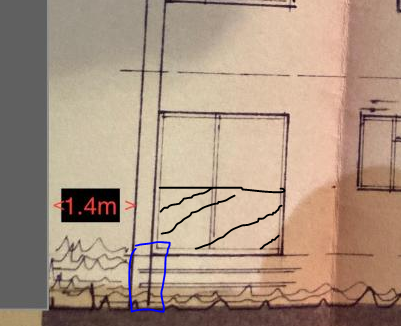
-
UFH controls - conventional or home automation?
IanR replied to Hilldes's topic in Underfloor Heating
I've only chipped in on other's posts if I feel something I've done is relevant. The actual call for heat is handled by the SMO40 Nibe controller, from the buffer return temp, rather than by Loxone. Loxone just enables/disables heating and cooling on the SMO40. This also helped have a clear line of responsibility for the ASHP installers. ie. their job was complete when the buffer and UVC were correctly heating or cooling without any argument as to whether Loxone is issuing the call for heat. The pumps and UFH isolation valve are automated by Loxone, with a manual override that allows the delay to wait for some forecast solar gain, hopefully avoiding any call for heat. -
UFH controls - conventional or home automation?
IanR replied to Hilldes's topic in Underfloor Heating
Thanks for that, I hadn't considered a non-Loxone option for the forecasting. My (house's) unusual proportions exaggerate the benefit of circulating the UFH. All habitable space is on the ground floor and due to the depth of the building (previously a cow-shed) we have a few rooms that have no direct light, so with those as well as the North-East and North-West elevation getting no solar gain we have less than a third of the area "benefiting" from solar gain. On the South-West and South-East elevations we have lots of full height glazing. This side of the building therefore over-heats quickly, and the rest is unaffected, so circulating the UFH triples the size of energy store available to the solar gain and helps equalise the building temps. -
UFH controls - conventional or home automation?
IanR replied to Hilldes's topic in Underfloor Heating
Nope, the MVHR wet heat exchanger is run from the same buffer as the UFH, so at best it trims temps. The difference in energy delivery that 7°C chilled water to the MVHR would make compared to 14°C hasn't encouraged me to add additional insulation to UFH manifolds and a few pipe runs (that use the same buffer) in order to avoid condensation. Loxone does a bit more for me as it gets ASHP, UFH, MVHR, vents and blinds all working together, by deciding whether to do nothing, take passive measures, or to heat/cool, and then get each system to do its part, as well as running MVHR boost, and DHW circulation loop based on presence sensing within the bathrooms. I hope to do a little more with it as currently I manually make a choice on whether it starts heating the house first thing in the morning, based upon forecast cloud level. If there is forecast clear or partially cloudy sky, I delay the buffer warming up until mid morning, to gives a chance for solar gain to do its job. But this means the temp dropping slightly below the target temp. If I don't do this I can often get a warm 200l buffer that then isn't used, since a couple of hours of winter sun pushes the temp up above target. I hope to automate this with a weather subscription. That also reminds me of another subtle difference Loxone makes, which is to, during the heating season (Dec-Feb) to allow the house temp to go a couple of degrees over target, if that additional heat is via solar gain (ie without ASHP space heating). It seems no one in the family minds if the house is a little over-temp in the Winter, and if it is a couple of degrees high in the afternoon/evening, then even on an over-cast following day there won't be another call for heat probably until the following afternoon. -
UFH controls - conventional or home automation?
IanR replied to Hilldes's topic in Underfloor Heating
Borrowed from Jeremy. Makes more use of the Solar Gain, moving the energy to areas of the slab that do not receive the solar gain directly. My initial setup did manage the cooling temp of the buffer, calculating the dew point from the current indoor air temp and humidity, and setting the cooling return temp to this. In practice I don't need to get the slab anywhere close the dew point to provide effective cooling, so I no longer change the buffer (cooling) return temp from 14°C. The heating temp of the buffer I've always left set by the ASHP controller. But, rather than changing flow/return temps to the buffer, which I now leave as set by the ASHP controller, I get Loxone to enable/disable cooling and heating on the ASHP controller, so that it will only have one enabled at any one time. I have a Nibe F2040-12 with SMO40 Controller and MODBUS comms unit. -
Mine's piped separately via distribution boxes that are lined with a bit of sound deadening foam. I was concerned this wouldn't be sufficient, but it is effective - I have no discernible noise transfer between rooms. The PH principle is to avoid the need for traditional boilers/HPs and heat emitters, so that the space heating energy requirements can be supplied via the MVHR, with a direct electric duct heater, avoiding the capital investment for boilers/HPs and emitters. But, I personally didn't feel a house would be saleable in the UK without "central heating" and you still need to heat your DHW, plus I knew I would have some cooling requirements.
-
Yes it can...but, MVHR does not move sufficient air to deliver very much energy in to the house. Depending on MVHR size, perhaps 0.5kW - 2.5kW. Add to this, the lower temp you can run your HP the more efficient it is, so for space heating if you are running your buffer at 35°C say, that's not going to add much energy to the MVHR supply, so you'll be in the lower range of the scale. An Electric Heater on the supply duct, which could be at 80°C, could be more effective, but you are not getting the benefit of the HP efficiency. If you plan to be at Passivhais levels of energy loss, then it may be possible to heat 100% via MVHR, but using a direct electric in-duct heater. Heat Pumps are best matched with UFH, and if not large or fan convector radiators.
-
UFH controls - conventional or home automation?
IanR replied to Hilldes's topic in Underfloor Heating
Do you have any other "systems" for heating, cooling, avoiding solar gain? For me it was an easier decision to have Loxone controlling the UFH as I also wanted to control the MVHR, roof vents and external blinds to ensure everything was working together to either heat, avoid heat or cool the house. Loxone decides whether the house is heating, cooling or taking passive measures using an average of all the temps from the Touch Pure light switches in each room AND comparing the temp of those rooms effected by solar gain with those that are not AND comparing the slab temp in those rooms effected by solar gain with those that are not. Loxone then decides whether to just circulate the UFH, without any heat/cool input in order to distribute solar gain, or to employ blinds and/or vents, or to heat/cool the buffer and distribute that heat/cool via UFH and MVHR. I have Loxone actuators on each loop of the UFH as well as relays to control the UFH pump, MVHR wet heat exchanger pump, DHW loop pump and a valve on the UFH splitter manifold that separates it from the buffer when it's just circulating the UFH to distribute solar gain. -
Good news, that was the first concern, and you'd have needed to take a few steps before speaking to the local planning authority.
-
Hi and Welcome. Does the property currently have planning permission? Sounds like when it first appeared on the landscape it may not have had residential planning permission, if so has that ever been normalised?
-
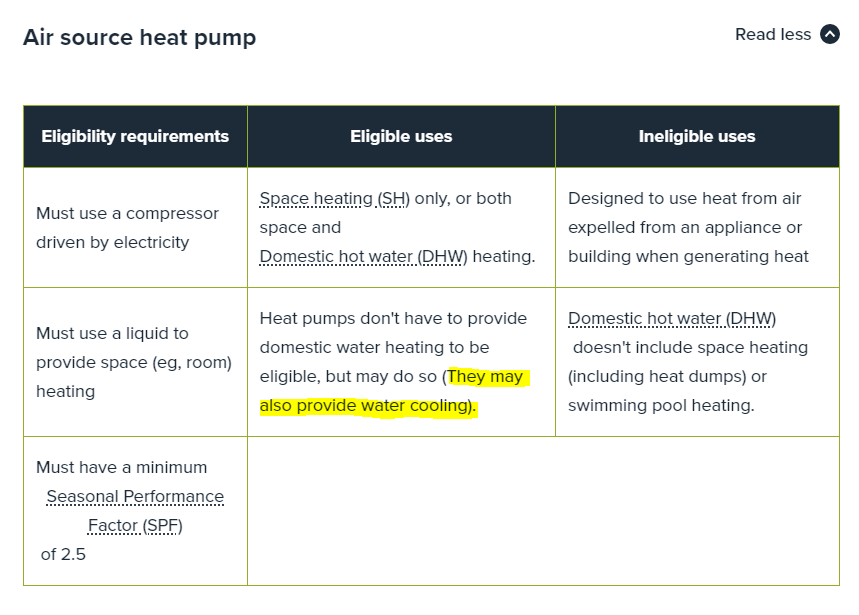
Yep, rules changed at end of 2017. HP "water" cooling is now allowed on RHI
-
100l per person per day seems high for hot water usage. I thought 50l per person was considered high usage. But, perhaps that's a rule of thumb he uses for sizing cylinders. After all you're not going to heat the water once a day and then use it all, your heating system will be topping it up though out the day. Should you not be sizing for the capacity of the house, rather than your particular usage? Also, falling in line with the 2022 regs seems a good idea, ie. sizing the UVC for a low temp heating system, avoiding having to refit later. If 4 adults is the capacity of the house (3 Bed??), and a low temp heating system is allowed for, then your plumber's 400l tank sounds about right. Maybe you could go a bit smaller, but if there's space, bigger is better - just don't run it hotter than you need to.
-
My 12kW Nibe requires a minimum 80l buffer (or always open loop), and I believe the 8kW Nibe was the same. I've gone with a 200l buffer, but for cooling reasons. ie. I can cool the buffer and let the UFH work off of that for longer while the ASHP is heating the UVC.
-
Hi and welcome. What made you choose Baufritz? (not a loaded question, I know nothing about them). What are the "Eco" credentials? Good U Values and Airtightness? What Foundation/floor systems will you use?
-
Your M&E guys must be assuming the energy losses of the FF (and basement) are then being covered by another heat source. I can't imagine you want to use the electric UFH and towel rads to fully heat the FF, but rather to top up those rooms if the GF heat has not permeated sufficiently. Your ASHP needs to cover the total energy losses for the house and the GF UFH needs to emit sufficient heat for the whole house. This will then permeate to the 1st floor via convection, conduction and MVHR. In a well insulated and airtight house, DHW is more likely to be the energy requirement that drives ASHP sizing. What size UVC have you spec'd? I have a slightly lower energy loss than your calculation, and a 500l UVC. I went with an over-sized 12kW ASHP for a quick reheat time on the cylinder. I could probably have gone with 8kW ASHP and not noticed the difference as the DHW usage is not as big an issue as I expected, even when both space heating and hot water are being called for simultaneously. Over-sizing the ASHP does of course require a decent size buffer for space heating.
-
Internal solid brick wall insulation. Insulated plasterboard or what?
IanR replied to howplum's topic in Heat Insulation
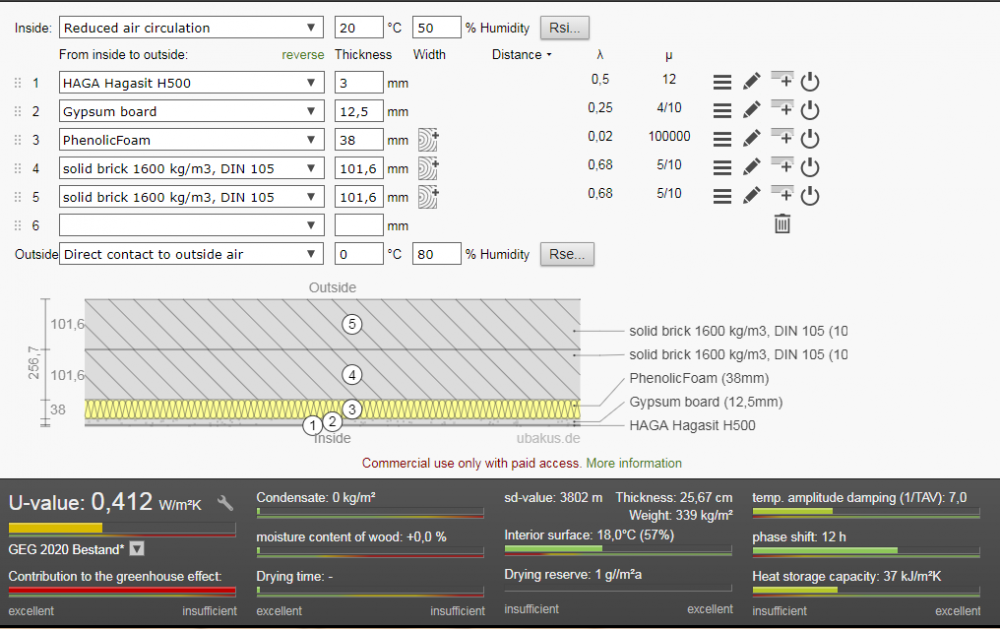
Apologies, in the very last calc., I've incorrectly used the the Thermaline's U Value and not its R Value. So, what I should have said is: And then to get the total U Value of the new wall build up: 1 / ( R of original wall + R of the Thermaline), so 1/ (0.51 + 1.96) = 0.405W/m².K Edited to add: ...and Ubakus roughly agrees